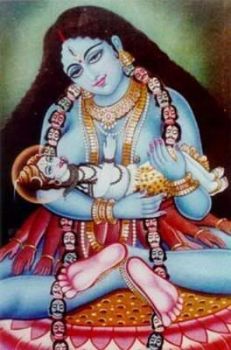
 In contrast to the linearity of our time concept in the West, Indians view life as infinite and cyclical. Although Hindus, like ancient Greeks, believe in four ages of humanity (the so-called yugas), these occur not just once, but repeat cyclically every several million years. Similarly, the creator god Brahma is said to have a daily cycle which has recurring effects on the existence of the world. When Brahma awakes the world is created anew, and when he falls asleep it dissolves once again into the primal waters of eternity. Fortunately for us, Brahma’s day lasts 4,320,000,000 human years.
Holland Cotter, in reflecting on Eastern art, once brought these temporal differences into sharp focus when he contrasted two of the major icons of East and West — Christ on the cross and the dancing Shiva. He said, “The Christ figure embodies the Judeo-Christian concept of divine history as a straight, purposeful line from the Fall of Man (sic.) to redemption, but with a tragic human story of self-sacrifice, loss and atonement at its heart. The dancing Shiva is, by contrast, a dynamic, joyous cyclical image: a poised, uplifted foot and hands form a circle echoing the nimbus of flames surrounding the figure. The image represents a culture which…views both humans and gods as participants in a cosmic game that periodically grinds to a catastrophic halt only to begin again.”[i]
Like Shiva, Kali has been depicted surrounded by a halo of flames. But unlike Shiva, her portrait is far from a joyous image. In one example, a 17th or 18th century North Indian sculpture, Kali is personified as a voracious, old hag squatting on a victim whose entrails she eats. Slicing open the belly of the anonymous corpse, Kali scoops out its intestines with her bony fingers and gobbles them with her protruding teeth. The anonymity of the victim brings home to the viewer the fact that ultimately we are all Kali’s prey. And the flames burning around her head reemphasize this point, for as the aureole of the Dancing Shiva, they are the fires of the final conflagration at the end of each world period. But in this image we realize that such flames flicker constantly, since time erodes all that has ever existed and Kali swallows all she has ever birthed.[ii] Continue reading “Kali Ma (Part 3 of 3) by Nancy Vedder-Shults”



 It’s been almost two years since I lost someone I loved. The relationship was short, tortured, unhealthy (as all my romantic relationships have been, but that’s another story…) However, I fell particularly hard for this one. When we separated, the pain was unthinkable. I was surprised by how deep it ran. I didn’t know until he was gone how much I really cared about him. I became physically sick, and even now there are days when I only have to bring him to mind to conjure a familiar pressure behind my eyes and in my throat.
 When I was about eight years old, I dreamed one night that I stood inside the workings of an immense instrument, so big it filled the sky. It was crafted of wood and gold, and although there was no obvious source of light, it was brightly illuminated. I could have confused it for the inner workings of a clock except that I could hear the sweet music it produced resonating throughout its cavernous hollows. It was curious to me that there seemed to be no atmosphere there either to breathe or to carry sound. Within it, I did not perceive any movement. And, there was no actual melody that it produced, which could be sung or repeated. There was only an enveloping harmonic thrumming. The sound was multiplicative and voluminous although not piercing. I understood it in the dream to be cosmic, structural, primordial, and generative. When I awoke, I had the feeling that I had seen something divine. It was not heaven. It was not God. It was more like the instrument of the universe, or the universal instrument, created as a first work among creation
 Ramakrishna was one of the major poets who popularized Kali’s worship in Bengal, the northeasternmost province of India. Born in the early part of the 19th century, he was a Hindu saint in a tradition known as bhakti, where devotees lovingly surrender their hearts, minds and spirits to their chosen deity in a practice which leads to ecstatic union with the divine. Such devotion is easier for us in the West to imagine when the beloved is the playful Krishna with his sublime flute-playing and sacred lovemaking. But in Ramakrishna’s case, the object of his devotion was the fierce Kali, the wild and uncontrollable aspects of the sacred, to whom he devoted himself as a child would to its mother.