Mountain Mother, I hear you calling me. Mountain Mother, we hear your cry. Mountain Mother, we have come back to you. Mountain Mother, we hear your sigh. Lyrics by Carol P. Christ [2]. Sung to the tune of “Ancient Mother.” (origin unknown)
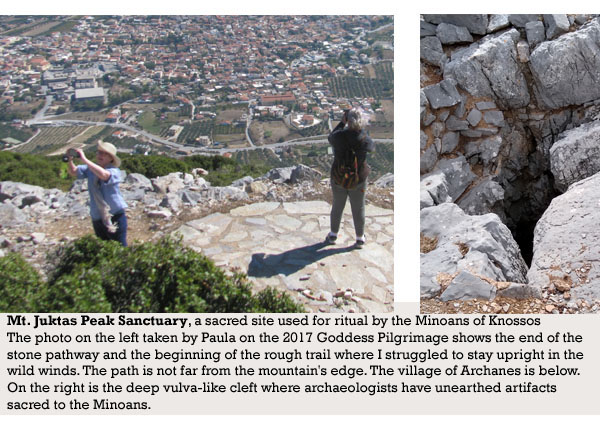
What do a bunch of feminist women do while riding a tour bus around the Mediterranean island of Crete? If they are on the Goddess Pilgrimage started by Carol Christ and continued by Laura Shannon, they sing songs honoring the Goddess. The song that drew me most from the first time I heard it on the fall 2022 Goddess Pilgrimage was “Mountain Mother.” Not surprising since the rocky, sparsely vegetated, yet hauntingly beautiful mountains of Crete surrounded us much of the time as our trusty bus wound its way up and down and around the island.
The mad pre-Christmas rush of activity has passed and we find ourselves again in the quiet, dark and cold of winter. Winter Solstice, the longest night and shortest day of the year in the Northern Hemisphere, occurred last week. With a gain of only a few seconds of daylight each day in the ten days after Winter Solstice, we can take advantage of the stillness offered to seek within ourselves for the seeds laying dormant, waiting to be recognized and nurtured into fruition and manifestation.
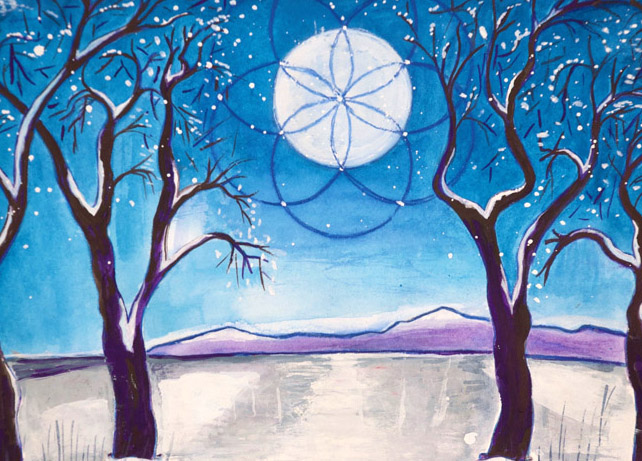
Bright Solstice Night by Judith Shaw
Having just finished all the pre-press and pre-order fulfillment of the first of the Animal Wisdom Oracle decks, now is the perfect time for me to work on seeds of my own – another project that has long been in the works. This project has gotten back burnered every spring for the past couple of years as I seem to need the dark of winter to complete the art. It’s a folk tale inspired by the ancient stories of the Reindeer Goddess. It’s a tale that honors the Sacred Feminine. The story is written and now I have the illustrations to complete. Here’s a little taste of what’s to come:
Elena and the Reindeer Goddess
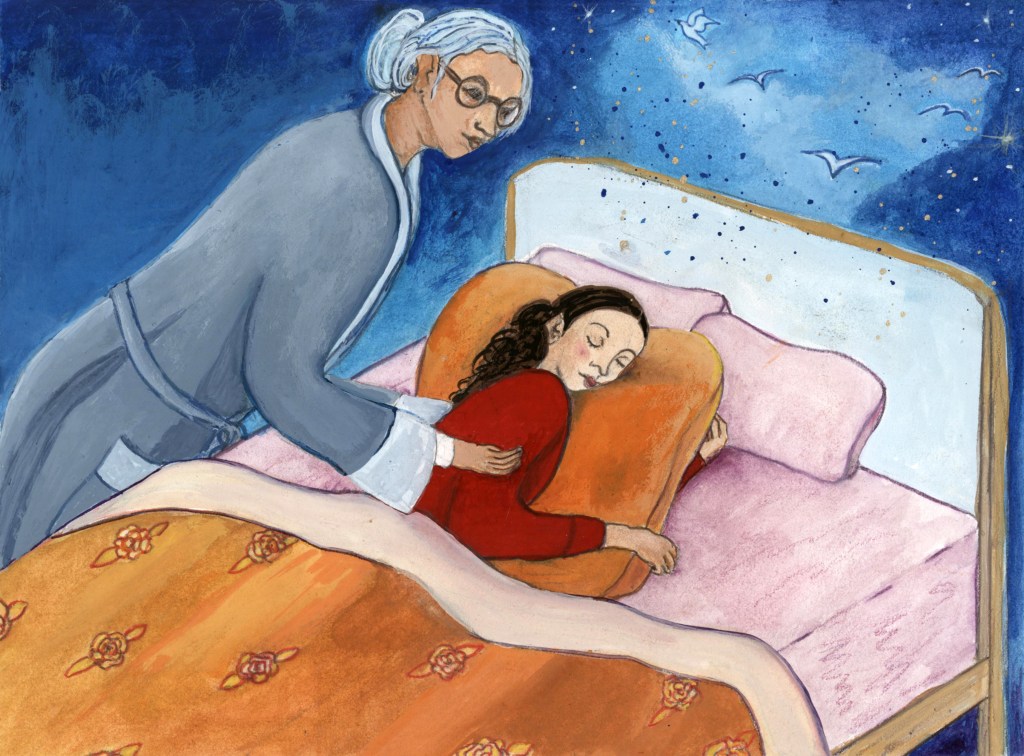
Just before dawn on a cold winter morning, Grandmother woke up with a smile on her wrinkled face and a feeling of hope in her heart. She had had a dream, one that had come from her ancestors, and from her own deep knowledge. It was a dream of prophecy.
“The Reindeer Goddess returns,” Grandmother whispered to herself.
She threw back her quilts and rose, shoving her cold feet into soft wool slippers, and hurried to wake her granddaughter, Elena.
She rushed into Elena’s cozy little room, then leaned over her and shook her gently, saying, “Elena, Elena, wake up. Quickly Elena, there’s no time to lose!”
Elena opened her eyes and yawned. “What’s wrong Grandmother? What’s happened?”
“It’s more about what will happen,” Grandmother said. “Come, let’s put on our coats and boots and while we walk I’ll explain everything. I need your pure heart, your quick wit, and your strength.”
Elena and Grandmother bundled up against the cold and stepped outside. They began to trudge through the snow lying thickly on the ground, past little puddles here and there, glinting hard as stone in the light from a million stars.
Grandmother gathered her coat more tightly around her as she began telling Elena the story, her breath puffing out like mist in front of her.
“Long, long ago in the northern lands of snow and ice – the Old World of our ancestors – the Reindeer Goddess was alive in the hearts of the people. It was she who took flight on the Winter Solstice bringing understanding of the power that lies in darkness and of the hope that spring would return.
“Our people knew her as Reinna. Sometimes she was seen as a woman who flew through the skies in a chariot pulled by reindeer. At other times she was seen as a flying reindeer herself.
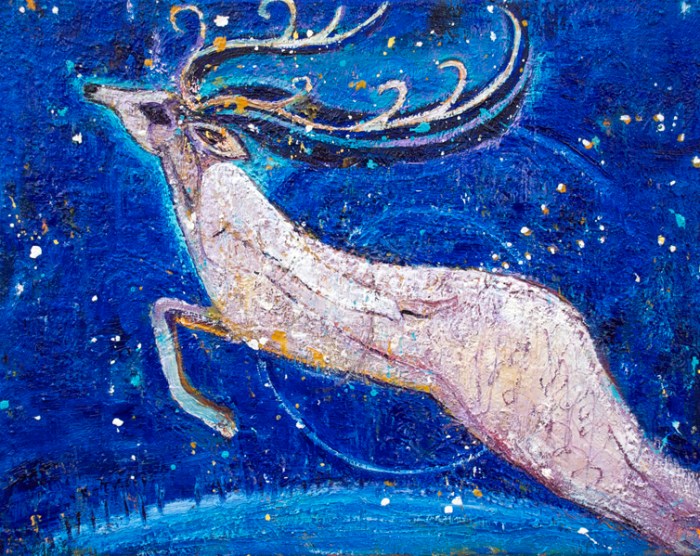
Flight of the Reindeer Goddess by Judith Shaw
Look for more excerpts over the winter months and discover how Elena helps the Reindeer Goddess accomplish her very important mission of love. The book should be ready for the printers by the end of summer – early fall 2024.
Reindeer are the only deer species in which the females grow antlers. And the females’ antlers are larger and stronger than those of male reindeer. So who was Santa Claus really and who were his flying reindeer?
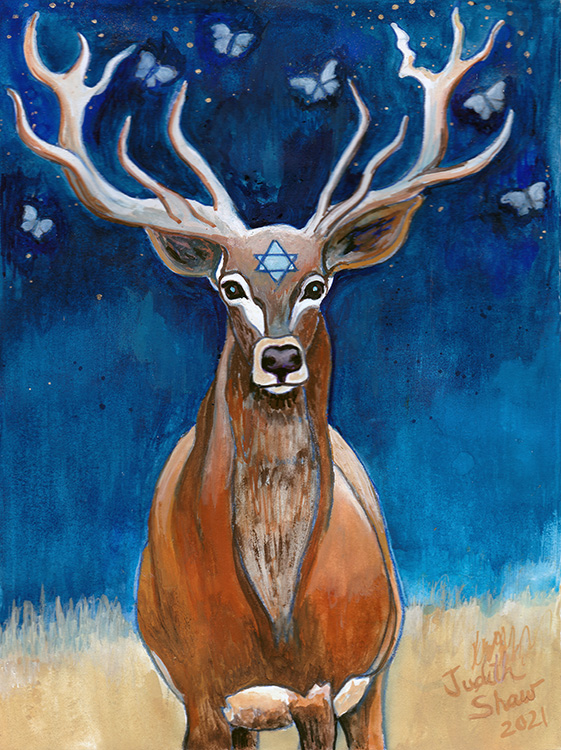
As our ancestors were well aware of the need for balance, Stag – the male red deer indigenous to the UK – is also celebrated at this time. Stag, who grows a massive rack, is symbolic of the masculine power of regeneration, a messenger from the spirit world and one who leads humans to spiritual enlightenment. Males are called bucks in other deer species.
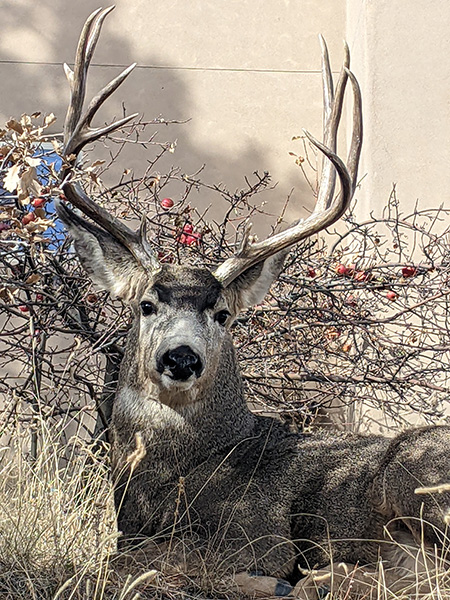
The racks found on bucks from other deer species during the fall rut are also impressive. I was lucky to see many mule deer during my Thanksgiving stay in the Jemez Mountains of New Mexico. Deer who wander into town are protected and thus not afraid of humans. This allowed me to get very close to this magnificent buck and capture his photo. He was not at all interested in looking at me so it took awhile to get this shot from just a few feet away.
And finally I’ll share my painting of Stag with you all again.
May the Reindeer Goddess continue to nurture you with her love and gifts of abundance while Stag guides you to spiritual enlightenment.
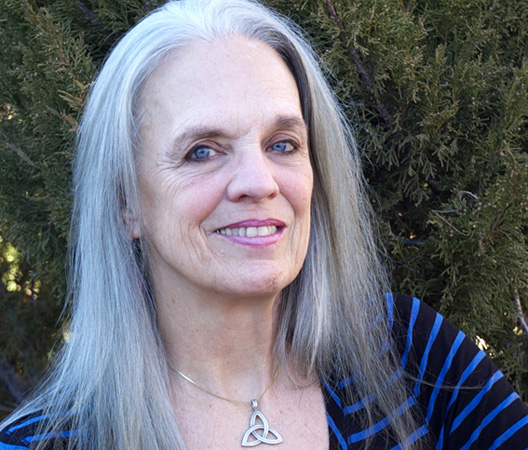
Judith Shaw, a graduate of the San Francisco Art Institute, has been interested in myth, culture and mystical studies all her life. Not long after graduating from SFAI, while living in Greece, Judith began exploring the Goddess in her art. She continues to be inspired by the Goddess in all of her manifestations, which of course includes the flora and fauna of our beautiful Earth. Originally from New Orleans, Judith makes her home in New Mexico, The Land of Enchantment.
Judith’s illustrated fairytale: Elena and the Reindeer Goddess — A Magical Winter Solstice Mission — will be released by late January 2024. Sign up for Judith’s newsletter on her website for more info on the release.
Judith’s oracle decks are available on her website: Celtic Goddess Oracle — order your deck here. Animal Wisdom Oracle – order your deck here.
When I became a feminist, I realized that somebody had to write all about this women’s art that was out there being totally ignored, and it was going to be me. And of course the ideas and the discoveries about what women’s art was……. I look at it for the information it gives me about women’s imagery, women’s psyches, women’s lives, and women’s experience.”
I have been making art, masks, and theatre about “surfacing” for a very long time. As a child I was always digging at the roots of trees, fascinated by their interwoven strength, wondering how far down they went. That fascination never really left me. Sometimes it occurs to me that I and most of my colleagues are “spiritual archeologists”, sorting through artifacts and the mythic overlay of the past to re-discover and re-vitalize the present. I joined many of those colleagues for over 20 years: un-earthing, re-inventing, and animating stories of the Great Goddess throughout world culture with the Masks of the Goddess Project (1999-2019), among other collaborations. I am not religious, so much as I am a mythologist, following archetypal trails of myth back and back, seeking the sacred source they often reveal.
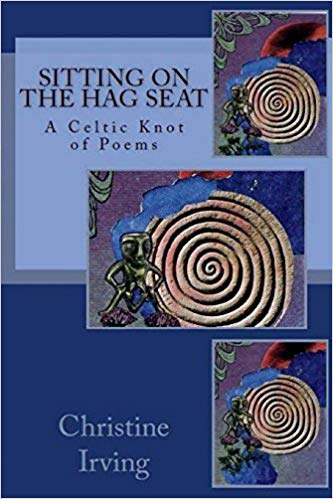
My book Sitting on the Hag Seat carries the blue cover I designed. Buried in the blue, riding the spiral Wheel of Return, stands a small Sheela-na-gig. The Sheela’ s origins remain unknown and controversial. It sometimes seem to me that the less explanation exists for a mysterious object or occasion, the more emotional attachment accrues to the opinions of diverging theorists. However, no matter what symbolism is ascribed to Sheela-na gig, her frequent placement above church doors or in the walls of cities, castles and watch towers, does seem to support a protective aspect not necessarily at odds with other attributions.
One of my oldest friends who I met when I was eight years old reached out to me the other day saying that if there was ever anything she could do, please let her know. She lives in another state far away but is a subscriber to one of my blogs so she has been aware of the various things going on in my life (second divorce, so many changes and transitions in my life yet again, etc.)
Her note said if there was ever anything she could do to help, just let her know.
And I thought to myself: hmmmmmm.
You see I just put a new feature on my app where it emails local events to local users, and one of the first steps in getting this to work is having those local events on the app. So I asked her if she would mind helping me put local events on the app.
We had not actually talked in a long time, and when we had a zoom call to discuss this, I broke down crying.
I felt the pity from her. I also saw just how far I had departed from ‘normal.’
Moderator’s Note: The blog was originally posted May 18, 2015
A friend who is a spiritual teacher speaks often “bringing back the values associated with the Divine Feminine.” For her this has to do with helping women to understand the beauty of our bodies and the importance of ways of being such as giving and caring for others that have been associated with the undervalued so-called “feminine” side of the masculine-feminine polarity. Though she also speaks about the Goddess, I think she prefers the term “the Divine Feminine” because of the implication that men too have their “Divine Masculine.”
This friend has a wonderful husband who is a teacher in his own right and who often ends up spending a lot of his time among powerful women who enjoy talking about the Goddess. In these conversations he sometimes speaks of the need for men to “recover the Divine Masculine” if they are to become whole.
Very early in Henri Bosco’s 1948 novel Malicroix, a young man, Martial de Mégremut, living placidly amid fruitful orchards in a tame Provençal village, receives a letter informing him he has inherited “some marshland, a few livestock, a ramshackle house” from a reclusive great-uncle, Cornélius de Malicroix. Against his family’s strenuous objections–with alarm they speak of “marshes, mosquitoes, miasmas”–Mégremut resolves to travel alone to the remote Camargue to claim his “wild” Malicroix inheritance. The house is on an island, and to reach it Mégremut must cross a rough river, at night, in a frail wooden boat piloted by a taciturn old man who meets him at dusk in the middle of a vast plain.
So begins a deeply internal quest narrative, an initiatory journey that forces Mégremut to come to terms with himself and with the elements–earth, water, wind, and fire–that are ever-present, sometimes terrifyingly so, on the island. For once he arrives, he learns that he must remain there alone for a full three months if he wishes to obtain the inheritance. Torn about whether to stay or leave, he finds that the decision to stay is made of its “own accord,” unconsciously.
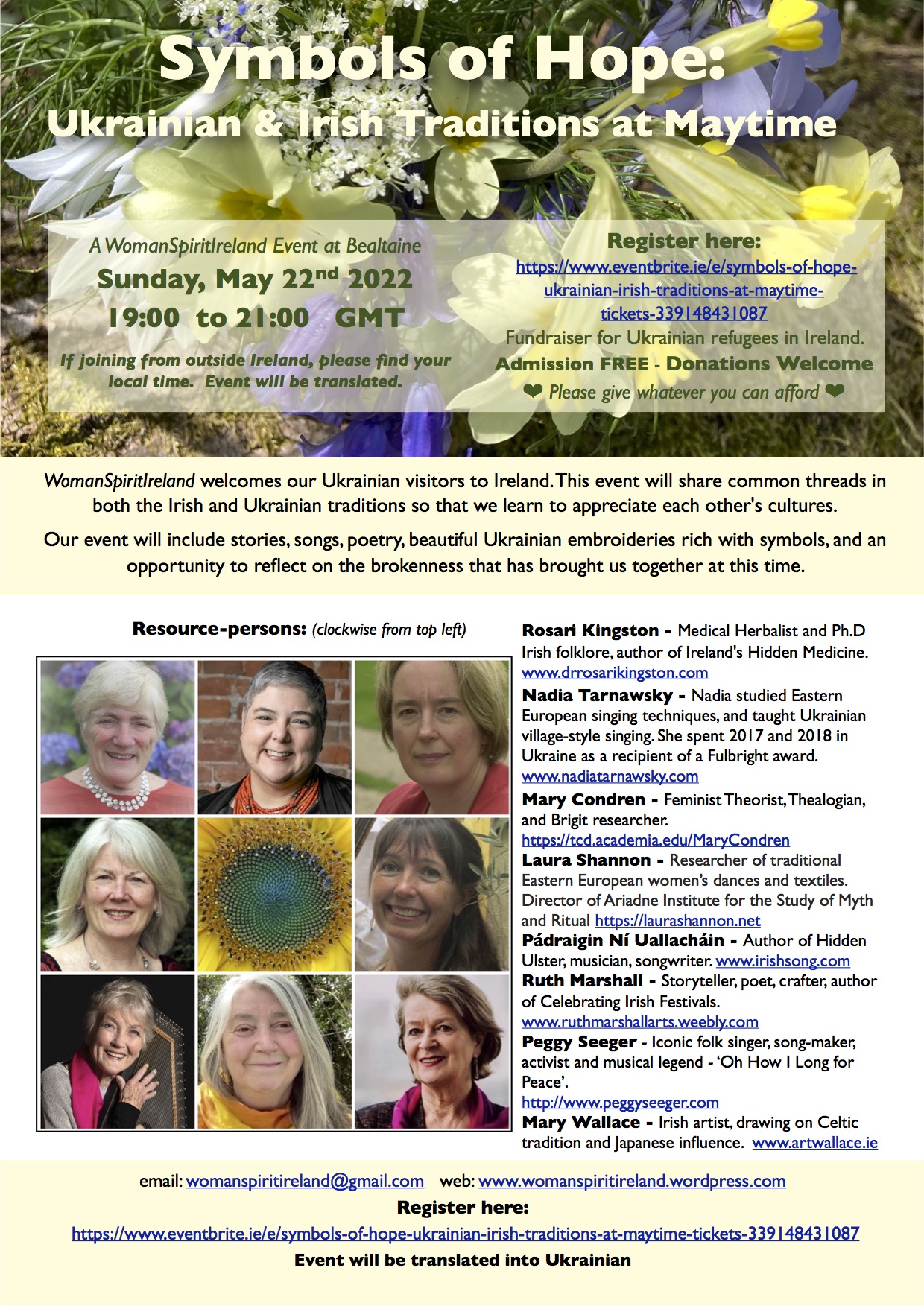
Womanspirit Ireland has organized an event for this coming Sunday, May 22nd, to exchange cultural themes with Ukrainian Refugees and to raise funds for the 30,000 refugees who have already arrived in Ireland, and the many more expected. All donations will go to the group: “IrelandforUkraine” to maximize the funding for Ukrainians in Ireland and those still in Ukraine.
FAR is happy to note that one our regular contributors, Laura Shannon, is part of the program. The event will include stories, songs, poetry, beautiful Ukrainian embroideries, rich with symbols, and an opportunity to reflect on the brokenness of the situation that brings folks at this time.
This post was originally posted on February 5, 2018
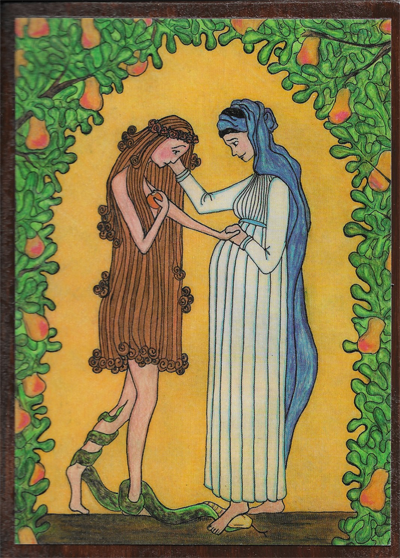
The symbol of the Goddess is as old as human history. The most ancient images of the Goddesses from the Paleolithic era are neither pregnant nor holding a child. In Neolithic Old Europe the Goddess was most commonly linked with birds or snakes and only rarely portrayed as mother. Yet we tend to equate the Goddess with the Mother Goddess. I suspect that images of the Virgin Mary with Jesus on her lap and prayers to God as Father have fused in our minds, leading us to think that the Goddess must be a Mother Goddess and primarily a Mother.
In a recent blog, Christy Croft reminded us that in our culture, women’s experiences of mothering and motherhood are not always positive:
[The mother] doesn’t always appear in our stories in simple or easy ways. Some of us mother children we did not or could not grow in our bodies; some of us birth babies who are now mothered by others. Some of us are not mothers at all. Some of us had mothers who could not love us unconditionally, or did not have mothers in our lives, or had mothers who brought us more pain and humiliation than comfort, from whose effects we are still recovering, are still healing.
Rather than being a bleeding image of female disempowerment, Medusa may be read as…one of the most ancient European symbols of women’s spiritual abilities… [and] an empowering image of feminine potential.’
–Patricia Monaghan, O Mother Sun! (1994:244)
The name Medusa means ‘sovereign female wisdom,’ ‘guardian / protrectress,’ ‘the one who knows’ or ‘the one who rules.’ It derives from the same Indo-European root as the Sanskrit Medha and the Greek Metis, meaning ‘wisdom’ and ‘intelligence.’ (1) Metis, ‘the clever one’, is Athena’s mother. Corretti identifies Athena, Metis, and Medusa as aspects of an ancient triple Goddess corresponding respectively to the new, full, and dark phases of the moon. (2) All three are Goddesses of wisdom, protection, and healing.
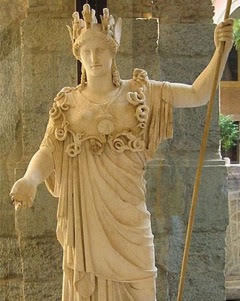
Athena with Gorgoneion in her heart. 5th C BCE.
Athena and Medusa are particularly linked: indeed, one may have been an aspect of the other, ‘two indissociable aspects of the same sacred power.’ (3) Their many common elements include snakes, wings, a formidable appearance, fierce eyes and powerful gaze. The serpent, like the Goddess, has been cast as an embodiment of evil in patriarchal retellings; yet as Merlin Stone points out, serpents were ‘generally linked to wisdom and prophetic counsel’, associated with ‘the female deity’ and ‘entwined about accounts of oracular revelation…throughout the Near and Middle East.’ (4) According to Ovid, the poisonous vipers of the Sahara ‘arose from spilt drops of Medusa’s blood.’ (5) Although this is presented as a further sign of Medusa’s horrifying character, the original Berber inhabitants of North Africa – where Herodotus reports that the Medusa myth began – viewed snakes as bringers of luck and portents of joy. (6)





 Feminism and Religion