The Beauty Way by Carol P. Christ

When I learned about the Navajo Beauty Way, I understood it to be a path in which human beings respect all beings in the web of life and live in harmony with them. But I didn’t understand why this path was called the “Beauty Way.” As a young woman, I knew that my worth was defined by many in terms of my ability to conform to ideals of female beauty promulgated in movies, tv, and advertising. I didn’t believe the Navajos were talking about beauty in that sense, but because of my conditioning, I was not yet able to fully grasp what they might mean by beauty. I would have called the way they were describing a “Way of Harmony” or a “Way of Respect for Life.”

Still, I wondered: why the Beauty Way?

Marija Gimbutas described the societies of Old Europe as peaceful, settled, agricultural, highly artistic, matrifocal and probably matrilineal, and worshipping the Goddess as the power of birth, death, and regeneration in all of life. Though I am impressed with the beauty of the many small works of art Gimbutas reproduced and interpreted in The Language of the Goddess, I sometimes inadvertently omit the words “highly artistic” when repeating in her definition of the culture of Old Europe. I have tended to view the fact that Old Europe was peaceful and matrifocal as more important than the fact that it was highly artistic.Yet this judgment is wrong. In calling the cultures of Old Europe “highly artistic,” Gimbutas was trying to convey her understanding that appreciation of the beauty of life was fundamental within them.

We have been taught that “high” or “great” art is most often monumental in size. The Pyramid of Giza is over 230 meters (756 feet) tall. The Great Sphinx of Giza is 20 meters (66 feet) high. The Parthenon rose to 14 meters (45 feet) and the statue of Athena inside it was 9 to 11 meters (35-40 feet). It is telling that we use the words “high” and “great” (originally measures of size) to describe the value of artistic creations.

Statue of Athena in Parthenon reproduction in Nashville, Tennessee

The purpose of monumental works of art is to diminish the viewer, to make the her feel small, to induce her to bow down, to worship, and to obey a power or powers greater and higher than herself.

In contrast, the small scale of the art of Old Europe does not diminish anyone or anything. Its purpose is not to make anyone one want to bow down. Instead small works of art make the viewer feel comfortable, welcomed, and part of the beauty of life that is depicted.

Goddesses of Old Europe c. 5000 BCE

Marija Gimbutas viewed ancient Crete in the Bronze age as the final flowering of the culture of Old Europe. In Crete too, everything is on a small scale. Though the so-called Palaces or Sacred Centers are large, the rooms within them are small. There is not a single room where crowds could have bowed down to a King or Queen. Nor are there images of deities larger than life. The famous Minoan Snake Goddesses are less than 15 inches tall and the well-known pitcher Goddesses are even smaller. Such objects would have been held in hands during rituals or set on low benches in small rooms lit by oil lamps.
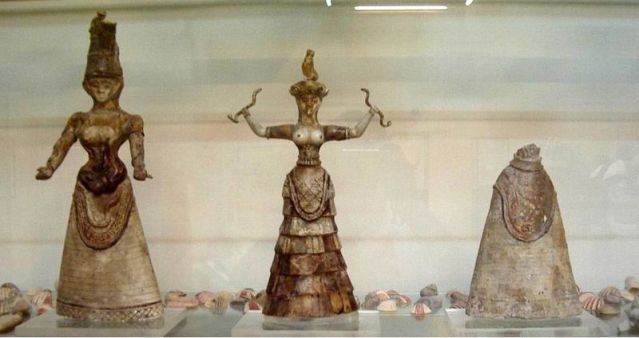
Snake Goddesses of Bronze Age Crete c. 1500 BCE

When my friend’s daughter Klia was seven years old, she spent her afternoons collecting stones by the sea. One day I asked her if the stones spoke to her. “Of course,” she replied. “What do they say?” “They say, ‘we are very beautiful.’”

Heart of stones in Lesbos

Klia intuited the meaning of the Beauty Way. It has nothing to do with artificial beauty standards. It has nothing to do with size. It is recognizing beauty everywhere and in everything. When we do so, we walk in beauty, in the grace and joy of life. And yes, the Beauty Way has ethical implications, for no one who truly recognizes beauty could want to harm it. This was understood by the Navajos, the Old Europeans, and the ancient Cretans, and many others. Only we seem to have forgotten. We can remember.

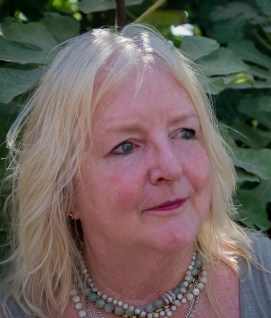
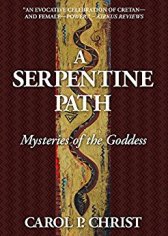
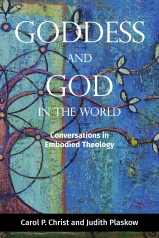
Carol P. Christ is an internationally known feminist writer and educator living in Molivos, Lesbos, who volunteers with Starfish Foundation that helps refugees, assisting with writing and outreach. Carol’s new book written with Judith Plaskow, is Goddess and God in the World: Conversations in Embodied Theology. FAR Press recently released A Serpentine Path: Mysteries of the Goddess. Join Carol  on the life-transforming Goddess Pilgrimage to Crete. Carol’s photo by Michael Honegger.

Reclaiming My Body by Carol P. Christ

Shortly after writing “Asking for Help,” a blog in which I described losing my physical strength following a series injuries, I finally took a friend’s advice—mainly to stop her from badgering me—and went to the doctor. This is something I don’t usually do, as not only have I almost always had excellent health, but also, I believe that, for the most part, the body can heal itself.  The first doctor sent me to an orthopedist who told me that the persistent bursa on my knee was nearly healed and to go ahead and exercise in order to regain my strength.

A few days later, I found myself walking to the end of my cobblestone street with my little dog and continuing on to the harbor, a walk of about fifty minutes that included a good deal of up and down, as my house is situated above the sea. As I had only planned to walk a short distance, I was amazed that I found the strength to go farther. Soon I found the perfect walk. Leaving home at 4:30 in the afternoon, I follow the road past houses and open fields down to the sea and around the harbor quay out to the lighthouse. The sun sets while I am on the quay and on most days the clear winter sky lights up and the sea turns rose-gold. The return around the harbor takes me past the little church of Agios Nikolaos where I stop to light a candle and say a prayer. Then back up the hill to my house, where I arrive just before dark. Continue reading “Reclaiming My Body by Carol P. Christ”

Wisdom of Reindeer Goddess and Owl by Judith Shaw

judith shaw photo

At this time of year in the Northern Hemisphere we are called to embrace the darkness. Nighttime rules, the cold has set in and we curl up for the long winter nights with our hot beverage and an anticipation of the messages found in our dreams.

There are certain animals which stand out as guides for us during this time of cold, long nights. Reindeer of course comes to mind by all of their associations with Christmas, Santa Claus and gift-giving. Northern European goddesses such as the Antlered Ukrainian Winter Goddess Rozhanitsa; Saule, Lithuanian and Latvian Goddess of Sun and Light; and Beaivi, Sun Goddess of the Sami all flew through the sky with their flying reindeer on the winter solstice bringing the gifts of light, life and nourishment to the people. Continue reading “Wisdom of Reindeer Goddess and Owl by Judith Shaw”

“It Came Upon a Solstice Morn” by Carol P. Christ

It came upon a Solstice morn,

that glorious song of old,

with angels bending near the earth,

to touch their harps of gold.

“Peace on the earth.

good will to all,”

from heaven’s all glorious realm.

The world in silent stillness waits,

to hear the angels sing.


I wake in the dark of Solstice morn.

Mountains shrouded in clouds,

cold wind blowing,

light dawns.


My mother heard

the angels sing,

on Solstice eve,

calling me to life,

her Christmas Carol.


Blessed Mother Always With Us.


Longing for my beloved,

on Solstice morn,

I heard Sappho sing:

Thank you, my dear

You came and you did

well to come: I needed

you. You have made

love blaze up in

my breast–bless you!

Bless you as often

as the hours have

been endless to me

when you were gone.


Cold tiles,

bare feet,

coffee brewing,

elderly dog stirring,

I open the garden door.


And there it is.

Solstice miracle.

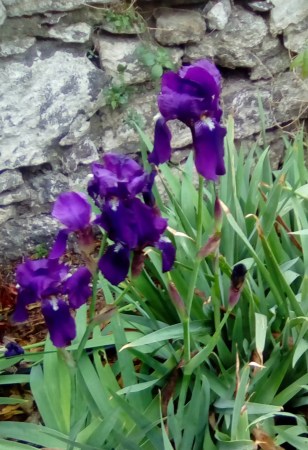
Three purple irises.

blooming in the cold.

Life triumphing over death,

every time.

New words to the traditional carol “It Came Upon a Midnight Clear” by Carol P. Christ.

Sappho translated by Mary Barnard.

Thanks to Miriam Robbins Dexter for the digging iris bulbs from her garden for me to plant in mine.

My mother promised my father to name me Susan or Peter but when she heard carolers in the hospital, she changed her mind.


* * *

a-serpentine-path-amazon-coverGoddess and God in the World final cover designCarol’s new book written with Judith Plaskow, is  Goddess and God in the World: Conversations in Embodied Theology.

FAR Press recently released A Serpentine Path: Mysteries of the Goddess.

Join Carol  on the life-transforming and mind-blowing Goddess Pilgrimage to Crete. It could change your life! Spring tour filled, sign up now for Fall 2018.

Carol’s photo by Michael Honegger


A Winter Woman by Molly Remer

“When winter comes to a woman’s soul, she withdraws into her inner self, her deepest spaces. She refuses all connection, refutes all arguments that she should engage in the world. She may say she is resting, but she is more than resting: She is creating a new universe within herself, examining and breaking old patterns, destroying what should not be revived, feeding in secret what needs to thrive…

Look into her eyes, this winter woman. In their gray spaciousness you can see the future. Look out of your own winter eyes. You too can see the future.”

–Patricia Monaghan, Seasons of the Witch

When the wheel of the year turns to winter, I always feel the call to retreat, to cocoon, to pull away. I also feel the urge for significant de-cluttering—my eyes cast about the house for things to unload, get rid of, to cast away. I also search my calendar for those things which can be eliminated, trimmed down, cut back on. I think it is the inexorable approach of the winter holidays that prompts this desire to withdraw, as well as the natural rhythm of the earth which so clearly says: let things go, it is almost time to hibernate.

This shift toward winter is a time of discernment. A time to choose. A time to notice that which has not made it through the summer’s heat and thus needs to be pruned away. In this time of the year, we both recognize the harvest of our labors and that which needs to be released or even sacrificed as we sense the promise of the new year to come. Continue reading “A Winter Woman by Molly Remer”

Jewish Folklore and Women’s Clothing: When Things are the Text by Jill Hammer

Two weekends ago, I had the pleasure of visiting the Jewish Museum on Fifth Avenue in Manhattan.  The Jewish Museum has long been a favorite museum for me.  My wife and I took our daughter to this particular exhibit because we knew she’d like it.  The exhibit is entitled “Veiled Meanings: Fashioning Jewish Dress from the Collection of the Israel Museum, Jerusalem.”  It consists of many, many garments created and worn by Jews, from Moroccan wedding clothes to German prayer shawls to Yemenite amuletic (meant to protect the wearer) dresses.  Accompanying the garments were placards explaining the folk traditions giving rise to the various garments.  What I realized (again) after viewing the exhibition was how much I could learn about the culture of Jewish women, and Jewish culture in general, by looking at things, not texts.

The sacred texts and laws central to Jewish life, while they certainly discuss Jewish women, tend not to be created by or for Jewish women.  This means many aspects of how Jewish women thought or acted (before the present day) are obscured. However, these garments were created by and often for Jewish women, and their shapes and symbols tell a great deal.  For example, the Moroccan Jewish wedding clothes I mentioned were embroidered with spirals, representing (according to the accompanying written material) the spiral of life.  These spirals were also found on Jewish tombstones. The spirals resembled, to me, the spirals I’d seen carved on stone at Newgrange and Knowth in Ireland—the ancient symbols of life and journey.  I was amazed to see them in a Jewish context.  Another dress that mixed Sephardic and Moroccan style also had spirals featured prominently.

Continue reading “Jewish Folklore and Women’s Clothing: When Things are the Text by Jill Hammer”

Asking for Help by Carol P. Christ

I climbed trees and rode my bike and roller skated on sidewalks for hours on end when I was a child. As an adult, I have always been physically strong without having to work at it. Nor have I had to think much about my health. I have been able to trust my body to do pretty much everything I wanted it to do. I am also fiercely independent. And I don’t always like to be touched because my body is extremely sensitive to other people’s energies.
On the Goddess Pilgrimage to Crete I was always the first one in and out of the caves and usually the first or one of the first up and down the mountains too. This changed when I injured my knee a few years ago in one of the caves and then six months later re-injured it in a fall on my front steps. I was told not to stress my knee by the pharmacist, and as a consequence stopped walking and doing yoga. I began to lose my physical strength. Continue reading “Asking for Help by Carol P. Christ”

Forgiveness and Faith by Chris Ash

Christy CroftSome of the most brutal weapons ever used against me were crafted and wielded by my own hands, forged in grief and self-loathing out of the words of others. In my better moments, I recognize that while another’s frustration with me frequently may be justified, any cruel words towards me never are, and are more a reflection of their speakers’ relationship with themselves than of any facts about me.

The parent who criticized me for being a “crybaby” saw in me a freedom of emotion that challenged the stoic denial of their own pain. The friend who criticized my optimism as “naïveté” and ignorance resented their own lack of hope about their future. The loved one who lashed out against my precious family deeply wished to experience that profound sense of belonging and acceptance that they’d not yet allowed themselves to feel.

In my heavier moments, when I’m questioning my choices and feeling the weight of responsibility that comes with adulthood, parenthood, and awareness, those words slither back into my brain, taking hold of my memory and trying to convince me of my own inadequacy and brokenness. Hopeful Me looks at my traits – my sensitivity, optimism, and devotion to loved ones – as strengths to be honed into tools I can use for my good and that of the world. Overwhelmed Me looks as these same traits as evidence of my damage – artifacts left behind by childhood trauma and occasional adulthood bouts of depression and anxiety. Continue reading “Forgiveness and Faith by Chris Ash”

Season of Change – Transformation by Judith Shaw

judith shaw photoFall is here, the leaves are changing color, the days are shortening and our ongoing natural cycle of change and transformation now moves toward the dark, quiet days of winter. Both the idea and the process of transformation have fascinated me my whole life. Blame it on my Scorpio rising. Scorpio is ruled by Pluto, the planet of transformation and regeneration. Diving deep and surfacing has always been my mode.

Continue reading “Season of Change – Transformation by Judith Shaw”

“Queen Sugar:” Must-See Ecowomanist TV by Elise M. Edwards

elise-edwardsHave you been watching “Queen Sugar”?  It is a thoughtful, compelling, and gorgeous TV show that evokes ecowomanist sensibilities.

“Queen Sugar” is a television drama in its second season on OWN, Oprah Winfrey’s network. It was created by celebrated filmmaker Ava DuVernay, who is also the show’s executive producer.  The show has an all-female directing team and an inclusive crew.  Like many of the original series on OWN, “Queen Sugar” features a predominately African-American cast, and like many other programs on the network, it delivers content intended to stir the viewer’s soul.  But notably, “Queen Sugar”’s soulful messages are not mediated by the cadre of life coaches and inspirational leaders often seen on Oprah’s network.  Instead, it is the fictional Bordelon family who invites us to reflect on their world and ours. The series’ three main characters, Nova, Charley, and Ralph Angel, are siblings who take over their father’s sugar cane farm in Louisiana after his death. Their narrative and the lush cinematography that captures it offers viewers the opportunity to consider the complexity, joy, and hardship of African-American characters who are rarely depicted on screen.  The show’s themes and aesthetics are expressive of ecowomanist spirituality.

Continue reading ““Queen Sugar:” Must-See Ecowomanist TV by Elise M. Edwards”