Brother Francesco, known to the world as Saint Francis of Assisi, left us many sweet and lovely poems and songs. In “The Canticle of the Sun,” he wrote about the gifts of nature. Brother Sun, his light and radiance.Sister Moon and Stars for their beauty.Brothers Wind and Air, through fair skies or storms. Sister Water for her humility, purity, and usefulness. Brother Fire, who lights the night, is playful and strong. And Sister Death, whom no one living can escape. And, of course, he included:
Praised be You my Lord through our Sister, Mother Earth who sustains and governs us, producing varied fruits with coloured flowers and herbs.
Mother Earth. We live on her, we eat what she provides, we use what wondrous supply she shares with us, and….
We are not the kindest of children. We are not always so Grateful for what our Mother so generously lends to us. Because it is a loan. Do not be mistaken. Mother Earth is not a bottomless well of giving. She is a Mother with expectations; a Mother who gives and then wants to see us give back.
I recently returned to Maine after what can only be called a harrowing journey from the Southwest. Grateful to feel beloved earth under my feet, I walk along the pine strewn woodland paths to keep myself sane. My animals have been ill, my neighbor was hospitalized briefly, other neighbors deliberately destroyed my garden wall crushing a baby balsam, and used this property as their personal ski slope, the threat of the C/virus looms – there are no words to describe this kind of exhaustion. As a PTSD survivor all my senses are on permanent scream. The simplest task has become monumental. And I am only one of so many…
Each day I attempt to feel gratitude for what is good in my life.
Momentary peace is found in the Dark Green Religion of Hope that I experience walking under every balsam, lichen, wet leaf, deciduous tree, listening to chickadees, phoebes, juncos, and finches, meandering along the swollen brook – Just to see clear mountain waters rushing to the sea reminds me that Nature’s rhythms are my own, and that most of the time I am not breathing with her – unless I take these walks. Somewhere along the way over these last weeks I have lost access to my body (PTSD). Continue reading “La Llorona and the Dark Green Religion of Hope by Sara Wright”
My previous post on this site, Trauma Healing through Communal Dance, on February 1, told of a traumatic event and its lingering effects, including insomnia, brain fog, nightmares, tearfulness, migraines, anxiety, and fear. Now I’m hearing reports of similar symptoms from virtually all of my friends who are affected by the trauma of the coronavirus pandemic.
Three months ago, Greek communal dance helped me recover from my traumatised state. Now, nobody has access to communal practices like circle dance to help us get through it.
So how do we heal when we all need healing? When we don’t have access to the things which would normally help us heal?
Circle Dance with Laura Shannon, Germany 2008 (photo: Beate Frey)
There is a lot of talk right now about strategies, small and large, which can keep us sane in this crazy time. Many speak of the ‘silver linings’ we can find in this enforced retreat, and I have found a few myself. But I have also heard from people who aren’t in a safe place, or who just aren’t coping well.
Even if you are blessed with a peaceful home, access to nature, and continuing income, not everyone is made for isolation. The lockdown can be particularly hard on extroverts. And many people may find that high stress levels in this time of separation, loss, and uncertainty awaken old ghosts of unhealed trauma.
My earlier blog named some of the therapeutic aspects of communal circle dance, including connection with others, shared movement synchrony, realignment with ‘my self, my body, my place between heaven and earth, and my home in the human community.’
Armenian Candle Dance with Laura Shannon, Findhorn 2015 (photo: Hugo Klip)
As I wrote in Medusa and Athena: Ancient Allies in Healing Women’s Trauma, “Past trauma can be transformed through ‘physical experiences that directly contradict the helplessness, rage and collapse that are part of trauma’ and which foster a renewed sense of self-mastery. Because trauma tends to be experienced in ‘isolated fragments’, treatment particularly needs to engage the entire organism, ‘body, mind, and brain’.”
So, dancing is perfect. Circle dance, particularly, is my ideal method of trauma healing. But how can we dance without a circle?
A lot of us are dancing on platforms including Skype and Zoom, but the slight time lag with this technology means that true synchrony is impossible; everyone’s movement appears slightly off the beat. Nevertheless, I love seeing cherished faces, talking together, and dancing despite the distance.
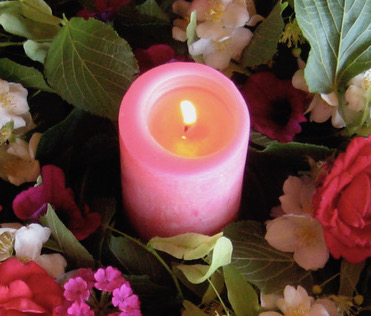
My favourite way to dance ‘in circle’ is without any online technology, simply connecting in heart and spirit. Since the start of the lockdown, my network of dance students, friends, and colleagues in different countries have been ‘meeting’ at set times twice daily, and it is deeply moving to join together in this way. We light a candle for loved ones, health workers, key workers, and anyone who is unwell or needs extra support at this difficult time. Then we each dance the same sequence of circle dances, plus our personal favourites. Knowing that my friends are all dancing in their own homes, and that we are all thinking of each other at the same time, is very precious.
Candle (photo: Laura Shannon)
If you too are separated from your loved ones, you can choose a time every day to stop what you are doing so you can think of one another, with no need for online technology. You don’t have to dance; just put on your favourite music and know you are connected.
Doing things you love can also provide an antidote to trauma – cooking favourite foods, lovingly repotting houseplants, or embarking on a fun creative project – anything you enjoy can connect you to your own power and experience of mastery as a source of healing. With my housemates here in Canterbury, we created a beautiful Easter feast – twice, first for Western and then for Orthodox Easter – with photos of our missing loved ones on the table. It was such a simple act, but nourishing on so many levels.
Time in nature connects us with the flow of life force which is in each of us. As we walk outdoors, feeling the earth below and the sky above, we can remember when we have come through challenges in the past, and let those memories reassure us that we will come through this now too. It was the same earth under our feet then, and it’s the same sky around us now and so it will be in the future when all of this is behind us.
Trees (photo: public domain)
Sometimes a larger crisis, like this pandemic, can put things in perspective, and bring us closer to forgiveness and healing. To support this inner process, I have found the Hawaiian indigenous practice of ho’oponopono to be very powerful. Hawaiian scholar and educator Mary Kawena Pukui describes it as a practice of forgiveness and reconciliation, for family members to ‘make right’ broken relations and prevent problems from erupting.
What can we do to foster forgiveness, move beyond blame, and focus on what we have in common? One recent story on the Karuna website tells how rival gangs in South Africa are now cooperating to deliver food to the vulnerable in their community. Amazing!
There is always something we can do, for ourselves and for others. And let’s not forget the larger context: life as we knew it has hit the pause button, and we have a chance to make some different choices in preparation for when we once again press ‘play’. Maybe we will find that all of us – and all of humanity – are suddenly dancing to a more beautiful tune.
Laura Shannon has been researching and teaching traditional women’s ritual dances since 1987, and is considered one of the ‘grandmothers’ of the worldwide Sacred / Circle Dance movement. She trained in Intercultural Studies (1986) and Dance Movement Therapy (1990), and is currently pursuing postgraduate studies in Myth, Cosmology, and the Sacred at Canterbury Christ Church University in England. Her primary research in Balkan and Greek villages seeks out songs, dances, rituals and textile patterns which descend from the Goddess cultures of Neolithic Old Europe, and which embody an ancient worldview of sustainability, community, and reverence for the earth. In 2018 Laura was chosen as an Honorary Lifetime Member of the Sacred Dance Guild in recognition of her ‘significant and lasting contribution to dance as a sacred art’. Her articles and essays on women’s ritual dances have appeared in numerous publications, including Re-Enchanting the Academy, Dancing on the Earth: Women’s Stories of Healing Through Dance, She Rises! Vol. 2, Inanna’s Ascent, Revisioning Medusa, and Spiritual Herstories – Call of the Soul in Dance Research. Laura is also Founding Director of the non-profit Athena Institute for Women’s Dance and Culture. She lives in Canterbury, Greece, and the Findhorn community in Scotland.
Medusa and Athena: Ancient Allies in Healing Women’s Trauma in Revisioning Medusa: from Monster to Divine Wisdom, edited by Glenys Livingstone, Trista Hendren and Pat Daly. Girl God Press, 2017, 206-222. www.thegirlgod.com. This excerpt cites Bessel Van der Kolk, The Body Keeps the Score (2014), pp 4, 40, 53.
Mary Kawena Pukui Karuna website: This site collects positive stories in the time of coronavirus. ‘Karuna’ is a Sanksrit word meaning compassion. Their site motto: ‘Karuna spreads faster than corona.’
I awakened this morning to frozen raindrops hanging from trees – jeweled beads, snow capped hills, and a cacophony of spring songs – I was serenaded by robins, chickadees, phoebes, goldfinches, and nuthatch tweets as I walked out the door into the early morning sun. I listened for the cardinals, who for the moment were absent. It was cold! 28 degrees at the end of April speaks to anomalies, or more realistically, Climate Change.
Yesterday we had rain, and working in the still damp air is literally a healing experience. The fragrance is a combination of chemicals released by soil-dwelling bacteria, oils released from plants during dry spells and ozone created when lightning splits oxygen and nitrogen molecules that then turn into nitric oxide.
I dug in baby trees that I had rescued from the side of the road the day before. Salt kills tender cedar seedlings if the road crew misses slaughtering them. Around Maine trees are worthless except as an economically viable product, a heartbreaking reality for someone like me. Continue reading “Earth Day Reflection by Sara Wright”
Over the past few weeks of lockdown in Greece, I have asked myself numerous times: if we can shut down the world economy because of a virus, why don’t we shut everything down until we end war or find real solutions to global climate change? In my mind the horrors of war are much worse than the horrors of disease and dying and the threat and reality of global extinctions pose a much greater threat to humanity (not to mention nature) than the Coronavirus.
Why is it that we are willing to take extreme measures to defeat the Coronavirus but we are not willing to take extreme measures to end war or to stop global climate change? A thought keeps creeping into the back of my mind: the fight against disease and death is (understood to be) a fight against Mother Nature and (sadly) we are well used to fighting against Her. If we recognized that human beings have brought the Coronavirus upon ourselves, we would have to face up to our responsibility for it. Continue reading “Coronavirus: The Villain Is Not Mother Nature: It Is Ourselves by Carol P. Christ”
In 2016, Zlinszky (Zlinszky/Molnar/Barfod) and his team released another study demonstrating that birch trees go to sleep at night (now we know that all trees – at least all the trees that have been studied so far – do sleep at night).
Trees follow circadian cycles responding primarily to light and darkness on a daily cycle. The researchers believe the dropping of birch branches before dawn is caused by a decrease in the tree’s internal water pressure while the trees rest. With no photosynthesis at night to drive the conversion of sunlight into simple sugars, trees are conserving energy by relaxing branches that would otherwise be angled towards the sun. Trees increase their transpiration during the morning, decreasing it during the afternoon and into the night. There is a change in the diameter of the trunk or stem that produces a slow pulse. During the evening and the night tree water use is declining, while at the same time, the stem begins to expand again as it refills with water.
When trees drop their branches and leaves its because they’re sleeping. They enter their own type of circadian rhythm known as circadian leaf movement, following their own internal tree clock. Continue reading “Trees Sleep? by Sara Wright”
The first time I saw Frozen 2, I was impressed by the ecofeminism and the efforts to respect the Sami culture. The second time, I thoroughly enjoyed the superb music and the character development. The third time… was a religious experience.
Other contrubutors have written wonderful reviews of Frozen 2, and I agree wholeheartedly that its animation reinforces the sexist idea that females should be tiny compared to males, except for our eyes, which should be larger than our wrists. These disempowering representations saturate today’s media, and I regularly spend a whole lot of time deconstructing them with my daughters.
However, there is a lot to love about Frozen 2, and as a Christian, I found myself resonating with several of the symbolic truths the film offers. I spent some time looking into the Sami religion, to see how much of it was incorporated into portrayals of the Northumbra. I knew that Disney had consulted with Sami representatives to portray their culture with respectful accuracy. The Sami history is an all too familiar tale of violent imperial conquest allied with Fundamentalist Christian Dominionism. The wounds of Sami history certainly give me terrible grief as a white American and a Christian, and I hope that the anti-colonialist messages of the film spread awareness of such violence in my country. Continue reading “Frozen 2: Can the Christian Church Hear its Gospel Song? by Trelawney Grenfell-Muir”
Every morning I walk to the river in the velveteen hour between the vanishing blue night and the coming of the first scarlet, pink, lavender, purple or golden ribbons that stretch across the horizon. Sometimes clouds with heavy gray eyelids mute first light. Either way all my senses except that of sight are on high alert; a deep peace embraces me in the dark. My body knows the way. I murmur to the willows as I pass through the veil and under their bowed bridge. Their response is muted, a song beneath words.
At first my footsteps are barely audible on the narrow serpentine dirt path but as I pass by the river I note that she too is singing; and my senses quicken. If the Crane spirits are with me I hear the first brrring of Sandhill cranes as they take flight. “Freezing” I am crane struck; the involuntary need to stand still is overpowering. Body -mind viscerally absorbs Oneness as I breathe in a multitude of crane songs or perhaps only that of a few. Now my eyes are suddenly open, straining to see the familiar brrring materialize into startling graceful heads, necks, and stream lined bodies…. I note the shimmering waters beginning to mirror blushing pastels or the gray smoke that stains the horizon. Sometimes these hues deepen into rose, blood orange, or scarlet. Continue reading “The Portal: How Do We Know What We Know? by Sara Wright”
Tomorrow is Tu B’Shevat, the New Year of the Trees, or their birthday. It is the day of the year when all trees, regardless of when they have been planted, turn another year older. The rabbis standardized this day in an effort to minimize complexities, since in the land of Israel, fruit can only be eaten from trees that are four or older (Leviticus 23-25). Tu B’Shevat, then, on a practical level, marks how old fruit bearing trees are.
The holiday has evolved since then. In the 16th century, Kabbalistic mystics developed a seder to celebrate the holiday, which involved eating certain fruits, drinking both red and white wine, saying blessings, and reading certain mystical texts. Each type of fruit one eats has a specific mystical meaning whether the fruit is completely edible (i.e. apple), has an inedible pit (i.e. olive), has an inedible shell (i.e. pistachio) or has a covering one generally wouldn’t eat, but could (i.e. orange). To this day, many congregations observe the holiday by hosting their own Tu B’Shevat seders often ripe with such kabbalistic overtones. Continue reading “When Every Day Will Be Tu B’Shevat by Ivy Helman.”


 Brother Francesco, known to the world as Saint Francis of Assisi, left us many sweet and lovely poems and songs. In “The Canticle of the Sun,” he wrote about the gifts of nature. Brother Sun, his light and radiance. Sister Moon and Stars for their beauty. Brothers Wind and Air, through fair skies or storms. Sister Water for her humility, purity, and usefulness. Brother Fire, who lights the night, is playful and strong. And Sister Death, whom no one living can escape. And, of course, he included:
  I recently returned to Maine after what can only be called a harrowing journey from the Southwest. Grateful to feel beloved earth under my feet, I walk along the pine strewn woodland paths to keep myself sane. My animals have been ill, my neighbor was hospitalized briefly, other neighbors deliberately destroyed my garden wall crushing a baby balsam, and used this property as their personal ski slope, the threat of the C/virus looms – there are no words to describe this kind of exhaustion. As a PTSD survivor all my senses are on permanent scream. The simplest task has become monumental. And I am only one of so many…
 My previous post on this site,


 I awakened this morning to frozen raindrops hanging from trees – jeweled beads, snow capped hills, and a cacophony of spring songs – I was serenaded by robins, chickadees, phoebes, goldfinches, and nuthatch tweets as I walked out the door into the early morning sun. I listened for the cardinals, who for the moment were absent. It was cold! 28 degrees at the end of April speaks to anomalies, or more realistically, Climate Change.
 Over the past few weeks of lockdown in Greece, I have asked myself numerous times: if we can shut down the world economy because of a virus, why don’t we shut everything down until we end war or find real solutions to global climate change? In my mind the horrors of war are much worse than the horrors of disease and dying and the threat and reality of global extinctions pose a much greater threat to humanity (not to mention nature) than the Coronavirus.
 This post follows last week’s post:
 Every morning I walk to the river in the velveteen hour between the vanishing blue night and the coming of the first scarlet, pink, lavender, purple or golden ribbons that stretch across the horizon. Sometimes clouds with heavy gray eyelids mute first light. Either way all my senses except that of sight are on high alert; a deep peace embraces me in the dark. My body knows the way. I murmur to the willows as I pass through the veil and under their bowed bridge. Their response is muted, a song beneath words.
 Tomorrow is Tu B’Shevat, the New Year of the Trees, or their birthday. It is the day of the year when all trees, regardless of when they have been planted, turn another year older. The rabbis standardized this day in an effort to minimize complexities, since in the land of Israel, fruit can only be eaten from trees that are four or older (Leviticus 23-25). Tu B’Shevat, then, on a practical level, marks how old fruit bearing trees are.
  Feminism and Religion