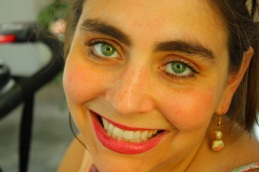
 Why bother? It’s a legitimate question. My oldest son, almost 12, announced that he is depressed. He’s got good reasons for it, so I don’t try to talk him out of it. My youngest, almost 8, told me yesterday that life was simpler when he was in my belly. Now, he says school is torture. They won’t just teach something and move on. They have to do “activities,” he says, he’s onto the racket that is known as busy work.
I spoke with an aunt, a cancer survivor, whose progress is steadily monitored. Life, it seems, has become about watching and waiting rather than living. There’s not so much to look forward to, she says wistfully, once you get to a certain age. My friend called in distress. Not one area of life – not work, not kids, not household, not romance – was untouched by significant stress. She said that she could understand how people are okay with their kids moving out. There is a time, she observed baldly, when it will be alright to die. She said, I’m tired.
What do we do with fatigue that becomes soul deep? In my own case, I used to move it around from one place to another, focusing on what I could do as a remedy for the things I could not change. What I have come to realize, though, is that we run out of storage space eventually. There’s no place to hide from this – this question – of meaning or meaninglessness. When I try to assess and work out what’s on my mind, that is, when I feel the fatigue of meaning, I realize that I am dealing with something spiritual in nature.
It’s plain as day, of course, when you give it a second’s thought. But, at first blush, it is not always immediately self-evident that the angry person mouthing “bitch” at me in the crowded parking lot or my frustration at my kids not responding to my third request, were and are, at the root, theological problems. Such things were and are, the things that push the self toward the precipice of spiritual demise.
Why bother, I wonder, when the handsome and seemingly happy couple in line in front of me to see Santa with their little boy turns to me hostilely and threatens me should my own eager child accidentally bump into them again. As I stand on, dazed, still looking at them with something of a smiling admiration on my face, trying to understand what I have just heard, I am yelled down for the look on my face. What is this world, I wonder, while my own joy begins to shift into an anger that I am now tasked with suppressing and rationalizing?
The more I recognize myself in this place, especially as a woman, the more I understand that traditional theology, and specifically traditional Christian doctrine of God, has more or less failed to help me here. It has failed to provide me, specifically as a woman, an adequate way of dealing with the inevitable fatigue of a life lived long enough. What do I mean by this? I find that I have internalized a distorted sense of value and more importantly a distorted sense of self in relationship to others.
In particular, the idea of servanthood, even service as leadership, can be an infectious and distorting delusion whereby one inclines oneself simply to be taken advantage of by others. This happens in family life, work, and even in volunteerism (especially at the Church). Likewise, the insistence on joy, hope, resurrection, loving the neighbor, the new day yet to come – these can become woefully burdensome, even to the very young, because such spiritual dispositions stifle the capacity to experience–honestly and without self-critique–anger, fear, boredom, and disappointment.
As a woman, I find myself to be particularly susceptible to spiritual instruction about service, docility, duty, and self-gift, in ways that I increasingly come to understand are not genuinely relationally intelligent or spiritually wholesome: they are gendered norms for desirable social being. Of course, I know all this stuff as theory. I have for two decades. But, now, now I know it for myself, in my skin, and that is a heavy transition in the soul.
I’m not sure I agree that religion the opiate of the masses, but I do agree that one of the foremost reasons people create religion as a framework for interpreting life is that they are confronted with the profound task of meaning-making out of what often seems to be the unfathomable reach of meaninglessness. Theology is a response to that, as is worship. The older or perhaps wiser or perhaps more reckless I get, the more I understand that is incumbent on each of us to be able to think theologically in ways that are authentic and true to our own experiences and insights.
It is perhaps for these reasons that I have been expanding my own capacity for prayer and ritual by participating in alternative spaces of worship, like the sweat lodge, as well as creating my own, as I have been over the past several on New Year’s Eves, with the invention of a symbolic meal, a structured memorial for the deceased, readings, and a fire ritual at midnight. I feel at times like a syncretistic pagan wannabe, but I set those self-critiques aside in the knowledge that I am exe(o)rcising the spirit.
That phrase, “exe(o)rcising the spirit,” feels laden, and I have yet to unpack its full import, but I know it means both ridding myself of what does not work and claiming the authority to honor what does in ways that are sacramental and meaningful to me and to those in my community of intimates.
Perhaps the best way that I alternatively theologize is through creative writing, through the beckonings of theopoesis, where I find I can speak without the impositions of structure in the quasi-grammarless realm of experiential knowing. It is here that I have discovered freedom to disagree and complain as well as to integrate and praise in a voice that talks to God in earnest, as though God were listening. In preparation, for a solstice sweat, this is what I had to say.
These sides are not
sharp antagonisms
that bring to points
their points of view
but a pond’s surface
under moonlight,
swirling like mercury,
beneath which minnows,
fluid, do
their works of
harmonious disruption.
So, let my prayer be not
please,
for, I fear
I have been
an ungrateful guest.
Sojourning pilgrim,
refugee,
all this life, all will be,
a lesson in how to say
thank you.
Natalie Kertes Weaver, Ph.D., is Chair and Professor of Religious Studies at Ursuline College in Pepper Pike, Ohio. Natalie’s academic books include: Marriage and Family: A Christian Theological Foundation (Anselm, 2009); Christian Thought and Practice: A Primer (Anselm, 2012); and The Theology of Suffering and Death: An Introduction for Caregivers (Routledge, 2013). Natalie’s most recent book is Made in the Image of God: Intersex and the Revisioning of Theological Anthropology (Wipf & Stock, 2014). Natalie has also authored two art books: Interior Design: Rooms of a Half-Life and Baby’s First Latin. Natalie’s areas of interest and expertise include: feminist theology; theology of suffering; theology of the family; religion and violence; and (inter)sex and theology. Natalie is a married mother of two sons, Valentine and Nathan. For pleasure, Natalie studies classical Hebrew, poetry, piano, and voice.


 In the middle of the night in waking sleep, I asked my great-great grandmother Annie Corliss to tell me the story of how she met and married James Inglis. This story came through me in a place I have come to call the Dreamtime. The Aboriginal term feels right. As I understand it, this is not a place where the dead speak to the living but rather a space where boundaries blur as the ancestors speak in us.
 I am writing this blog on New Year’s Day, so Happy New Year! Today I say these words as both a statement of hope and as invocation. Happy New Year: may it be! My twin sister told me that our horoscope said that 2017 would be a party: we should throw our energies into anything and everything we want to see happen in our worlds because it can and will happen this year—may it be! Because it certainly doesn’t feel like a time for flourishing. I echo the introductory sentiments of
  In early December 2016 I visited central Williamsburg in Brooklyn, New York, where my 2x great-grandparents
 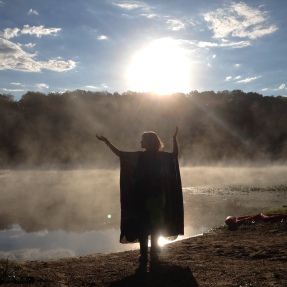 living with your feelings, touching the earth, and embracing the fullness of your humanity.”
 In this building I write, work, create, and hold small rituals with a circle of friends. I call it my Tiny Temple and it is the proverbial, “room of one’s own” described by Virginia Woolf in 1929. Having a dedicated work and ceremony space in the midst of a home-based life, which includes a home business shared with my husband, and four homeschooled children, has changed my life profoundly. In the tiny temple, I feel most wholly myself: connected, powerful, free, authentic, and completely alive.
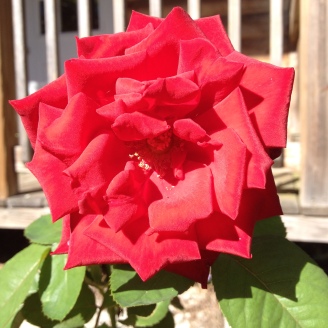 “We may need to be cured by flowers.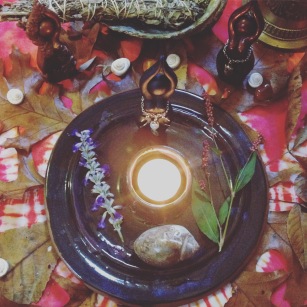
 Embodiment is a feminist principle which has, as its basis, two fundamental criteria. First, humans require their bodies to live. We must acknowledge that our existence is tied to our bodies. This fact grounds us in this world. Here, and not in some other-worldly place, we live out our lives. We are dependent on our bodies and what the world provides for our survival. In other words, humans are inseparable and interconnected to this world. Humans are not above nature as the Western hierarchical dualist mindset would suggest.
 There are days I find myself so overwhelmed with sadness concerning the state of our world that I break down crying. Last week, I saw an episode of Mars, a scripted documentary shown on the National Geographic channel about human colonization of the red planet in 2033. One of the astronauts “interviewed” prior to leaving was asked why she was taking such a risk to inhabit Mars. She said something like, “We will give everything for this.” Why not give everything for Earth?
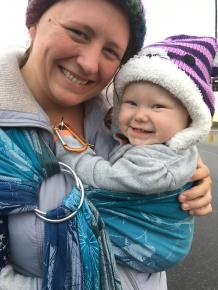 This month I turn one as a mother. My daughter, consequently, is also turning one—a first birthday I am excitedly planning. Specifically, I want to make Hazel a rainbow cake with lots of colored layers and white frosting. I’m not even sure she’ll be able to eat the cake (avoiding lots of sugar for a one-year-old and all), but among those family pictures I treasure, my mother held a cake for her little ones. I want to be like my mother. I am going to make a cake.
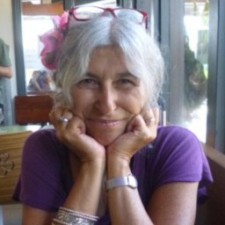 Never has it been more difficult for me to affirm that “love trumps hate” as during this unprecedented United States election season. After watching the Republican Convention last July in mute horror, I took to bed for several days, overwhelmed by the presentiment that everyone–blacks, women, Jews, Latinos, Muslims, queers– other than a certain breed of white American males was doomed to shameless malignment and persecution. The palpable hatred in Donald Trump’s acceptance speech seared me, arousing my ancestral memory of various persecutions of Jews, Muslims, and others–not something I usually think about or choose to foreground. For several months now, I have been haunted (and almost paralyzed) by fear.
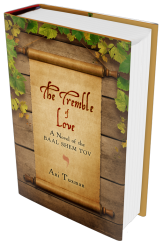 Hence Ani Tuzman’s
 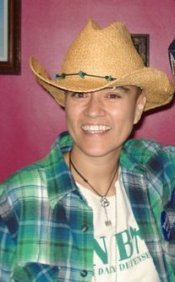 I caught myself reinforcing the norm. The ever present default
  Feminism and Religion