Fannie Lou Hamer’s Commitment to Life by Elise M. Edwards

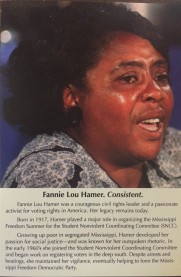
Elise EdwardsA few weeks ago, I came across a postcard that I was given at a conference last year. I got the postcard (advertisement?) because it has a picture of Fannie Lou Hamer on it, and in my home and office, I like to display images and quotes from inspirational women, especially black women. Hamer was a sharecropper from rural Mississippi who became a leader within the civil rights movement in the United States. I was happy to have something with her likeness on it. It was only later that I looked at the text on the front and back of the card, which read in part, ”Often called the ‘spirit of the Civil Rights Movement,” Hamer worked tirelessly on behalf of the rights of others—including the unborn. [She said,] ‘The methods used to take human lives such as abortion, the pill, the ring, etc. amounts to genocide. I believe that abortion is legal murder.’” I realized then that the card was distributed by an organization called Consistent Life, who, in support of a “consistent ethic of life,” is “committed to the protection of life threatened by war, abortion, poverty, racism, capital punishment and euthanasia.”

I was conflicted about the ushamere of Hamer’s image for this organization’s purposes. It is true, Hamer did have those views about abortion and birth control. But I did not know if her image and story was being manipulated for a particular political and religious agenda—one I do not align myself with. I put the card in a box of other images and quotes. I didn’t display it, but I didn’t throw it away, either, which is why I came across it again a couple weeks ago as I was cleaning and decorating my home office. I had the same misgivings about the image as before, and I set it aside again. Continue reading “Fannie Lou Hamer’s Commitment to Life by Elise M. Edwards”

More than Individual Concerns by Elise M. Edwards

Elise EdwardsWell, the fall semester of the school year has begun. I’m teaching undergraduate classes in Christian Ethics and Bioethics this fall. I’ve designed my classes so that they are much more discussion-based than they have been in previous semesters and as a result, I’m noticing the things that challenge and confuse my students fairly early. I have readings from feminist, womanist, and mujerista thinkers in these courses, and unsurprisingly, some of my students don’t know what to do with the arguments feminists make about how we arrive at moral decisions and live them out. I hope that as we work through the essays together, my students and I learn from each other.

I assigned an essay called “Theology’s Role in Public Bioethics” by Lisa Sowle Cahill that was included in the Handbook of Bioethics and Religion edited by David E. Guinn (2006). Cahill, a feminist thinker, asserts that theology can be a conversation partner in public debate about bioethics and also an advocate for just, compassionate, and inclusive health care practices. Citing the work of another feminist, Maura Ryan, Cahill argues that ethical questions about reproductive technologies should be examined not only as individual dilemmas but as issues that exist within a social justice context. In the conclusion of the essay, she states, ”Specifically, one of [theology’s] most important and distinctive contributions to public discourse is a critique of the ways in which modern biomedicine and biotechnology have become luxury items marketed to economically privileged classes, while the world’s poor majority lacks basic health needs.” (55).

I suppose because I’ve been reading feminist thought, theology, and social ethics for years, some of the claims that my students see as radical and new are commonplace and go unquestioned by me. I expected some of my students to disagree with Cahill and Ryan’s particular positions about assisted reproduction. But I was surprised by students’ rejection of the idea that debates about reproductive technologies include MORE than individual considerations.

I’ve blogged on this site about reproductive rights before, and let me be clear that I do not think that the church, state, or any institution should have more governance over a person’s body than that person herself. But while respecting individuals’ rights to make health decisions for themselves, I also acknowledge that these “individual” decisions have broader social implications and meanings. This is one reason second-wave feminists have insisted that “the personal is political.”

Feminists routinely relate individual, “personal” acts and beliefs to larger constructs and the too-often asymmetrical power dynamics at work within them. This is why we are disturbed by video of a man who knocks his fiancée out and drags her unconscious body from an elevator and pop stars who gain commercial success by graphic displays and descriptions of sexuality that is objectifying or exploitative. And, in response to one of my students who wondered if feminist interpreters of religious texts go too far, that is why they point to patriarchy in a story that seems to be about devotion (referring to the Book of Ruth).

I’m grateful to my students for prompting me to explain some of these convictions that feminists hold. Certainly feminism is not monolithic. We feminists disagree on many issues including the scope of individual rights, the role of religion in public debate, and the extent of harm (or lack thereof) in media portrayals of female sexuality. But I believe we tend to agree that our personal decisions as well as our societal issues should be addressed with a consciousness that as humans we are beings-in-relation. Our conviction that we are connected and affected by each other lies behind our motivation to make the world a better place for women and girls and others who suffer from patterns of dominance.

What do you think?

Elise M. Edwards, PhD is a Lecturer in Christian Ethics at Baylor University and a graduate of Claremont Graduate University. She is also a registered architect in the State of Florida. Her interdisciplinary work examines issues of civic engagement and how beliefs and commitments are expressed publicly. As a black feminist, she primarily focuses on cultural expressions by, for, and about women and marginalized communities. Follow her on twitter, google+ or academia.edu.

Anger is Not a Panacea: The “Next Stage” after Rage by Carol P. Christ

carol mitzi sarahIn a recent post Xochitl Alvizo cited Beverly Harrison’s much-loved essay “Anger as a Work of Love.” Harrison captured feelings that were in the air at the time of its writing several decades ago. Women were laying claim to the right to be angry at the silencing of our voices, the double standard, the media portrayal of women, income inequality, lack of access to good jobs, failure to prosecute rape and domestic violence, and a host of other injustices.

Most of all we were protesting the cultural stereotype that the “good woman” (understood to be white, Christian, and married or hoping to be) would not protest loudly or at all, would turn the other cheek, and would think about others rather than herself. (Jewish women and black women had to strive doubly hard to “live up” to this standard, as it was assumed that Jewish women were “overly assertive” and that black women were “too strong” and often “angry.”)

In this context Harrison’s essay and Mary Daly’s epithet “rage is not a stage” gave women—especially white women–permission to get in touch with our feelings of anger and to express them. We understood that “good women” had been hiding and repressing their feelings for centuries if not millennia with the result that the structures of injustice remained intact. Continue reading “Anger is Not a Panacea: The “Next Stage” after Rage by Carol P. Christ”

Thealogy of the Ordinary by Molly

crop027

The Goddess Gaia is alive
In this time and in this space
She speaks in sunrises
And waves against the shore
She sings with the wind
She dances in moonlight
She holds you close
Your heart beats in time with hers
A great, grand hope and possibility
For this planet…

Over the last two months, I have been listening to a wonderful telesummit about priestesses. I am also a huge fan of the radio show, Voices of the Sacred Feminine. However, as I listen to both, I sometimes find myself wondering if walking a Goddess path is also viewed as synonymous with, “believe everything, question nothing.” Crystal essences, gemstone healing, soul contracts, past lives, spirit guides, astrology, the many realms and dimensions of the occult, mystical, New Age and metaphysical. Is wholesale suspension of logic required to join hands with the Goddess? Is deft management of the tarot essential to the priestess path?  Is excavating my “inner masculine” relevant or appropriate? Must I ascribe to “enlightened” tenets like, “you are not your body,” “I am a spiritual being having a spiritual experience” and “we made an agreement to do this work before we showed up in this body at this time and place” in order to move forward? Continue reading “Thealogy of the Ordinary by Molly”

Transcendence, Immanence, and the Sixth Great Extinction by Carol P. Christ

carol christIn my recent blog “The Flourishing of Life and Feminist Theology” I discussed Grace Jantzen’s view that theology should focus on “natality” or birth and life, rather than life after death or life apart from this world. This week Tikkun magazine published its summer issue with a feature called “Thinking Anew about God.” In it two male thinkers, one Buddhist and one Christian, argue for a similar turn toward the world in their traditions. Their calls for religions to focus on this world were published the same week scientists warned that the world stands on the brink of the sixth great extinction.

I have come to believe that any religion espousing cosmological dualism (devaluing this world in favor of a superior reality such as heaven) and individual salvation (the idea that what ultimately happens to me is disconnected from what ultimately happens to you) is contributing to our world’s problems rather than offering a solution. … [Religions should] stop emphasizing the hereafter and focus instead on how to overcome the illusion that we are separate from this precious, endangered earth. –David Loy, Buddhist, writing in Tikkun Summer 2014

My aim in this regard is to reawaken in each of us an emotionally felt and primordial sense of spiritual belonging within the wider natural world. In turn, my hope is that this deep sense of belonging to the earth — to God’s body, as it were — will en-flame our hearts and empower our wills to commit us to healing and saving the earth.—Mark I. Wallace, Christian, writing in Tikkun Summer 2014 Continue reading “Transcendence, Immanence, and the Sixth Great Extinction by Carol P. Christ”

The Flourishing of Life and Feminist Theology by Carol P. Christ

carol christI first encountered the image and concept of “flourishing” in Grace M. Jatzen’s feminist philosophy of religion, Becoming Divine. For Jantzen “flourishing” is a symbol of a theology of “natality” or birth and life, which she contrasts to the focus on death and life after death in traditional Christian theologies.

Jantzen argues that the focus on death and life after death is a rejection of birth. Birth is rejected because birth through a body into a body implies finitude. Birth ends in death.  Jantzen argues that embracing natality means embracing finitude and death.

Jantzen is not arguing that motherhood is the highest calling or saying that all women must be mothers. Rather she is calling us—women and men—to embrace finite life in the body and the material world as the final and only location for spirituality. Defending pantheism as an alternative to transcendent theism, she argues further that divinity is to be found “in” the physical and material world—and nowhere else. Though she speaks of natality, Jantzen is no essentialist.  Rather she is a metaphysician making claims about the nature of life. Continue reading “The Flourishing of Life and Feminist Theology by Carol P. Christ”

Sleeping: Thinking about Bodily Practices, Pt. 2 by Elise M. Edwards

Elise EdwardsAs I mentioned in my previous post, I’ve been reflecting on bodily practices–especially those that are not typically associated with feminism and religion. Our lives as embodied persons are so multi-dimensional! There is so much we perceive and experience through our senses, through our movements, and through the places we locate ourselves. So I have decided to use this blog to think through some ideas and learn from you in this community of readers, contributors, and commenters. Over the next few months, I will continue to discuss the ways I am becoming more intentional about connecting habits surrounding the body to feminist and religious concerns. Once again, I’ve glossed on only a few of the many connections we could make about women, religion, and bodily practices. Today I write about sleep. I would love to hear your thoughts in the comments below.

Do feminism and religion have anything to do with sleep?

Sleeping is as vital to human survival as food and water. But lamentably, getting the proper amounts of sleep is not one of those healthy goals that is fiercely defended. It is much more common to hear someone brag about how productive she can be on a few hours of sleep than to boast about her productivity after a full night’s rest. I have to admit, I am always a little suspicious of those people who proudly proclaim they only need 4 or 5 hours of sleep, and I’m a little antagonistic to those who want to recruit the rest of us into their sleepless world: “There is so much else you could be doing with your time than sleeping!” They say, “I’ll sleep when I’m dead!” I have even heard “Sleep kills dreams!” Um, actually, dreams come when you sleep. Sleep breeds dreams, you could say. More on that below.

As you might be able to tell, I am the type of woman who loves sleep. I love climbing into my bed at night. I enjoy the feeling of waking up with a rested body and a renewed spirit and a groggy-but-fresh mind. I especially love naps for that reason. The most enjoyable and perhaps “productive” seasons of my life have been those when I could take a nap after class, after work, or after the gym.

Sleep is vital because it allows the body to rest. In the Christian tradition, we claim that rest is part of the creation of the world. That God marveled at the wonderful world God created, and when the work was done, God rested. This rest inspires the Sabbath. Sabbath is a day set aside for rest, worship, and contemplation of the holy. It is regrettably observed less and less in contemporary American Christianity. Since we have let go of the need for the Sabbath, it certainly no surprise we have also lost sight of the importance of daily rest, too.

Although my thoughts are little uncharitable towards those who preach the gospel of little sleep, I am very sympathetic to those who feel they do not have enough time to sleep. To those who feel like sleep is a luxury they cannot afford. Certainly many women tasked with numerous responsibilities often feel this frustration. They make do with less sleep because they have to complete more tasks in their waking hours. Yet it has been my experience that even those who are overworked and overscheduled appreciate the uncommon times when they can sleep a little longer than usual.

For me, times of sleep are very much connected to gratitude. In the past year or so, I have retrieved the practice of nightly prayer, which sadly got left behind in my childhood years. In all honesty, it was not a renewal of spiritual piety that led me to resume these bedtime prayers. It was insomnia. As much as I love sleep, I am often kept from it by anxieties and thoughts of the coming day. I started using bedtime prayers as a way of turning my cares over to God. These silent prayers become conversations about what is important to me and what concerns me. I talk to God about what I am grateful for. I talk to God about my family and my friends, about their lives and concerns that weigh on me. And then I let it go–at least for the night–and trust my soul to the divine power who cares for me while I sleep.

These nightly prayers have not only promoted peaceful sleep (for most nights, at least) but also the experience of vivid dreams. Dreams, like other visions, are honored in many religions as a place where the divine communicates with humanity. But this too, seems absent from contemporary American Christianity. Perhaps it is because dreams are associated with the intuitive senses, and therefore the feminine, that they are overlooked. Dreams are less clear and presumably more open to speculative interpretations than the texts we read during the day. I cannot say whether I meet God or whether I meet my deeper self in dreams, but I do know I am connected to powerful ways of being in my sleep, and that this is important for my spiritual life.

My final reflection about sleep is an acknowledgment that we often do not sleep alone. While sleep itself takes us to a solitary place, we often share our beds with lovers, children, and other family members and friends. Like those bedtime prayers, the words we speak under the covers in those moments before sleep connect us to our bed-mates. Whether they are ghost stories or secrets or incoherent ramblings about the day to come, these nighttime words prepare our minds for the sleep that will soon overtake us. Unless, of course, we are next to someone who snores or kicks.

Elise M. Edwards, PhD is a Lecturer in Christian Ethics at Baylor University and a graduate of Claremont Graduate University. She is also a registered architect in the State of Florida. Her interdisciplinary work examines issues of civic engagement and how beliefs and commitments are expressed publicly. As a black feminist, she primarily focuses on cultural expressions by, for, and about women and marginalized communities. Follow her on twitter, google+ or academia.edu.

Eating: Thinking about Bodily Practices, Pt. 1 by Elise M. Edwards

Elise EdwardsI am currently preparing to teach a course on bioethics in the fall. I plan on combining some common, secular materials on biomedical ethics with some theological material and some feminist readings. After all, in a course that centers around practices related to the body, birth, and death, there seems ample opportunity to introduce feminist themes. Some feminist perspective, of course, is typical, like when we will discuss abortion and contraception. (Or at least it is common in my courses where try to present multiple sides of an issue.) Anything related to conception, pregnancy, and birth is easily understood as a “women’s issue” and therefore something that feminists address. I’ve discussed abortion and contraception in previous posts on this forum.

However, I realized in going through readings for this course that I have not focused much on other practices related to the body in my scholarship or personal reflection. Specifically, I have not connected them to theological principles or feminist convictions. Perhaps not everything concerning the body is directly relevant to feminism. But I am sure if I thought about it, I would be able to make the connections. We are physical creatures and the feminist movement generally affirms recognizing our embodiment.

Continue reading “Eating: Thinking about Bodily Practices, Pt. 1 by Elise M. Edwards”

Gendered Imagery of God (Part 2) by Elise M. Edwards

Elise Edwards

In my previous post, I shared some of the ways in which I’ve been wrestling with gendered imagery for God, the first person of the Christian Trinity often referred to as God the Father. In this entry, I’d like to reflect on ways I am reconsidering the gender of the Christ.

It is only recently, after reading Melinda Bielas’ post “Waiting for Jesus… I mean, Superman” (December 17, 2013), that I began to question male language for the Christ. I got into an interesting conversation with Grace Kao in January about it. My thoughts on this topic are still unformed and more theologically “speculative” than I usually share on this site, but I’d love to hear what you think. I think it is important for Christian feminists to consider the doctrines of the faith and assess where they support the co-humanity of women and when they degrade it. Continue reading “Gendered Imagery of God (Part 2) by Elise M. Edwards”

Pap Smears I Have Known by Molly

IMG_0522Your body is your own. This may seem obvious. But to inhabit your physical self fully, with no apology, is a true act of power.”

–Camille Maurine (Meditation Secrets for Women)

“I used to have fantasies…about women in a state of revolution. I saw them getting up out of their beds and refusing the knife, refusing to be tied down, refusing to submit…Women’s health care will not improve until women reject the present system and begin instead to develop less destructive means of creating and maintaining a state of wellness.”

Dr. Michelle Harrison (A Woman in Residence)

One afternoon at the skating rink for homeschool playgroup, a few of my friends sit in a hard plastic booth and the conversation turns to pap smears and pelvic exams. Later, I read Michele Freyhauf’s post about her hysterectomy experience and the skating rink pap smear stories come back to me with vivid clarity.  Being a woman is such an embodied experience and we have so many stories to tell through and of our bodies. During my conversation with my friends, I warn them: watch for my new show–Pap Smears I Have Known. At the time, several other friends are preparing for a local production of the Vagina Monologues and I have a vision: The Pap Smear Diaries. But, really, how often do we have a chance to tell our Pap smear stories, our pelvic exam stories? Where are they in our culture and do they matter? Continue reading “Pap Smears I Have Known by Molly”