Emotional Policing from Within: Choosing Right Relationship Over Being Right on FAR by Elisabeth Schilling

I have something hard to say. It is about some of ourselves, some of the time.

Let me start by offering you my perspective on negativity on the internet: people are not always conscious or mindful. We let our bitter wounds affect our ability to listen to each other and respond in compassionate ways. Being compassionate does not mean we have to agree with each other. But it means that we shelf our ego and do not immediately jump to disregarding another’s experience or perspective; we can disagree without being harsh. We can be honest, while being kind.

There is some negativity in the comments from regular FAR readers and contributors that I want to speak to in hopes we can become a more supportive community and a better model of peaceful difference. Support simply means that we will create a more safe space for people to share their experiences, give their opinions, and be able to disagree. Diplomacy is the key. If diplomacy does not feel authentic to you. If it feels repressive and you equate it with being polite, then let’s look at the definition of the term:

Diplomacy: “The art of dealing with people in a sensitive and tactful way.” Continue reading “Emotional Policing from Within: Choosing Right Relationship Over Being Right on FAR by Elisabeth Schilling”

Priestesses at the Parliament by Rae Abileah, Bekah Starr & Chaplain Elizabeth Berger

During the first week of November 2018, 12 graduates and current students of the Kohenet Hebrew Priestess Institute attended the Parliament of the World’s Religions in Toronto, Canada. The Parliament is a conference with a 125-year-old history that has grown to an estimated 10,000 participants representing more than 200 spiritual traditions. To share a Jewish feminist perspective with the Parliament’s attendees, we sought to create moving experiences and  intimate spaces through a variety of invited and informal initiatives.

Priestessing Panels

Many of us were slated to speak at the Parliament, and rather than just show up and give an academic presentation on a panel, we brought the feminist spirit of Kohenet into our sessions, moving rows of chairs to create a circle, guiding participants through embodied practices rather than giving speeches, and crafting ritual. Continue reading “Priestesses at the Parliament by Rae Abileah, Bekah Starr & Chaplain Elizabeth Berger”

Bringing About the Revolution by Xochitl Alvizo

Happy day friends. It’s Sunday – maybe you have a day off from your income-making labor, maybe you’re home with the kiddos working more than usual since they have no school, or maybe it’s a day you have all to yourself – whatever is before you, I have a word I’d like to share with you today – enjoy being with you.
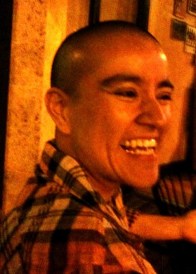
I say this because it’s the word I have needed for myself for a little while now. I have not enjoyed myself lately – neither being with myself nor being myself. As of late, I had lost touch with the fact that I am, or can be, an enjoyable person to be around. I know that sounds like a funny thing to say, and I don’t mean it in any weird or arrogant way; I just mean that yesterday morning I remembered that I can be quite fun. I can be goofy, loving, encouraging, friendly, attentive, thoughtful, strong, grounded, intellectually engaged…and, because of all this, I make pretty good company—even to myself! Continue reading “Bringing About the Revolution by Xochitl Alvizo”

Mary Daly and Simone de Beauvoir: Sister Diagnosticians by Xochitl Alvizo

Xochitl Alvizo; Photo by http://www.chrispinkham.com/

Mary Daly still causes me awe. I think about the way she was so keenly able to diagnose the Catholic Church’s collusion in creating, sustaining, the oppressive structures that directly impact women (and men, as she always affirmed). Mary Daly knew that the situation of women’s second-class status, outlined at the time most powerfully by Simone de Beauvoir in her book The Second Sex,[1] was in great part made possible by the Catholic Church. The church used Christianity to justify the creation of gender hierarchies (for it can be used otherwise), and regarded a category of humans as having greater value and worth than others by default. So much so that it comes to be understood as “god ordained” or “natural” – the right order of things.

At the time of her early writing, Mary Daly still identified as part of the Catholic Church – but she did not hesitate to call out her church. Building on the work of existentialist philosopher Simone de Beauvoir, Daly made a powerful case against the church. She described the antagonism between the Catholic Church and women as based on the fact that the Church’s teachings perpetuated a “traditional view of woman” that both “pretends to put woman on a pedestal but which in reality prevents her from genuine self-fulfillment and from active, adult-size participation in society.”[2] She drew on insights from de Beauvoir to make her case and wrote her book The Church and the Second Sex with the conviction that there were “harmful distortions of doctrine and practice” in the Catholic Church. Continue reading “Mary Daly and Simone de Beauvoir: Sister Diagnosticians by Xochitl Alvizo”

This Is What Rape Culture Looks Like: Then and Now by Carol P. Christ

I was not paying full attention when I heard a news report on CNN saying that archaeologists had uncovered an “ancient erotic fresco” in Pompeii. Hmm, I thought to myself, this story deserves further investigation.

I had heard whispers about frescoes that only men were allowed to see when I visited Pompeii as a student years ago. I now know that these were idealized pornographic wall paintings in brothels of handsome young men engaging with beautiful prostitutes in variety of sexual positions. In real life prostitutes in Pompeii were slaves who worked in appalling conditions in dark, dank, windowless cells. No doubt many of their customers were unwashed toothless dirty old men.

The fresco in the news turned out to be an image of the rape of the Spartan queen Leda by Zeus disguised as a swan; it was found in a bedroom of a house or villa in Pompeii. Continue reading “This Is What Rape Culture Looks Like: Then and Now by Carol P. Christ”

Celebrating the Winter Solstice by Barbara Ardinger

Even though Jesus was born during the reign of Augustus, first Roman emperor, the empire didn’t celebrate that birth until three centuries later when his birth date was moved to mid-winter to match the birth date of the sun god Mithra. The Romans already had a long tradition of celebrating the winter solstice. This celebration was called the Saturnalia. Here are three days in December, taken from my daybook, Pagan Every Day. (When I wrote this book in 2003, I wrote longer days. The publisher demanded that I reduce every day to 300 words. I edited them all down to 301 words.)

December 17: Saturnalia begins

Saturn, who was conflated with the Greek Titan, Cronus, was an ancient Latin agricultural god whose name may derive from satur, “stuffed,” or sator, “a sower”; in either case he stands for abundance. He was a working god who oversaw viniculture and farming, the king of Italy during the golden age. When Jupiter conquered him, he hid himself (latuit) in the region that came to be called Latium. The Romans said Saturn’s body lay beneath the Capitol in Rome. Because his reign brought prosperity to the city, the state treasury and the standards of the Roman legions were kept in his temple when the army was at home. Saturn’s statue was bound in woolen strips to keep him from leaving Rome.

Continue reading “Celebrating the Winter Solstice by Barbara Ardinger”

The Gifts of Life: Do We Remember? by Carol P. Christ

Strawberries shaped my view of a world full of gifts simply scattered at your feet. A gift comes to you through no action of your own, free, having moved toward you without your beckoning. It is not a reward, you cannot earn it, or call it to you, or even deserve it. And yet it appears.
Sweetgrass belongs to Mother Earth. Sweetgrass pickers collect properly and respectfully, for their own use and the needs of their community. They return a gift to the earth.

That is the fundamental nature of gifts: they move, and their value increases with their passage. The fields made a gift of berries to us and we made a gift of them to our father. The more something is shared, the greater its value becomes. This is hard to grasp for societies steeped in notions of private property, where others are, by definition, excluded from sharing.

The essence of a gift is that it creates a set of relationships. The currency of a gift economy is, at its root, reciprocity.

Robin Wall Kimmerer, Braiding Sweetgrass, 27-28

Thanksgiving has come and gone. We gave thanks for the food placed on the table and for the family or friends who shared it with us.

In our culture giving thanks can feel forced: I remember how my brothers and cousins and I hated to be asked to say grace at Grandma’s house. When we have not been taught, it can be difficult for us to understand that nothing is ours by right. Continue reading “The Gifts of Life: Do We Remember? by Carol P. Christ”

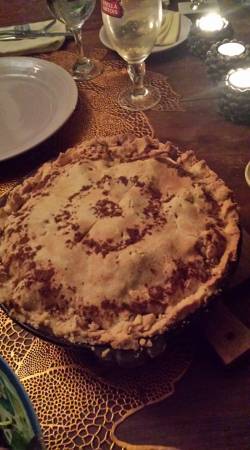
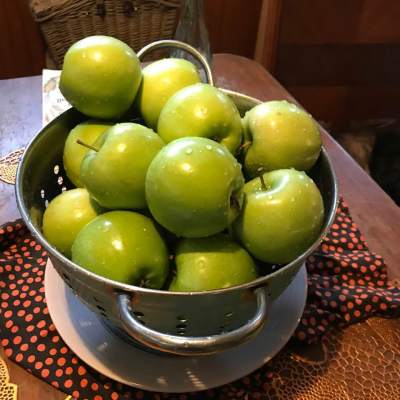
And the Pies! Ongoing Grateful Thanks for Tradition by Marie Cartier

In November 2017 I wrote about pie baking. 

And in November 2015 I also wrote about pie baking.

Photo by Lisa Hartouni

In November 2016, I was destroyed by the “election” and wrote a post in November of that year “For Strong Women” just to help many of us keep going.

Continue reading “And the Pies! Ongoing Grateful Thanks for Tradition by Marie Cartier”

My Original Uncultured Mother by Deanne Quarrie

Deanne Quarrie

In the earliest of times, I believe humans did not see themselves as separate from all that was around them.  All of life was interdependent.  I see this in my own practice today.  When we are born, we are born to a mother.  Our lives are solely dependent on her for survival.  We are birthed by her, nourished by her, protected by her, and sometimes forced out to experience on our own, by her.  She is at first, our own Original Uncultured Mother.  Once we move from her shelter, we begin to experience our world in the same way, looking not only for what nourishes, what protects and what shelters, but also for what we need to be mindful of for our own safety, those forces far out of our control.  Those forces, which were uncontrollable, the ancients held in high esteem, and honored with reverence.

Continue reading “My Original Uncultured Mother by Deanne Quarrie”

Witness by Sara Wright

Witness


It was dark

when I first heard Her

whooing overhead

bearing witness,

ushering in

the First of the

Harvest Moons.

The seasonal wheel turning towards

ripe fruit and swelling seeds.

Summer’s Bounty.

This goddess

is cloaked

in feathery mole brown splendor

a Sphinx flying

through the night.

S/he heralds the

Gift of Water

answering earnest prayers…

As ‘Changing Woman’ she brings rain

to soften cracked desert ground…


Hidden in a tangle of branches

Owl observes my approach…

When I pass

under the Cottonwood tree

she takes flight in silence.

lands on a snag –

luminous eyes glowing.

Fiery embers

sweeten the night.

Her beneficent

Presence floods me

with wonder –

Oh, I know Her well.

Love seeps through

a body punctured by holes.

Seen at last by my Beloved

I give thanks for Owl

whooo calls my name.

Continue reading “Witness by Sara Wright”