WHY I AM RUNNING WITH THE GREEN PARTY IN ANOTHER ELECTION IN GREECE by Carol P. Christ

carol christOn Sunday May 18 the first round of Municipal and Regional Elections were held in Greece, and I ran for office again. A month or so before the 2010 Regional Elections were held in under a newly reorganized electoral system, my friend Michael Bakas sent me an email saying simply: “You are running with the Green Wind in the upcoming elections.”  Michael asked me to run because we had worked together to save the wetlands in Lesbos and he had supported me as I wrote an official Complaint to the European Commission documenting the failures of national and local authorities to uphold European laws.

I did not know what I was supposed to do as a candidate on a Greek parliamentary-system list, but in the end I passed out flyers in my village and the adjoining one. My name was mentioned in a newspaper article because I was foreign-born. To everyone’s surprise, I came in 3rd of 18 candidates for the Green Wind in Lesbos, and we elected our first councilor in the regional government. After the election Michael told me that we were going together to Chios to meet with candidates to celebrate our victory. There I met an amazing group of green activists and despite being a “foreigner” was warmly received.

In 2012, I ran again in the national elections, that time passing out flyers in more than 20 villages and towns.  As I have been pretty busy campaigning, I thought I would share translations of 2 statements from me that were posted in Greek on the blog and facebook page of the Green Wind. Continue reading “WHY I AM RUNNING WITH THE GREEN PARTY IN ANOTHER ELECTION IN GREECE by Carol P. Christ”

A Love Poem for My Mother, On Earth Day by Candice Rose Valenzuela

Candice Rose Valenzuela teaches English Literature at Castlemont High School in East Oakland, California, and she has been teaching and organizing inner-city youth for the past eight years. She is currently pursuing a Masters in East-West Psychology at the California Institute for Integral Studies, and desires to bring indigenous healing methodologies into teaching and learning in the inner-city.

I wrote this poem in observance of Earth Day, April 22nd 2014, and it was inspired by the work of Audre Lorde, Starhawk and Christine Hoff Kraemer in their discussion of the powerful erotic pulse underpinning our connection with ourselves and with all beings on Earth. 

as a child, i spent a lot of time wondering what love is.
and this was because

expressions of it around me were unclear, inconsistent, fleeting or unnamed

but mostly because no one

could teach me to see

what they themselves were blind to.

this is for my Mother. To let her know I see.

Continue reading “A Love Poem for My Mother, On Earth Day by Candice Rose Valenzuela”

COMPLICATIONS AND CONFUSIONS IN DISCUSSIONS OF THE GODDESS by Carol P. Christ

carol christAlthough writing in patriarchal Greece from a patriarchal perspective, Hesiod said in his Theogony or Birth of the Gods that Gaia or Earth alone was the mother of the Mountains, Sky, and Sea. With the male Sky she gave birth to the next generation of deities known as the “Titans,” who were overthrown by Zeus. Hesiod’s was a “tale with a point of view” in which “it was necessary” for the “forces of civilization”–for him represented by warrior God and rapist Zeus–to violently overthrow and replace earlier conceptions of the origin life on earth and presumably also to overthrow and replace the people and societies that created them.

With the triumph of Christianity in the age of Constantine in the 4th century AD, Christus Victor replaced Zeus in the cities, while the religion of Mother Earth continued to be practiced in the countryside. Over time, many of the attributes of Mother Earth were assimilated into the image of Mary, and priests began to perform rituals earlier dedicated to Mother Earth, such as blessing the fields and the seeds before planting. In the Middle Ages “the Goddess” re-emerged within Western Christianity in devotion to the Virgin Mary, the female saints, and figures such as Lady Wisdom, at the same time that the history of the Goddess was being erased.

In the middle of the 19th century, in Das Mutterrecht (The Mother Right), J. J. Bachofen stunned the scholarly world with his theory that matrilineal kinship, matrilineal inheritance, and reverence for the Great Mother were to be found at the origins of civilization. Bachofen challenged the view that patriarchy and the worship of male Gods had existed “from the beginning .” Continue reading “COMPLICATIONS AND CONFUSIONS IN DISCUSSIONS OF THE GODDESS by Carol P. Christ”

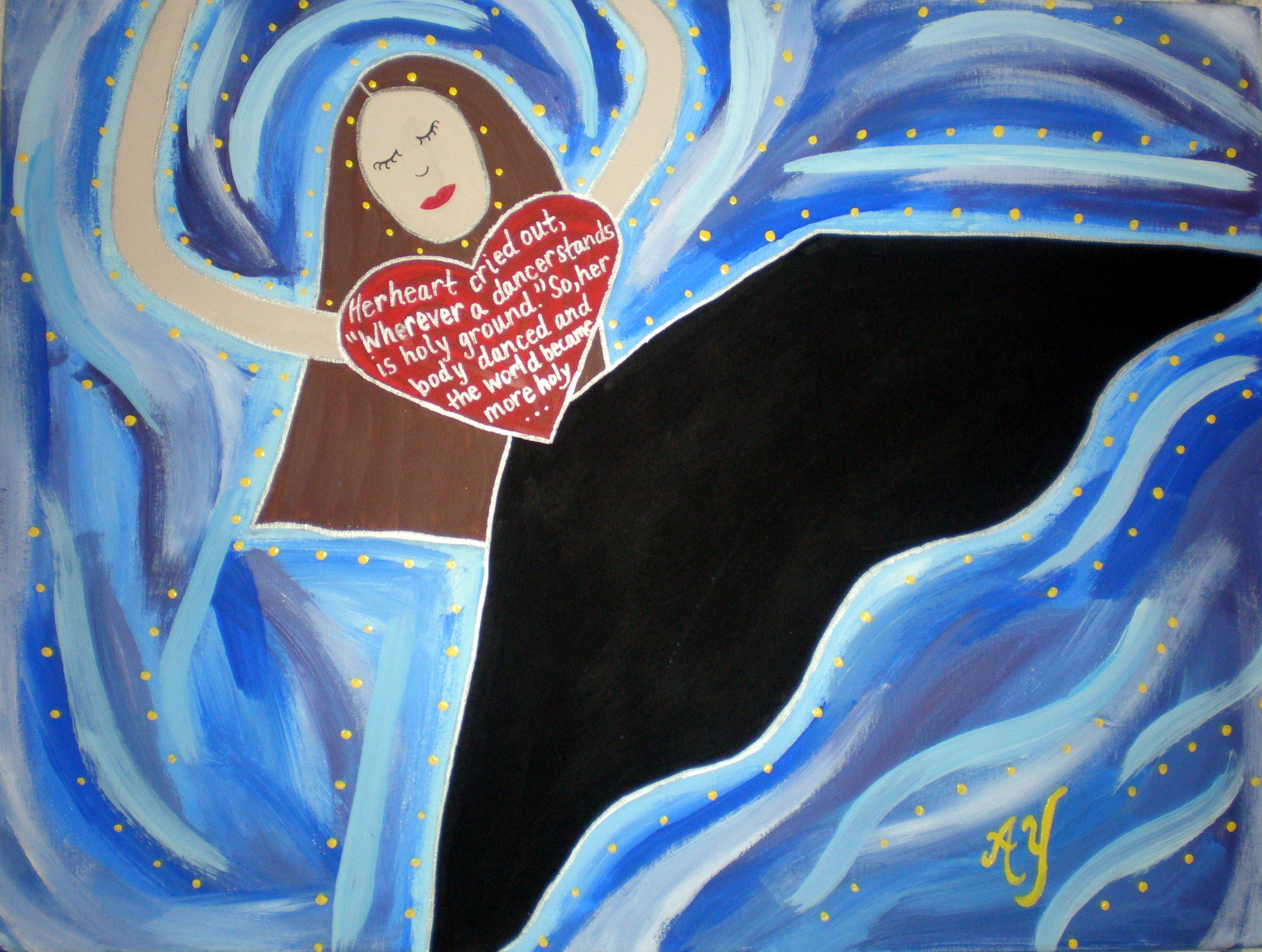
Writing Holy Women Icons by Angela Yarber

angelaFor two years I have had the great privilege of writing a monthly article about one of my Holy Women Icons with a folk feminist twist for Feminism and Religion. Virginia Woolf , the Shulamite, Mary Daly, Baby Suggs, Pachamama and Gaia, Frida Kahlo, Salome, Guadalupe and Mary, Fatima, Sojourner Truth, Saraswati, Jarena Lee, Isadora Duncan, Miriam, Lilith, Georgia O’Keeffe, Guanyin, Dorothy Day, Sappho, Jephthah’s daughter, Anna Julia Cooper, the Holy Woman Icon archetype, Maya Angelou, and many others that will follow in the months and years ahead have guided, empowered, and inspired me as an artist, activist, feminist, scholar, and preacher.

I knew from that outset that writing about them would deepen my relationship with each of these amazing women. I also knew that their power and efficacy monumentally increases when they join together. This colorful cloud of witnesses has filled myriad galleries, reminding viewers of the powerful women who have paved the way for us today. Many have left the group, finding a resting place in the homes, offices, and galleries of friends, colleagues, and strangers who have purchased or commissioned an icon along the way. And those that remain erupt the hallways of my home with a cavalcade of color, daily reminders of who I am called to be and become.

Between researching their stories, painting them, hanging them in galleries, and selling them, I knew that one day I would bind their stories together in a book. So, it is with tremendous joy that this dream has become a reality. Parson’s Porch Publishing, a non-profit publishing house whose mission is to “turn books to bread” by giving their profits to feed the poor, has lifted up the stories and images of nearly fifty of my beloved Holy Women Icons in a book. So, along with originals, commissions, and prints, Holy Women Icons are now available as a book and as individual greeting cards. It is my sincere hope that by binding the stories of these holy women together, they may provide inspiration and empowerment for all readers, binding all our diverse stories together in a collective cry for beautiful, unabashed, prophetic justice for all. Continue reading “Writing Holy Women Icons by Angela Yarber”

Songs for the Soul by Elise M. Edwards

Elise EdwardsDuring the Christian season of Lent, many Christians focus on spiritual practices or disciplines that bring them closer to God. This year, I did not really engage in this type of reflection until the end of Lent. I have been wrapping up my first year teaching college students full-time, I’ve been focused on several writing projects, and I’ve been traveling. I did not intentionally think about spiritual practices until I participated in a silent retreat before Holy Week and traveled first to spend the holiday with my family and then again to mourn and remember the life of my aunt.  I reflected on them when I most needed them.

Continue reading “Songs for the Soul by Elise M. Edwards”

RAPE IS A NATIONAL CRISIS by Carol P. Christ

carol christWhen I was in high school I heard a story about a girl who got drunk at a party after a football game and had sex with more than one of the football players. The story was told at the expense of the girl, who was categorized as “easy” and “cheap.” The idea that gang rape might have occurred was not something that either the teller or I might have been capable of considering, for these words and the reality to which they point were not part of our vocabulary.

However, the fact that I remember this story decades later suggests that even then something did not “sit right” with me about the way it was told. The image of the girl, who was cute and had curly long light brown hair still fleets through my memory.

Yesterday I read that the following universities are under investigation for possible violation of Title IX Civil Rights protections for failure to investigate charges of rape on college campuses. Continue reading “RAPE IS A NATIONAL CRISIS by Carol P. Christ”

Transforming the Church from Within or Without? by Xochitl Alvizo

“Power belongs to those who stay to write the report!” stated Jeanne Audrey Powers during her presentation at the Religion and the Feminist Movement conference at Harvard Divinity School back in 2002. Though the statement sounds a little funny, it does raise a good question about how one participates in creating change. Where does the power for change and transformation lie? Is it in the writing of reports; is it from within institutions; from without? This question seems to be of particular relevance to those of us who have feminist visions and commitments and also remain involved in Christian churches – churches of a tradition with deeply embedded patriarchal habits and practices.

Recently, this concern was raised in a class for which I am a TA. We were talking about the fact that some feminist theologians develop feminist systematic theologies; by definition a cohesive theological system done from a feminist perspective. In part, the motivation is to reclaim the systematic way of doing theology and have it stand alongside other widely recognized theologies – but do so in a feminist way. Additionally, the traditional systematic format gives it validity and may serve to temper the prevailing habit of teaching feminist theologies as so-called ‘contextual’ theologies (as if other theologies are not also contextual, but that’s a topic for another post). A critique of this development, of course, is that by writing systematic theologies feminists are simply reinforcing patriarchal forms and patterns of academentia instead of expanding and creating new ones. Continue reading “Transforming the Church from Within or Without? by Xochitl Alvizo”

THE DIVINE DRAMA AND THE UNIVERSALITY OF DEATH by Carol P. Christ

carol christIn Greece the liturgies of lent and especially of the week before Easter are known as the “divine drama,” in Greek theodrama.  This may refer to the “drama” of the capture, crucifixion, and resurrection of Jesus and to the suffering of God the Father and Mary.

However, it is important to recall that the drama in ancient Greece referred to both the tragedies and comedies, most specifically, those that were performed in the theater of Dionysios in Athens.  While we have been taught that the Greek tragedies celebrated “downfall of the hero” due to his “tragic flaw,” it is important to remember that Dionysios was the original protagonist of the Greek tragedy: it was his death and rebirth that was first celebrated.

Some have argued that the Greek tragedies should never be “read” alone, for they were always “performed” in tandem with the comedies, which were followed by the bawdy phallic humor of the satyr plays.  The tragedies end in death and irreparable loss.  But if the comedies and satyr plays are considered an integral part of the cycle, death is followed by the resurgence of life. Continue reading “THE DIVINE DRAMA AND THE UNIVERSALITY OF DEATH by Carol P. Christ”

Curiosity About Everything and the Language of the Goddess by Carol P. Christ

carol christMy recent discovery of Marija Gimbutas on Youtube rekindled my admiration for her work. In her slide-lecture “The World of the Goddess” Marija Gimbutas allows us to follow the line of reasoning she used to decipher the “language of the Goddess” in Old Europe.

Careful attention to her lecture shows that Gimbutas did not close her eyes, dream, and then attach her own ideas and intuitions to the artifacts she later discussed. Rather, she catalogued groups of images with similar symbolism and used her knowledge of nature (what does a water bird or an owl look like?) and folklore (she collected thousands of songs connected to the agricultural and life cycles in her native Lithuania in the 1930s) to unlock the meaning of ancient symbols.

I suspect that most of the critics of Gimbutas lack the knowledge she gained through her wide curiosity about life. Do other archeologists as a group know what specific species of water birds or owls really look like? Do they have the same kind of knowledge of folklore and folk traditions that Gimbutas had?   Continue reading “Curiosity About Everything and the Language of the Goddess by Carol P. Christ”

Pesach, Patriachy and the Unfinished Work of Liberation.

headshot2Pesach, or Passover, begins tomorrow at sunset. It has always seemed strange to me that a festival centered on liberation begins with a focus on housework and cleanliness to the point where one is almost a slave to the process of chametz (leavened food) removal.  Not only that, but the spiritual interpretation of what the chametz represents adds to this conundrum.

The Rabbis of the Talmud teach us that chametz represents egotism and arrogance. The divine instruction to eat only unleavened bread for the festival of Pesach is a call to cultivate humility because they believe that our inflated sense of self-worth causes harm to other human beings as we value ourselves and our lives more than them. As we remove the chametz from our homes, we are also supposed to be removing the self-centeredness, arrogance and egotism within ourselves. Cultivating humility redirects our attention to all those parts of our lives that have suffered by being too self-centered, including our relationship with the Holy One. Continue reading “Pesach, Patriachy and the Unfinished Work of Liberation.”