The Purity Complex: Are Men Really Less Affected Than Women? by Andreea Nica

Andreea Nica, pentecostalismWomen’s bodies continue to receive an inexhaustible amount of attention. As a society, we have glorified, scrutinized, degraded, hypersexualized, underrepresented, and misunderstood the female body. Purity culture has orchestrated a movement around the management, perception, and regulation of women’s bodies. As a former Pentecostalist, I grew up knowing there was more focus on my body versus those of my  brothers in Christ. There was a bodily divergence between men and women that I did not fully comprehend but felt obligated to adhere to; the ideological basis of this difference was filled with much ambiguity.

Each time the church organized a sexual purity event and/or discussion, boys and girls were unfailingly segregated. I was always so curious about what was discussed in the boy’s group so I would ask my brother, Christian boyfriend, and male friends at the church to fill me in on the gossip. In my teens, I didn’t know how to perceive the information relayed to me. Looking back now, I am surprised at the discourse around purity culture and masculinity in the church. During my earlier years at college, I convened with the male pastoral leadership, and they confirmed the following main themes taught to men during sexual purity discussions. Continue reading “The Purity Complex: Are Men Really Less Affected Than Women? by Andreea Nica”

Cultural conditions and Spiritual Subtleties by Oxana Poberejnaia

oxanaI am very grateful to Carol P. Christ and other contributors for their insightful comments and thoughtful questions to my post “Blindness of the Gals”. As I promised to Carol, here is my post that starts answering some of the issues raised in the comments.

I cannot say that it was giving birth to my daughter that first made me question my blindness to patriarchy in religion and culture. Rather, it was a gradual process of educating myself by reading works by feminist thinkers, and learning about the brave women and men who have been fighting and are still fighting for women’s rights.

Continue reading “Cultural conditions and Spiritual Subtleties by Oxana Poberejnaia”

On Reading, Not Reading, and Disagreeing by Linn Marie Tonstad

Linn Marie TonstadThe theology blogosphere in all its glory has been alive in recent days with furor sparked by a blog post from Janice Rees at Women In Theology, where she discusses not reading Karl Barth, the heavyweight German 20th-century Protestant theologian, as an act of resistance against his dominance in the theological academy and his status as a litmus test for serious scholarship. Reminding myself repeatedly of the great xkcd comic, I’ve resisted my urge to comment on this and a number of other recent debates. (See here for a list of links if you wish to catch up on the discussion, however.) So this is not a post on whether to read Karl Barth.* Rather, the debate made me take a look at some of my own reading practices, and the visions of theological discussion that they encode. It also brought me back to the question of feminist disagreement, which continues to lurk in the back of my mind as I pursue disagreements with some prominent feminist theologians in my current book project.

I’ve written here before about reading authors that I disagree with, and indeed working on theologians I think are wrong about certain issues. On the simplest level, as a feminist and queer theologian, many of the theologians I work on would have questioned or outright resisted my participation in the discipline to begin with – although we cannot always know whether and how they would have done so today (since many of them are dead – yes, the dreaded dead white European males). But I often – not always – find projects that I sincerely disagree with utterly fascinating. From what perspective does the system being developed in such a project make sense? Where would one have to stand to see what that author sees? What do I come to understand about my current context, or the author’s context, from the perspective of the debates and decisions that the author finds pressing? One fairly trivial example: any interest I might once have had in historical Jesus debates was settled forever by reading Albert Schweitzer as an undergraduate. I simply do not find such debates compelling in themselves. (That does not mean I think they are valueless, of course!) But reading theologians who were engaged in such debates teaches me a great deal about how the commonsense assumptions many of us today operate with came to be. And seeing how such debates accompany disagreement over right social relations, over the nature of transmission of Christian traditions, and over what counts as scholarship in theology and religious studies is simply fascinating. Continue reading “On Reading, Not Reading, and Disagreeing by Linn Marie Tonstad”

The Difference a Feminist Makes by Elise M. Edwards

Elise EdwardsOf the many reasons I am grateful for feminismandreligion.com, I have to say that I am most grateful for the time it requires of me to reflect about feminism’s impact in my life, faith, and work.  I decided it was time to reflect on this question: What difference does feminism make for the way I structure and approach my classes?

I recently started a new position as a full-time lecturer in the Department of Religion at Baylor University.  Earlier this week, I attended a gathering for the department, where I was introduced, along with a few others, as new faculty.  At the end of the evening, the wife of a retired male professor introduced herself to me and remarked about how happy she was to see more women in the department. (Four full-time faculty members were hired this year, and three of us are women.)  She had been looking forward to this kind of change for quite a while.  I was appreciative of her remarks, just as I have been generally pleased with the warm reception I have received around the University.

Her excitement about the increase in the number of women faculty provoked me to reflect on what I add to my department, particularly for my undergraduate students.  I have thought before about how, from a purely representative standpoint, I bring something different to the faculty.  I have thought about how my students may not have previously had a professor–especially a religion professor–who looks like me.  Even if they had, I’ve had different life experiences than many of my colleagues, and that this bears on my approach to theology and ethics.  Therefore, the research I do and share is distinctive in its approach.  Yet, I am slightly embarrassed to admit that I have not given much thought about how my being a black feminist woman might impact my students.  I am tempted to blame it on the fact that I have just been trying to keep my head above water in a new position.  Of the many reasons I am grateful for feminismandreligion.com, I have to say that I am most grateful for the time it requires of me to reflect about feminism’s impact in my life, faith, and work.  So I decided to reflect on this question: What difference does feminism make for the way I structure and approach my classes? Continue reading “The Difference a Feminist Makes by Elise M. Edwards”

Two Reflections for the New Year: 5774 By Ivy Helman

ivyIn June, my friend, Shifra, and I became Co-Chairs of the Ritual Committee at our shul. During the past few weeks, we have occasionally turned to one another and said, “I can’t wait for the High Holy Days to be over!”  Then, we have paused realizing what we have said and have sworn that we didn’t mean it.  We don’t.  Truly, we don’t.  But we are overwhelmed by the sheer amount of detail required for the days to go well.  There are babysitters to find, flowers to pick-up and drop off and pick-up again, kiddushim to organize, chairs to arrange, musicians to contact, mahzorim to bring up from the basement, bulletins and programs to coordinate, volunteers to recruit, parking to find for Tashlich, carpets to be cleaned, pianos to be tuned and so much more.  Thank G-d there is a committee and a community to help us, but we still have much of the organizing and synchronizing to do.  It’s a lot for two people who also have jobs, family and other responsibilities to fit in as well.

What concerns me more than anything in all of this organizing and busyness is that I won’t be personally prepared for the High Holy Days.  These days require personal, spiritual and relational work which all takes time.  I can’t show up on Yom Kippur morning and expect to have an amazingly deep spiritual experience if I have done nothing to prepare myself for it.  To me, this would be the irony of all ironies: the one who has spent the past three months making sure the shul is ready isn’t prepared herself.  Since the last week of August, I have been setting aside time away from the details to make sure that doesn’t happen.  Within the personal work I’ve done, I have found two inspirational and meaningful reflections which I’d like to share with you. Continue reading “Two Reflections for the New Year: 5774 By Ivy Helman”

Interview an Atheist at Church Day by Kile Jones

Kile Jones, atheistAs some of you may know, I run a project called “Interview an Atheist at Church Day.”  This project aims at bettering understanding and furthering dialogue between atheists and Church-going religious persons.  So far we have had over a dozen interviews take place, and we have more in the making.  If you are a pastor interested in interviewing an atheist during service, or an atheist willing to be interviewed, please contact us here.

Our most popular interview so far is with Neil Carter (atheist) at a church in Mississippi.  You can read up on it here and watch it below.  At Feminism and Religion, I have made it my task to highlight some strong atheist women, and discuss some of the ways in which they can work together with religious women (sometimes this can cause a little friction).  Gretta Vosper, a pastor in Canada, is just such a woman.  She was interviewed as an atheist IN HER OWN CHURCH!  If you are not familiar with her work, I highly recommend it.  Another strong atheist woman who has participated in this project is Sarah Kaiser.  She works with the Center for Inquiry promoting LGBTQ rights. Continue reading “Interview an Atheist at Church Day by Kile Jones”

The Institutional Silencing of Women by Natalie Weaver

Natalie Weaver

On July 26, 2013, I had the opportunity to hear Rev. Helmut Schüller speak at the City Club of Cleveland’s Friday Forum.  He spoke to a convened audience of around 150 people, in addition to the much greater broadcast audience, and he responded to questions that ranged from wholly supportive, to sincerely questioning, to highly critical.  I myself sat with a group of vowed religious women from Pittsburgh who seemed enthusiastic about Rev. Schüller’s Austrian Priests’ Initiative, while behind me sat a table of obvious, vocal critics.

Rev. Schüller’s initiative, now represented by over 400 priests, began in 2006 as an effort to mobilize priests to lead the way for change in the Catholic Church in at least four crucial areas: women’s ordination; married priesthood; same-sex marriages; and lay participatory voting in the election of their bishops.  Of course, Catholics have been having these conversations long before the Priests’ Initiative.  What makes Father Schüller’s work different is that it is an “insider job.”  He argued that the laity have done their part, and now it is time for the clergy to speak, even at some personal and professional risk to themselves. Continue reading “The Institutional Silencing of Women by Natalie Weaver”

What I’m Wearing to the Pool and What it Means, by Sara Frykenberg

Sara FrykenbergRecently a FAR colleague sent us writers an article entitled, “Toward a New Understanding of Modesty,” and asked if any of us would like to comment on it.  I dove at the chance, pun intended.  Not only did the article address the politics of swimwear (a kind of clothing I spent nearly a third of my life wearing everyday, swimming competitively for eight years), it also discussed the swimsuit designs of Jessica Rey – a former Power Ranger, the white-suited one to be specific.

The article’s author, Katelyn Beaty, explains that Rey believes, “that the now-ubiquitous bikini hurts women” because it encourages men to see women as objects to be used.  Beaty states, “Rey has a mission: to get as many women as possible in one-piece swimsuits.”  This mission immediately perked my attention.  As a Power Ranger, Alyssa  (Rey) is all too familiar with the utility of a shining, stretchy body suit.  Armored head to toe in white, pink and gold lycra and spandex, sporting a skirt over her leggings,[1] Alyssa defeats many monsters in the Power Ranger universe.

Sourced from: http://www.1up.com/do/blogEntry?bId=8982878
Source

But fantasy aside, the utilitarian nature of swimwear is often overlooked in deference to “sexiness” and fashion.  Bikinis are featured in most fashion magazines as the standard for bathing beauty, as is the ‘ability’ (or supposed ‘right kind of body’) to wear a bikini, aka the elusive “bikini body.”

Continue reading “What I’m Wearing to the Pool and What it Means, by Sara Frykenberg”

The Hot Seat by John Erickson

Being a man in feminism isn’t easy and that’s how it is supposed to be.

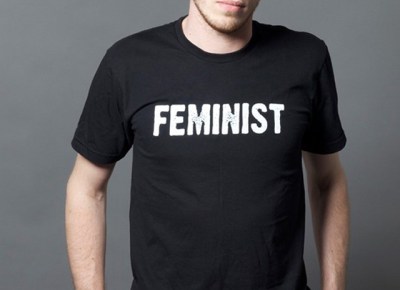
men_feminist_mainI’ve been thinking a lot about what it means to be a male feminist lately.  As the only man to be a permanent blogger on this very site until my colleague and friend Kile Jones came on board, I took my role, as a man in a traditional feminist (online) space very seriously.  Although the ongoing struggle to be a male feminist is one continually wrought with dialogues about power and positionality (amongst a host of many other topics), I am often conflicted when I see male feminists take advantage and destroy the hard work that many, specifically on this site and beyond, worked hard to build and defend.

Not wanting to reopen old wounds or start new online battles, men have been involved in feminism for quite some time.  From James Mott chairing the first women’s rights convention, to radical feminist Andrea Dworkin’s life partner John Stoltenberg, to Michael Kimmel and Michael Kaufman’s life long work to legitimize not only men in feminism but also what it means to be a man who works for gender equality, being a man in feminism isn’t easy and that’s how it is supposed to be. Continue reading “The Hot Seat by John Erickson”

Feminism vs. Humanism by Gina Messina

Gina Messina-Dysert profileRecently Susan Sarandon was asked if she is a feminist and her response left many asking if perhaps we are moving towards a post-feminist world. Of course, the very fact that Sarandon was asked if she is a feminist well demonstrates that gender politics continue (certainly, men are not asked such questions).

According to Sarandon, “I think of myself as a humanist because I think it’s less alienating to people who think of feminism as being a load of strident bitches.”  She went on to explain that “feminist” is an “old-fashioned word” and is actually used to minimize women and girls.

Sarandon’s comments left many questioning what the difference is between humanism and feminism, particularly when a definition of feminism calls for the honoring of the full humanity of all women and all men, as it does here on Feminism and Religion.  Why not move to a humanist identification and leave behind the baggage of feminism?  Continue reading “Feminism vs. Humanism by Gina Messina”