Redefining Sex and Intimacy in the New World We Are Making by Caryn MacGrandle

TRIGGER WARNING: Post divorce, I find myself redefining my relationships and want to share some discoveries I have made about sex and intimacy, and how that relates to my spirituality and identity as a feminist. I freely admit they might be a bit shocking.

Post divorce, I have had three ‘relationships’. Okay who am I kidding, I’ve had sex with three men.  I suppose you could call them ‘relationships’. We talked. We texted.  We fucked.

All three were painful in their own way. All three were pleasurable in their own way. 

I’m redefining this area of my life just like I am redefining all the areas  in my life.  ‘Cernunnos’ points the way. This is one of my favorite cards in my Druid Craft Tarot deck, and I pull it often. 

‘Cernunnos’ is the Lord of the Animals. “This card represents the raw power of the instincts and of Nature, and also the dangers of delusion and excess, but offers the potential for achieving both freedom and abundance.”

Like so much else in life, it’s all about the balance.

Continue reading “Redefining Sex and Intimacy in the New World We Are Making by Caryn MacGrandle”

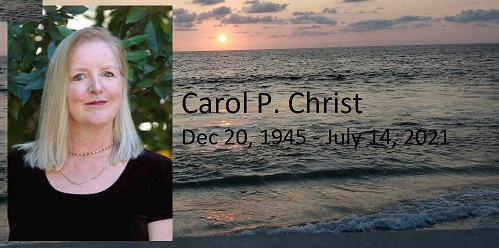
The Legacy of Carol P. Christ: Was Ariadne the Most Graceful Bull-leaper of All? Deconstructing and Re-visioning Greek Mythology

This was originally posted on March 3, 2014

Sometimes we think of Greek myth as a pre-patriarchal or less patriarchal alternative to the stories of the Bible. After all, Goddesses appear in Greek myths while they are nearly absent from the Bible. Right?

So far so good, but when we look more closely we can see that Greek myth enshrines patriarchal ideology just as surely as the Bible does. We are so dazzled by the stories told by the Greeks that we designate them “the origin” of culture. We also have been taught that Greek myths contain “eternal archetypes” of the psyche. I hope the brief “deconstruction” of the myth of Ariadne which follows will begin to “deconstruct” these views as well.

bull leaping ring before 2000 bc phourni

Ariadne is a pre-Greek word. The “ne” ending is not found in Greek. As the name is attributed to a princess in Greek myth, we might speculate that Ariadne could have been one of the names of the Goddess in ancient Crete. But in Greek myth Ariadne is cast in a drama in which she is a decidedly unattractive heroine.

Continue reading “The Legacy of Carol P. Christ: Was Ariadne the Most Graceful Bull-leaper of All? Deconstructing and Re-visioning Greek Mythology”

What Would a “Good Christian Woman” Do? by Liz Cooledge Jenkins

Early morning lap swim at the local pool is generally a peaceful space for me. It’s usually pretty uneventful. I try to go three times a week; I don’t always feel like going, but I always feel better after I do. The other day, though, something happened that upset my equilibrium and got me thinking.

When I showed up at the pool, ready to mind my own business and get a good workout in, I was happy to see three empty lanes. I don’t mind splitting a lane when needed, but it is a nice little luxury to have a lane all to myself. I chose one of the empty lanes, and in the next few minutes, two other swimmers arrived and filled in the other two. I did a long, leisurely warm-up and then stopped at the wall to find that another swimmer had joined me in my lane.

As he swam back and forth on the right side of the lane and I did the same on the left, I realized that he was taking up more than his fair share of the lane. I felt a little annoyed and disrespected. But it didn’t seem like a big deal. I started on my next set.

Continue reading “What Would a “Good Christian Woman” Do? by Liz Cooledge Jenkins”

The Legacy of Carol P. Christ: What if Divine Feminine and Divine Masculine Are Not Oppositional Categories?

Moderator’s Note: The blog was originally posted May 18, 2015

A friend who is a spiritual teacher speaks often “bringing back the values associated with the Divine Feminine.” For her this has to do with helping women to understand the beauty of our bodies and the importance of ways of being such as giving and caring for others that have been associated with the undervalued so-called “feminine” side of the masculine-feminine polarity. Though she also speaks about the Goddess, I think she prefers the term “the Divine Feminine” because of the implication that men too have their “Divine Masculine.”

This friend has a wonderful husband who is a teacher in his own right and who often ends up spending a lot of his time among powerful women who enjoy talking about the Goddess. In these conversations he sometimes speaks of the need for men to “recover the Divine Masculine” if they are to become whole.

Continue reading “The Legacy of Carol P. Christ: What if Divine Feminine and Divine Masculine Are Not Oppositional Categories?”

From Footbinding to Abortion and Beyond – This Has to Stop! by Janet Maika’i Rudolph

Children’s Museum of Indianapolis

My husband, Marty, is a retired podiatrist.  He worked in pockets of New York City that were poor and largely immigrant. When he first started his practice, he treated women from China whose feet had been bound. Despite being officially outlawed 1912, footbinding was still being practiced well into modern times. He saw these patients in the 1970s and 80s.

For those who don’t know what it is, young girls, as young as 3-5 would have the bones in their feet broken and then the feet bound with cloth strips. Every few years, the feet would be broken again until the desired result was created. To create that affect, the toes would be flattened against the bottom of the foot and arch would be so broken and damaged that the heel would curl back to the front of the foot. At each of the breakings the girl would need to learn to walk again.  One can only imagine that pain of walking on foot bones that had been repeatedly broken. And here is an especially chilling part. The mothers would do it to their own daughters. I won’t go into further gruesome details because they can be easily looked up on the internet.  It left the girls crippled for life.

Continue reading “From Footbinding to Abortion and Beyond – This Has to Stop! by Janet Maika’i Rudolph”

All these sexist movies turn me red by Trelawney Grenfell-Muir

*Warning* – contains spoilers about the movie “Turning Red” as well as “Brave,” “inside Out,” and “Encanto.”

Imagine something with me for a moment. Imagine there is a movie about an adolescent boy who discovers that he has magic shapeshifting powers to become a fierce, powerful animal. The males in his family have had this power for generations because a deity granted the power to a male ancestor in order to help him protect his family from enemy invaders. The boy has to learn to control the amazing power and potential of this fierce warrior alter-ego. What’s the next part of the story?

Would he save his family from an evil ruler trying to harm them?

Would he save his town from an earthquake that almost destroys a stadium full of people?

Would he save his city from an evil power that wants to enslave the population?

Or… would he get in an argument with his dad about going out with his friends and end up doing intense emotional labor to heal intergenerational dysfunction in his wider family?

Do you think boys and men would ever, in a million years tolerate that last option? This boy superhero uses his superpower to… do emotional labor for his family. The end.

Continue reading “All these sexist movies turn me red by Trelawney Grenfell-Muir”

The Legacy of Carol P. Christ: Sappho Chose Love Not War, What Will You Choose?

This was originally posted on November 12, 2012

We have been taught to speak of war and the heroes of war in hushed tones. We have been told that evil Helen’s choice was the cause of the Trojan war.  2600 years ago Sappho, known as the greatest lyric poet of ancient Greece, spoke truth to power and unmasked the lies told at the beginning of western tradition.

*

In a poem addressed to Anactoria, Sappho writes:

            Some say a cavalry corps
            some say infantry, some, again,
            will maintain that the swift oars
            of our fleet are the finest
            sight on dark earth …

Here, Sappho invokes the heroic tradition celebrated in the epic poems of Homer that shaped the values of ancient Greek culture and all the cultures that followed it, including our own.  This tradition tells us that to serve in a war and to be remembered as a hero is the highest goal to which a man can aspire.  Sappho does not agree:

             …but I say
             that whatever one loves, is.

Continue reading “The Legacy of Carol P. Christ: Sappho Chose Love Not War, What Will You Choose?”

Moses and the Rambo Problem by Janet Maika’i Rudolph

Moses is an interesting character is in the pantheon of religious leaders. He is such a major personage, considered the founder of Judaism and yet there are no extra-biblical accounts of his life and his deeds. He only exists in the bible. You’d have thought that such a major event as leading a whole class of people away from Egyptian slavers, would have shown up on the radar of other written or mythical accounts from the time. Nothing!

Even his name is interesting. When the Egyptian princess gathered Moses out of the waters she said:

She named him Moses, explaining,

“I drew him out of the water.”

Exodus 2:10

This is one meaning of his name. But there are others. In Egypt, the land where he was born and raised, the M-SH (variations: m-s or m-ss) root simply means “son.” Or it can mean “child” in a non-patriarchal sense. We see this in other Egyptian names Ramses is the child of the sun god Ra. Tutmose is the child of Tut. 

Continue reading “Moses and the Rambo Problem by Janet Maika’i Rudolph”

From the Archives: Uppity Women Unite by Barbara Ardinger

This was originally posted on August 2, 2014

I have a poster on my wall: UPPITY WOMEN UNITE. In big, red, capital letters. I don’t remember where I got this poster, but I know I’ve had it since the late 70s or early 80s. I’m sure it comes from the raggedy late 60s, when second-wave feminism got up a head of steam and uppity women began getting our attention. That’s when Betty Friedan said being a proper 50s housewife was like having a mental illness. It’s when Gloria Steinem founded Ms. Magazine, which (oh, horrors!) did not give us recipes or home-making tips and did not tell us how to dress to lure our men into bed. It’s when Mary Daly started giving us a whole new, original take on the English language. Ahhh, yes, those were the good ol’ days. And the bad ol’ days, too, when the Equal Rights Amendment was not ratified.

“Uppity” can be a troublesome word. In the olden days, if someone called you uppity, it means you were inferior to them and weren’t staying in what they thought was your proper place. If you were a black person, for example, and if you didn’t step off the sidewalk when white men were coming, you were uppity. If you were a woman who wanted equal pay for doing the same work a man did, you were uppity. Those women in the 1980 movie, 9 to 5, were majorly uppity. And they won the battle.

Continue reading “From the Archives: Uppity Women Unite by Barbara Ardinger”

From the Archives: I Believe Anita! by Marie Cartier

This was originally posted on April 7, 2014

During the past week I attended a Los Angeles premiere of a new documentary Anita: Speaking Truth to Power (Dir: Freida Lee Mock USA, 2013). The screening was sold out and I had great seats saved for me– sitting with a friend who works at Samuel Goldwyn, the distributor of this fine film.

In 1991, Anita Hill provided testimony she hoped would serve to dissemble the nomination of Clarence Thomas as a Supreme Court justice. Although the vote would end up being close (52-48) Hill’s testimony did not serve to dissuade the decision — Clarence Thomas’ nomination was confirmed and he was appointed to a life term on the Supreme Court four days after Hill’s testimony concluded. Here is an outline of the debate.

anita-580x857

I remember watching the hearings in 1991 at a friend’s house in Sacramento, CA where I was couch-surfing with another friend while we were in Sacramento from Los Angeles to protest for gay rights—to speak our truth to power. I remember being amazed that she was doing this—and that it was being televised. We were glued to the set before we went off to the protest we were attending.

Continue reading “From the Archives: I Believe Anita! by Marie Cartier”