THREE POEMS OF LIFE by Janet Maika’i Rudolph

As Above So Below

Yes, I believe we are made in god’s image.

If god is the wild, passionate, loud, sexual, sizzling, dancing fires of creation.

And should I ever forget my fiery, heavenly vision, the sun comes out every day to remind me.


And I ask myself, which is more miraculous? Our local star feeding earthly life?

Or me, reflecting the sun, feeling the passion, sizzling in response?

Jacob Dreams and So Do We

(inspired by Genesis 28:12)

As darkness slips into light,

dawn,

with its unique melody,

grows brighter.

As light slips into darkness,

dusk,

with its mysterious possibilities,

settles softly upon the land.


Creation is oneness, but we need duality to experience sex, symphonies, hot fudge sundaes.

Creation is pure love, but it is to the passions of the human heart that we owe our earthwalk


Dawn and dusk hold open the thresholds of mystery inviting our human hearts to experience . . .

The sacred dance where one becomes two becomes three.

The sacred song where three becomes two becomes one.
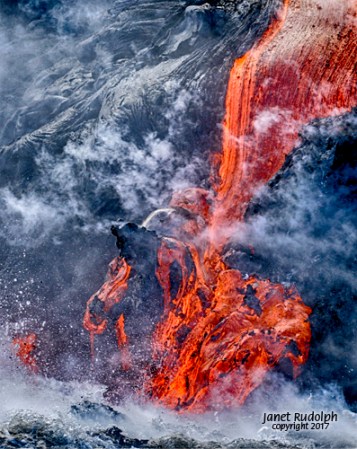
 

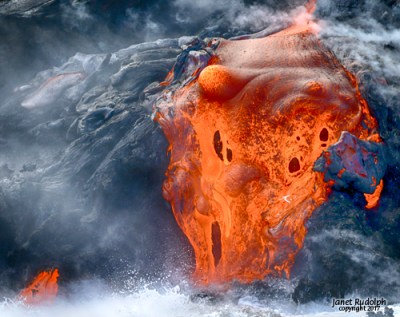
Pele’s Birth Dance

Twinkling stars ignite waves of fire that explode into a tumultuous, joyful noise:

“EH YEH, EH YEH, EH YEH.”


And Mother Earth awakens.


Matter bathed in Pele’s cauldron flares up, erupting into waves of baby earth while roaring:

“EH YEH, I AM, EH YEH.”


As seeds rise from great watery oceans of fire, my heart swells, breathing air into newly forged matter and causing my breath to become song:

“I AM, EH YEH, I AM.”


Fire,

that reflects flame-drenched stars,

that reflects Pele’s dance,

that reflects the passionate seed,

echoes within my belly until I glow with waves of love which burst forth to sing:

“I AM, I AM, I AM.”


And then . . .

Riding a watery wave that gushes forth new life, my newborn erupts from my body, then twinkles, then cries tumultuous joyful noise:

“EH YEH, EH YEH, WAHHHHhhhhhh.”

(Note: “Eh yeh” is God’s name in phonetic Hebrew as given to Moses in Genesis 3:14. “I am” is its traditional translation into English)
 

Janet Rudolph has written three books on the subject of ancient Biblical Teachings.  One Gods: The Mystic Pagan’s Guide to the Bible, When Eve Was a Goddess: A Shamanic Look at the Bible, and the just recently released book, When Moses Was a Shaman. For more information visit her website at /www.mysticpagan.com/
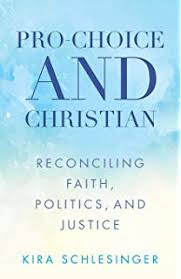
 

Pro-Choice and Christian: Reconciling Faith, Politics, and Justice BOOK REVIEW by Katie M. Deaver

In 2015 Kira Schlesinger wrote piece for Ministry Matters about how her own pro-choice stance on abortion had become more complicated the more she explored the issue of abortion. The article was widely read and shared, as well as hotly debated by many. You can read this article and the many comments here. Out of the response to this article grew Schlesinger’s Pro-Choice and Christian: Reconciling Faith, Politics, and Justice.

The book does a great job of walking the fine line of being both academically engaging and an easy enough read to engage a book or Bible study group as well. Schlesinger uses the first couple of chapters to dig into the history of abortion, listing recorded examples of the process as early as 1300 BCE. From there she briefly walks the reader through the roughly 100 years (Comstock Act in 1873 until Roe v. Wade in 1973) during which abortion was illegal in the United States. Finally, she wraps up this beginning historical section with details about the generations after Roe v. Wade up to our current reality.

Continue reading “Pro-Choice and Christian: Reconciling Faith, Politics, and Justice BOOK REVIEW by Katie M. Deaver”

A Blinding Light? by Sara Wright

Nature is a Living Being. Animals and plants have souls, and a spirit. Each species is unique, and yet we are all interconnected, human and non – human species alike. This is more than a both and perspective; its multi-dimensional.

Many books are written about using nature to heal humanity of its ills. ‘Recreate’. Climbing a mountain, or taking a walk are common examples of using nature to help ourselves, but how many of us are asking the question of how we can give back?

This is a question I was obsessed with for about thirty years and may be the reason I gained entrance into this seemingly secret world that we call Nature.* When I experienced unconditional love from both animals and plants I needed to reciprocate in kind. This idea of reciprocity between humans and the rest of Nature is probably similar to what Indigenous peoples experienced because they loved (or feared) and learned directly from animals, plants and trees. They respected animals, for example, for their unique qualities. Indigenous people never psychologized Nature the way westerners routinely do.

I rarely read books about Nature anymore because I am so troubled by this psychologizing. From my point of view psycho-babble is just another way of dismissing the reality of Nature as a living feeling, sensing, sentient Being.

Continue reading “A Blinding Light? by Sara Wright”

Harriet Boyd Hawes, Marija Gimbutas, and the Religion of Ancient Crete by Carol P. Christ

One of the projects I am working on these days is an essay on the religion of ancient Crete for a series of books on various aspects of the Minoan site of Gournia.
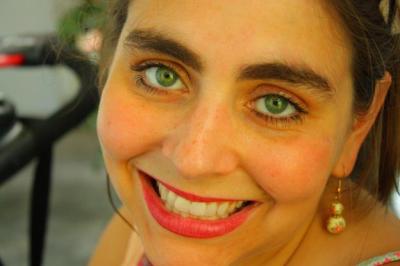
Harriet Boyd excavated the Minoan town of Gournia in 1901-1904. She was one of the first woman archaeologists and the first woman to run her own excavation in Crete, to be followed by Edith H. Hall whom she trained. She was also the first to excavate a Minoan town as opposed to a “palace,” providing the first evidence of daily life in Minoan Crete. Harriet Boyd might have continued to excavate in Crete, but her marriage in 1906, followed by the birth of her son soon thereafter, caused her to lose interest in a career as an excavator. Nonetheless, she published the results of her excavations in her book Gournia in 1908 and taught at Wellesley College until she reached retirement age.* Continue reading “Harriet Boyd Hawes, Marija Gimbutas, and the Religion of Ancient Crete by Carol P. Christ”

I’m That Trump Voter You Hate by Trelawney Grenfell-Muir

There are people in my family who believe Christianity to be so inherently oppressive and harmful, that anyone who identifies as Christian is culpable for all of the harm done by all imperial colonization by Christian empires and nations, all harm done to Native Americans, to LGBTQ people, most slavery, racism, genocide, ecocide, and basically almost every problem the world has had for 2000 years.

Theirs is not an unusual view. I encounter this view regularly here in the Northeast US, though most people assign the blame to religion in general. For parts of my family, Christianity is the true evil because it was so popular, and thus the religion most commonly tied to violent and oppressive political leaders and structures.

I also encounter this attitude from feminists, quite frequently. According to many feminists, I am everything that is anti-feminist and misogynist… precisely, solely because I am Christian.

Continue reading “I’m That Trump Voter You Hate by Trelawney Grenfell-Muir”

The Truth About Humans by Natalie Weaver

I have greatly enjoyed an odd little book I read over the summer.  It is Lucy Cooke’s The Truth About Animals (Basic Books, 2018). Cooke takes us through a journey of animal behavior, chronicling the curious narratives that naturalists, philosophers, theologians, and other high-thinking professionals impose on animals to render their behaviors meaningful, moral, and relevant.  Cooke shows us how tempting it has been historically for people to seek and discover confirmation of human values in all those other pairs so happily coupled on Noah’s Ark.

It has often been an important tool for feminists, as with other sets of thinkers, to make these connections as well.  And, as one familiar with the classical charges that women are more inherently corporeal than their spiritual-intellectual male counterparts, and that therefore women are more animal than the more accurately “human” form that their male counterparts represent, I understand the feminist investment in nature.  I appreciate that it involves a sort of ownership and redefinition of the slur; an acceptance of space and place as limited and essentially animal; an awareness of environmental sustainability; a deep sense of connection to the continuum of creaturely being that is the giant ecology of our planet.

Continue reading “The Truth About Humans by Natalie Weaver”

The Swan-Bone Flute by Rachel O’Leary: Reviewed by Max Dashu

A girl leaps out of her tree perch to warn a pregnant doe that a hunter is drawing his bow against her. For this act of defending the mother deer, who should never be hunted, her uncle beats her. And so this novel drops us into the world of East Anglia in the year 598, in the wake of the Saxon invasions and enslavement of some of the British population. In this world, the old folkmoot councils are threatened by the rising power of the thanes, a hierarchy of lords under the new Saxon kings. And these lords are eroding women’s power at a rapid pace. Continue reading “The Swan-Bone Flute by Rachel O’Leary: Reviewed by Max Dashu”

Finding Missing Pieces of My Ancestral Story: Scotland and Ireland by Carol P. Christ

When I began researching years ago, I knew the names of my grandparents and what country in Europe their ancestors were from, but not much more. I have now traced most of my ancestors back to the Old Country, some to the 1600s. But there remained four ancestors with unknown places of origin among my sixteen 2x great-grandparents. A week or so ago, I decided to go back to the online resources, focusing on James Inglis, the Scottish seaman, and his Irish wife, Anne Corliss. This time I was more experienced, and I was determined to find the records.
Several sources confirmed that James’ parents were James and Isabella. Unfortunately, more than one James Inglis was born about 1838 to parents with these names. I had already ruled these Jameses out, because they were living in Scotland during the 1861 census, while my ancestor was by that time married and living in New York City. Scottish birth, marriage, and death records are incomplete before 1855 when civil registration was required; neither the marriage of James’ parents, nor his birth record were online. Continue reading “Finding Missing Pieces of My Ancestral Story: Scotland and Ireland by Carol P. Christ”

Insect Conversations by Barbara Ardinger

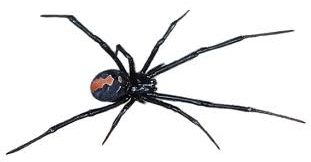
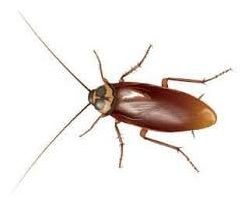
“She’s doing it again,” Mrs. Cockroach is saying to her friend Old Mrs. Spider. “You know? The giant? She’s been blowing on me and telling me to live somewhere else. Like, I’d leave a good home?”


Old Mrs. Spider looks up from her weaving. “Yes,” she says in a weary voice. “But you know she’s not a giant. She’s just a normal human being, well, overweight, as I understand humans measure their bodies. And if she’s going to blow on us and ask us to live somewhere else, well…..I think she needs to brush her teeth.”

Mrs. Cockroach chuckles. “Indeed. We insects, maybe with the exceptions of fleas and termites, we don’t have bad breath. Blood-breath and wood-breath are sour! I was sitting on the wall in her bathroom, keeping an eye on things and telling the termites to get away from the window, and she just walks up. Doesn’t she know we insects and arachnids are protecting her house?”

Continue reading “Insect Conversations by Barbara Ardinger”

Siddur – An Amendment by Ashley Roque

July 24, 2018

“Blessed are you O God, King of the Universe,
Who has not made me a Gentile
Who has not made me a slave
Who has not made me a woman”

Blessed are you Yahweh Elohim
Jehovah Jireh
Alpha and Omega
The Author and Finisher of my feeble faith
Who makes faith and hope temporary
And love last forever 

But I am a woman
In your eyes and in mine and in the monthly passage
Of my bloody womb
It all gives me away Continue reading “Siddur – An Amendment by Ashley Roque”