With this season of the festivals of light upon us (Hanukkah, Christmas, Solstice, Kwanzaa), I wanted to focus on the more joyful aspects of our lives. For that, I have been diving into passages about joy and singing in the bible.
Sometimes when I write these posts, they take me in directions I never thought to go. This post is one of them. The surprise direction I found is in the Psalm below:
Sing unto him, sing psalms unto him: talk ye of all his wondrous works. Glory ye in his holy name: let the heart of them rejoice that seek the LORD. Psalm 105:2-3 KJV
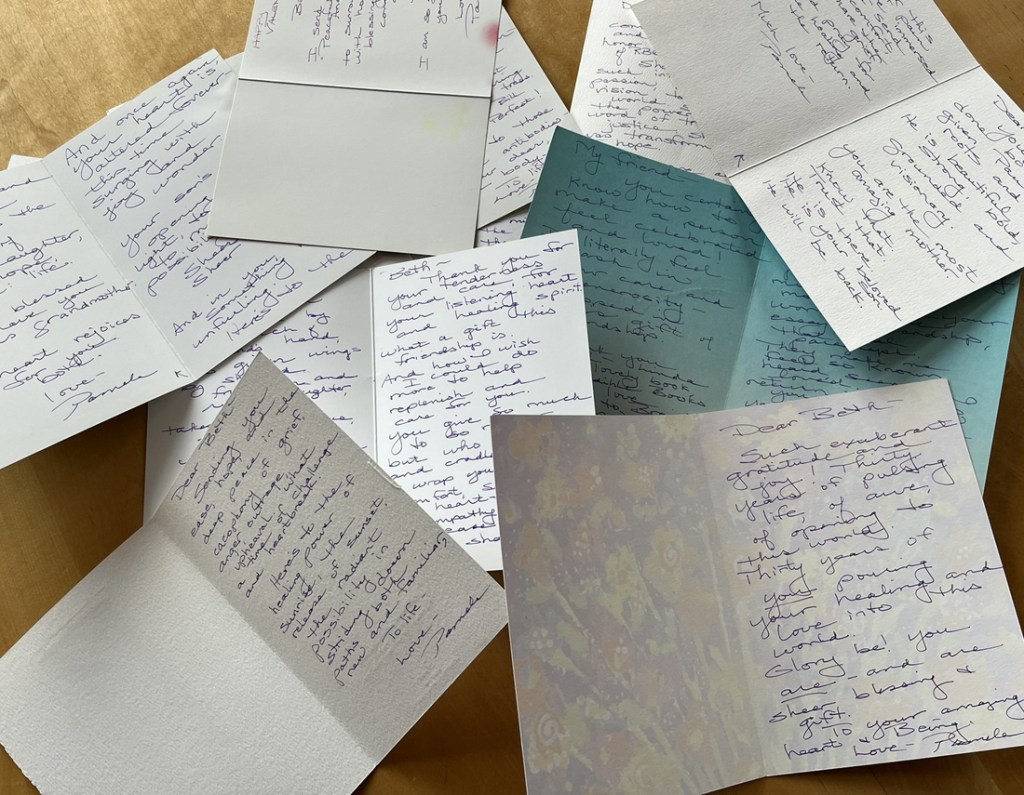
I looked for my friend, Pamela’s email the morning after she died. Every morning I have looked forward to her email from the day before — the last one sent at 4:37 on the Tuesday afternoon before Thanksgiving. Did she ever see my response sent at 6 AM the next morning – my wish for her to know joy this Thanksgiving, my sending much love? The bulk of it was full of mundanities. How differently might I have written it had I known it would be the last she would see? Our ongoing call and response email conversation — now without response, forever without response.
Ours was a friendship of words — words in the cards she has given me over the years, in her detailed responses to my blog posts, in the thousands of emails passed between us over several years. I’ve saved them all. They were too precious ever to delete. How we both loved words — their poetry, their capacity to communicate, convey, confound, console, comfort. I eagerly anticipated her words every day. For years I have entrusted my daily thoughts, worries, joys, activities, hopes, and the occasional dream to her tender care, always knowing her response would be a mirror, reflecting me back to myself, she reflecting on all I had written – giving witness and testimony, always with the deepest of care and affirmation. As Adrienne Rich wrote in the poem we both loved — “Phantasia for Elvira Shatayev” – I have never seen/my own forces so taken up and shared/and given back. Yes, this – the immensity, the intensity, the profound reciprocity of our sharing.
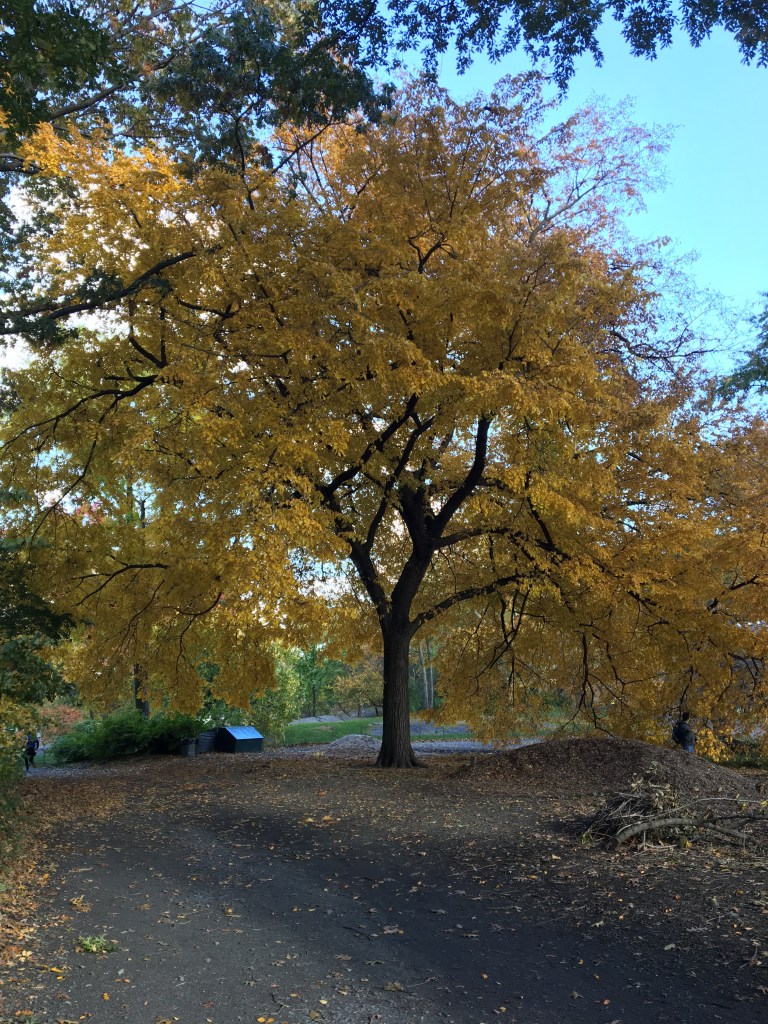
Almost every day, I walk in Central Park. There are certain trees there I’ve come to know: the gnarled cherry trees by the reservoir, the bending willows and tall bald cypress by the pond, the sycamores that drop their bark each summer, the hawthorn not far from Central Park West. Lately I’ve been taking photos of the trees to try to capture their essence, their posture in the world. The trees around me feel like friends, which is what an ancient midrash (interpretation/legend) called Genesis Rabbah says about trees: that they are friends to humankind. To me, they’ve always been a central manifestation of Mother Earth.
Currently, the national parks in the United States have no staff because of the government shutdown. Some people have taken the opportunity to cut down the rare and endangered Joshua trees in the Joshua Tree National Park—just for fun, I guess, or as a trophy of some kind. Meanwhile, President Bolsonaro of Brazil recently has indicted that he wants to remove protection for the rainforest, in order to allow development. It appears that my friends the trees have enemies. Sometimes the enmity is for personal/corporate gain, and sometimes the enmity seems to have no reason at all.
This post was originally published on Dec. 16th, 2011
Yesterday I was watching an episode of Grey’s Anatomy in which George’s father said to him, “you’re not like us, you’re a surgeon.” “And,” George’s father added, “you don’t like to do the things we like to do.” It is not easy not being like your family and not liking the things they like. When my mother was alive, she was the glue that held us together. Since then, my sheer presence in the lives of my father and my brothers and their families is disruptive. No matter that I try not to make waves, I make them all the same. I do keep my mouth shut about politics and religion and feminism. Even so, the last time I was home for the holidays my father asked me to stay in a hotel because having me in the house made him nervous and uncomfortable. To be fair, how would you feel if your daughter was 6 feet tall and you weren’t, she had a PhD and you didn’t, and even if she didn’t open her mouth at all, you knew that she didn’t agree with your political views or your everyday assumption that men make the final decisions on all important matters? Or if you were my brother who does not have a college education and who feels that women and minorities and gays have taken something from him? Or if you were my Mormon brother who is trying to keep his three daughters on the straight and narrow and not on the path chosen by their aunt? On the last Christmas day I spent at my brother’s house, I did not mention any of the obvious things, but it was hard to hide being astonished by the number of presents and the amount of money spent on them, and I simply could not force myself to watch football. Continue reading “Legacy of Carol P. Christ: Home for the Holidays”
This post was originally published on Aug. 26th, 2011
Carol P. Christ earned her BA from Stanford University and her Ph.D. from Yale University. She is a founding mother in the study of women and religion, feminist theology, women’s spirituality, and the Goddess movement and work has revolutionized the field of feminism and religion.She has been active in anti-racist, anti-war, feminist, and anti-nuclear causes for many years. Since 2001 she has been working with Friends of Green Lesbos to save the wetlands of her home island. She drafted a massive complaint to the European Commission charging failure to protect Natura wetlands in Lesbos. In 2010 she ran for office in Lesbos and helped to elect the first Green Party representative to the Regional Council of the North Aegean. She helped to organize Lesbos Go Green, which is working on recycling in Lesbos.
My hope for the new blog on Feminism and Religion is that it can become a place for real discussion with mutual respect of feminist issues in religion and spirituality.
I agree with Rosemary Radford Ruether who argued in a recent blog “The Biblical Vision of Ecojustice” that the prophets viewed the covenant with Israel and Judah as inclusive of nature. Indeed in my senior thesis at Stanford University on “Nature Imagery in Hosea and Second Isaiah,” in which I worked with the Hebrew texts, I argued that too. I also agree that the dualism Rosemary has so accurately diagnosed as one of the main sources of sexism and other forms of domination comes from the Greeks not the Hebrews. I agree that Carolyn Merchant is right that nature was viewed as a living being in Christian thought up until the modern scientific revolution. I agree with Rosemary that it is a good thing for Christians to use sources within tradition to create an ecojustice ethic. I am happy that there are Christians like Rosemary who are working to transform Christianity. Finally, I am pleased to admit that I have learned a great deal from her.
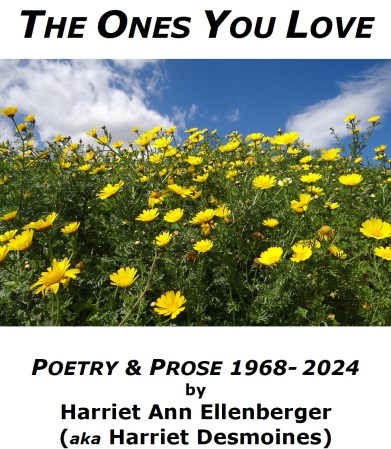
The Ones You Love, Poetry and Prose 1968-2024 is a half-century retrospective love letter from Harriet Ann Ellenberger to friends, family, and lovers; lesbian and overall feminism; lesbian feminist literature and theater; Nature; and those who have been victimized by war. Infusing the book is her overarching love of freedom, not only for herself, but for women, for humanity, and for the Earth. Harriet has been using her authorial and editorial gifts for her entire adult life to move our planet away from extinction into new ways of being, and has now collected her best writings, both prose and poetry, into a single volume. The book is both a brilliant, truthful, unglossed portrait of herself as well as a glimpse into feminism, and lesbian feminism in particular, over decades through one woman’s experience. She often notes in introductions to various pieces that she no longer completely agrees with what she wrote so long ago, but she does not edit out these views, (speaking of her “younger fiery-feminist self,” she says “I’m proud of her courage and proud of the work she undertook” (11)) which offers us a better understanding of both her own progression of thoughts and ideas as well as what issues and points of view were of concern at the time.
Of her most well-known achievement, she writes, “On July 4, 1976, the 200th anniversary of the American Revolution, Catherine Nicholson and I published the first issue of Sinister Wisdom, which has since become the longest-lived lesbian literature and arts journal in the world” (11). She explains the journal’s expansive perspective: “We exist in the interface between a death culture and the faint beginnings of a culture of — not humans — but life-lovers, a culture that embraces animals, plants, stars and those women who choose the future at the risk of their ‘sanity’ and security” (17). This is a vision she has carried with her ever since.
Some years ago when I was speaking on ecofeminism, womanist theologian Karen Baker-Fletcher posed a question that went something like this: What I am missing in your presentation is reference to ancestors. For black women, this issue is critical.
Baker-Fletcher’s question provoked a process of thinking that continues to this day. For example, I began to notice that when black women spoke at the American Academy of Religion, they often began by thanking their foremothers Delores Williams and Katie Cannon for beginning the womanist dialogue. It is far rarer to hear a white woman thank Valerie Saiving, Mary Daly, Rosemary Radford Ruether, or Marija Gimbutas before her talk.
To the contrary, many white women take great pains to distance themselves from feminist foresisters. I once heard a white woman Biblical scholar tell women students to do work on women in the Bible or other areas of religion without using the word feminist or placing their work in a female or feminist train of thought– if they wanted to get it published. She was very proud that she had used this method and succeeded. In other words, she was following in the footsteps of Mary Daly, Phyllis Trible, and Elisabeth Schüssler Fiorenza but acting as if she had invented the study of women and the Bible herself. The reason for this, she freely admitted, was that male scholars who held power in her field would not respect her work if she used the “f” word. Continue reading “Legacy of Carol P. Christ: Do White Feminists Have Ancestors?”
This post was originally published on Aug. 5th, 2011
The following is a guest post written by Carol Christ, Ph.D., a pioneer and founding mother of the Goddess, women’s spirituality, and feminist theology movements, and director of the Ariadne Institute. She is also the author of multiple books including Rebirth of the Goddess.
Although there are some of us who disagree, the “party line” in the fields of Religious Studies and Archaeology—even among feminists– is that there never were any matriarchies and that claims about peaceful, matrifocal, sedentary, agricultural, Goddess-worshipping societies in Old Europe or elsewhere have been manufactured out of utopian longing.
I myself and most other English-speaking scholars defending Marija Gimbutas’s theories about Old Europe have studiously avoided the word “matriarchy” (speaking rather of “matrifocal, matrilineal, and matrilocal” societies) because the very word “matriarchy” conjures up the image of female-dominated societies where women ruled, waged wars, held men as slaves, and raped and abused men and boys. In fact, this fantasy tells us far more about patriarchy than about it does about matriarchy. Continue reading “Legacy of Carol P. Christ: Exciting New Research on Matriarchal Societies”
Shortly after Kamala Harris was announced as Joe Biden’s choice for his Vice Presidential running mate, a panel of black women were asked, “How do you feel right now?” “I feel heard” was the simple yet profound response of one of them. As is well-known to those who follow the polls, black women voters are the backbone of the Democratic party. In the primary election, black women in South Carolina delivered the Presidential nomination to Joe Biden. Yet all too often black women have felt that their votes were taken for granted.
Instead of focusing on the needs and priorities of black women and their communities, all too often the Democratic Party’s strategy has been to reach out to other groups—for example working class white men or white suburban women. To feel heard at this moment means to be taken seriously as a political actor and as a person. Right now, the fact that a black woman was selected is what matters most. There were other qualified women and out of all of them. a black woman, Kamala Harris was chosen. And because of this, black women feel heard. It’s about time. Period.
As no doubt everyone reading this knows, this election season is full of twists and turns and highly unpredictable. I struggle daily with ways to manage my stress without destroying my health.
As a practicing Wiccan, my faith does not encourage me to curse or ill-wish anyone, no matter how tempted I may be. In response to that, I wanted to create something I could do on a daily basis to promote the electoral outcome I desire from a spiritual perspective. A long-forgotten quote from Rumi provided me with the key to what I want. “The breeze at dawn has secrets to tell you. Don’t go back to sleep. You must ask for what you really want.”
“You must ask for what you really want.” As a woman reared in the south in the 1950s, I am not really accustomed to asking for what I want. So Rumi quote liberated me. I can ask for what I really want as the outcome of this election. Although I completely support the only feminist candidate, what I really want is a president that embodies certain traits and characteristics that, from my perspective, make a strong and creative leader. So I’ve created a simple little ritual that anyone can do that gives me a framework to ask for what I really want—to spread my prayers and intentions to the cosmos.





 Feminism and Religion