As a professor, I find myself returning to a similar struggle again and again. I know what I know; and I know what I hope students will gain from the class, in terms of content knowledge, critical thinking, classroom community-making, etc. But often, I don’t know what they don’t know.
This might seem a silly kind of observation. No duh, Sara, you barely know this group of people. Also, this may seem an easy question to answer. And sometimes it is; and I do have part of the answer when I begin a class. My “Intro to Ethics” students, for example, will understand and be frustrated by the way people use the Bible to justify their own positions, but they usually won’t know the term “proof texting,” or easily understand “hermeneutics.” My “Women in Christianity” students will understand sexism and often, the idea of gender as a social construct, but they are usually unfamiliar with the dualistic gendering and ranking of larger social realities, like nature and culture, production and reproduction, etc.
There are obvious differences in academic training—that’s why I’m allowed to teach at a university after all. But I’m not really wrestling with what I can contribute in terms of content knowledge or historical/ theoretical contextualization. I think what I don’t know is what understandings of reality they bring into the classroom and what these realities have allowed them to see. Learning and/or teaching feminist theory and theo/alogy for the last fifteen years at least, I also often take my own reality for granted. I “know what I know,” after all—I just can’t always remember what it was like to learn it. And all of these classroom dynamics can make it harder to catch the realities we can’t yet know or can’t see. Continue reading “What We Can’t See by Sara Frykenberg”
In my genealogy research, I traced my father’s grandmother, Catherine, to her roots on the Iloff farm in Cherry Ridge, Honesdale, Pennsylvania, about two hours north of New York City. Catherine’s parents were Henry Iloff, who emigrated in 1841 from St. Nicholas, Saarland, and Catherina Lattauer who emigrated in 1845 or 1846 from Ober-Floerscheim, Hesse-Darmstadt. They were married February 2, 1846 at St. Matthew’s Church in “Little Germany” on the Lower East Side of Manhattan.
Iloff farmhouse
In 1850, Henry and Catherina purchased land in Cherry Ridge, Honesdale, where they built the farm that remained in the family for a hundred years. In 1851 Catherina’s sister Agnes Lattauer Schweizer emigrated with her family from Ober-Floerscheim to Cherry Ridge. The Schweizer farm also remained in the family for a hundred years.
I had been told about the family Henry Iloff had with two wives who were somehow related: nine children with his first wife and nine with his second over a forty year period–fourteen of whom were living at the time of his death in 1889. I was shocked to learn that when his first wife died in 1869, Henry married his wife’s sister’s daughter Johanna Schweizer–who was half his age and his children’s cousin. I suspect that the marriage was considered scandalous in a conservative farming community, and that it did not sit well with the children of the first marriage, four of whom left the local area. Nonetheless, Henry Iloff was elected to the prestigious position of Wayne County Commissioner a decade later. Continue reading “Children of German Immigrant Farmers in Cherry Ridge: American Stories by Carol P. Christ”
I’ve long held that feminism, in order to be true and engaged and practical, must be intersectional. The work of justice for women must also include justice for other marginalized groups. Because many women are also LGBTQ, people of color, people with disabilities, Muslims, immigrants, and others marginalized for identities other than their gender. Paying attention to these intersections—of sexuality, gender, race, class, ability, religion—and acknowledging that many people have multiple intersecting identities for which they are oppressed is vital to the work of justice.
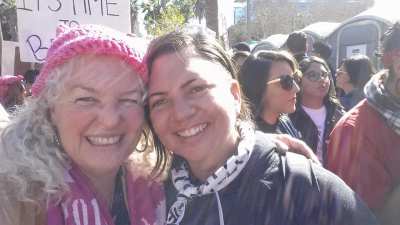
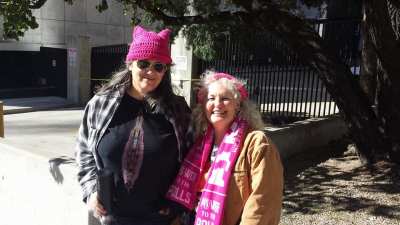
These thoughts remained at the forefront of my mind as I recently marched in one of the sister marches of the Women’s March in my home of Hilo, Hawaii. I heard many straight, white, cisgender women claim that women are not oppressed while mocking the march as irrelevant. I heard some gay men purport that such a march was unnecessary. And I wondered. Are not women of color also women? Muslim women? Immigrant women? Women with disabilities? Queer women? Trans women? Are not our quests for liberation and rights and legal validity interrelated, mutually dependent, might I even say, intersectional? Continue reading “The Protest Goddess by Angela Yarber”
It certainly is a busy time of year for me, but I’m fortunate that many of the events I am participating in offer a chance to share what is important to me. Next week, I’ll be speaking to a group of students in one of my campus’ residence halls about feminism and Christianity. For this informal setting, I was allowed to choose my own topic under the broad heading of “Questions That Matter.” I’ve decided to take on the f-word in religion and attempt to explain why it’s important to me and how it relates to my religious identity. Although I’m still trying to figure out what to say, I’d like to share my thoughts so far and get some insight from you. Continue reading “Questions that Matter: What is Feminism? by Elise M. Edwards”
Before coming to the U.S., I felt disconnected from feminist theory. I thought this framework labels women as haters of men and seekers of obscure rights. I was not sure who could identify with it or belong to it. For me, it was just a scholarly concept women used to justify their rights. I could not perceive it as an empowering tool, even if it is being so popular. While there is no problem having the concept to be loud and popular, this loud voice did not speak for me. I could not let it represent me or speak on my behalf. Every time I google it, I see angry faces, naked women, people yelling, women in chains, and much more. Instead of accepting it, I resisted it.
At that time, my understanding of feminism was associated with women’s liberation outside the circle of culture and religion. It scared me since I am who I am because of my culture, my community, and my religion. This feminism has my respect, but it is alien and does not call for my needs. For a long time, I resisted feminist discourse or, to be clear, white western feminism. Its discussion about equality, oppression, and marginalization is different from mine. I knew that as a Muslim woman, I had no room in this discourse.
The symbol of the Goddess is as old as human history. The most ancient images of the Goddesses from the Paleolithic era are neither pregnant nor holding a child. In Neolithic Old Europe the Goddess was most commonly linked with birds or snakes and only rarely portrayed as mother. Yet we tend to equate the Goddess with the Mother Goddess. I suspect that images of the Virgin Mary with Jesus on her lap and prayers to God as Father have fused in our minds, leading us to think that the Goddess must be a Mother Goddess and primarily a Mother.
In a recent blog, Christy Croft reminded us that in our culture, women’s experiences of mothering and motherhood are not always positive:
[The mother] doesn’t always appear in our stories in simple or easy ways. Some of us mother children we did not or could not grow in our bodies; some of us birth babies who are now mothered by others. Some of us are not mothers at all. Some of us had mothers who could not love us unconditionally, or did not have mothers in our lives, or had mothers who brought us more pain and humiliation than comfort, from whose effects we are still recovering, are still healing.
Why are so few women mentioned in the great feast days like Pentecost, the Last Supper, the Baptism of Christ, etc.? God made no commandment that they not be included.
Inquisitive women like myself have always been around Christ listening to His message. There they were, cooking and cleaning at the Last Supper, at the wedding at Canon and when He fed the five thousand. When Christ invited the children to come to him, you can be sure the mothers were there, too.
Beginning as early as the fourth century the dominant Christian leaders, all men, twisted and distorted Holy Scriptures to thwart the ascendant positions for women within the religious hierarchy and in christian societies in general. Yet, the underlying teachings of Jesus Christ, the Apostle Paul, Moses and the prophets, – all call for the proper and equitable treatment of God’s children. Without a doubt, God and Christ love all of humankind with no gender bias. When women listen to scripture we naturally fill in the gap, or adjust the gap knowing in our hearts and souls, we are not inferior to men.
Have you heard about, applied or received the Feminist-O-Meter lately?
The Feminist-O-Meter is a tool that often appears in feminisms and women rights activisms, fostering power struggles, cliques, jealousies and -if that is not enough – encouraging the reproduction of mainstream socialization that fosters competition and alienation among women.
It can be summed in the expression:
“Not my way to see Feminism? Then, that’s NOT Feminism”
I see feminisms as revolutions of subjectivities based on the radical idea that women are people … and it turns out that people are diverse, we are the result of our experience and the way we interpret them.
So, I do not understand why there is so much drama, judgment, outrage and social punishment in feminist spaces when those involved are undertaking the process of discovery, of claiming back our personhood by legitimizing our different ways of thinking, our understandings of liberation, and our acknowledgment of what makes us happy and makes us feel feminist.
When I was in graduate school, I learned to doubt myself. Despite having won Danforth and Woodrow Wilson graduate fellowships that paid for my tuition and living expenses, I was continually told by professors and male students alike that I would not finish my degree and that if I did I would get married, have children, and never use the degree I had earned. I tried hard to maintain my confidence in myself, but it was difficult when I was the only woman in the program. There was one other woman my first year, but she was older than I was, a nun, and I never saw her in class or at social events. My self-esteem was gradually eroded. If I had not had a fellowship, I would probably have dropped out.
Fast forward a few years. There were several more women in the program, but only one in theology, my friend Judith Plaskow, and she too struggled. I was working on my comprehensive exams and wondering if I had what it takes to pass them and then write a Ph.D. thesis. After the initial shock of being treated as if I was not the equal of the male students in the program, I began to look around me. A few of the male students seemed really bright, many of them were average, and some of them were plodders. I hate to admit it, but I looked at the least competent among them and said to myself, “If he can do it, then surely I can.” And I did. I passed my exams. A few years later my Ph.D. thesis was approved.
If contributions to the field are any indication, Judith Plaskow and I were not only as good as the most mediocre men in our graduate program, we smarter than the average ones, and at least as smart as the smartest ones. But we didn’t know that then. Men have been getting degrees and being promoted and moved up that ladder because other men like them, identify with them, feel sorry for them, and for lots of other reasons having nothing to do with excellence, and sometimes not even do do with competence.
Last week I heard Cecile Richards say something to Lawrence O’Donnell that reminded me of this. Speaking of the huge numbers of women who—inspired by the women’s marches–will be voting, registering voters, campaigning, and running for office in 2018 and beyond, she said women “totally understand that they can do better than who’s in office now.”
photo by Marie Cartier
For far too many years women have been held back by lack of self-confidence and self-esteem. We didn’t think we could and we didn’t. We don’t think we can and we don’t. We thought men were smarter than us or had more time or more drive. The founder of the Society of Women Engineers at San Jose State told my classes that women who got even one B+ in an engineering class were likely to drop out of the program, while men graduated who graduated with C averages went on to get great jobs. Now we see truly mediocre white men holding public office all across the country and in its highest offices. The harm they are doing to women, to children, to the elderly, to people of color, to the environment has been a wake-up call for all of us. There are so many mediocre white men in office that women–of all colors and ethnicities–are realizing that we can do better than that! Once we begin to see what we can do when there are large numbers of us holding office all across the country, there will be no stopping us!


 In my genealogy research, I traced my father’s grandmother, Catherine, to her roots on the Iloff farm in Cherry Ridge, Honesdale, Pennsylvania, about two hours north of New York City. Catherine’s parents were Henry Iloff, who emigrated in 1841 from St. Nicholas, Saarland, and Catherina Lattauer who emigrated in 1845 or 1846 from Ober-Floerscheim, Hesse-Darmstadt. They were married February 2, 1846 at St. Matthew’s Church in “Little Germany” on the Lower East Side of Manhattan.
 I’ve long held that feminism, in order to be true and engaged and practical, must be intersectional. The work of justice for women must also include justice for other marginalized groups. Because many women are also LGBTQ, people of color, people with disabilities, Muslims, immigrants, and others marginalized for identities other than their gender. Paying attention to these intersections—of sexuality, gender, race, class, ability, religion—and acknowledging that many people have multiple intersecting identities for which they are oppressed is vital to the work of justice.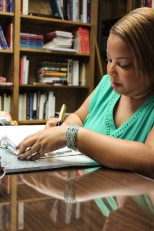
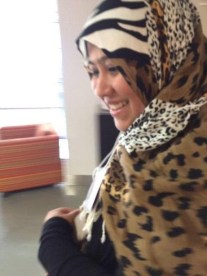 Before coming to the U.S., I felt disconnected from feminist theory. I thought this framework labels women as haters of men and seekers of obscure rights. I was not sure who could identify with it or belong to it. For me, it was just a scholarly concept women used to justify their rights. I could not perceive it as an empowering tool, even if it is being so popular. While there is no problem having the concept to be loud and popular, this loud voice did not speak for me. I could not let it represent me or speak on my behalf. Every time I google it, I see angry faces, naked women, people yelling, women in chains, and much more. Instead of accepting it, I resisted it.
 The symbol of the Goddess is as old as human history. The most ancient images of the Goddesses from the Paleolithic era are neither pregnant nor holding a child. In Neolithic Old Europe the Goddess was most commonly linked with birds or snakes and only rarely portrayed as mother. Yet we tend to equate the Goddess with the Mother Goddess. I suspect that images of the Virgin Mary with Jesus on her lap and prayers to God as Father have fused in our minds, leading us to think that the Goddess must be a Mother Goddess and primarily a Mother.

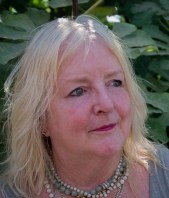 When I was in graduate school, I learned to doubt myself. Despite having won Danforth and Woodrow Wilson graduate fellowships that paid for my tuition and living expenses, I was continually told by professors and male students alike that I would not finish my degree and that if I did I would get married, have children, and never use the degree I had earned. I tried hard to maintain my confidence in myself, but it was difficult when I was the only woman in the program. There was one other woman my first year, but she was older than I was, a nun, and I never saw her in class or at social events. My self-esteem was gradually eroded. If I had not had a fellowship, I would probably have dropped out.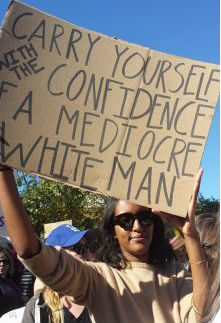
 Feminism and Religion