

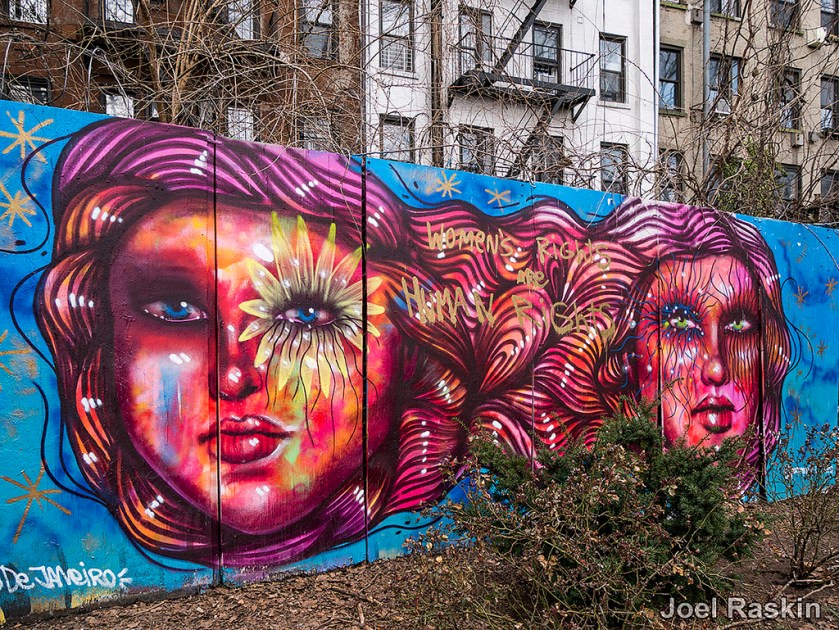
Please be warned, this post details violence against women.
A new March 8.
Another year protesting
Another evening taking the streets of our cities around the world
In Rome, in Lima and Santander
A new slogan, a new banner, for the same rage
A decent man, one of those who define himself as a good citizen and father stands in front of me asking: “Why are you so angry? …. Why are feminists so angry? I am asking you: Why are you so fucking angry?”
Why are you angry?
Because my friend went to the police to put a complaint that her husband beat her and they did not take the complaint. When she returned home, her husband hit her again.
Why are you angry?
Because I am 16 years old and every day after school, older men shout sexual things to me in the street, they even follow me and when I get upset and tell them not to do it they say that I am being rude … I am afraid to walk in the street. Continue reading “Why Are You So Angry? by Vanessa Rivera de la Fuente”
 In my genealogy research, I traced my father’s grandmother, Catherine, to her roots on the Iloff farm in Cherry Ridge, Honesdale, Pennsylvania, about two hours north of New York City. Catherine’s parents were Henry Iloff, who emigrated in 1841 from St. Nicholas, Saarland, and Catherina Lattauer who emigrated in 1845 or 1846 from Ober-Floerscheim, Hesse-Darmstadt. They were married February 2, 1846 at St. Matthew’s Church in “Little Germany” on the Lower East Side of Manhattan.
 I’ve long held that feminism, in order to be true and engaged and practical, must be intersectional. The work of justice for women must also include justice for other marginalized groups. Because many women are also LGBTQ, people of color, people with disabilities, Muslims, immigrants, and others marginalized for identities other than their gender. Paying attention to these intersections—of sexuality, gender, race, class, ability, religion—and acknowledging that many people have multiple intersecting identities for which they are oppressed is vital to the work of justice.
 Before coming to the U.S., I felt disconnected from feminist theory. I thought this framework labels women as haters of men and seekers of obscure rights. I was not sure who could identify with it or belong to it. For me, it was just a scholarly concept women used to justify their rights. I could not perceive it as an empowering tool, even if it is being so popular. While there is no problem having the concept to be loud and popular, this loud voice did not speak for me. I could not let it represent me or speak on my behalf. Every time I google it, I see angry faces, naked women, people yelling, women in chains, and much more. Instead of accepting it, I resisted it.
 The symbol of the Goddess is as old as human history. The most ancient images of the Goddesses from the Paleolithic era are neither pregnant nor holding a child. In Neolithic Old Europe the Goddess was most commonly linked with birds or snakes and only rarely portrayed as mother. Yet we tend to equate the Goddess with the Mother Goddess. I suspect that images of the Virgin Mary with Jesus on her lap and prayers to God as Father have fused in our minds, leading us to think that the Goddess must be a Mother Goddess and primarily a Mother.

 Feminism and Religion