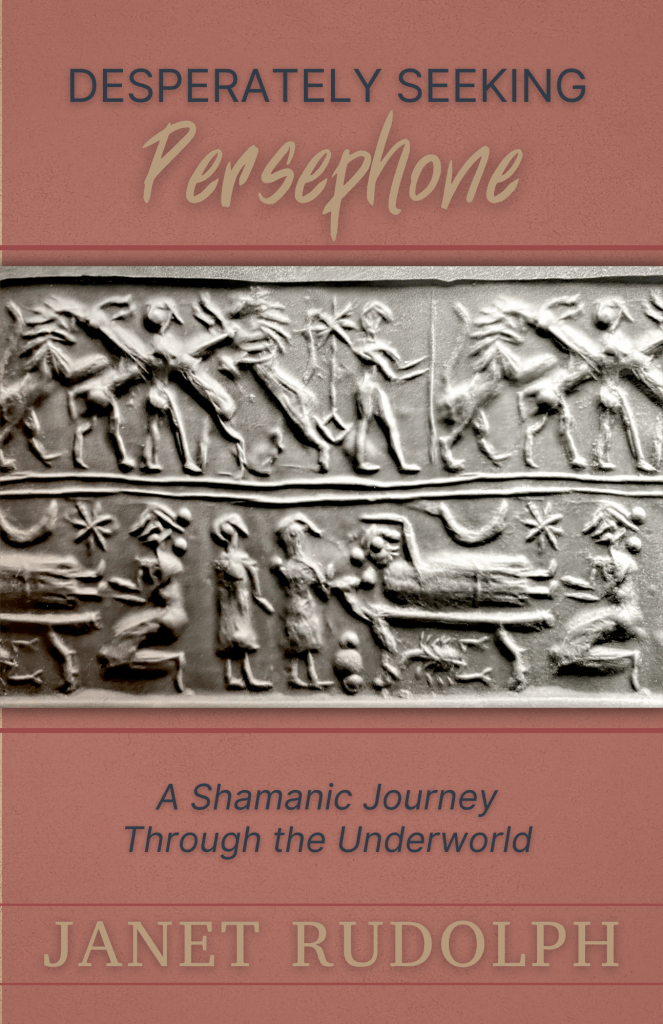
To Stand in the Presence of the Ancients! – Enheduanna, Part 2 by Janet Maika’i Rudolph

Yesterday I wrote about the priestess/scribe Enheduanna and her warrior/king father Sargon. I posited their connection to the codification of patriarchy. They did not invent it, as war and the diminution of women had been happening in some circles. I do wonder, however, if they furthered it along to a point of no return.

Another king of the time, Urukagina from circa 2350 bce[1] codified laws under the guise of reformation.  Some of his reforms were progressive in that they sought to protect the poorer classes against aristocracy and the priesthood.  But they also were clear to let women “know their place.” Here are the translated words from his laws:

“If a woman to a male has spoken . . .[bad] words(?) which exceed (her rank?), onto the teeth of that woman a baked brick shall be smashed, and that brick will be hung at the main gate.”

Continue reading “To Stand in the Presence of the Ancients! – Enheduanna, Part 2 by Janet Maika’i Rudolph”

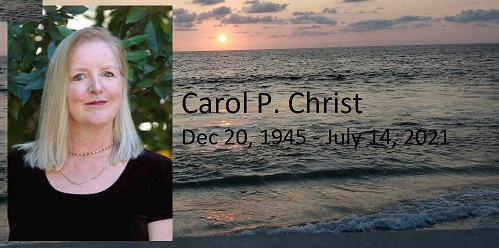
Legacy of Carol P. Christ: REMEMBERING MERLIN STONE, 1931-2011

This was originally posted on February 20, 2012

“In the beginning…God was a woman.  Do you remember?”  Feminst foremother and author of these words Merlin Stone died in Feburary last year.

I can still remember reading the hardback copy of When God Was a Woman while lying on the bed in my bedroom overlooking the river in New York City early in 1977.  The fact that I remember this viscerally underscores the impact that When God Was a Woman had on my mind and my body.  Stone’s words had the quality of revelation:  “In the beginning…God was a woman. Do you remember?”  As I type this phrase more than thirty-five  years after first reading it, my body again reacts with chills of recognition of a knowledge that was stolen from me, a knowledge that I remembered in my body, a knowledge that re-membered my body.  My copy of When God was a Woman is copiously underlined in red and blue ink, testimony to many readings.

Continue reading “Legacy of Carol P. Christ: REMEMBERING MERLIN STONE, 1931-2011”

From the Archives: The Hunger Games, Holy Week, and Re-imaging Ritual by Xochitl Alvizo

This was originally posted on April 3, 2012 and serves as a nice follow up to my recent posts, and to the Christian holy days being celebrated this week.

Being passive spectators of violence and injustice, even if mournfully so, is not just a thing of Panem, it is our everyday reality.

In The Hunger Games Suzanne Collins takes the reality of an unjust society and gives it an imaginative makeover. In Panem, most people are kept at such extreme levels of hunger that even when they do eat they cannot fill the hollowness that has settled in their stomachs, while others are deciding on the next cosmetic alteration they will undertake – whiskers, jewel implants, or green-tone skin color? The disparate conditions between the rich and the poor, the few and the many are absurdly and starkly portrayed but done so in a way that we can still recognize our world in theirs. And at the center of this world is the state imposed ritual of punishment and control, the yearly Hunger Games – a nationally televised competition that all the people of Panem are required to watch. The 12 districts watch mournfully as two kids from each of their districts compete to the death, and the wealthy watch gleefully, for the games are the height of their excesses and entertainment. The yearly Games conclude when one kid, the lone ‘victor’, is left standing. All while the nation watches.

Continue reading “From the Archives: The Hunger Games, Holy Week, and Re-imaging Ritual by Xochitl Alvizo”

Rethinking Church from the Ground Up by Xochitl Alvizo

In the last post about rethinking church communally, I ended with reference to the fact that those who do not identify with an organized religion – nearly 70% of the religiously unaffiliated – think that churches “focus too much on rules,” “are too concerned with money and power,” and “are too involved in politics.”

I found this to be the case also among participants of “Emerging Church” congregations, which I researched for my dissertation. Many participants of the congregations I visited had previous negative and damaging experiences of church – experiences that caused them to become unaffiliated from church and Christianity all together. But, when discovering or happening upon an “emerging” congregation, some were pleasantly surprised by the experience of an open, welcoming, and justice-oriented community of faith that was creative in form and ritual, and egalitarian in leadership.

Continue reading “Rethinking Church from the Ground Up by Xochitl Alvizo”

Legacy of Carol P. Christ: Reading Plato’s Allegory of the Cave as Matricide and Theacide

This was originally posted on October 22, 2012

When I read Plato’s allegory of the cave as an undergraduate, I was told it had something to do with the idea that the “form” of a table is more “real” than the table itself. I must confess that I had no idea what this could possibly mean.

As a graduate student, I struggled with philosophical and theological ideas rooted in Platonism.  Rosemary Radford Ruether named the flawed worldview created by a “classical dualism” that separates mind from body, spirit from the world, rationality from emotion, and male from female.  Her ground-breaking essay “Mother Earth and the Megamachine” clarified the difficulties I was having.

Continue reading “Legacy of Carol P. Christ: Reading Plato’s Allegory of the Cave as Matricide and Theacide”

Rethinking Church Communally and Creatively by Xochitl Alvizo

I spend a curious amount of time discussing, studying, and writing about polity – the structures and procedures of congregational/denominational governance (my previous post about communion reflects one kind of polity). Amid theological and sociological research about the decline, revival, or re-emergence of Christianity and the church, my research specifically focused on how emerging congregations organized and structured their decision-making processes. As a “body” – ecclesial, social, political – what are the new and creative ways that congregations structure and organize their collective living and relating?

Continue reading “Rethinking Church Communally and Creatively by Xochitl Alvizo”

The Motomami Theology: “Segundo chingarte, lo primero Dios.”* Part II

*“God comes first. Fu*king you, a close second.”

In Part 1 of this post, I described my first encounters with Rosalía’s music and visual arts, which are controversial for many, but I find them wonderful. I mentioned how she integrated God, mainly Catholic references and images, into a story of love and suffering in El Mal Querer. But I finished emphasizing my surprise when I listened to the album Motomami, since she managed to combine reggaeton (sexual-indecent music) and her views of God.

So, here is my attempt to describe Rosalía’s theology in Motomami. (Before I start, let me say: yes, I heard every song multiple times collecting references of God or the Christian tradition, so I hope you enjoy it.) Rosalía understands God as someone who controls our destinies amid grief and joy. In Como un G she says “It’s sad when you want something, but God has different plans for you” (“Qué pena cuando quieres algo pero Dios tiene otros planes pa’ ti”.) In Diablo, she says, “What God gives, God takes back” (Si Dios te lo da, te lo quitará), referring to her fans who first loved her but afterward became haters. God also protects us from an evil former partner when she says in Despecha‘ “May God forbid I go back to you” (“Que Dios me libre de Volver a tu la’o). God also is our help and supports our choices. Rosalía brings this concept talking about her identity as a woman, her freedom and autonomy in Saoko: “I know who I am, and I don’t forget where I’m going. I’m driving while God guides me. I am mine and I transform myself” (“Sé quién soy, y a dónde voy nunca se me olvida. Yo manejo, Dios me guía.)

Continue reading “The Motomami Theology: “Segundo chingarte, lo primero Dios.”* Part II”

The Motomami Theology: “Segundo chingarte, lo primero Dios.”* Part I

*“God comes first. Fuc*king you, a close second.”

I went to Rosalía’s promotional concert for the Motomami album in Boston a month ago. I knew some songs from her 2018 album El Mal Querer (Bad Love), a musical masterpiece. That album made Rosalía a visible star in the constellation of musicians and composers in Hispano-American mainstream music. The album has a particular story that Wikipedia explains very well:

The album was written by Rosalía and co-produced with El Guincho on an initial low budget as an independent artist. Presented as experimental and conceptual, revolving around a toxic relationship, the album was inspired by the anonymous 13th-century Occitan novel Flamenca. Therefore, every song on the album is conceived as a chapter of the book. It served as the singer’s baccalaureate project, graduating from Catalonia College of Music with honors. [Read more here]

In El Mal Querer, Rosalía mixed electronics, contemporary dances and rhythms, and traditional flamenco sounds and movements in a beautiful musical and visual collage. Some musically conservative audiences characterized the album as the “profanation” of traditional flamenco music, but there’s no doubt that Rosalía brought the genre back to life and made it mainstream again.

Continue reading “The Motomami Theology: “Segundo chingarte, lo primero Dios.”* Part I”

Toward an Alternative Ecclesiology by Xochitl Alvizo 

I mentioned in a recent post that I would share a little more about my current research, as one of the aspects of my life I gained more clarity in during my recent process of regrounding was in the area of my research.

Two things stood out to me as I reflected on my work and scholarship: my concern for individual human dignity drives my work—it is an underlying thread in how I think and theologize. The second is that I want to make a major contribution to the theology of the church—I know I want to write a feminist ecclesiology. These two things are obviously related. I have witnessed enough of the ways that not only Christianity harms people, but how the church specifically is a conduit for the damages Christianity causes. At the same time, Christianity remains a living tradition, a shared story and language, and a community to which many are committed. So just as people are harmed by church, some are also nurtured and held by it. While it is true, then, that church indeed harms people and violates their dignity, often also justifying that violation on theological grounds, it need not do so and has other possibilities before it.

Thus, I want to contribute to a theology of church that is a grounded and liberating alternative to the problematic one to which people most often default or inherit. A queer, feminist, anti-racist, and decolonial ecclesiology.    

Continue reading “Toward an Alternative Ecclesiology by Xochitl Alvizo “

Spill that Tea: Catholic Nuns, Meghan Markle, and Theological Feminism by Anjeanette LeBoeuf

I wrote a piece in March 2021 regarding the British Royal Family and their horrendous treatment of the Duke and Duchess of Sussex, Prince Harry and Meghan Markle. On August 23, 2022, Meghan released her first podcast episode for her series titled “Archetypes”. The first episode had guest speaker, famed legendary tennis player Serena Williams. They talked about the misconceptions of ambition and the two-edged sword that women have to endure in society when striving to be their best in a male centric world. And for many of us within Religious and Theological spaces, the disparities that women, queer folk, and non-binary peoples have endured in society are also tied into the misconceptions and harmful archetypes found within religious spaces.

Continue reading “Spill that Tea: Catholic Nuns, Meghan Markle, and Theological Feminism by Anjeanette LeBoeuf”