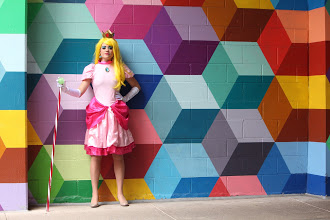
Princess Peach from The Goddess Project: Made in Her Image by Colette Numajiri

Toy stores and department store aisles are decked with pink and purple princess paraphernalia. Disney has provided an array of princesses for little girls to choose their birthday party or bedroom decor from. But as we all know, there’s a deeper secret hidden in the FAIRY TALES that high powered media execs have made their fortunes on: THE GODDESS.

Every hero’s tale, be it in video games or romantic movies sets out to do one thing: SAVE THE PRINCESS.  When I was a child I saved Her myself on my little Nintendo system never knowing why She was in trouble in the first place. And was I the only one who ever wondered why NONE of the PRINCESSES HAD MOTHERS!?

In the early Centuries during the Christianization of Europe, Pagans (which means “people of the land”) hid truths right under the nose of the newly forming Christian Church in their folklore, games and children’s rhymes to avoid being burnt at the stake. These simple people tried to covertly keep the Wisdom of the Sacred Feminine that they’d been honoring since the beginning of time, ALIVE.

Continue reading “Princess Peach from The Goddess Project: Made in Her Image by Colette Numajiri”

A Rescue Remedy, Part 2 by Barbara Ardinger

The handsome but uncharming prince having been magicked, the witch and her coconspirators know it’s time to focus on finding Ella. The witch looks around the table.

“Mrs. Janedoe and Mrs. Worthington,” she says, “you are two of our most highly experienced sauceresses…I mean sorceresses. Mrs. Bezukhov, you are also a woman of great, if temporarily diminished, power. Let us work together and see what we can do. Surely when people of good will work together they can raise energy that leads to positive results. Yes?” She looks around. “Please come up to my study.” The ravens of course know they are members of this ad hoc coven, and Mrs. Bezukhov goes out to her little room (actually a stall) in the barn to fetch her old scrying stone.

“Now,” says the witch, “we need to find out where Ella is and—”

“Before that,” says Kahlil, the prophetic raven, “we gotta fly that…er…sausage to the city ’n’ drop it on that lousy prince and hit ’im where it’ll do the most good. Make sure he got the message, doncha know. I got a new buddy who’ll fly with us.” He waves a wing at the window and another raven flies in. “This’s Icarus.” The new raven bows. “Despite his name, he’s a good flyer ’n’ he knows the safest routes to the capital and the bestest ways to get around the city.” Kahlil shows the bagged sausage to Icarus, who studies it and shakes his head like he’s just been attacked by a million fleas. “Okay,” says Kahlil, “youse girls just keep an eye on us in that there scrying stone.” He starts to rise from the table, but Mrs. Worthington stops him.

Continue reading “A Rescue Remedy, Part 2 by Barbara Ardinger”

Opening Our Hearts Through Armenian Dance by Laura Shannon

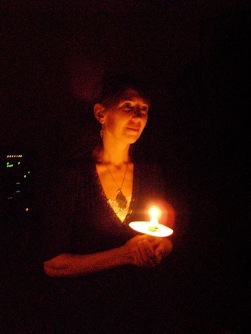
The candle represents the light of love, compassion and connection kindled in our hearts as we dance.
In these challenging times, one of the hardest things to do is to keep our hearts open. Grief and despair tend to shut them down. And even among close friends, colleagues, family members, and people with whom we share worship, when we clash over differing political opinions, trust can swiftly erode. These kinds of losses and sorrows can make us just want to close the doors to our hearts.
Yet hardened hearts and minds are not going to help us overcome conflicts and affirm connections. Only if we can open our hearts to one another, holding the fullness of our (and others’) feelings in a compassionate way, can we weather the storms which threaten to divide us further. And only if we are united can we find our way together through those storms.
One of the best ways I know to connect with others and to open my heart is through the joyful experience of traditional circle dance, particularly Armenian dances. I have written previously on this blog (The Dance of MemoryThe Wishing Tree) about Armenian dances and their ancient roots, their links to the pre-Christian Goddess, and how they affirm survival throughout the traumas of history. I have also written about my friend and colleague Shakeh Major Tchilingirian and her inspiring Circle of Life project, which brings Armenians, Turks, Kurds, Assyrians, and other survivors of atrocities and genocide to dance together for reconciliation.

Continue reading “Opening Our Hearts Through Armenian Dance by Laura Shannon”

In Light of Women by Mary Jane Miller

Why are so few women mentioned in the great feast days like Pentecost, the Last Supper, the Baptism of Christ, etc.? God made no commandment that they not be included.
Inquisitive women like myself have always been around Christ listening to His message. There they were, cooking and cleaning at the Last Supper, at the wedding at Canon and when He fed the five thousand. When Christ invited the children to come to him, you can be sure the mothers were there, too.
Beginning as early as the fourth century the dominant Christian leaders, all men, twisted and distorted Holy Scriptures to thwart the ascendant positions for women within the religious hierarchy and in christian societies in general. Yet, the underlying teachings of Jesus Christ, the Apostle Paul, Moses and the prophets, – all call for the proper and equitable treatment of God’s children. Without a doubt, God and Christ love all of humankind with no gender bias. When women listen to scripture we naturally fill in the gap, or adjust the gap knowing in our hearts and souls, we are not inferior to men.

Continue reading “In Light of Women by Mary Jane Miller”

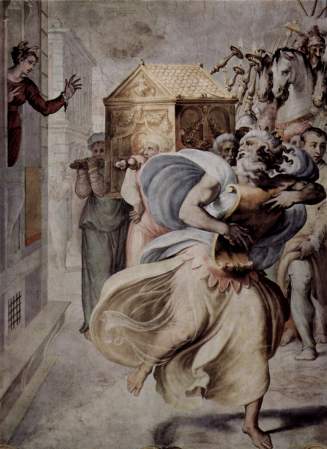
Michal the Priestess: Midrash, Multiplicity, and the Tales of King David by Jill Hammer

When I was in my late teens, I discovered midrash: the Jewish exegetical process by which commentators weave creative and additive interpretations into the sacred text.  Midrash comes from the word “to ask,” “to seek,” or “to divine.” For example, the tale in which a well follows the prophetess Miriam through the wilderness is an ancient midrash. The story in which God stops the angels from singing as the Egyptians drown in the Sea of Reeds is a midrash. Each of these stories derives from a particular close reading of text, whether a Torah text or a verse elsewhere in the Bible.  Each of them allows a new generation to add its own perspectives to the tradition.

Contemporary feminists, and many other contemporary artists, writers, and exegetes, have used a modern form of midrash to add liberatory perspectives to Jewish tradition and to biblical lore.  From Miriam to Vashti, female biblical characters shine in the creative interpretations of feminist midrashists.  Judith Plaskow’s “The Coming of Lilith” made a huge impact on the reading of the story of Eve and the legend of Lilith. Anita Diamant’s The Red Tent changed the conversation on Dinah forever. Alicia Ostriker, Norma Rosen, Veronica Golos, and many others have joined in this creative play which highlights marginalized voices within the text.  Wilda Gafney has made contributions to a Christian and womanist form of midrash.  Voices like Andrew Ramer and Joy Ladin have invited us to see queer and trans themes in the text. And of course many others, from poet Yehuda Amichai to bibliodramatist Peter Pitzele, have added to this rich tapestry.

Continue reading “Michal the Priestess: Midrash, Multiplicity, and the Tales of King David by Jill Hammer”

A Rescue Remedy, Part I by Barbara Ardinger

A year, now. It has been a full year since the phony election that put El Presidente in the Golden Office. A year since people began leaving the capital and the nation’s other large cities. While some of the refugees emigrated to quasi-democratic nations, most of them settled in the small towns and on the farms across the countryside, where they began building new, rural lives. A year ago, it was a flood of refugees. Now fewer people are able to escape.

A year, now, and even though she has studied and practiced, the wicked witch is no wickeder than she ever was. Nowadays she even forgets to put on the wicked-witch mask that she used to think scared people. But it’s easy for everyone to see that, masked or not, she’s just an ordinary woman practicing an old-time religion. She’s never fooled anyone, not the sixty or so refugees who now live on her farm, especially not the various ravens who drop by regularly for snacks in exchange for gossip.

Continue reading “A Rescue Remedy, Part I by Barbara Ardinger”

Saving Joan of Arc by Natalie Weaver

I’m finished with my first semester as a studio arts major at Kent State University.  I am not sure whether I’ll be registering for a second one.  There were pros and cons about the experience, and I am not sure if one set outweighed the other. Regardless, I am on sabbatical this spring, have two books to complete, and figured I would do well not to be trekking back and forth in an hours worth of snow and ice over the next few months from my home to the school.  So, I am taking a semester off, and I have become one of those retention risks. I am grateful for the opportunity to reflect on the experience with only minimal consequence to my bank account and my (laughing) future in the arts.

It wasn’t a bad experience; it wasn’t a good one either, really.  I learned some things in drawing, but I am very much on the fence about my experience in sculpture.  For starters, I imagined playing with clay and making pinch pots while some Swayzesque spirit from beyond rubbed my shoulders.  Instead, I was more Jessica Beal with a welding mask, except, instead of wearing a swanky black leotard and off-the-shoulder-slouch-dance tunic, I was wearing ugly jeans and steal-toed shoes under the green welding suit that had half-dollar size holes in it.  The protective gear only partially worked; I was scared of the tools after a classmate almost lost a finger; and the top of my hair went up in smoke when a spark shot under my ill-fitting Vader hat on week two.  I put it out quickly, fortunately.

Continue reading “Saving Joan of Arc by Natalie Weaver”

Jewish Folklore and Women’s Clothing: When Things are the Text by Jill Hammer

Two weekends ago, I had the pleasure of visiting the Jewish Museum on Fifth Avenue in Manhattan.  The Jewish Museum has long been a favorite museum for me.  My wife and I took our daughter to this particular exhibit because we knew she’d like it.  The exhibit is entitled “Veiled Meanings: Fashioning Jewish Dress from the Collection of the Israel Museum, Jerusalem.”  It consists of many, many garments created and worn by Jews, from Moroccan wedding clothes to German prayer shawls to Yemenite amuletic (meant to protect the wearer) dresses.  Accompanying the garments were placards explaining the folk traditions giving rise to the various garments.  What I realized (again) after viewing the exhibition was how much I could learn about the culture of Jewish women, and Jewish culture in general, by looking at things, not texts.

The sacred texts and laws central to Jewish life, while they certainly discuss Jewish women, tend not to be created by or for Jewish women.  This means many aspects of how Jewish women thought or acted (before the present day) are obscured. However, these garments were created by and often for Jewish women, and their shapes and symbols tell a great deal.  For example, the Moroccan Jewish wedding clothes I mentioned were embroidered with spirals, representing (according to the accompanying written material) the spiral of life.  These spirals were also found on Jewish tombstones. The spirals resembled, to me, the spirals I’d seen carved on stone at Newgrange and Knowth in Ireland—the ancient symbols of life and journey.  I was amazed to see them in a Jewish context.  Another dress that mixed Sephardic and Moroccan style also had spirals featured prominently.

Continue reading “Jewish Folklore and Women’s Clothing: When Things are the Text by Jill Hammer”

Sheep, Goats, and a Donkey Named Balthazar by Joyce Zonana

JZ HEADSHOTA few days ago, at the New York State Sheep and Wool Festival in Rhinebeck, NY, I purchased a six-ounce skein of fine, reddish-pink mohair bouclé, directly from the woman who’d dyed it using the natural pigments cochineal and logwood. My plan is to make a soft, long winter scarf with it.

I recently started knitting again, lured by some thick, heathered purple wool yarn I’d glimpsed in a farm store in upstate New York. “Is this wool from your sheep?” I asked the farmer. “No, but it’s from a farm down the road,” she assured me. “Her sheep and mine are related, and I know those sheep well.”

I was delighted to be knitting an afghan with wool carded and spun from the fleece of Continue reading “Sheep, Goats, and a Donkey Named Balthazar by Joyce Zonana”

Hillary Clinton, What Happened and What Happens Now? by Marie Cartier

“In the past, for reasons I try to explain, I’ve often felt I had to be careful in public, like I was up on a wire without a net. Now I’m letting my guard down.” —Hillary Rodham Clinton, from the introduction of What Happened

I just finished reading Secretary Hillary Clinton’s new book, What Happened. It is currently Number One on Amazon, outselling even Stephen King’s It and Margaret Atwood’s The Handmaid’s Tale at this moment. Put another way- hardcover sales of the book are the highest for any non-fiction book in the past five years.

I’ve written several times during the past year regarding Hillary Clinton and the election of 2016. About the real meaning of “sanctity of life”—living a full life and voting for a candidate who believed in that for everyone, including women’s right to choose and also about the process of those trying to silence her/ shame her/ not listen to her and how she refused to be silenced.

Devastated after the election I wrote a post here on FAR. And months afterward, I wrote how many of us were not “over it” and were not “ready to play nice.” We, along with Secretary Clinton, are not “ready to play nice” still. And probably will not ever be. We may be willing to (as I will speak of later) lead with love and kindness—but that is different from “playing nice.”

Continue reading “Hillary Clinton, What Happened and What Happens Now? by Marie Cartier”