Saving Joan of Arc by Natalie Weaver

I’m finished with my first semester as a studio arts major at Kent State University.  I am not sure whether I’ll be registering for a second one.  There were pros and cons about the experience, and I am not sure if one set outweighed the other. Regardless, I am on sabbatical this spring, have two books to complete, and figured I would do well not to be trekking back and forth in an hours worth of snow and ice over the next few months from my home to the school.  So, I am taking a semester off, and I have become one of those retention risks. I am grateful for the opportunity to reflect on the experience with only minimal consequence to my bank account and my (laughing) future in the arts.

It wasn’t a bad experience; it wasn’t a good one either, really.  I learned some things in drawing, but I am very much on the fence about my experience in sculpture.  For starters, I imagined playing with clay and making pinch pots while some Swayzesque spirit from beyond rubbed my shoulders.  Instead, I was more Jessica Beal with a welding mask, except, instead of wearing a swanky black leotard and off-the-shoulder-slouch-dance tunic, I was wearing ugly jeans and steal-toed shoes under the green welding suit that had half-dollar size holes in it.  The protective gear only partially worked; I was scared of the tools after a classmate almost lost a finger; and the top of my hair went up in smoke when a spark shot under my ill-fitting Vader hat on week two.  I put it out quickly, fortunately.

Continue reading “Saving Joan of Arc by Natalie Weaver”

Jewish Folklore and Women’s Clothing: When Things are the Text by Jill Hammer

Two weekends ago, I had the pleasure of visiting the Jewish Museum on Fifth Avenue in Manhattan.  The Jewish Museum has long been a favorite museum for me.  My wife and I took our daughter to this particular exhibit because we knew she’d like it.  The exhibit is entitled “Veiled Meanings: Fashioning Jewish Dress from the Collection of the Israel Museum, Jerusalem.”  It consists of many, many garments created and worn by Jews, from Moroccan wedding clothes to German prayer shawls to Yemenite amuletic (meant to protect the wearer) dresses.  Accompanying the garments were placards explaining the folk traditions giving rise to the various garments.  What I realized (again) after viewing the exhibition was how much I could learn about the culture of Jewish women, and Jewish culture in general, by looking at things, not texts.

The sacred texts and laws central to Jewish life, while they certainly discuss Jewish women, tend not to be created by or for Jewish women.  This means many aspects of how Jewish women thought or acted (before the present day) are obscured. However, these garments were created by and often for Jewish women, and their shapes and symbols tell a great deal.  For example, the Moroccan Jewish wedding clothes I mentioned were embroidered with spirals, representing (according to the accompanying written material) the spiral of life.  These spirals were also found on Jewish tombstones. The spirals resembled, to me, the spirals I’d seen carved on stone at Newgrange and Knowth in Ireland—the ancient symbols of life and journey.  I was amazed to see them in a Jewish context.  Another dress that mixed Sephardic and Moroccan style also had spirals featured prominently.

Continue reading “Jewish Folklore and Women’s Clothing: When Things are the Text by Jill Hammer”
Sheep, Goats, and a Donkey Named Balthazar by Joyce Zonana

JZ HEADSHOTA few days ago, at the New York State Sheep and Wool Festival in Rhinebeck, NY, I purchased a six-ounce skein of fine, reddish-pink mohair bouclé, directly from the woman who’d dyed it using the natural pigments cochineal and logwood. My plan is to make a soft, long winter scarf with it.

I recently started knitting again, lured by some thick, heathered purple wool yarn I’d glimpsed in a farm store in upstate New York. “Is this wool from your sheep?” I asked the farmer. “No, but it’s from a farm down the road,” she assured me. “Her sheep and mine are related, and I know those sheep well.”

I was delighted to be knitting an afghan with wool carded and spun from the fleece of Continue reading “Sheep, Goats, and a Donkey Named Balthazar by Joyce Zonana”

Hillary Clinton, What Happened and What Happens Now? by Marie Cartier

“In the past, for reasons I try to explain, I’ve often felt I had to be careful in public, like I was up on a wire without a net. Now I’m letting my guard down.” —Hillary Rodham Clinton, from the introduction of What Happened

I just finished reading Secretary Hillary Clinton’s new book, What Happened. It is currently Number One on Amazon, outselling even Stephen King’s It and Margaret Atwood’s The Handmaid’s Tale at this moment. Put another way- hardcover sales of the book are the highest for any non-fiction book in the past five years.

I’ve written several times during the past year regarding Hillary Clinton and the election of 2016. About the real meaning of “sanctity of life”—living a full life and voting for a candidate who believed in that for everyone, including women’s right to choose and also about the process of those trying to silence her/ shame her/ not listen to her and how she refused to be silenced.

Devastated after the election I wrote a post here on FAR. And months afterward, I wrote how many of us were not “over it” and were not “ready to play nice.” We, along with Secretary Clinton, are not “ready to play nice” still. And probably will not ever be. We may be willing to (as I will speak of later) lead with love and kindness—but that is different from “playing nice.”

Continue reading “Hillary Clinton, What Happened and What Happens Now? by Marie Cartier”

The Spirit and Jarena Lee: Inspiration to Break Boundaries by Elise M. Edwards

elise-edwardsI am so frustrated that we are still fighting to affirm women’s place in leadership.  I’ve been thinking about this struggle in the context of church ministries (especially preaching) and social activism, seeing a stark contrast between the way institutional churches and universities promote and subvert women’s authority and the ways movements like Black Lives Matter do.

Particularly, I’ve been struck by the ways that more radical movements employ language and practices that are based in spirit more than hierarchical authority.  I have found a theme emphasizing equality in humanity’s access to spirit in both historical and contemporary movements and writings about religious experience.  I’m certainly not the first one to notice or discuss how appeals to Spirit have empowered those excluded from dominant systems of power to challenge constrictive social structures, but I would like to share how this dynamic has become more visible to me so that, together, we might find encouragement, inspiration, and food for thought.

Continue reading “The Spirit and Jarena Lee: Inspiration to Break Boundaries by Elise M. Edwards”

Healing from beyond the Grave by Carol P. Christ

Despite having thought that I had resolved my issues with my father, shortly after his death I fell into a lethargy accompanied by stomach flu and a cold. After about two weeks, the only symptom was a lingering cough. But I had no energy. I knew there were a number of essays to write or edit in the pending file on my computer, but didn’t have the will to do anything.

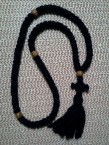
During this time, I came across the Greek Orthodox prayer rope (komboskini) that had been spontaneously removed from her person and given to me by the Mother Superior of the Paliani Convent in Crete a few years previously. Made of black wool yarn with one hundred intricately woven knots and a cross, it was not something I could easily wear in my everyday life. But as I was still lounging around in a black jersey nightgown, I put it on. I felt it on my skin and cradled between my breasts. Continue reading “Healing from beyond the Grave by Carol P. Christ”
Shakespeare’s Sister Revisited: A Circle of Female Lineage by Mary Sharratt

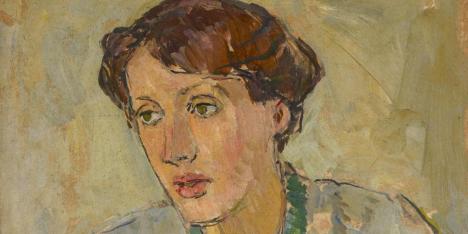
Vanessa Bell’s painting of her sister, Virginia Woolf

What do groundbreaking 17th century poet, Aemilia Bassano Lanier, and 20th century feminist icon, Virginia Woolf, have in common? A lot actually.

In her 1929 essay, “A Room of One’s Own,” Woolf imagines the tragedy of Shakespeare’s brilliant sister, Judith, barred from the grammar school because of her sex and forced to hide her writing from her family. To escape a forced marriage to a man she hates, she runs away to London to seek her fortune in the theatre, only to end up pregnant, abandoned, and destitute. Out of despair, she kills herself. Continue reading “Shakespeare’s Sister Revisited: A Circle of Female Lineage by Mary Sharratt”

Remembering My Saints by Katie M. Deaver

My mother and I have always been very interested in our personal connection to the spirit realm.  This connection, for us, is an important one.  We pay attention to the signs and messages that remind us of our continued connection to those we love who no longer occupy our own physical time and space.  Each cardinal, butterfly, and ceaselessly repetitive number (310 in our case) promises the continuation of relationship with the ones we miss so dearly.

A few years ago my mother and I were able to see a live show at the Chicago Theater featuring Long Island Medium Teresa Caputo.  Even with hundreds of people in the audience, specific moments of Caputo’s readings spoke to images and memories that resonated and connected to our experiences.  The show allowed us to once again be reminded of the continued connection between us and those special ones who we love and miss. Continue reading “Remembering My Saints by Katie M. Deaver”

Writing Through the Body: Betty Smith’s A TREE GROWS IN BROOKLYN by Joyce Zonana

 TreeGrowsInBrooklynIn her 1975 manifesto, “The Laugh of the Medusa,” French feminist Hélène Cixous urges women to write: “Writing is for you, you are for you; your body is yours, take it. . . . Women must write through their bodies, they must invent the impregnable language that will wreck partitions, classes, and rhetorics, regulations and codes . . .”

“The Laugh of the Medusa” remains a thrilling essay, challenging and inspiring women to “return to the body” and to language.  “Woman must write woman,” Cixous insists, “for, with a few rare exceptions there has not yet been any writing that inscribes femininity.”

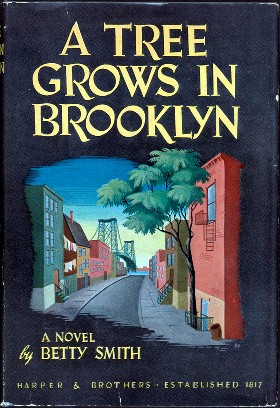
Although Cixous may not have been aware of it, Betty Smith’s beloved, perennially popular 1943 novel, A Tree Grows in Brooklyn is one of those “rare exceptions” that “inscribes femininity” in precisely the way she advocates. This autobiographical novel, so often dismissed as sentimental or as a children’s book, is actually written through the female body—which may explain its lasting popularity and power. Continue reading “Writing Through the Body: Betty Smith’s A TREE GROWS IN BROOKLYN by Joyce Zonana”

Public Art and Personal Transformation by Jessica Bowman


Public Art Sculptures

Borrego Springs, CA

Artist: Ricardo Breceda

Photo: Jessica Bowman


Public Art displays like the image above, a dragon that appears to be moving through the sand dunes of Borrego Springs, California offer tremendous insight into the time and era of the society when it was created, the surrounding community, the patron of the work and of course, the artist. In the case of this artwork and several other similar sculptures found in the barren but beautiful landscape within the Anza-Borrego Desert State Park the subject matter supports the wildness of the region and invites the viewer to consider the area before the impacts of modern civilization.  In this case, it isn’t difficult to imagine such an untamed time as there are miles and miles of sandstone, treeless mountains and desert brush with very few people anywhere to be found. Also in this case, the artwork is absolutely appropriate for the environment in which it is placed.

“If private art suggests an intimate exchange, public art gathers a congregation.  While I have observed that all art is to some degree public, pubic art merits its name in virtue of the fact that the creation of a public is its point of departure.  Public art presupposes the public sphere and produces a public in relation to that concept.  Unlike popular or mass art, it does not assume a preexistent generic audience to be entertained or instructed but sets out to forge a specific public by means of an aesthetic interaction.” (Hein, pg. 49)

Continue reading “Public Art and Personal Transformation by Jessica Bowman”