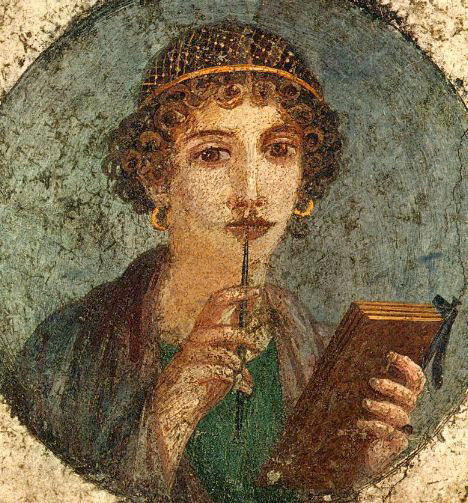
We have been taught to speak of war and the heroes of war in hushed tones. We have been told that evil Helen’s choice was the cause of the Trojan war. 2600 years ago Sappho, known as the greatest lyric poet of ancient Greece, spoke truth to power and unmasked the lies told at the beginning of western tradition.
*
In a poem addressed to Anactoria, Sappho writes:
Some say a cavalry corps
some say infantry, some, again,
will maintain that the swift oars
of our fleet are the finest
sight on dark earth …
Here, Sappho invokes the heroic tradition celebrated in the epic poems of Homer that shaped the values of ancient Greek culture and all the cultures that followed it, including our own. This tradition tells us that to serve in a war and to be remembered as a hero is the highest goal to which a man can aspire. Sappho does not agree:
Today our country and global community need religious leaders to utilize their theological education and feminist principles to model the formation of ally ships across ecumenical and interfaith perspectives, laying the foundation for a more just and peaceful society. While Reif and Nakashima Brock did not know each other, their feminist stance of commitment to social justice and praxis should give us pause.
In 2002, Claremont Graduate University and the Immaculate Heart Community collaborated and created an endowment to sponsor a Lectureship in honor of the memory of feminist teacher, scholar and activist, Dr. Patricia A. Reif. Each year the Dr. Patricia A. Reif committee invites cutting edge feminist scholars in religion to discuss the intersection of their research interests and its influence on their scholarship, activist work and teaching in the broader sense of the term, both inside and outside of the classroom. This year the Reverend Dr. Nakashima Brock is the select guest Lecturer to honor Reif’s life, memory, and legacy. Tammi Schneider, committee member and Dean of the School of Religion stated Nakashima Brock’s visit is timely because in three weeks the national U.S. presidential elections will define the trajectory of our country for, minimally, the next four years. Nakashima Brock’s involvement in the Occupy Movement on a local and national level extends from her feminist commitment and advocacy for the rights of the 99% of our country who are being squelched by U.S. policies that favor the elite 1% of our nation. For Nakashima Brock it is a moral imperative for persons of faith and goodwill to educate individuals and take a stand on policies, on a state and nation-wide level that safeguard the livelihoods of the majority poor of our country. For Nakashima Brock this means quality health care for all, living wages and decent jobs, free high quality public education through college, and an end to the prison-military-industrial complex. Continue reading “Social Engagement as Feminist Praxis in the lives of Patricia A. Reif & Rita Nakashima Brock By Teresa A. Yugar”
“I never told my grandmother I was gay. I’ve often wanted to visit her grave, clench my hands together, and pray that she forgive me for betraying the trust she instilled upon me long ago. However, even today, I cannot bring myself to make that trek, up the hill into the countryside where her ashes lay below the ground.”
I haven’t dreamt of my grandmother since her passing one hot summer July evening.
The night, and the days that followed, continue to be a blur. However, as my family members continue to see her in their nightly visions, I, go on unabatedly longing to see and hear the voice of a woman who made me feel the presence of the divine with each passing story.
My sister saw her in a dream when she was buying shoes, my mother has seen her multiple times when she would be undergoing a particularly stressful situation, and I, left alone and oftentimes wondering through an abyss of loneliness and disarray, wake up each morning wondering why, I am left all alone. Continue reading “Visions of My Grandmother by John Erickson”
As we approach the election period infused with controversy, saturated by television commercials, as well as endless advertisements on the radio, Internet, and yes, even Facebook, we must remember the sacrifices made by our foremothers during the suffrage movement, which gave women the right to vote. While all elections are important, this one has targeted issues involving women in a way that could negatively impact our rights – to the point of rewinding the clock on progress made in women’s equality during the last 40+ years. This election needs the voice of all informed voters. However, it is imperative for all women to make their voices heard this year by casting a vote. To turn a blind eye to these issues diminishes the sacrifices our foremothers made for us. To not cast a vote takes away your voice, makes you a silent bystander – something that was tried by the government and patriarchal system during the suffrage movement.
To illustrate this, I would like to highlight Lucy Burns and the Night of Terror endured at the Occoquan Workhouse by her and many of her friends. Of all Suffragettes, Lucy Burns spent more time in jail then any other protesters. Born 1879 in Brooklyn, Lucy was raised in the Roman Catholic tradition by a father who believed that his sons and daughters should be educated equally. Burns gradated from Vassar College in 1902, then attended Yale Graduate School studying linguistics. She eventually went to Oxford University in England to resume her studies. It was at Oxford that she became involved with activism and the suffrage movement. Continue reading “Lucy Burns, A Look at a Catholic American Suffragette by Michele Stopera Freyhauf”
Howling from the mountaintops
wailing from the riverbanks
scooping the moon into their waning wombs
the old women know that lies kill,
distortions maim, hope isn’t enough to feed starving
babies, school the ignorant, put an end to war.
Like Furies, the old ones rise,
clench their furious fists against the blazing sun;
like Harpies they roar, casting dire warnings
upon the winds of change; soothsaying Sibyls
decipher omens, portend the future, speak in baffling koans.
With dakini wisdom they cut through
illusion, vote in primaries, attend caucuses,
raise their voices against power, shatter
the corrupted ceilings that chafe the crowns
of their wizened heads.
The wandering Maenads cry: “This is no country
for old women.”
Medea calls down her midnight powers,
prays for revolution, strengthens the tired tongues
of memory. Eloquence isn’t enough to heal
a wounded country; sequined celebrities
can’t mend a nation’s odiferous past. Kali avenges
her sisters, the long-patient Queens & Crones,
Maidens & Mothers. The forgotten ones
wait and watch and warn: “Beware the hubris
of ages. Beware the greedy hand that grabs the golden fleece.” Continue reading “Sacred Outcry: A Poetic Trilogy by Mary Saracino”
During July 8-11, 2012 twenty Catholic feminist leaders met in a retreat center near Baltimore to discuss their concerns and hopes in the light of the recent and ongoing attacks of Catholic bishops on women and especially on feminist work in the church. The group consisted of representatives from many sectors of Catholic institutions and movements. There were the founders of a peace and justice movement of the Sisters of Charity and the Institute for Communal Contemplation and Action. There was a pastor and leadership trainer from an alternative parish and a writer for the National Catholic Reporter.
Many in the group were professors of theology or ethics at Catholic, Protestant or state schools. Among them were teachers at Whittier College, Claremont School of Theology, Santa Clara University and San Jose University in California, Loyola University in Chicago, St. Catherine in Minnesota, Drew University in New Jersey and Boston College. Catholic reform movements were well represented, with leaders from Dignity, the Women’s Ordination Conference, Call to Action and RomanCatholicWomenPriests. There was a teacher at Marymount School in New York City, the President of Marymount School in Los Angeles and a doctoral student in theology. Continue reading “Catholic Feminists Meet, Strategize by Rosemary Radford Ruether and Theresa Yugar”
I forgot, that relationships, like feminism, are not easy, and that it is a conscious and continual effort of renewal to remind yourself everyday why you love the person you love and more importantly, in the case of feminism, why you fight, “the good fight.”
I was once told by my ardent feminist advisor in undergrad to “not put all my proverbial eggs in one man basket” after discussing my relationship with my boyfriend over a cup of coffee. Thinking my relationship was different and that we were special, I heeded the warning but thought of it no further. Now, looking back on it three in a half years later, I wish I would have.
Relationships are a powerful tool. They help to make you feel special. They help to bring you joy. They help you discover the reason why a divine presence may have endowed us with the ability to love and most importantly they help you realize and discover things about yourself you may have never taken the time to notice.
Feminism 101 is more than just the pop culture stereotype of a bunch of women advising the younger generation of girls to be weary of men and the pain they can bring. Feminism, specifically as what I now call Feminism 101, is the transformative ability to listen to your elders, trust yourself, and ultimately, if you happen to trust in the relationship you have built, knowing deep down that it is built on equality, love, and trust. Continue reading “Why I Failed Feminism 101: Gender, Sexuality, and the Power of Relationships”
“Yo soy mujer en busca de igualdad, no aguantar abuso ni maldad. Yo soy mujer y tengo dignidad, y pronto la justicia serd una realidad. Mujer, tù eres mujer, porque supiste ver, la realidad de tu poder. Hoy canto al Dios del Pueblo en mi guitarra, un canto de mujer que se libera” – From “Mujeristas: A Name of Our Own!” – Ada María Isasi-Díaz [i]
Translation: I am woman searching for equality; I will not put up with abuse and wickedness. I am a woman and I have dignity, and justice will soon be a reality. Woman, you are woman, because you have known how to recognize the fact that you are powerful. Today I sing to the God of my people with my guitar, I sing a song of a woman who liberates herself.
Labels, names, and categories can evoke prejudice and oppression. Ada Maria Isasi-Díaz, the founder of Mujerista Theology, wrote:
To be able to name oneself is one of the most powerful abilities a person can have. A name is not just a word by which one is identified. A name provides the conceptual framework and the mental constructs that are used in thinking, understanding and relating to a person.[ii]
These words relate to U. S. Hispanic women, who, according to Isasi-Díaz, struggle against ethnic prejudice, sexism, and in many cases classism [and who] have been at a loss as to what they should be called.[iii]In finding that common name, lyrics from three different songs inspired Isasi-Díaz who developed the term “Mujerista Theology,” replacing Hispanic women’s liberation theology:
“Yo soy mujer en busca de igualdad, no aguantar abuso ni maldad. Yo soy mujer y tengo dignidad, y pronto la justicia serd una realidad. Mujer, tù eres mujer, porque supiste ver, la realidad de tu poder. Hoy canto al Dios del Pueblo en mi guitarra, un canto de mujer que se libera”[iv]
For Isasi-Díaz, mujerista unifies Hispanic women and embodies strength. Mujeristas are those:
Ada Maria Isasi-Díaz Picture From Drew University’s website
Who desire a society and a world where there is no oppression.
Who struggle for a society in which differences and diversity are valued.
Who know that our world has limits and that we have to live simply so others can simply live.
Who understand that material richness is not a limitless right but it carries a “social mortgage” that we have to pay to the poor of the world.
Who savor the struggle for justice, which, after all, is one of the main reasons for living.
Who try no matter what to know, maintain, and promote our Latina culture.
Who know that a “glorified” self-abnegation is many times the source of our oppression.
Who know women are made in the image of God and, as such, value ourselves.
Who know we are called to birth new women and men, a strong Latino people.
Who recognize that we have to be source of hope and of a reconciling love.
Who love ourselves so we can love God and our neighbor.[v]
For Isasi-Díaz, Mujerista Theology is defined as:
“a process of enablement for Latina Women, insisting on the development of a strong sense of moral agency, and clarifying the importance and value of who they are, what they think, and what they do….mujerista theology [also] seems to impact mainline theologies, the theologies which support what is normative in church, and, to a large degree, in society.”[vi]
The altar was not for particular spirits, but honored all the ‘spirits’ we brought with us to share: the spirits of the women and men in our stories, the memories imbedded in the items we gathered together and the spirit of every person present in the class that day.
Last week my students and I created a non-religious altar to conclude our class, Women, Religion and Spirituality. We read about different feminist spiritual traditions in which women created altars to honor their ancestors, spirits or deities; and I thought it might be fun to practice our own form of literal physical creation. I asked students to bring in inspiring items, pictures of people who’d helped them to grow or anything that honored what they considered sacred in their lives. I also asked them to bring food to share, as no altar seems complete without food of some kind. However, asking my students to participate in a course ritual, I also felt it was important to respect their very different beliefs… which resultantly, left me wondering how we would create an altar without God.
My religious experience taught me that altars were a place to surrender gifts in return for a greater gift of God’s blessing or love. The church I attended as a child did have a literal, physical altar; but this raised table was only used monthly to present the communion bread and grape juice before it was passed through the pews. Otherwise, I came to understand, one’s heart was the altar and we needed to present our sacrifices there. Financial gifts needed to come from the heart, then put into the offering plate. Gifts of time or action had to start in the heart, even when required by the youth group or spiritual authority; and resistance to giving these gifts also required sacrifice. My resistance or lack of desire to sacrifice required that I leave my unwillingness at the altar so that I might become appropriately grateful.
The depth of life’s interconnection is our greatest vulnerability and our greatest hope. We are beings in relation.
Today we celebrate Mother’s Day. Drenched in some strange amalgam of consumerism and genuine desire to nurture the ones who have nurtured us, we buy flowers and gift cards. We plan Sunday brunches or make that extra-long phone call to our mothers living far from us. My own mother, to whom I owe my courage and creativity, lives two thousand miles away. It was she whose breath gave rise to my own, whose gentle strength and fierce passion made way for my being in the world. It is my mother to whom I trace my beginning, and yet, if life is as Anais Nin imagines it, a “process of becoming” are we not ever-beginning? If all life itself is in process, if the powers of destruction and creation flow, creating and re-creating all that is, I wonder at the wombs that make and re-make us.
This process of becoming is an adventure through the whirlwind, a tour of the chaosmos. Our becoming, wrapped up with the becoming of Creation itself, is an unwinding of the fibers of the universe and our own souls, spiraling toward liberation. And so, on this Mother’s Day, I offer gratitude and honor toward all that gives us birth, to all who take part in our process of becoming.
Wave Womb by Galen Dara
In honor of ourselves. There is a sense that each of our beginnings emerges out of a wound, out of a dying. The day I was born was the day I received my first scar. I was a C-Section baby and the doctor nicked the edge of my forehead narrowly missing my eye. Soon enough, the wound healed and I still have a tiny scar by my right eye. Today, many years and many scars later, I marvel at our ability to heal. We give life to ourselves, after the movements of death have swept through us, after long nights of grief and the collapse of all we knew. In the quiet stillness of a soul razed, creativity moves. Continue reading “In Honor of All that Gives Life by Ashley Anderson”



 Continue reading “Sappho Chose Love Not War, What Will You Choose? by Carol P. Christ”







 Feminism and Religion