
Breathe with me.
I know. I know. I understand.
Breathe with me anyway.
It hurts. It’s scary. It’s horrible. It’s relentless. I know.
Just breathe.
Every time we breathe out, our bodies release things we do not want.
So breathe it out. All of it. Let it go.
Deep breath. However you prefer—mouth, nose—just breathe.
What do you need to let go?
For me right now, there’s rage.
All the people refusing the masks, refusing the vaccine, even friends of mine who have watched me suffer with post-COVID syndrome for almost a year, still blaming me somehow for my illness.
Breathe. Let it out. Don’t have to carry it anymore.
There’s fear, too — friends, family, fighting COVID, or taking dangerous, unnecessary risks.
Long, slow breaths. Release. Into the loving matrix of Creation-Life-Love. I can’t hold this anymore. I release it.
There’s grief. Loss. Suffering. Isolation. Pain. Oh, breathe, let the tears flow, let the breaths and the tears just be what they are.
Stress. So much stress. We’re all frayed, so far beyond our limits. Breathe it out. Breathe it out again. Deep breaths – make noise if you want. Moan.
She cradles us in breath, the Divine Womb. She is the Source of our breath, and She is always cradling us, always breathing with us.
Breathe again. Close your eyes. Let your Holy Spirit bathe you in its healing power.
But it doesn’t fix anything, doesn’t DO anything!
I know. But it is enough. Just let it be. Be breath breathing itself.
What if you deserve to let go?
What if you deserve to be cradled in healing Love?
What if you deserve just to be?
Breathe. It sometimes feels so nice. Breath in, breath out.
Your body is letting go of anything you do not want.
You can release it now. Breathe it out. It’s ok.
Anywhere you want to feel your breath is ok. Wherever you want it to go, just breathe it there, and then release.
There’s no way to do this wrong. It’s your breath. It’s your breathing. A gift your body has, a magical, powerful, simple, holy gift. Breathe however feels good and right to you.
No rush. Take your time. As long as you want. As often as you want.
What if you deserve compassion?
What if you deserve to be bathed in healing Love?
What if you deserve to rest in your breath?
Breathe, darling. Close your eyes if you like. With every breath, you are holy.

In my Methodist tradition, which focuses heavily on the Holy Spirit, we sing a breathing hymn I love. Here is my rewritten version:
Breathe on me, Breath of Love,
fill me with Life anew,
restore my soul with ev’ry breath,
to do what Love wouldst do.
Breathe on me, Breath of Love,
so shall I rest, secure,
cradled in Love’s bright healing peace,
and held in compassion pure.
Breathe on me, Breath of Love,
till I am wholly thine,
till body, spirit, all of me,
glows with thy Fire divine.
Breathe on me, Breath of Love,
until my heart is free,
and I perceive my ev’ry breath
is thine Eternity.
—Edwin Hatch (1878), revised.
Our world is so frayed right now. We are all at the end of our rope. We feel the same way most new mothers feel in capitalist patriarchies, in which motherhood means financial strain (or poverty), isolation, anxiety, constant demands, an inability to meet basic physical and mental health needs, and no escape from continuous, relentless emotional and physical labor. Women are expected to embrace this level of self-sacrificial stress in motherhood, as part of our female slave role in capitalist patriarchy, which defines our unpaid, unvalued labor as a natural extension of our biological sex. The burden on women is higher than ever these days, with women and even girls taking the lion’s share of extra household duties so that boys and men can continue in their education and careers. Women are suffering 100% of job losses as well.
In times like these, I keep turning to my faith for comfort and strength. In my tradition, the Holy Spirit is the Divine Breath, the Source of Life, which animates all living things and all Creation as sacred. It comes originally from the Hebrew “ruach,” a feminine noun. So when I take time just to breathe, that is sacred time, allowing my true, divine self to feel its divinity (as Methodism’s founder John Wesley might say). I do not take breathing for granted. After my COVID experience, how could I ever take it for granted again? So, for me, breathing time is holy — “set apart” as a communion, a Eucharist of Grace: life-giving, healing, restorative, and liberative. Almost every night for the past eleven months, I have spent time lying in bed just breathing: feeling the breath of the trees behind me in the woods, allowing their wellness to enter me, breathing out to them whatever I want to let go. In breathing this way, I am able to understand bodily that my breath is Goddess. Goddess who is ever birthing Love and Liberation. The Divine Source of All, who is every justice, every healing, every restoration. My breath is fair economies and safe respected female bodies; it is just relationships and female thriving. This is my breath. This is the Source of the Healing that rebirths every death into Life. This is Goddess.
So, breathe with me, sisters. And brothers. She is here, and we are the ones who breathe her. What if we deserve to be bathed in Healing Love? She knows. She understands.
Just breathe.
Trelawney Grenfell-Muir teaches courses about Sex, Dating, Marriage, and Work in the Religion and Theological Studies Department at Merrimack College and about Cross Cultural Conflict in the Department of Conflict Resolution, Human Security, and Global Governance at the University of Massachusetts, Boston. A Senior Discussant at the Religion and the Practices of Peace Initiative at Harvard University, she holds an M.Div. from the Boston University School of Theology with a concentration in Religion and Conflict, and a Ph.D. in Conflict Studies and Religion with the University Professors Program at Boston University. She currently writes articles, book chapters, and liturgical resources about feminist, nature-based Christianity.


 This is an encore performance of a satire I wrote in November 2019, when I thought Trump’s sociopathic behavior was at its height. Little did I know. Little did we know. Only a year later, following the 2020 election, we watched him lie and deny, spread conspiracy theories, and finally encourage his true believers to invade the Capital and “stop the steal.” It’s good to see that President Biden is a normal person who knows what presidential behavior and work really are. A small example: right after the inauguration, we watched him signing executive orders. Did he use a Sharpie? No. Biden used (and still uses) a normal pen to sign his name. And he doesn’t wave an illegible signature at the TV cameras.


 If we begin from the hypothesis ancient Crete was matriarchal, matrifocal, and matrilineal, what would we expect to be the central focus of the its religion?* Harriet Boyd Hawes and her colleague Blanche E. Williams presented an incipiently feminist, woman-centered, analysis of the religion of ancient Crete in Gournia, the book describing their excavation of a Minoan village at the beginning of the twentieth century. Boyd Hawes argued that the archaeological evidence showed not only the pre-eminence of the Goddess, a conclusion with which Williams agreed, but also the strength and independence of women in a culture she defined as matriarchal and matrilineal, centered around the Mother family. If ancient Crete was matrilineal, matrifocal, and matriarchal, we should expect to find evidence that women were not only strong and independent, but also that they had leadership roles in religion and culture. Williams noted the presence of priestesses. The miniature frescoes from Knossos show a group of older women sitting in the place of honor and a group of women performing a ritual dance. Where evidence concerning leadership roles is lacking, it should not be assumed that leadership must have been in the hands of men.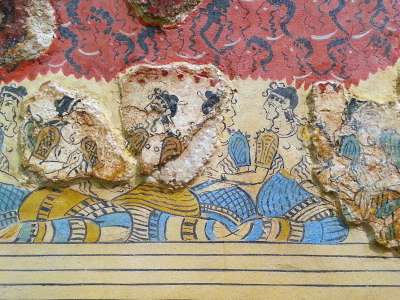


 When I went to the hospital for chemo on Thursday, the doctor told me it would be my last one. That was a surprise. I thought I would have at least one more. But it was a good surprise, because I had felt more tired than usual after my most recent treatment. Apparently, I had started to feel a bit better when my cancer became inactive, but chemo is cumulative, and it caught up with me.
