I am mad by Mama Donna Henes

Donna Henes, Urban Shaman, Queen of my self, crones,

I am mad. So very mad. No, that doesn’t begin to describe it. I am pissed. I am angry. I am irate. I am incensed. I am outraged. I am enraged. I am livid. I am GODDESS DAMN FURIOUS.

“All men are created equal,” states the Declaration of Independence. From the very beginning, women were denied equality in this country. It has taken over two centuries for women to win the right to vote, to have alleged protection under the law, to earn as much as 68 and 77 cents on the dollar (depending on our skin color) that men are paid, and to gain control over our own bodies and destinies.

And now, nearly 250 years later, we are seeing our rights, our freedoms, our health care being stripped away, one by one, by mean spirited, misogynistic, right wing religious uber-conservatives. In 2015 there is still no Equal Rights Amendment. Women are still not equal under the law. Continue reading “I am mad by Mama Donna Henes”

Covenanting Justice. Covenanting Joy. by Margot Van Sluytman

MargotJustice as a lived and living experience is a poem. Is a song. And as a song it is filled with all manner of rhythm, of texture, and of sound via melody and lyric which affects us in an infinity of ways. The voice of poetry is the voice of The Song of Songs. It is a voice of invitation. Chapter Two of The Song of Songs is an invitation to strangers to Scripture. Strangers who want to feel a rhythm of joy, of loving embrace of tender and generous welcome. The gravity of the language is its graceful invitation to be seen, to be gazed at, to be heard.

My own vocation as a Sawbonna/Restorative Justice practitioner and a Therapeutic Writing facilitator, has blessed me with the opportunity to share words, via Word, in many different places and spaces around the Globe. The word that I use for justice as a lived and living experience is: Sawbonna. Sawbonna is a Zulu greeting that means I see you. You see me. I hear you. You hear me. Sawbonna contextualizes Restorative Justice in the crucible of our connectedness. Sawbonna, which is the essence of Chapter Two of The Song of Songs, clears the way for engagement, via words, with Word. Continue reading “Covenanting Justice. Covenanting Joy. by Margot Van Sluytman”

I Am A Woman’s Poet by Marie Cartier

MarieCartierforKCETa-thumb-300x448-72405This is the first poem I ever wrote and had published.

I wrote it in the early 80s at the height of the second wave of Women’s Liberation.

Having just returned from the final Michigan Womyn’s Music Festival, I publish it here with FAR today as an homage to that time period, to those women (myself among them), to many “womyn with a ‘y,’” and what we accomplished—battered women’s shelters, rape crisis centers, health clinics, women’s studies programs, bookstores, festivals, music and culture etc. etc.

Much of what we accomplished is because we learned to listen to each other’s repetition until, as Nelle Morton said, we “heard each other into speech.” Continue reading “I Am A Woman’s Poet by Marie Cartier”

Is There a Such Thing as a Code of Ethics in Academia?  by Michele Stopera Freyhauf


One of things that has dismayed me since I began graduate school and started focusing my study on the Bible, is how much sensationalism exists. We are told in the academy not to use Wikipedia or watch the History Channel. The first, as we know, is unreliable due to the fact that anyone can enter information and make changes. The other caters to the general public. What compounds this problem is the fact that scholars, many times – even reputable ones – appear on these shows. Sometimes creative licenses are exercised by the producer distorting or otherwise shifting the message of what the scholar was trying to explain. Other times, scholars will just give the producers and the public exactly what they want to hear and thus perpetuating myths rooted in literalism.

Alpocalypse_Cave
Cave in the Church of the Apocalypse in Patmos, Greece

This is not the only time this issues manifests.  The other time I encountered this is when I travel to sacred or holy sites in the Middle East.  The people in charge of sites may want raise money and increase tourism – so they give the people what they want.  What do I mean by this?  Walking into a place that has a story whether true or not provides pilgrims a sense of awe and wonder.

Certainly I am not saying that this experience should be diminished or should be taken away. What I am saying is that we should be a bit more truthful in our descriptions and remove the shroud of literalism that seems to fuel tourism and not faith. What was difficult for me when visiting Patmos is the rhetoric surrounding the island. It may or may not have been where John had his visions, but certainly the mystique surrounding the Church of the Apocalypse seems to perpetuate the literalism that surrounds the Book of Revelation as being prophetic in dealing with the end times.  Moreover, the vendors around the Church certainly focus their merchandise to support this myth.  However, while I study the Book of Revelation and teach that it is something other than prophetic, a person visits the island and the church, are told that it is prophetic – who is a person to believe?   Me or the religious order running the Church or the vendors living on the island?

This also happens at dig sites.  If a tourist is led by a guide or lead at a holy site being excavated and they tell them what they want to hear so they come back and tell their friends, who has more creditability – me or the person who guides on the site?  When scholars like myself, write about a topic that seems to gel with what the commonly held view of the academy, and goes against literalism or fundamentalist beliefs, we become heretics in relation to the information being fed by the sensationalism on the History Channel and the tourist industry.  So the popular view does not change and the academic view is left on the margins and Biblical literalism wins.

Continue reading “Is There a Such Thing as a Code of Ethics in Academia?  by Michele Stopera Freyhauf”

Francis: My Holy Conundrum by Linda Pinto

Linda PintoChicago enjoys a long history of women whose voices echo a call for dignity and equality.

Jane Addams was a pioneer American-settlement social worker, public philosopher, sociologist, author, and leader in women’s suffrage movement. In an era when presidents such as Theodore Roosevelt and Woodrow Wilson identified themselves as social activists, Addams outshined them as one of the most prominent reformers of the Progressive Era.

Ida Bell Wells was an African-American journalist and newspaper editor, a sociologist, and an early leader in the women’s as well as civil rights movement. Notably and disturbingly, she courageously documented lynching in the United States, showing that it was often used as a way to control or punish blacks who competed with whites.

Frances Xavier Cabrini was an Italian nun, who founded the Missionary Sisters of the Sacred Heart, serving the Italian immigrant population in Chicago. Despite the lack of support by bishops and clergy alike, her groundbreaking outreach to the poor and marginalized, earned her the privilege of being the first naturalized citizen of the United States to be canonized by the Roman Catholic Church.

More contemporary Chicago feminist prophets include Tina Fey, Jennifer Hudson and Chaka Kahn. And, I would be remiss not to invoke the names of the Holy Trinity of contemporary Chicago women saints….Hillary Clinton, Michele Obama and Oprah Winfrey.

So, now we focus on Francis, who I call my Holy Conundrum.

His words are, indeed, impressive….listen to what he says…..

The best wines come from every person who risks everything on love.

Things have a price and can be for sale, but people have a dignity which is priceless.

Let the church always be a place of mercy and hope where everyone is welcomed, loved and forgiven.

It is vital that government leaders and financial leaders take heed and broaden their horizons working to make sure that all citizens have dignified work, education and healthcare.

Finally,

Let us not be afraid to say it: we want change, real change, structural change. We want change in our lives, in our neighborhoods, in our everyday reality. We want a change which can affect the entire world, since global interdependence calls for global answers to local problems. The globalization of hope, a hope which springs up from peoples and takes root among the poor, must replace the globalization of exclusion and indifference!

Makes one wonder….

Does Francis truly intend to inspire the church to become the open window of John XXIII, letting in the fresh air of the Spirit or does he represent an institutional dose of air freshener; hoping we would smell the roses rather than the stench of a clerical system which, at best isolates women and at worst, renders them invisible? Continue reading “Francis: My Holy Conundrum by Linda Pinto”

The Book Is Finished, Now On to Publicizing It by Carol P. Christ

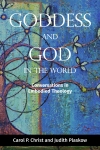
Carol in Crete turquoiseGoddess and God in the World: Conversations in Embodied Theology by Carol P. Christ and Judith Plaskow, forthcoming from Fortress Press in 2016.

In Goddess and God in the World, two leading theologians model a new method of embodied theology, rooted in experience and tested in dialogue. Christ and Plaskow agree that the God who is dead in our time is the transcendent and omnipotent male God of traditional theology. They believe that we must create new understandings of divinity because theologies not only help us to make sense of the world, but also provide guidance as we face the urgent social, political, and environmental issues of our time. In contrast to traditional views, Plaskow and Christ situate divinity in the world and place responsibility for the fate of the world firmly in human hands. They argue for an inclusive monotheism that affirms the unity of being through a plurality of images celebrating diversity and difference. Carol believes Goddess is the intelligent embodied love that is in all being, a personal presence that can inspire us to love the world more deeply. Judith understands God as an impersonal power of creativity, the ground of being that includes both good and evil. Their intense questioning of each other’s views provides an exciting model for theological conversation across difference.
Continue reading “The Book Is Finished, Now On to Publicizing It by Carol P. Christ”

And Then There Was Sita by Vibha Shetiya

VibaWe have been hearing a lot about Kali and Durga lately, manifestations of the great goddess (“Kali Ma,” by Jassy Watson, July 3; “What Would Durga Do?” by Barbara Ardinger, August 2). Nancy Vedder-Shults’ three-part series on Kali (August-October, 2014) too helped shed light on an often misunderstood deity. Both Kali and Durga personify the power or shakti within women, a force that can be empowering and terrifying at once. Kali represents uncontrolled female energy, whereas Durga is portrayed as one in control of her abundant power. These images, especially the one of Kali are double-edged; they can prove problematic for women insofar as – from the male perspective – they confirm the fact that women possess an alarming energy, especially a sexual one, which in turn justifies the need for men to subdue them.

Sita's abduction by Ravana. Artist: Raja Ravi Verma
Sita’s abduction by Ravana. Artist: Raja Ravi Verma

Within this context, I would like to talk about Sita, who, one could argue, is the antithesis of the two. Sita is the gentle wife of Lord Rama, hero of the Ramayana, a two-thousand year old Sanskrit epic. In the Ramayana, Rama, the crown-prince of Ayodhya, is exiled to the forest for fourteen years. His loyal and faithful wife, the princess and goddess Sita, insists on accompanying him to the wilderness. There, the demon king, Ravana kidnaps her leading to a battle between Rama and Ravana. Almost a year and thousands of casualties later, Rama succeeds in slaying Ravana and reclaiming Sita.

But alas, Rama rejects his wife in the presence of the hundreds of onlookers, eagerly awaiting the reunion of the couple, on the grounds that her chastity was suspect; after all, says Rama, surely Ravana couldn’t have resisted her ravishing beauty? If she is to be worthy of Rama, Sita has to undergo a trial by fire to prove that she had indeed remained chaste throughout her captivity. Although she passes with flying colors, Rama eventually gives in to gossip and banishes her to the wilderness a few years later – while she is pregnant with his twins – where she is left to die (she, however, does not). Continue reading “And Then There Was Sita by Vibha Shetiya”

The Great Dragon, Níðhöggr by Deanne Quarrie

Deanne Quarrie, D.Min.I am a student of the Northern European/Old Icelandic worldview known as Seidr. What I find particularly fascinating in my studies are not the deities but rather the creatures living on the World Tree, along with the Primordial Giants who predated the gods. One such creature is Níðhöggr, the “Derision Striker.” Níðhöggr is a great dragon who lives at the base of Yggdrasil, the World Tree. She gnaws on the roots of the tree, stimulating new growth. Her home stretches from icy Niflheim, near what is called the “Roaring Kettle”, the sacred well of all the rivers of Niflheim, all the way to Dead Man’s Shore in Helheim where she devours the piled corpses.

NíðhöggrNíðhöggr embodies the principle of rot, which is that all things must decay to make room for those things that are new. It is Níðhöggr’s job to clean up the mess! She is involved in acts of undoing. She reminds us of the impermanence of life and that eventually, all that is must become undone. It is important to know this so that we can be prepared for unexpected or difficult changes in our lives.

Níðhöggr is there to devour nasty things in one’s self, both physical and emotional. She is there to take away anything that no longer serves us, as long as we are willing to give it to her. She also is there to help anyone working to clean up the environment, especially from our own pollution.

Many fear Nidhogg because of the job she must do but without this part of the life cycle there would be no cycle at all. We make every effort to hide things that are unpleasant. We flush our human waste into our water supply instead of simply giving back to the Earth where we can restore it and use it as nourishment for new life. Menstrual blood is hidden away as if somehow shameful. We hide all that is ugly or that which makes us uncomfortable. And so it is too, with creatures and characters in mythology. Somehow in our dualistic world, the lines between good and bad, negative and positive are clearly drawn. So often those things we suppress, hide and call negative are actually, what save our lives. They are the things in our basic natural spirit that propel us forward into becoming better human beings.

Níðhöggr also serves us as a moral agent, reminding us that our own cruelty, especially harmful acts that undermine another’s sense of self. Bullying behavior is a good example. She reminds us that our actions always have consequences to the energy of the whole, not just our own lives.

Her work is much like that of the vulture, a bird so ugly it is beautiful. I have always thought of vultures as the great recyclers, returning what is lifeless and no longer useful back to the Earth to make ready for new growth.

She is truly all about roots, and keeping them clean. As that, she reminds us that real strength is found in one’s roots.

In her story, at the end of days, Níðhöggr chews through a root and upends the World Tree. Clearly if this were the root upon which all else depended, the mighty tree would fall. Perhaps this would represent our own failure to clean up after ourselves, both in our own lives as well as here in this place we call home, the Earth.

Deanne Quarrie. D. Min. is a Priestess of the Goddess. She is the author of five books. She is the founder of the Apple Branch where she teaches courses in Feminist Dianic Witchcraft, Northern European Witchcraft and Druidic Shamanism. She mentors those who wish to serve others in their communities. She is also an Adjunct Professor at Ocean Seminary College and is the founder of Global Goddess, a worldwide organization open to all women who honor some form of the divine feminine.

The Dog Days of Summer by Carol P. Christ

Sirius in the Sky


Sirius rises late in the dark, liquid sky
On summer nights, star of stars,
Orion’s Dog they call it, brightest
Of all, but an evil portent, bringing heat
And fevers to suffering humanity. –Homer, The Iliad


The dog days of summer are associated with the reappearance of the brightest star in the sky, the “dog star,” also known as Sirius, just before dawn from July 23 until August 23. This star heralds the days of the most intense summer heat. Though this is the time of the summer harvest in Mediterranean cultures, it a time of death. Energy wanes. The grasses have dried out on the hillsides, plants in gardens will die too unless they are watered. The healthy “sit out” the heat of the day with closed shutters, while those who are old or very ill often give up the ghost. They say that this is also a time when babies are conceived during long and languid afternoon naps.

The Greater Mysteries of Demeter and Persephone were celebrated at the end of this period, and the Greek Orthodox festival of the Dormition (Death) and Assumption (Rebirth) of the Panagia (the Virgin Mary) echoes an ancient rhythm.

This year I have spent most of the dog days in air-conditioned rooms, feeling little inclination to brave the heat of the day even for a refreshing swim in the sea. During this time, Judith Plaskow and I completed the final draft of the manuscript of Goddess and God in the World and submitted it to our publisher: a midsummer harvest!

To be truthful, I also spent many of the dog days days glued to my computer watching reruns of D.C. Banks and Blue Murder. These days of rest were good for the knee I had injured earlier in the summer, which now is almost healed. They must have been good for my spirit as well, for a friend who had not seen me since late spring told me that I looked refreshed and renewed.

In nature, the death days of late summer are followed by rebirth. At the very time when the sun is at its most intense, the days become shorter—first imperceptibly, and then quickly. While sun “stands still” for several months, setting at more or less the same time before and after the Summer Solstice, all of a sudden (or so it seems), the sun sets half an hour earlier. From then on, it sets several minutes earlier each day: a clear indication that fall is on its way. Before long, the rains come and the hillsides become green again.

beachttime in anaxos by Andrea Saris

For me, August 14, celebrated in Greece as the day of the Dormition of the Panagia, marks the beginning of the end of the intense heat of midsummer. Yesterday, on this day, with some trepidation, I packed my dogs into a hot car and headed for the sea. Our favorite tavern was empty and a light breeze coming from the sea tempered the heat. A friend arrived unexpectedly, and—joined by my intrepid miniature schnauzer—we enjoyed a swim so refreshing we didn’t come out of the water until our fingers became wrinkled. Just before sunset my friend and I met again to ascend the stairs to the shrine Church of the Panagia on the Rock to light candles for Rebirth and Renewal, ending our day with dinner by the sea.

As I write the next morning, I feel poised on the edge of rebirth and regeneration. I don’t yet have new ideas in my mind, nor do I have the fullness of energy I know will continue to return as the heat wanes. I look forward to the coming of fall and await new green shoots of inspiration in my life and my work.

carol mitzi sarah

Carol P. Christ leads the life-transforming Goddess Pilgrimage to Crete (facebook and twitter).  Carol’s books include She Who Changes and and Rebirth of the Goddess; with Judith Plaskow, the widely-used anthologies Womanspirit Rising and Weaving the Visions and forthcoming in 2016 from Fortress Press, Goddess and God in the World: Conversations in Embodied Theology. Explore Carol’s writing. Photo of Carol by Shanti Jones. Photos of beach at Anaxos by Andrea Sarris.

My Problem with the “Proverbs 31 Woman” by Elise M. Edwards

elise-edwardsIn my home, in my journals and notebooks, and in my office, I display proverbs and quotes of all kinds around me to inspire me to live meaningfully. Proverbs and fables from around the world are stacked on my bookshelves and bedside tables. I love reading what is called “wisdom literature” in the Christian Scriptures. But when I get to those final lines of the Book of Proverbs in the Bible, Proverbs 31 sets me on edge.

Proverbs 31 is a poem that begins with sayings of King Lemuel described as “an inspired utterance his mother taught him.” Lemuel’s mother instructs him to not spend his strength on women, to refrain from drinking and to defend the rights of the poor and needy. Verses 10-31, the ones I’ve heard most often read in church settings, follow that advice. They are an acrostic poem of verses that begin with the successive letters of the Hebrew alphabet to describe a noble wife. Instead of reciting the entire A-Z list (A is for adoring, B is for busy, C is for caring, D is for dutiful…), Christians will frequently read aloud only the verses selected below.

Epilogue: The Wife of Noble Character

10 A wife of noble character who can find?
She is worth far more than rubies.
11 Her husband has full confidence in her
and lacks nothing of value.
12 She brings him good, not harm,
all the days of her life.

25 She is clothed with strength and dignity;
she can laugh at the days to come.
26 She speaks with wisdom,
and faithful instruction is on her tongue.
27 She watches over the affairs of her household
and does not eat the bread of idleness.
28 Her children arise and call her blessed;
her husband also, and he praises her:
29 “Many women do noble things,
but you surpass them all.”
30 Charm is deceptive, and beauty is fleeting;
but a woman who fears the Lord is to be praised.
31 Honor her for all that her hands have done,
and let her works bring her praise at the city gate.

I’ll admit it–the woman described here does sound honorable and praiseworthy.   My problem with this poem has more to do with the way I’ve heard it used than its content. In all but one setting, I’ve heard these verses proclaimed as a model for the ideal woman or as a guide to virtuous living for young women.

My first concern about that is a common feminist criticism: Not all women aspire to be wives and mothers. Some of the poem’s statements could apply to all women, like verse 21: “She opens her arms to the poor and extends her hands to the needy.” But others are specific to marital domestic life, like verse 28 (above) and verse 15: “She gets up while it is still night; she provides food for her family.” Women without husbands and children cannot meet all Proverbs 31’s standards. And while family is of primary importance to many women, it is not the only area of a woman’s life that can provide her value and meaning.

I am also concerned that defining Proverbs 31 as a standard of womanhood communicates the idea that it is about women only. While there are references to tasks that have been traditionally gendered (women cook and sew, men take leadership roles outside the home), many of the qualities extolled here are commendable for adults of all genders. Strength, dignity, wisdom, and care are not gender-specific virtues. So why haven’t I heard this proverb set as an example for men, too?

My third concern about making this a guide to womanhood is that it seems to reinforce a standard of perfection. The Proverbs 31 woman is certainly industrious—no one can call her idle! But she also sounds exhausted. By my count, this woman does 23 things surpassingly, including buying fields, planting vineyards, making clothes and selling them. I’m concerned that when emphasizing the Proverbs 31 woman tells Christian women that they are not good, are not lovable, or are not enough until they meet this standard. For me, the message of the Christian gospel is about God’s radical, all-encompassing love for humanity in the face of our imperfection. While I do know some women with a healthy self-image, many are painfully aware that they do not meet some standard set for them. They could stand to be told more often that they are loved simply because they exist, not for what they do.

When I heard Proverbs 31 read at my Aunt Ruby’s funeral , I began to see something more meaningful in these words than an impossible standard for women to attain. The preacher quoted “She is worth far more than rubies” noting my beloved aunt’s name and her character. However, the message he preached that day wasn’t to set a standard of a good wife. It was to honor a woman who had lived a noble life. She was strong, dignified and wise. Her family knew she was blessed and that they were blessed by having her in their lives. She worshiped God and communicated her love of the Lord to successive generations.

When I heard Proverbs 31 spoken about my aunt, I began to find resolution to my concerns. In that setting, the poem was an affirmation of a life lived well, not an exhortation to perfection. Honoring someone is primarily about demonstrating love or respect to that person, not a list of qualities or accomplishments. Certainly, the person we admire may have qualities we seek to adopt to our own lives, but following their model involves more creativity and agency than reducing a poem like Proverbs 31 into a list of standards allows. Integrating those qualities into our own lives requires adapting their traits to our own circumstances and even rejecting some of our model’s qualities that don’t fit the unique vision of our lives that we (or God) have. While I admire the Proverbs 31 woman’s work ethic, I strive for a life with regular periods of rest and renewal.

Elise M. Edwards, PhD is a Lecturer in Christian Ethics at Baylor University and a graduate of Claremont Graduate University. She is also a registered architect in the State of Florida. Her interdisciplinary work examines issues of civic engagement and how beliefs and commitments are expressed publicly. As a black feminist, she primarily focuses on cultural expressions by, for, and about women and marginalized communities. Follow her on twitter, google+ or academia.edu.