Northrop Frye (1912-1991), a Canadian literary critic, is probably best known for his book THE GREAT CODE: THE BIBLE AND LITERATURE (1983). In it, he demonstrates how the Bible is foundational for our understanding of Western literature, a body of work replete with Biblical allusions.
Today, most of us are not familiar enough with the Bible to appreciate where many literary themes take root. We fail to see how its stories—gathered over centuries—relate to us. Not only does Western literature mine from Biblical text, our lives as we experience them mirror much of Biblical story and narrative.
I was raised on the Protestant Bible. To this day, I experience the world through Biblical story. There is nothing sacrosanct (to me) about the familiar text. The Bible is not unique.
Last week Sara told the story of Changing Woman. You can read it here.
What I love the most about this story is that Changing Woman evolves from a woman who is passively acted upon into a self – directed deity who stands up for what she wants and needs. A second reason I feel so strongly about this tale is that Changing Woman demonstrates the importance of having a relationship with more than human beings – animals and plants. A third reason I am so attracted to this myth is the gender balance that eventually evolves between the two – Changing Woman and the Sun. But I think the most important part of the story for all of us is that Changing Woman never dies. She grows old and then young again reflecting the powers of the Great Round to renew All Life.
Imagine if we were all brought up with this kind of myth to guide us…
When I returned from NM five years ago, I brought home fragments of worked and unworked chert not realizing at the time that Changing Woman accompanied her stones and that they would continue to exert an influence on me. My relationship with that mountain is not distance dependent. I also continue to re – experience the wonder and awe I experienced as becoming part of that mountain, although these periods wax and wane like the moon. The Navajo call Changing Woman’s Mountain Tsip which means tree mountain and the Tewa use a similar word Tsip’in, to name this Being obsidian or flint mountain. A shining mountain crafted of stones and trees, yes!
This post was originally published on Oct. 29, 2012
Indiana Republican candidate Richard Mourdock’s statement that pregnancies resulting from rape are “something God intended” not only shows an appalling lack of empathy and distain for the experiences of raped women, it also is bad theology.
The controversy ignited by Mourdock provides a good opportunity to discuss the theological mistake of “divine omnipotence” also known as the “zero fallacy.” Mourdock’s belief that God intends the pregnancies of raped women is rooted in the notion that “whatever happens” is the will of God.
The theological category of “divine omnipotence” means that God is all-powerful. It also means that God has all the power. From this it is said to follow that everything that happens must in some way be the will of God. Such views are held not only by many devout believers, but also by everyone else who asserts that “there must be a reason” when bad things happen.
The notion that a good God is responsible for all the events that occur in the world is rendered questionable by every bad thing that happens–particularly by bad things that happen to good people. This was the question of Job, and there has never been a satisfactory answer to it. If God can intervene to stop the innocent from being harmed, why does he not do so? God’s failure to stop rape suggests that either that God is not good, or that a good God chooses a really bad outcome, or that God is not the cause of everything that happens in the world.
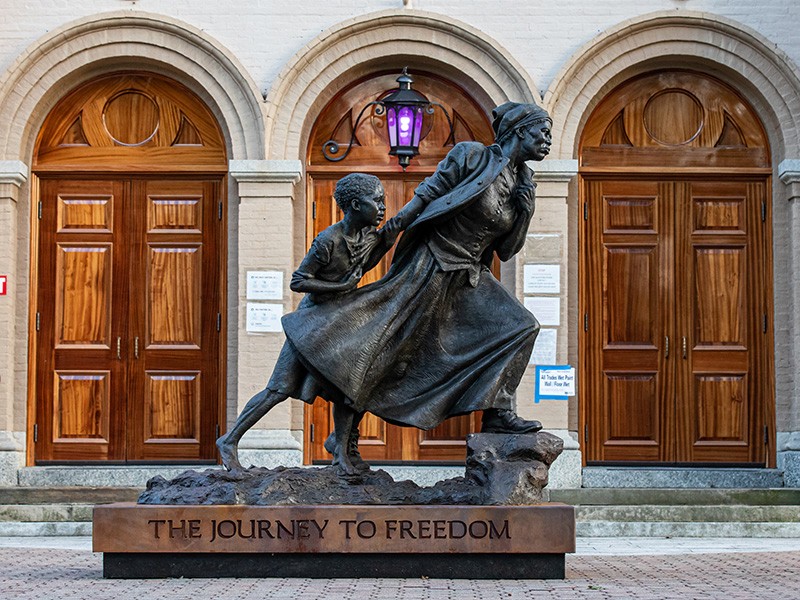
Although there’s a significant dearth of statues depicting real women in our country, Tubman’s image and legacy have done much to address this gap and put a serious dent in the bronze ceiling.
There are said to be at least 9 full-figure sculptures of Tubman with others in the works, along with plaques, busts, parks and museums named in her honor. Also, three commemorative coins have been released, each depicting a particular phase in Tubman’s life.
Speaking of currency, the plan to replace President Andrew Jackson’s image with that of Harriet Tubman’s on the twenty-dollar bill is still in the works. It’s an important endeavor that’s taking far too long. Annie Linskey with The Philadelphia Tribune explains:
“There has never been a Black person on the U.S. currency, nor has there been a woman on a bill in the modern era, despite repeated attempts to diversify the currency.”
Moderator’s Note: This post is brought to you by a collaboration by FAR and Nasty Women Writers written and hosted by Maria and Theresa Dintino. This post originally appeared on their website on Feb. 20,2024. It has been updated to reflect recent events. the post is subtitled: Nasty Women Writers: Breaking the Bronze Ceiling – Statues of Real Women in Public Spaces
It’s quite fitting that the 9-foot bronze statue of Harriet Tubman, named Journey to Freedom is still on the move, as was Tubman for much of her life.
Since 2020, the statue has traveled around the country. It’s currently on Hilton Head Island, South Carolina, in Historic Mitcheville Freedom Park. The monument will remain on Hilton Head through April 2025 and from there be transported to Vienna, Virginia.
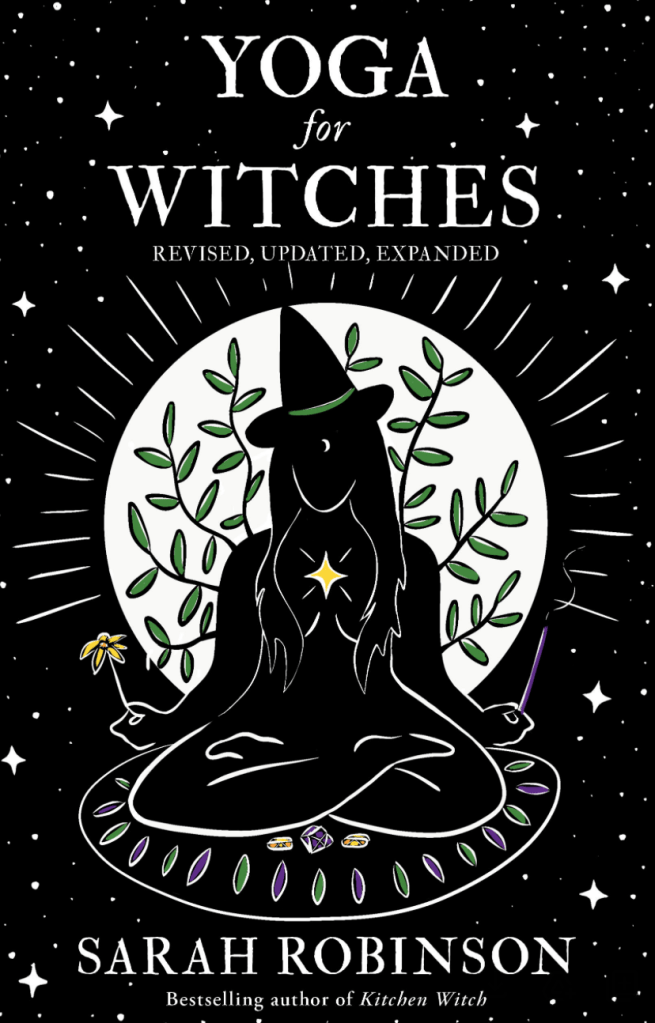
In this post, I review Yoga for Witches by Sarah Robinson, a practical book that weaves together two ancient practices with surprising similarities, yoga from the East, and witchcraft as practiced in Northwestern Europe.
I start with what I loved, and how Robinson describes the similarities and differences between those two traditions. That weaves into some personal and deeper reflections on the theoretical background and yoga sequences. At the end you’ll find a specific recommendation so you’ll know if this is the book for you!
From my earliest memories, I saw things that others didn’t see and knew things I had no business knowing. But at the time, I didn’t realize that others didn’t witness the dance of light around their bodies or the life forms at the base of trees. I didn’t know that the insights I had into people’s emotions were not universally shared. My curiosity led me to ask questions about these things… until my grandmother, Savta (Heb), took me into the kitchen (where everything important happened), closed the doors, and told me never to talk about these things with anyone except her. And so, my training began.
Savta was gifted in ways different from mine. She had grown up in a circle of women and their daughters, a circle where women educated each other, shared their unique gifts and insights, and passed down a legacy of wisdom.
The wisdom she shared with me was as ancient as the land on which we lived. We began with reverence for the Earth and all her elements—pre-patriarchal Goddess wisdom. We explored what it means to be intimately connected to all aspects of Creation, understanding that we are interdependent. Harm to a tree, an insect, or the water harms us. We learned that the respect we wish to receive from others must first be shown by us. I learned to never pick up a beautiful stone that caught my attention without first asking permission to remove it from its resting place. When harvesting fruit from one of the many trees in my grandparent’ yard, I expressed deep gratitude to the mother-tree whose body nurtured that fruit to ripeness.
One of my earliest lessons from karate, which I am still working to integrate, is about the necessity of making mistakes. I used to apologize every time I make a mistake, “I’m sorry,” I’d immediately say to my instructor. She would smile at me and at the end of class would say, “You don’t have to apologize for making a mistake; your body is just learning to do this for the first time, so of course you’re going to make mistakes. Mistakes are part of the process.”
The necessity of making mistakes was something I needed to learn to embrace. As with other areas of life, making mistakes in karate made me feel like a fool. I would get frustrated with myself and would feel embarrassed, and would feel like my teachers were disappointed in me too. But one of the things that has helped me embrace my mistakes is seeing how I have indeed improved in my practice. The mistakes I now make are new ones and are about higher level forms and techniques—things that used to absolutely seem impossible for me.
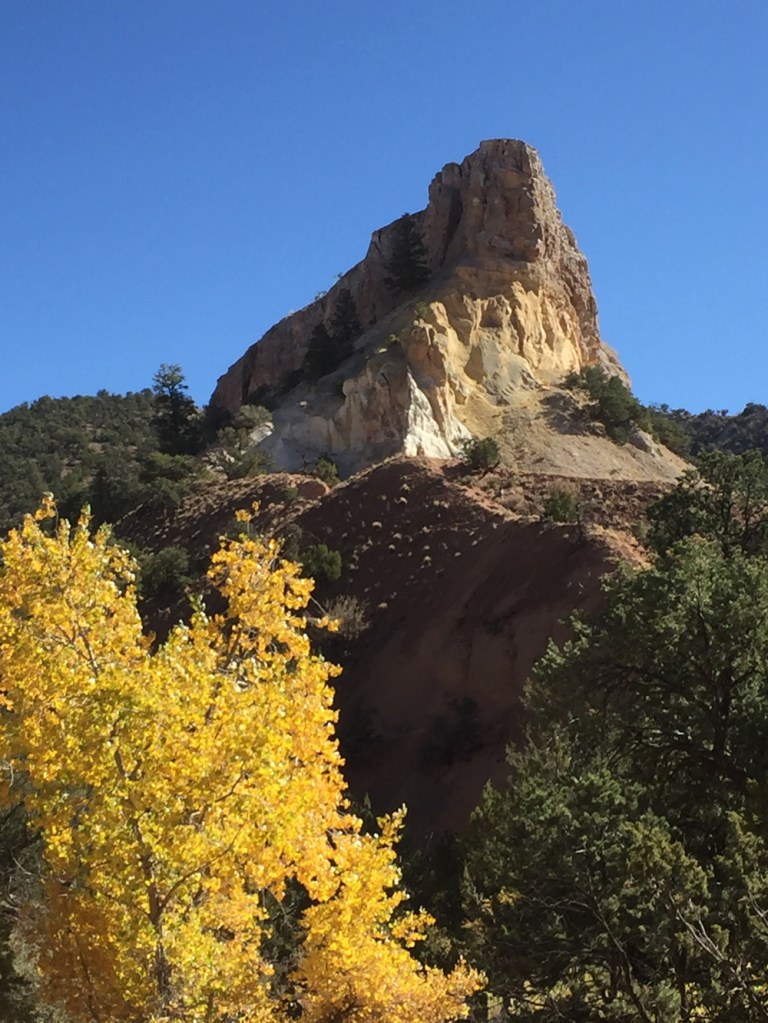
Born of Stone and Trees Birthing a People from a Mountain of Light I hold slivers of her body touch numinous fragments worked by Peoples who honor and live the Great Round Pungent scent of red pine and spruce, luminescent lemony cottonwood cobalt sky steep gorges, sand flakes of pink, rust a splash of bittersweet translucent charcoal flint spiny cactus juniper serpents twisted into fantastic shapes a peak that pierces sky flat topped on one side I belong to Her and She to me Mother of all Creation.
Changing Woman’s Mountain
I have written before about Changing Woman’s Mountain located near Abiquiu New Mexico. Most call this mountain Cerro Pedernales and an image of the flat side of this mountain, her mesa, was made famous by artist Georgia O’Keefe.
Astonished by my first glimpse I climbed a long serpentine road that wound around steep gorges, rivulets of water, open meadows and unbroken stretches of lush fragrant green forests to reach the backside of this mountain. I couldn’t get over the fact that one side was a mesa and other was a peak that pierced the sky like a sword.
Moderator’s Note: Below is a letter from Mahmoud Khalil in its entirety, dictated over the phone from Immigrations and Customs (ICE) detention in Louisiana. A permanent resident taken by the government for his political speech. The phrase “who has the right to have rights?” was coined by Hannah Arendt who escaped Nazi Germany and wrote poignantly and pointedly about the rise of fascism. While on the surface, this letter doesn’t have an obvious link to FAR’s mission, we feel it is deeply intertwined. Who has the right the have rights? Women once had no rights and it appears we are losing them again at breakneck speed. Immigrant’s rights in this country are being stripped also at breakneck speed. And that is just the tip of the iceberg. If we can’t answer “EVERYONE” to Arendt and Khalil’s question, then human rights mean nothing for any of us.
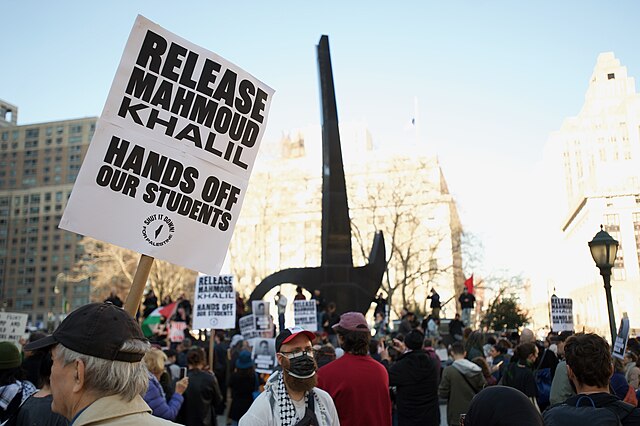
Wikimedia Commons: Protests in Thomas Paine Park against the detention of Palestinian activist and Columbia student Mahmoud Khalil. [SWinxy]
My name is Mahmoud Khalil and I am a political prisoner. I am writing to you from a detention facility in Louisiana where I wake to cold mornings and spend long days bearing witness to the quiet injustices underway against a great many people precluded from the protections of the law.
Who has the right to have rights? It is certainly not the humans crowded into the cells here. It isn’t the Senegalese man I met who has been deprived of his liberty for a year, his legal situation in limbo and his family an ocean away. It isn’t the 21-year-old detainee I met, who stepped foot in this country at age nine, only to be deported without so much as a hearing.
Justice escapes the contours of this nation’s immigration facilities.
On March 8, I was taken by DHS agents who refused to provide a warrant, and accosted my wife and me as we returned from dinner. By now, the footage of that night has been made public. Before I knew what was happening, agents handcuffed and forced me into an unmarked car. At that moment, my only concern was for Noor’s safety. I had no idea if she would be taken too, since the agents had threatened to arrest her for not leaving my side. DHS would not tell me anything for hours — I did not know the cause of my arrest or if I was facing immediate deportation. At 26 Federal Plaza, I slept on the cold floor. In the early morning hours, agents transported me to another facility in Elizabeth, New Jersey. There, I slept on the ground and was refused a blanket despite my request.



 Feminism and Religion