The Cauldron of Life: Destruction and Creation in Celtic Myth, Part 2 by Judith Shaw

Branwen’s Story

Branwen, sister of King Bran the Blessed, was cherished for her gentleness, compassion, and beauty. As the mother of the future king in the tradition of the Old Tribes of the British Isles, she embodies Sovereignty. She is the source of all life, ruling over both the spirit and the land.

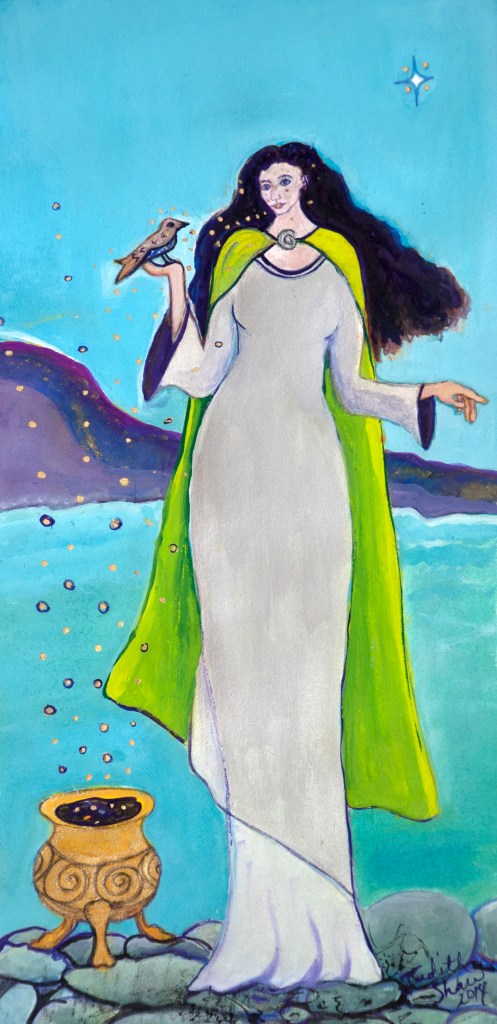
Branwen, Celtic Goddess painting my Judith Shaw
Branwen: Celtic Goddess of Love and Compassion by Judith Shaw

We first meet Branwen when the Irish King Matholuch arrives, his fleet signaling peace with a great shield pointing outwards. He asks for Branwen’s hand in marriage—a significant event, as no woman of the old tribes had ever left her people for a foreigner, much less she who would give birth to the next king. Nonetheless, Matholuch is welcomed ashore, and Branwen is summoned.

Continue reading “The Cauldron of Life: Destruction and Creation in Celtic Myth, Part 2 by Judith Shaw”

Legacy of Carol P. Christ: IS THE SPIRIT OF GREAT GENEROSITY IN CRETE A SURVIVAL OF ANCIENT MATRIARCHAL VALUES?

carol-christ

This post was originally published on Oct. 28th, 2013

At a coffee shop in Agios Thomas, Crete last month a perfect stranger offered to pay for the coffees and sodas of the 16 women on the Goddess Pilgrimage to Crete. This spirit of great generosity is rarely experienced in the United States or other parts of Europe, but it is still common in rural Crete and some parts of Greece.

 In fact our group was in Agios Thomas because our bus driver Babis, also in a spirit of great generosity, insisted on stopping to show us his village when we were passing nearby. He guided us to see Roman rock cut tombs and arranged for the early Byzantine church to be opened. At the end of the our pilgrimage, Babis stopped the bus at a wooded glen beside a small church where he offered us his own homemake raki, wine, and olives, accompanied by local sheep cheese he had purchased while we were climbing a mountain. After every meal that we ate in local tavernas, we were offered bottles of cold raki, fruit, and sweets.

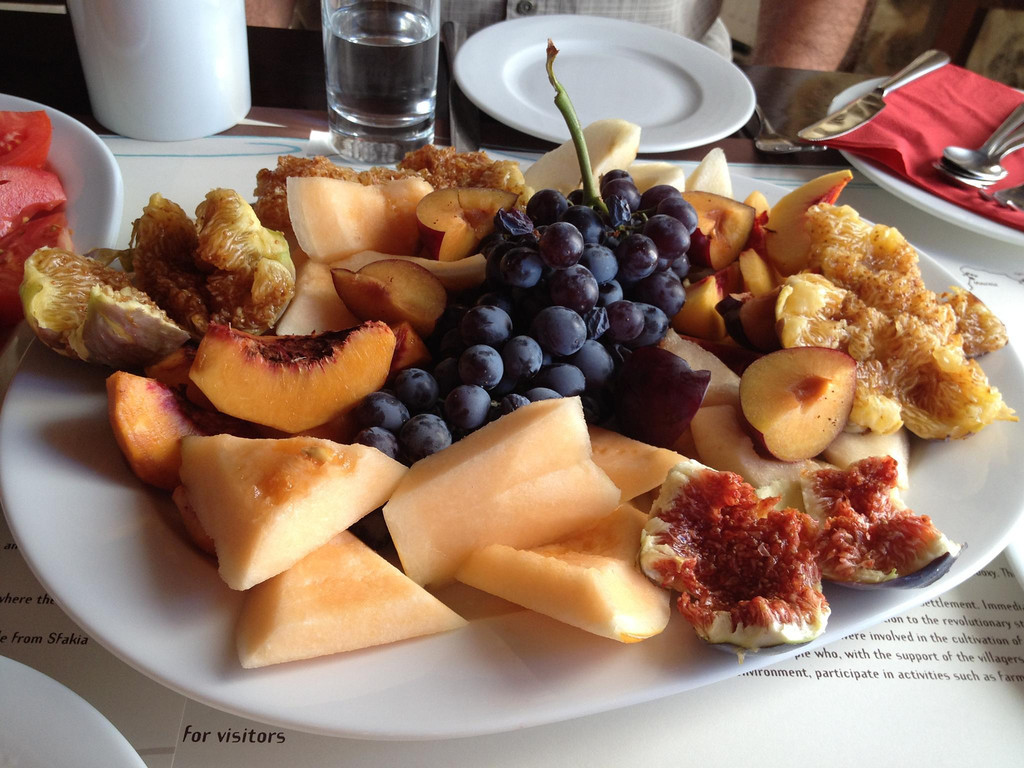
crete fruitsThis spirit of great generosity has long been commented on by travelers in Greece, who often speak of it as unexpected (for them) hospitality to the stranger or traveler. That it is, of course. Through the work of Heidi Goettner-Abendroth, I now understand that the famous Greek hospitality to the stranger has deep roots in matriarchal cultures. According to Goettner-Abendroth, equality of wealth is assured through the widely-practiced custom of gift-giving in matriarchal cultures. Continue reading “Legacy of Carol P. Christ: IS THE SPIRIT OF GREAT GENEROSITY IN CRETE A SURVIVAL OF ANCIENT MATRIARCHAL VALUES?”

Summer Lessons, by Molly M. Remer

Let us be gentle with ourselves 
as we cross the threshold 
into summer, 
as we both open our hearts to change 
and open our hands to choice. 
It is now that we both let things go 
and celebrate what is flourishing, 
what is thriving and growing 
and calling us onward. 
Let us be soft and supple, 
luminous and languorous. 
Let us practice the discipline of pleasure 
and the liturgy of delight. 
Let us protect wide margins for magic,
commit to our own life’s unfolding 
and swim freely 
in the current of the sacred 
that is always available 
to receive us 
and welcome us home.

Today, I sit missing the orioles and thinking about cycles of change, how things grow and decline, and how we can choose to be present or not with what we see and feel. I tip my head back in the green filtered light of morning and discover berries beginning on the mulberry trees. The wild raspberries and blackberries too are tipped with small, firm caps of green. I am feeling the sort of overdue clarity that descends when I finally realize I can let something go, that not everything is mine to carry or mine to fix. I know that this clarity too will come and go, but for now, I welcome it, feeling the cool wind stirring my hair and brushing my shoulders as I enjoy the sunshine and the sound of hawks on the wing. There is a powerful hope in these blue sky days and for now, I bask in the sensation of both remembering and reclamation.

This year, as we tip into summer in the Northern hemisphere, the temperatures in my own Midwestern biome have been surprisingly cool, peaceful and rainy. In an era of climate change, this slow entry into the heat of the year has felt welcome and encouraging. Something that continues to inspire and teach me this year has been to start where my feet are, to return again and again to where I am on this earth and in my body. In a culture that encourages fragmentation and distraction, distance, discord, and dis-embodiment, this practice of return is an act of both rebellion and reclamation.

I have been writing for Feminism and Religion for 13 years. This year, sitting down to write and reflecting on the life lesson of starting where my feet are, I decided to go back through my past summer posts here to discover the other lessons I have learned from summers gone by. I chose thirteen lessons to share from past summer posts:

Continue reading “Summer Lessons, by Molly M. Remer”

Reconsidering the Venus Myth by Lisa SG

Venus.  The Roman Goddess of the third-party situation.  Lady who wouldn’t stay faithful.  Hoochie who couldn’t, or wouldn’t, keep her coochie home.  Or is this viewpoint on the actions of Venus maligned?  (See Ancient-Origins:  Venus: Eroticized Goddess of Love, Fertility, Agriculture… And Infidelity? by Wu Mingren.)

Venus is often conflated with her Greek counterpart, Aphrodite.  Their myths intertwine in such a fashion that the two figures many times seem to be one; we will honor the ancient commingling in this article. 

Venus’ myth starts with the castration of her father by her brother.  Saturn, the Lord of Time and Karma, usurped his father Caelus (Uranus) (See World History Encyclopedia:  The Mutilation of Uranus by Saturn (Cronus) by Giorgio Vasari).  When Saturn used his sacred scythe to castrate his father, some of the seed of Uranus fell upon the sea and Venus was born from the sea foam (See The Internet Archive:  Theogony by Hesiod).  She rose whole and pure from the ocean and fell immediately under her brother’s care as reigning king of the Gods (See Le Gallerie Degli Uffizi:  Birth of Venus by Sandro Botticelli).

Continue reading “Reconsidering the Venus Myth by Lisa SG”

The Furious Sun in Her Mane: Nine Poems to Goddesses by Annie Finch

Poet’s Note: I composed this sequence of poems for performance, for chanting, and for devotion. I wanted people who would hear, read, memorize, and speak each poem to channel the original energetic patterns that the poets who best knew that Goddess used to connect with Her. So for each poem, I researched the meter and prosody of the original language in which that Goddess was first worshipped.  Then I carried the exact rhythmical pulse of Her language into my poem to Her in English.

The sequence was set to music by composer Laura Manning and choreographed by Georgia Bonatis, and I directed and performed a devotional dance collaboration version of it in 1994. That archival video of this performance has just been recovered for the first time in 31 years. It is now posted on my Youtube channel.

Continue reading “The Furious Sun in Her Mane: Nine Poems to Goddesses by Annie Finch”

Legacy of Carol P. Christ: What Was Your Childhood Religious Tradition And Do You Still Follow It?

This post was originally published on Nov. 26th, 2012

Recently, in an interview with the Women’s Living History Project of Claremont Graduate University, I was asked: What religious tradition did you identify with as a child and how did it impact your childhood? and: Is your tradition the same today that you had when growing up?

I was surprised that the interview questions didn’t ask anything about feminism, experiencing exclusion in patriarchal religions, or belief.  My religious and political convictions, which are intertwined, have alienated me from family members.  Therefore, I was suspicious of questions that seemed to have been formulated by someone for whom religion and family go together, and for whom believing or not believing (!) did not seem to be an important issue.

After expressing criticism of the questions, I agreed to work with them.  My answer to the first question was that I did not have a single religious tradition as a child. I had four.  Continue reading “Legacy of Carol P. Christ: What Was Your Childhood Religious Tradition And Do You Still Follow It?”

The Wisdom of Cerridwen: Transforming Her Cosmic Brew by H. Bryon Ballard

Moderator’s Note: This is the Preface to the recently published anthology, The Wisdom of Cerridwen: Transforming Her Cosmic Brew.

Cerridwen, ancient Queen,
Dark Mother, take us in.
Cerridwen, ancient Queen,
Let us be reborn.
—a Reclaiming chant

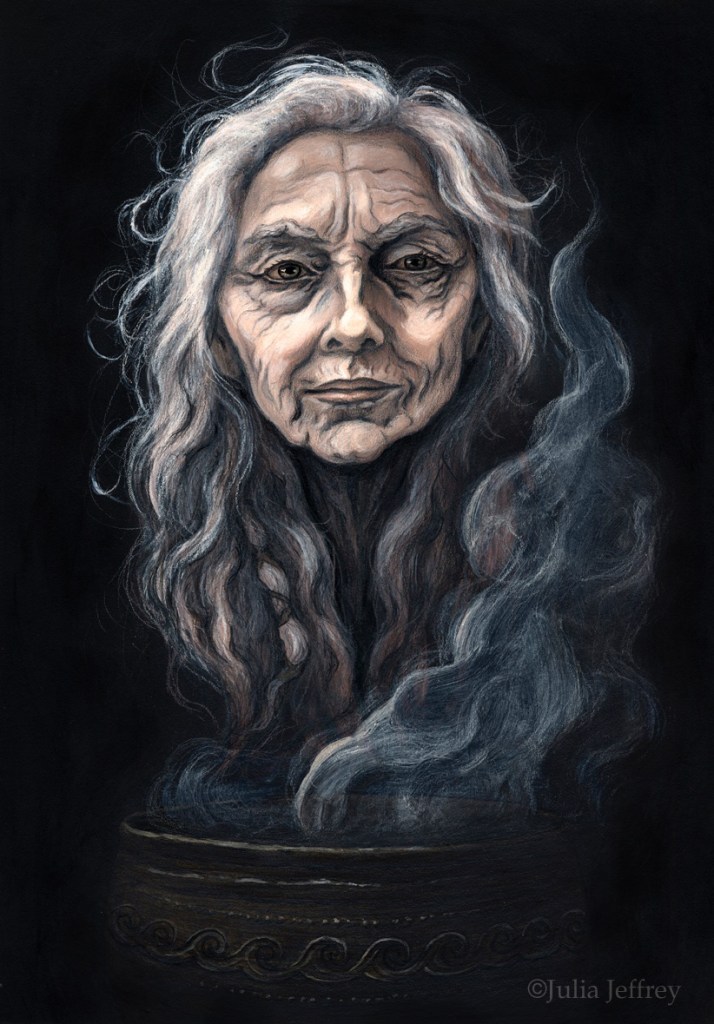
The Cauldron, Julia Jeffries

Open these pages and relish the words of this divine Mother, this wild Sister, this trickster and keeper of the Cauldron of Eternity! Spend time with Her. Learn Her sacred ways, Her stories, Her lore.

I learned the chant above at the Glastonbury Goddess Conference where I taught several years ago. I often use it in both my private meditations and in public rituals. It is simple but direct, quite unlike the Goddess it honors. I learned how to pronounce Her name from a Welsh-speaking colleague who gave it a rolling “r” and an emphasis on the second syllable. Keh-RRRHID-wen. Try it. So delicious to say.

Continue reading “The Wisdom of Cerridwen: Transforming Her Cosmic Brew by H. Bryon Ballard”

The Dark Goddess Los Angeles by Arianne MacBean

“Welcome to Hollywood! What’s your dream?” the character Happy Man says in the opening scene of Pretty Woman, a movie that epitomizes mythic Los Angeles, a place where fairy tales come true. The Dark Goddess Los Angeles, with Her lure of wealth and transformation, Her persona of glamour and aspiration, where even a down-and-out sex worker can be saved by a lawyer with a fear of heights and “save him right back.” Los Angeles calls out a westward invocation of promise. But as much as She pledges, She deceives. Her thick air, dense with unseen harmful toxins, a costly nutrient. Her sinewy highways, the blood lines of her body, sites of daily catastrophe. Our pilgrimage is the slow crawl of passing car crashes on the opposite side of the freeway divider wall. Our mantra, That could have been me. That could have been me.

Spiderweb of Freeways

I’ve been hating LA for thirty-five years. Hating Her May Grey and Her June Gloom. Hating Her maze-like web of concrete highways, Her center-less-ness. Only in Los Angeles are the freeways archetypes, “Take The 2 to The 5 to The 110 to The 10.” I’ve never felt lonelier – alone in my apartment, alone in my car, alone in my thoughts. But over time, I’ve learned to love traversing Los Angeles’ arteries. I have had some of my most profound ideas, my most aha moments, while flowing through Her pulsing veins. The neither here-no-thereness of this city is pregnant with patient possibility. Anything can happen in Her spaciousness, Her waiting.

Continue reading “The Dark Goddess Los Angeles by Arianne MacBean”

Legacy of Carol P. Christ: “Mermaid, Goddess Of The Sea”

carol-christ

This post was originally posted on Nov. 4th, 2013

On the recent Goddess Pilgrimage to Crete, I visited the Historical Museum in Heraklion where I saw a beautiful embroidered silk panel of a mermaid identified only as having come from Koustogerako, a village in western Crete. As it is unlikely that a man in a Cretan village would have been talented in embroidery, in this case “Anonymous” most definitely “was a woman.”

In this thread painting a mermaid surrounded by fish is holding the anchor of a ship in one hand and a fish in the other. In Greece the mermaid is the protectress of sailors. In a well-known legend, a mermaid said to be the sister of Alexander the Great, emerges from the sea in front of a ship during a storm and asks: “Is Alexander the Great still living?” If the sailors answer, “Yes, he lives and reigns,” the ship is saved.

mermaid greek0001

In this image the mermaid–who does not much resemble “the little mermaid” of recent lore—is identified by the woman who embroidered her as: “GORGONA, H THEA TIS THALASSIS,” MERMAID GODDESS OF THE SEA.” Assuming that the woman who created this embroidery was probably a Christian, I was surprised to see that she nonetheless referred to the mermaid as a Goddess. Was this phrase passed on to her down to her from pre-Christian times? Did she see any contradiction between her Christian beliefs and the “Goddess of the Sea?” Continue reading “Legacy of Carol P. Christ: “Mermaid, Goddess Of The Sea””

Pandora/Gaia—Bringer of Gifts by Judith Shaw

As we move deeper and deeper into full autocratic rule, the timeless themes found in mythology help me find my way. 

My first thought for these days was of Pandora, whose story in the myth of Pandora’s Box serves as a powerful metaphor for the complexities of human choice—relevant today by the choice of many to elect Trump, resulting in multiple destructive consequences. 

Hope Endures, by Judith Shaw, gouache on paper, 7.5″x10″
Continue reading “Pandora/Gaia—Bringer of Gifts by Judith Shaw”