The story of how Cerridwen, the witch goddess, brews a magic potion full of awen (inspiration) which is then accidentally imbibed by the boy Gwion Bach, is well loved across the Western world, especially by neo-Druids. Gwion Bach is then reborn as Taliesin, the greatest bard in Britain. It is a typical heroes tale, with Cerridwen as the muse and initiatrix.
Or is it? This tale has always left a funny taste in my mouth, and when I recently read The Broken Cauldron by Lorna Smithers, I understood why. In the oldest version we have of this tale, Gwion Bach doesn’t accidentally taste the awen. He steals it.
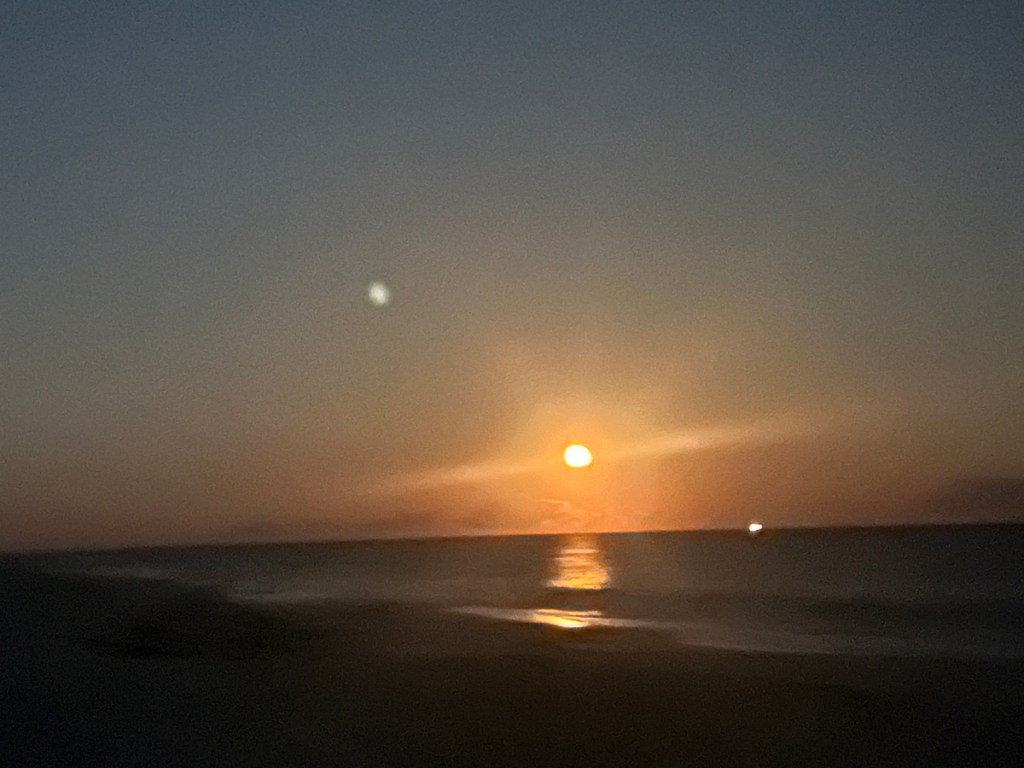
This summer I had the opportunity to travel to Fire Island, New York, which is a long sand bar full of small beach towns with no cars. Fire Island’s been a haven not only for beachgoers but for queer folk for many decades. We stayed in the town of Cherry Grove with friends, and one night we went out to look at the supermoon/blue moon. The moon rose over the horizon, red and a little scary, a sight like none of us had ever seen. Not far from the moon was a star so bright it came out in the photographs. I wondered if that was the morning star. Venus, in our current understanding. Inanna or Ishtar, among some of the ancients. And that made me think of Istehar.
Istehar, in Jewish legend, is a maiden who became one of the Pleiades. Her legend is unusual among Jewish legends because it reads like a Greek myth. It takes place during the time when some angels had descended to earth because they desired human women. One of these angels, Shemhazai, noticed a certain woman named Istehar, and desired her and wanted to be intimate with her. Istehar wished to flee this angel, and so she said: “I won’t accept you as a lover until you give me your wings and teach me the Divine Name that allows you to fly to heaven.” The angel gave her his wings and taught her the Divine Name. Istehar immediately uttered the Name and flew up to the sky, thus escaping the angel. God was impressed by her virtue and decided that she would be placed among the seven stars, in the constellation of the Pleiades, “that humans might never forget her.” (Legends of the Jews I:4:11).
Modern science has proven what ancient myth has long told us about our Earth — billions of years ago our world was a water world. It’s not surprising then to find water-based creation stories and goddess mermaids in the myths of our ancient ancestors.
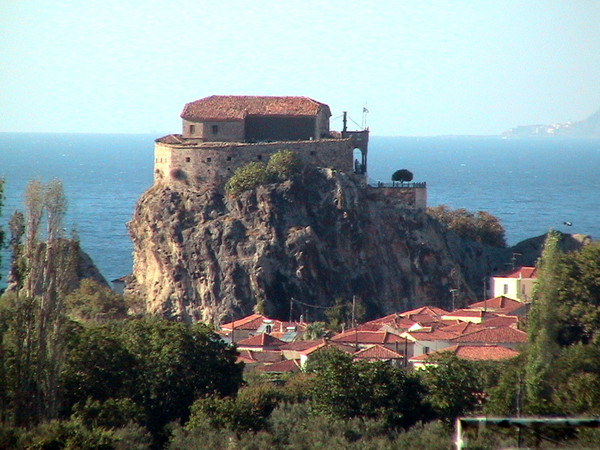
From the evening of the 14th through the day and night of the 15th of August, thousands of pilgrims ascended the Holy Rock of Petra to honor the Panagia—She Who Is All Holy.
There is “something really beautiful”* in being among them.
Six of us set out from Molivos at 7:30 on the 14th to meet in the square of Petra to ascend to the church. Petra was already full of so many pilgrims that police had forbidden traffic in the main square and were directing cars into a nearly full parking lot in a field. When we got out of the car, the two others who came with me and I had a perfect view of the steady stream of pilgrims climbing the rock, which was already lit up in the twilight.
The editor of this anthology, Anne Wilson Schaef, goes on to say:
“When we do stop, many times we look around and realize that we are the only ones rushing around. We realize that the roses, the trees, even the clouds seems suspended in space, and it is as if the universe has paused for a breather. Life has time to experience itself.
Often, when we stop and let ourselves take in the beauty that is around us, we realize there is much more than we originally imagined. Our eyes begin to see beauty in the cracks in the sidewalk, the crookedness of tree limbs, the cragginess of faces, even the color of cars.
We don’t have to travel to see beauty. It is everywhere.
How much more alive we are when we can feel those times that the earth has ‘stopped in astonishment at its own beauty.’”
Do you have time for beauty? When was the last time you stopped in astonishment? What is astonishing you lately? Where are you discovering beauty?
I buried you today, a fluff of earthly feathers dipped in ebony bronze and gold. He left you on my road innocent already broken Just a tiny bird peeping pitifully in fear and pain cocooned in deep distress.
I scooped you up held you against my heart
Instantly Still I felt you knew…
Wild Mothering kicked in create a loving space for life or death
Above all Be Present for whatever is ahead…
I dug a grave where you were born nestled under pines fragrant roots cradled what was left your bones are made of light
Offering prayers to Her Our Bird Goddess* I bowed my head Ancient and Wise She who Sees She who holds Abusers accountable (as do I) She watches over us all honoring the dead.
The concept of two ultimates, the ground of being and Goddess, can be helpful in understanding differences of emphasis within and among religions. Some religions or strands within religions focus on relationship with or worship of a personal God, while other religions or strands within religions focus on identifying with or merging with the impersonal ground of being or the whole of which we are part. These two ultimates are found in feminist spiritualities and theologies.
In “Being Itself and the Existence of God”* process theologian John Cobb identifies two ultimates. The ground of being as the metaphysical principles that structure all of life is unchanging; as the whole of which individuals are part, the ground of being is impersonal. God, on the other hand, is an active presence in the world, is personal, and cares about individuals in the world. If God is understood to be in some sense an individual in relation to other individuals, then God cannot be identified with the whole, because the whole is made up of God and other individuals. Yet God is not simply one individual among other individuals. Only God has perfect knowledge of the world and every individual within it and only God cares for the world in light of perfect knowledge of it.
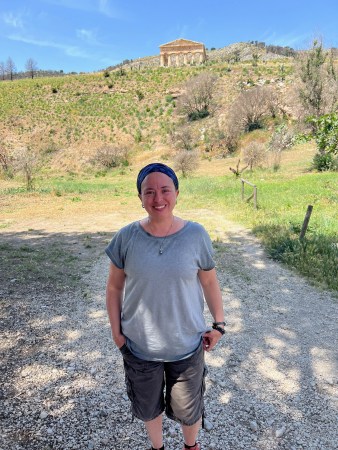
This May, I visited Sicily to present at the European Academy of Religion’s Annual Meeting. There I saw various historic, religious sites: parts of the city of Siracusa; the Valley of the Temples in Agrigento; mikvot in Palermo; various churches including the Cathedral in Palermo and the Church of St. Cataldo; the Segesta temple; and lake Pergusa where Hades emerges from the land to abduct Persephone. In this blog, I will focus on this lake. As an ecofeminist focusing on religion, this place gave me mixed feelings.
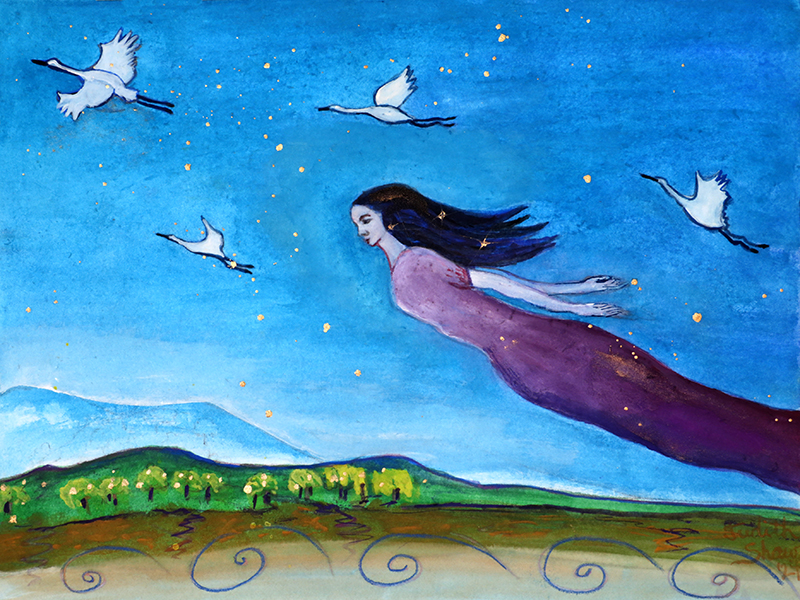
Artists tend to develop their own visual language over the course of a career, returning again and again to certain motifs. That’s certainly the case for me with trees, women and goddesses, doorways and passages, ancient symbols, flowers, and animals — in particular birds — emerging again and again.
The Fibonacci series has been called the fingerprint of god. That is because they are a sequence of numbers found ubiquitously in nature. I’ve been thinking up new names for it. It is a progression created by adding each number to its previous number after starting with the number one. It looks like this:
1, 1, 2, 3, 5, 8, 13, 21, 34, 55 and so on to infinity.
The Fibonacci Sequence was first described in the 12th century by Leonardo Pisano Bigollo, an Italian mathematician. His nickname was Fibonacci, which translates to “son of Bonacci.” He has been called the Leonardo of Pisa, the city of his birth. The series is unique. When you take the ratio of any two successive numbers in the series (after the three), the resultant numbers have a pattern. They fall into an increasingly narrow range with the sequence revolving around a ratio called the Golden Mean, the golden ratio, or the golden number. It is 1.618. Below is an example of how the number sequence works:




 Feminism and Religion