The Solstice Tree of Life by Judith Shaw

The exact day of the Winter Solstice ushers in what I think of as the Winter Solstice Season — a ten day period when, in the northern hemisphere, the sun barely moves from it’s most southerly position in the sky. The days are very short and the nights are long, long, long. 

At this time of year I embrace the worldview of my Celtic ancestors who relished the darkness in a way that is foreign to us today. Every day began at dusk not dawn. The new year began on October 31, as the cold set in and the world turned toward the dark. The harvest was in, thanks were given, and nature was moving into its period of death. I find an inherent wisdom in this counting of time.

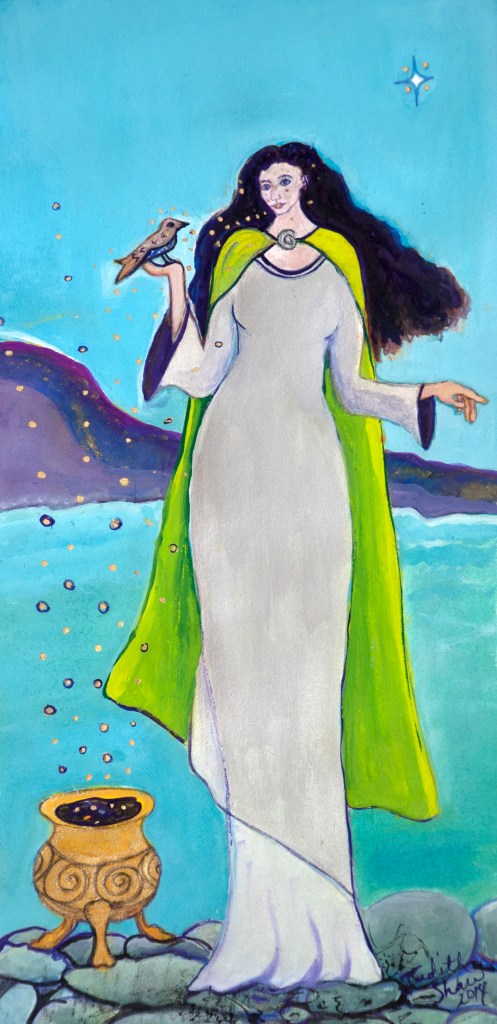
In this moment, my connection to trees feels especially profound. I find such beauty in the winter trees, naked of their green and golden finery, etching stark lines in the sky. As we drew near to the solstice, I felt compelled to create a new painting that expresses my love for winter trees and the Winter Solstice. 

Solstice Tree of Life, by Judith Shaw
Continue reading “The Solstice Tree of Life by Judith Shaw”

From the Archives: I Sing Asherah Exalted! by Janet Maika’i Rudolph

This was originally posted Dec. 16th, 2021

With this season of the festivals of light upon us (Hanukkah, Christmas, Solstice, Kwanzaa), I wanted to focus on the more joyful aspects of our lives. For that, I have been diving into passages about joy and singing in the bible.

Sometimes when I write these posts, they take me in directions I never thought to go. This post is one of them. The surprise direction I found is in the Psalm below:

Sing unto him, sing psalms unto him: talk ye of all his wondrous works.
Glory ye in his holy name: let the heart of them rejoice that seek the LORD.
Psalm 105:2-3 KJV

Continue reading “From the Archives: I Sing Asherah Exalted! by Janet Maika’i Rudolph”

As Above, So Below—A Cosmic Tale by Mary Gelfand

It was when I was studying to become a Witch that I first encountered the phrase ‘As Above, So Below,’ which I now know to be a paraphrase of a ninth century Hermetic text from an Arabic source.  I liked this phrase from the beginning as it expressed something I believed but had struggled to articulate so elegantly.  I believe that there is a sacred connection between our earthy human existence and the grandeur of the cosmos—our very bodies are composed of star dust.

Helix Nebula from the Hubble Telescope

I was delighted to discover a more specific description of that connection in the Journey of the Universe, by cosmologist Brian Swimme & Mary Tucker, founder of the Forum on Religion & Ecology at Yale. They discuss the creation of the universe in terms of natural cycles of expansion and contraction, which they also refer to as ‘attraction,’ or gravity. They write “All of space and time and mass and energy began as a ‘single point’ that was trillions of degrees hot and that instantly rushed apart. (p. 4)” That expansion is on-going, billions of years later. 

Continue reading “As Above, So Below—A Cosmic Tale by Mary Gelfand”

Samhain: The Cailleach, Wolf, and Black Cat  by Judith Shaw


Halloween, with its Celtic pagan roots in the sacred day of Samhain, which later morphed into a Christian holiday, is now mainly a nonreligious celebration in Europe and North America. It’s enjoyed by both young and old with scary outdoor decorations, parties, spooky costumes, haunted houses, carved pumpkins, and candy-giving.

Continue reading “Samhain: The Cailleach, Wolf, and Black Cat  by Judith Shaw”

Ariadne and Me – The .5% by Arianne MacBean

When I travelled to Crete on a Goddess Pilgrimage last year, we were asked to introduce ourselves by our matrilineal lines. I am Arianne, daughter of Bernadette, granddaughter of Helen and a long line of women, known and unknown, stretching back to Africa. Many of the women in the group were able to intone long lists of names in their matrilineal lines. I was not able to go further than my Grandmother, Helen. No one in my mother’s large Polish family could remember my Great Grandmother’s name.

My journey toward Ariadne has been as circuitous as the labyrinth itself. In many ways, I have been searching for her since those first bedtime stories my father used to tell me as a child, when Theseus was the main character and Ariadne, merely a stop on his road. I longed for her, even then, to have her own heroine’s journey. I tried to imagine what that might look like but, without models, could not conjure anything beyond holding the red thread so others could triumph. Later, I began a more conscious search for Ariadne as I became curious about the connections between her choices, feelings, expressions and my own longings, betrayals, and outbursts. Since then, there have been moments when I let myself fantasize about being connected to her in some real way, beyond being named after her, or feeling and acting as she may have. In these fleeting moments when I imagine we are bonded, I am awash in an intense sense of belonging, something I never felt as an only child of divorced parents. But then in a flash, my mind takes a sharp turn, as in a labyrinth, and I negate those feelings with logic. You want to be connected to Her, so you are finding ways to make it true.

Continue reading “Ariadne and Me – The .5% by Arianne MacBean”

Legacy of Carol P. Christ: WOMEN ARTISTS AND RITUALISTS IN THE GREAT CAVES: THE BEGINNING OF THE END OF INDOLENT ASSUMPTIONS

This was originally posted October 21, 2013

In an earlier blog, I suggested that women might have blown red ocher around their hands to leave their marks in prehistoric caves.

At the time I thought this was a rather bold suggestion.

Had I been asked why I thought the images were made by women, I might have said that people have understood caves to be the womb of the Great Mother, the Source of All Life, from time immemorial. I might have added that those who performed rituals in the caves cannot have been performing simple “hunting magic,” but must also have been thanking the Source of Life for making life possible for them and for the great beasts they hunted.  Still I am not certain that I imagined women as the artists in the Paleolithic caves.

handprint peche merle cave
Continue reading “Legacy of Carol P. Christ: WOMEN ARTISTS AND RITUALISTS IN THE GREAT CAVES: THE BEGINNING OF THE END OF INDOLENT ASSUMPTIONS”

How we Began the Movement of Goddess Feminist Activist Spirituality in the 21st Century (Part 1) by Helen Hye-Sook Hwang

Mago is an East Asian/Korean word for the Cosmic Mother or the Creatrix. This piece is written as the first of a four-part essay. In this series I am surveying the past 9 years of The Mago Work (A collective effort to restore the consciousness of Mago, the Creatrix), which birthed the Movement of Goddess Feminist Activist Spirituality, while being shaped by the latter.

Continue reading “How we Began the Movement of Goddess Feminist Activist Spirituality in the 21st Century (Part 1) by Helen Hye-Sook Hwang”

Flowers — Gifts of Goddess by Judith Shaw


I was captivated by a bunch of wispy, weedy zinnia flowers on my dining-room table, with its bright blossoms sprinkled on the curling stems. The zinnias pulled me from my current obsession with sea goddesses into a different zone, into the Kingdom of Plants (Kingdom Plantae). The Plant Kingdom is an important part of Goddess manifest, having come into being long before the appearance of our human family. It’s no wonder that flowers and other members of the Plant Kingdom play an important part in the mythology of our ancestors worldwide. 

Zinnia Joy, gouache on paper by Judith Shaw
Continue reading “Flowers — Gifts of Goddess by Judith Shaw”

Legacy of Carol P. Christ: A New Glossary for Crete: The Power of Naming and the Study of History

This was originally posted on Sept. 2, 2013

The words we use affect our thinking. In the case of ancient Crete the repetition of the terms “Palace,” “Palace of Knossos,” “King Minos,” “Minoan,” “Priest-King,” and “Prince of the Lilies” shape the way we understand history–even when we ourselves know these terms are incorrect. We must engage in “new naming.”

Ariadne. May have been a name of the Goddess of pre-patriarchal Crete. The ending “ne” signifies that Ariadne is not of Greek or Indo-European origin and thus predates the later Greek myths.

Ariadnian. The name I have given to the Old European pre-patriarchal culture of Crete, from arrival of the Neolithic settlers from Anatolia c.7000 BCE to the Mycenaean invasion c.1450 BCE. Arthur Evans named the Bronze Age (c.3000-1450 BCE) culture of Crete “Minoan” after King Minos of Greek mythology, son of Zeus and Europa, husband of Pasiphae, father of Ariadne, whose gift of the secret of the labyrinth to Theseus led to the downfall of her culture. Evans assumed that Minoan Crete was ruled by a King.

This image I call “Ariadne Dancing” could become the new “icon” of Ariadnian Crete.

minoan woman dancing
Continue reading “Legacy of Carol P. Christ: A New Glossary for Crete: The Power of Naming and the Study of History”

Cerridwen’s Brew; the Psychedelic Priestesses and the Theft of Indigenous Wisdom by Kelle Ban Dea

Katerina Shkribey, mushroom. Unsplash stock

Recently I wrote about how the story of Cerridwen and Taliesin is not a muse and hero tale but a tale of stealing from the goddess. Violating her priestesses and exploiting the land.

That is one reading of it. There is another though, which may have some grounding in historical fact and may be a warning to a particular issue gaining prominence today; the rise of the psychedelic industry.

Although neo-Druids, for whom this tale forms part of their core mythology, interpret the awen that Cerridwen brews in her cauldron as the ‘flowing spirit of inspiration,’ the original text makes it clear it is a potion. Cerridwen gathers ‘every kind of charm-bearing herb’ for the potion. Three drops of it turn the boy Gwion Bach into the shaman-bard Taliesin, but the rest is poison.

Continue reading “Cerridwen’s Brew; the Psychedelic Priestesses and the Theft of Indigenous Wisdom by Kelle Ban Dea”