Arianrhod, Celtic Welsh Star Goddess of Reincarnation, is known as “Silver Wheel”, “Silver Circle”, “High Fruitful Mother”, “Star Goddess”, and Sky Goddess. She is considered by many to be a Moon Goddess. She is a primal figure of feminine power, a Celestial Mother Goddess who through her role as Goddess of Reincarnation, rules fertility and childbirth.
Arianrhod, the most powerful child of the great Mother Goddess, Don, was very beautiful, with extremely pale skin. She was a virgin goddess in the ancient meaning of the word virgin – a woman who is complete unto herself; a woman who needs no protection from a man. She enjoyed herself sexually, with a distinct preference for mermen.
Small joys are the things we often forget, we need to be reminded that they exist.
All gods, divinities, myths or legends started with one human being’s UPG (unverifiable personal gnosis). Human beings have a deep need to explain the unexplainable and we do it best by creating a deity and then sharing it with others, thus religions and pantheons are born.
The notion of the earth as the body of Goddess has taken on deeper meaning for me in recent years. I have felt connected to nature all of my life. Yet often, though not always, I have related to nature in general rather than in specific ways. Some years ago, after reading Hartshorne’s essay “Do Birds Love Singing?” I stopped for the first time in the wetlands of Kalloni, Lesbos, to see the flamingoes that live in the salt pans there.
With the eyes of your imagination, see our bright goddess standing tall and fine at her anvil. Her holy and wholly unquenchable fire is burning in the forge. See her holding her hammer and tongs. Perhaps she’s beating a sword, for we sometimes need to defend ourselves, or perhaps she’s beating a sword into a plowshare, for we also need to feed the hungry.
February 2 is the pagan sabbat, or holy day, devoted to the great Celtic triple goddess Brigid (pronounced “Breed”). Brigid is the goddess of poetry, fire, and smithcraft. We’re told that she was converted to Christianity by St. Patrick and later canonized. Her temple was located at Cill Dara (better known as Kildare), where a holy fire was maintained for a thousand years. It was put out during the Dissolution of the Monasteries under Henry VIII when that British king left the Roman church. The fire was relit, but extinguished again in the 18th or 19th century. Today there is an order of Irish nuns that keeps Brigid and her fire alive. As you read the following meditation, imagine that you’re hearing the voice of an elderly priestess. Continue reading “A Meditation on the Shamrock By Barbara Ardinger”
Brigid, the Celtic Goddess of Healing, Poetry, and Smithcraft, begins her reign on Imbolic, February 2, the midpoint between winter solstice and spring equinox. On this day the ancient Celts held their Fire Festival in honor of Brigid and the growing light. In Scotland, as recently as the mid-twentieth century, houses were cleaned and the hearth fires rekindled on February 2, to welcome in Brigid. Remnants of this festival are found in America today on Groundhog Day.
Like the Cailleach, She existed in many places and was known by many names. The Irish called her Brighde; she was Bride in Scotland, Brigantia in Northern Britain, and Brigandu in France. Some called her Brid, Brig or Brighid. Later she was transformed by Christianity into Saint Bridget. Her older name was BREO SAIGHEAD. Her name has various interpretations, many relating to fire – “Power,” “Renown” “Fiery Arrow of Power ” “Bright Arrow”, “The Bright One”, “The Powerful One”, “The High One” and “The Exalted One”.
Epona, Celtic Horse Goddess was worshipped by the Gauls (the Celtic French). Her worship spread to Britain and Rome from Western Europe. Hundreds of statues and shrines dating from between the first and third centuries CE have been found in France alone.
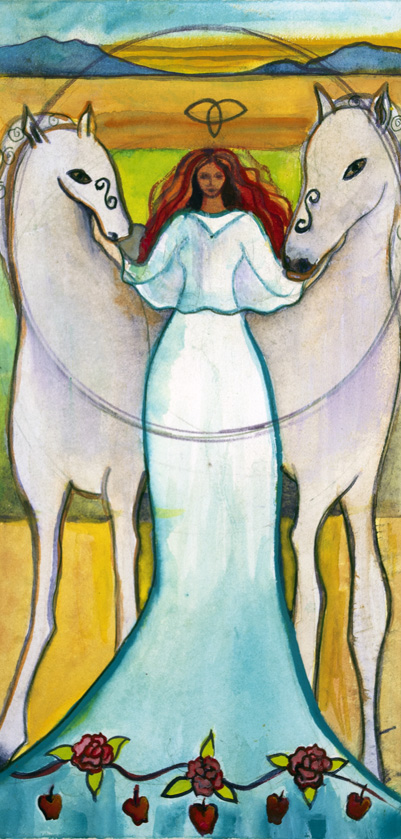
Today we can understand Epona mainly from her images, as few stories of her have survived. She is often shown either riding a white horse side saddle or standing or sitting between two horses. Many images show her feeding mares and foals from a cornucopia or a basket of fruit.
The Great Goddess and Divine Mother of Us All manifests where and to whom She chooses, no matter what faith we hold. In the 12th century, She manifested to a German nun named Hildegard. Hildegard’s story has been told in many places, including a highly detailed entry in the Catholic Encyclopedia, which is a wonderful resource for stories about saints. I’ve just finished reading Illuminations (Houghton Mifflin Harcourt, 2012), a splendid new novel about Hildegard by Mary Sharratt, who is the author of other excellent novels, including Daughters of the Witching Hill.
Hildegard, who lived from 1092 to 1179, was the tenth child of a family of minor nobility in the Holy Roman Empire. She’s a sturdy child who loves the outdoors and enjoys running through the forest with her brother. But early in the novel, she learns that she is to be her family’s tithe to the church. Her mother has already arranged for this bright and curious eight-year-old child to be the companion to Jutta von Sponheim, a “holy virgin” who yearns to be bricked up as an anchorite in the Abby of Disibodenberg. Being an anchorite means that, like Julian of Norwich (about 250 years later), this girl and her magistra are bricked in. There is a screened opening in the wall through which their meager meals are passed and through which they can witness mass and speak to Abbott Cuno, the other monks, and visiting pilgrims, but they can never go out. Never. In the Afterword, Sharratt writes that “Disibodenberg Abbey is now in ruins and it’s impossible to precisely pinpoint where the anchorage was, but the suggested location is two suffocatingly narrow rooms and a narrow courtyard built on to the back of the church” (p. 272). As Sharratt vividly shows us, Hildegard survived in that awful place for thirty years. Continue reading “Illuminations: A Novel of Hildegard von Bingen By Barbara Ardinger”
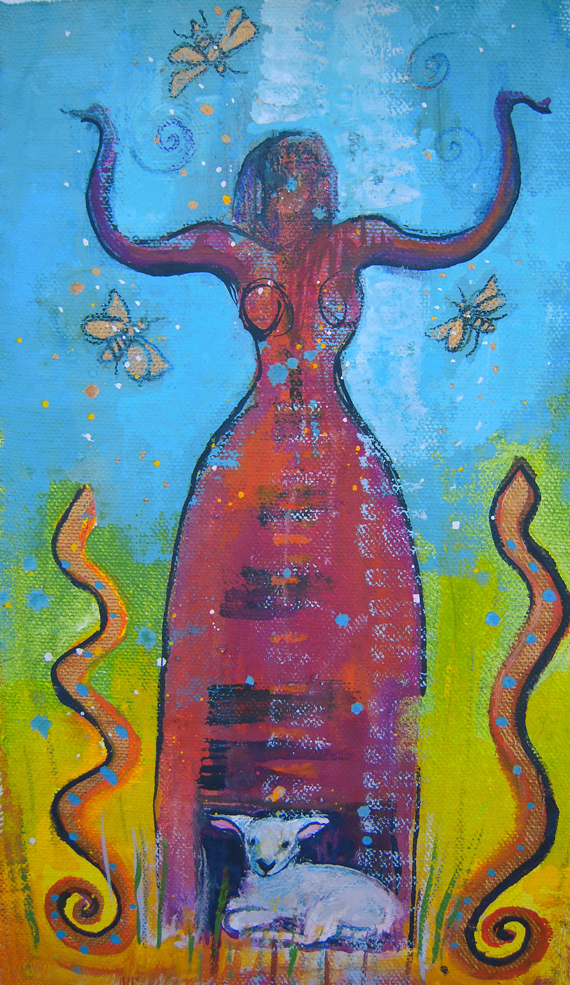
This “Mountain Mother” painting is an ode to women’s earth wisdom and is my prayer for reclaiming of that wisdom to heal the earth and all her beings.
When I am inspired to paint I can think of nothing else, the desire to put brush to canvas takes over every ounce of my being, and it is difficult to be present in everyday life. There are other times where I’ve wanted to create but inspiration was lacking: I would start a painting and have no desire to finish it. I would often get quite frustrated at myself. It’s only recently that I’ve had the realisation that down time is just as significant as the up time. Rather than get anxious about not creating a masterpiece, I have learnt to go with the flow, take pleasure in the time of rest, because I know it’s all part of the cycle. My inspiration always returns with abundance. Presently I am bursting at the seams with creativity, and I can’t find enough hours in the day to let all this inspired energy out. I am overcome with a sense of urgency I can’t explain. I am committed to paint and write with the intention that my personal message becomes part of the global message for change as our sacred feminine wisdom is being called forth. I am determined and full of courage to be part of the movement that brings about a shift in all aspects of life.
My present state of inspiration can be attributed to my recent Goddess pilgrimage to Crete with Carol Christ. I am sure that anybody who has attended such pilgrimages will attest that these experiences are life-changing. Travel alone is profound, but to share the experience in a circle of twenty amazing women is even more so. We sang, danced, trekked through the Cretan countryside, delved deep into caves; the womb of our great mother, climbed mountains and cleansed in the sea. We prayed and communed with the goddess daily, participating in rituals that were meaningful, un-contrived and safe. While I have always known that the goddess is everywhere, within and without–encountering her ancient past in a present day context is a feeling I’m not sure I can adequately describe with words, hence my desire to express some of these feelings through my art.
It is from this dark space that we emerge—whether from our own mothers or from the more mysterious cosmic “sea” of soul—and it is to darkness that we return when we close our eyes for the final time.
I find that within Goddess circles the idea of “the dark” remains commonly associated with that which is evil, negative, bad, or unpleasant. The Dark Mother, while acknowledged and accepted, is often at the same time equated with death, destruction, challenge, trials, and obstacles. While I recognize that the concept of a dark, demonic, and destructive mother might too have a place in goddess traditions (as with Kali or Durga), I also think this is unnecessarily limiting and that the idea of the “Dark” in general is in need of re-visioning. It is not just with regard to the role or place of death within the wheel of life or the Goddess archetype that Goddess as Dark Mother and destroyer can be honored or recognized, but the Dark as a place of healing and rest can also be explored. Continue reading “Endarkenment By Molly”