From the Archives: Artemis As Artemisia: Ancient Female Spirituality & Modern Medicine by Stuart Dean

This was originally posted on November 29, 2015

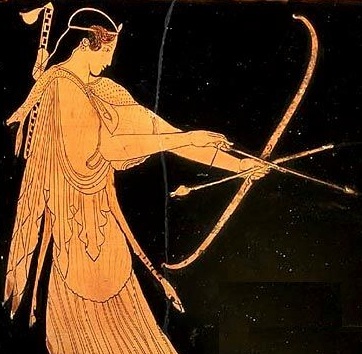
Detail of Artemis from a 5th century BCE Attic Vase

The 2015 Nobel Prize for Medicine was awarded in part to a Chinese woman (Tu) for her identification and isolation to treat malaria of a chemical known as Artemisinin.  The name of that chemical derives from the fact that it is found in varying amounts in the ‘family’ (technically, genus) of plants known as Artemisia.  The name of that family derives from its association with the goddess Artemis.

Because Tu’s work began in China in the 1960s it is understandable that even if she knew this about Artemisia (a term I use to refer to any one plant or all of the plants of that family) it would not have been a ‘careerbuilder’ for her to point it out to those for whom she was working.  It was bad enough that she was a woman.  At that place and time, however, if she had said or done something that could be associated with Western culture her name might not even be known today.


Continue reading “From the Archives: Artemis As Artemisia: Ancient Female Spirituality & Modern Medicine by Stuart Dean”

Integrating Snake Medicine Part 1

This post describes some of the steps on my personal journey of soul recovery across many, many years. It can be traced back to when I was 3 or 4 years old. Each header reflects a significant moment towards finding my Medicine and embracing my Golden Shadow of stepping into an ancient lineage of Snake Healers.

Although many of the steps created an immediate shift in my consciousness, this kind of individuation usually doesn’t happen overnight. I’m sharing it to honour the unfolding trails across time, and to encourage people to surrender to their journey, while letting go of a specific outcome. Part 2 will be published tomorrow.

Continue reading “Integrating Snake Medicine Part 1”

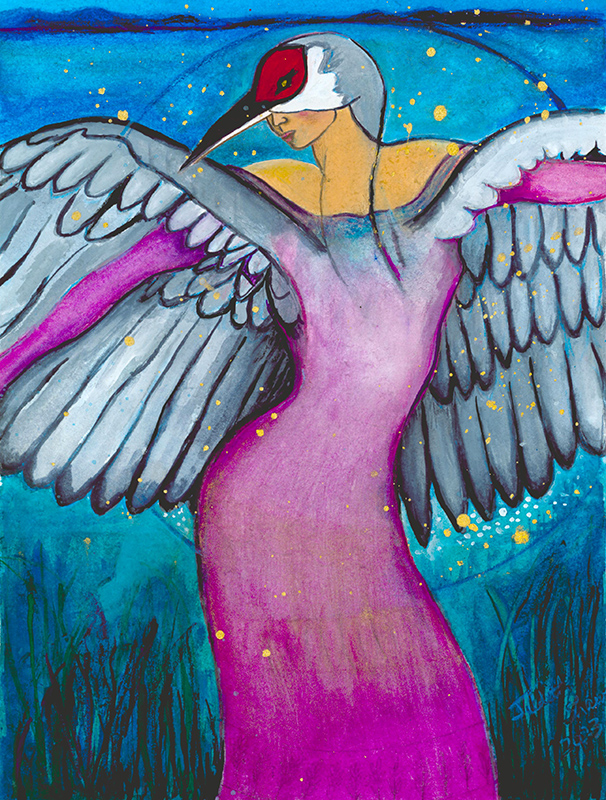
Aviana, 20th Century Crane Goddess by Judith Shaw

People think that goddesses only came into being long, long ago. People think goddesses are only found in ancient mythology. But people are wrong.  I know because I am Aviana, the Wetlands Crane Goddess who helped create the Bosque del Apache Wildlife Reserve of New Mexico. I first manifest on Earth as an Otherworldly force in the early 1900s. It was the migrating birds and waterfowl, in particular sandhill cranes, who called me into being.  

You see before Euro-Americans arrived in the land of the American Southwest, the Rio Grande was a mighty river which flooded every year bringing life and renewal to the land. These wetlands were a favorite wintering habitat of the Sandhill Cranes. They left their summer nesting grounds of Alaska, Canada and the northern United States and headed south for the winter.  Every year in November hundreds of thousand of cranes arrived in New Mexico. Here they fed on grasses and small animals throughout the short winter days. 

Continue reading “Aviana, 20th Century Crane Goddess by Judith Shaw”

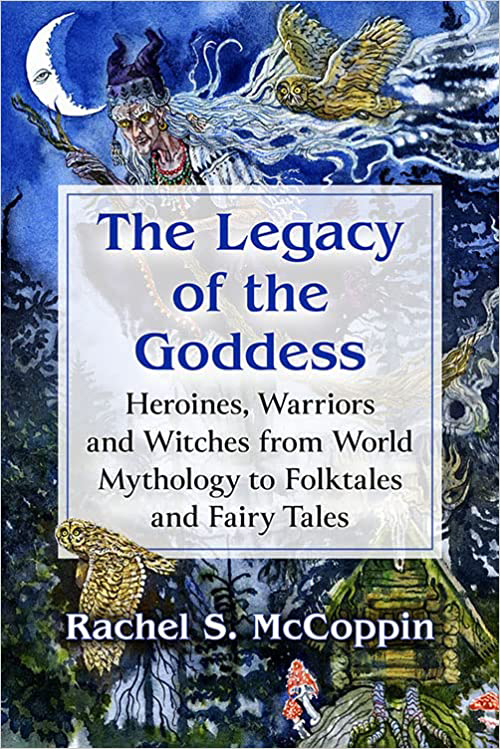
The Legacy of the Goddess: Heroines, Warriors and Witches from World Mythology to Folktales and Fairy Tales by Rachel McCoppin

This is part 1 of a two part posing. Part 2 will be posted tomorrow.

In this blog post, I would like to take the opportunity to discuss my new book, entitled: The Legacy of the Goddess: Heroines, Warriors and Witches from World Mythology to Folktales and Fairy Tales. This book argues that hundreds of folktales and fairy tales from around the world have preserved elements related to goddess worship from the sacred myths of many ancient civilizations.

Powerful goddesses were worshipped in most global cultures for centuries, until, in many regions, episodes of diffusion, conquest, colonialism, etc. caused the worship of these goddesses to be revised, lessened, or in some cases eliminated. To “preserve at least part of the reverence of goddesses, as well as the memory of the powerful religious and social roles women once held as representatives of goddesses”, hundreds of folktales and fairy tales were created, “told, and retold, most often by women storytellers” to impart goddess ideology (McCoppin, 2023, p. 5). Thus, many folktales and fairy tales portray myriad examples of powerful female characters who portray important messages connected to the goddesses and sacred women of ancient mythology.

Continue reading “The Legacy of the Goddess: Heroines, Warriors and Witches from World Mythology to Folktales and Fairy Tales by Rachel McCoppin”

Spiritual Practices for Summer Flourishing by Molly Remer

The spiritual life need not be
divorced from the physical.
It is with our hands that we make magic
It is with our breaths that we offer prayers. 
It is with our eyes that we see beauty. 
It is with our hearts that we know love. 
It is with our ears 
that we hear birdsong and ballads.
It is with these bodies 
that we reach out to touch the holy 
every day.

This morning, I watched the baby woodpeckers. Still nestled safe within their tree they stab wildly at their brave parents who cautiously poke snacks into the trunk and then dive away again, narrowly evading the enthusiasm of their progeny. I peek at the baby phoebes too, heads nearly full-feathered, no more room for a parent in the nest against the wall of our house. They peer back at me, black eyes solemn, while the hummingbirds dodge and weave and battle it out between branches. I hear the thin and persistent cry of a broad-winged hawk from somewhere in the oaks just outside my vision. Summer is settling into the woods, though spring seems just barely to have arrived. The woods are becoming heavy and green and closing to exploration as the bugs and brambles stake their claim and exact their blood prices for entry. The blackberries are in bloom, wild and riotous, their white flowers open gratefully to both rain and sun. The wild raspberries have already begun to set their fruits, hard knobs of green clustered hopefully on each cane. The mulberries were brave enough to try again after frost crisped their efforts to black, now re-leafed, small green flowers and starts of berries once more emerge to hang with delicate promise next to their ruined brethren. As I finish writing my poem and offer my prayers, I look up to see a bald eagle making great wide circles above the house. The sky is clear and blue and the air is sweet and fresh and full of promise. I sit, as I do, in this cocoon of green, my heart wide, my mind soothed, and my soul replenished by the magic of place and all it manages to hold and teach each day. 

Continue reading “Spiritual Practices for Summer Flourishing by Molly Remer”

Durga Rising: Feminism as Fierce Compassion By Beth Bartlett

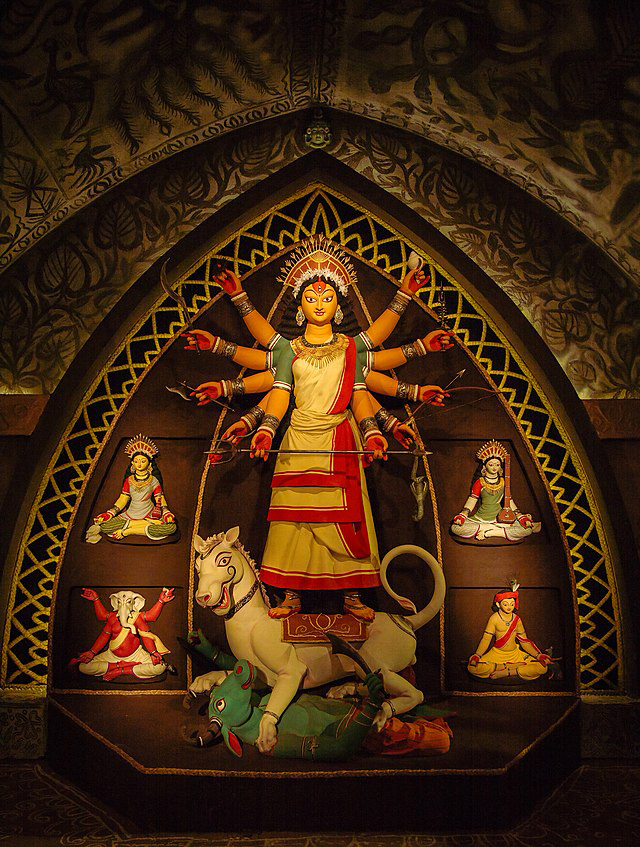
In her FAR post earlier this year,[i] “Why Feminism Needs the Fierce Goddesses,” Susan Foster argues that a “flagging” feminist movement needs the revitalizing energy of the “fierce goddesses” of ancient times to challenge the patriarchal forces that seem to be on the rise as increasingly we find women’s lives and freedoms constrained. She writes, “the dark goddesses of ancient times have been submerged in our psyches, but they serve as a repository of fierce energy, of female rage against injustice.”  She continues, “It’s important and healthy for us as women to reclaim our anger, using it to protect ourselves and fight for our rights in systems that are oppressive.”

Reading this, I immediately thought of Beverly Wildung Harrison’s, “The Power of Anger in the Work of Love,” and China Galland’s, The Bond Between Women: A Journey to Fierce Compassion. Anger as the work of love; fierce compassion.  In this time of mass shootings, insurrection, the ongoing assault on women, LGBTQ, and BIPOC peoples, when rage seems so easily fueled by hate, envy, and greed, it is the rage based in love and compassion that is most needed.  This is the rage of the fierce dark goddesses who are moved to act against injustice, the rage of the feminism I love. With its source in love and compassion, it is a rage that rebels in the best sense of the word – that at once refuses injustice and affirms dignity and respect, that speaks truth to power, that is grounded in solidarity and friendship, and values the immanence of the earth, the water, the body, and the divine spark in all beings.[ii] 

Continue reading “Durga Rising: Feminism as Fierce Compassion By Beth Bartlett”

From the Archives: Are Bees Begotten from Bull? by Judith Shaw

This was originally posted on June 23, 2021

At first glance the ancient belief that bees were birthed from dead bulls seems odd. But if we delve deeply into pre-historical artifacts we discover the mythopoetic roots of this idea.

Our Paleolithic ancestors lived immersed in nature within the cyclical nature of time. For them the moon, which revealed monthly, yearly and even longer cycles of time, became the symbol of the cycle of birth, death and regeneration.

By photo 120 – Own work, CC BY 3.0, https://commons.wikimedia.org/w/index.php?curid=5044488
Continue reading “From the Archives: Are Bees Begotten from Bull? by Judith Shaw”

From the Archives: Aren’t We All Divine Children? by Janet Maika’i Rudolph

This was originally posted March 18, 2021
Note from Janet: Thank you all who supported the launch of my book Desperately Seeking Persephone on May 19. Due to a printer’s error, the original books sent out were deeply damaged without formatting, editing and with uncertain content. If you received one of these books you are entitled to a free replacement. I have put instructions at the bottom of the post for anyone affected to receive their copy.

Consider the following four birth stories:

Continue reading “From the Archives: Aren’t We All Divine Children? by Janet Maika’i Rudolph”

Is A Balanced World Possible? by Judith Shaw

Are cruelty, violence and greed written into the human DNA?  Are we destined as a species to continually and for eternity create our world in a hierarchical manner where the privileged few receive almost all of the goods and services while the masses live in slavery of one form or another? 

Continue reading “Is A Balanced World Possible? by Judith Shaw”

The Return of the Goddess to Our Human Consciousness by Caryn MacGrandle

One of the over 700 granodiorite statues made of the Goddess Sekhmet almost 3500 years ago, “the Lady of the Place of the Beginning of Time.” 

Molly Remer of Brigid’s Grove, a fellow contributor here at Feminism and Religion recently wrote on the Mother Well section of the divine feminine app: “I feel like Inanna & Enheduanna are all around in recent months!”

Yes. I do as well.

A year or two ago, I read a book by Lauren Sleeman entitled ‘Behold’.  The premise of the book has remained with me:  a telling of the Goddesses, in particular Lilith, the Great Mother and Crone of the Cosmos, and Hekate, Goddess of the Dark Moon and the Mysteries of Life, who have been silently watching and waiting these past few thousand years to return to our human consciousness. 

Continue reading “The Return of the Goddess to Our Human Consciousness by Caryn MacGrandle”