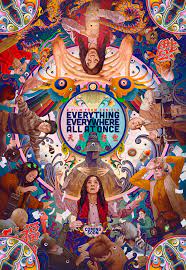
Considering “Everything Everywhere All at Once”

The multiverse as a metaphor for trauma is rather compelling to me. It speaks to the way in which different realities and experiences impose themselves on others as a matter of fact rather than malintent. These realities necessarily co-exist in interrelationship but may compound the weight and confusion of present experience.

Warning: Spoilers Ahead!

Everything.

Everywhere.

All at Once.

I remember thinking, this is kind of a weird name for a movie, even if it is about the multiverse and shifting realities. But I’m a big sci fi fan, so of course, I jumped at the chance to see it when my friend said she wanted to see the movie, again, with me specifically. Mom’s day out for both of us. Check. A… m.o.v.i.e. I remember movies from a time pre-pandemic: there’s a big screen, right? And food? I like food. Sign me up. (j/k). I seem to remember movie theaters being more crowded though—my friend and I had almost a private viewing. And sitting practically on top of my friend by the end of the film, after laughing so hard I cried, crying because I was so sad, gaping in shock, horror, and even disgust, and wondering what I just saw, I reflected: this movie was perfectly named.

Continue reading “Considering “Everything Everywhere All at Once””

Memoirs of a Cult Survivor by Chasity Jones

This blogpost is a reflection on my experience creating a podcast series concerning religious trauma experienced in cults as well as how to heal from traumatic cult experiences.

Firstly, I had to be very intentional about the word survivor as opposed to victim. Survivor was the obvious choice because I used to cringe when thinking of myself as a victim. However, As I heal, I can honor both the survivor and the victim, for they are the same. I cannot forget to acknowledge though that some victims do not survive and this is the same concerning cults. Many people at this very moment are in exile or in hiding from their cults when they escape and for that reason some of the people who engaged in this series were forced to engage anonymously.

Continue reading “Memoirs of a Cult Survivor by Chasity Jones”

Remembering “The Burning Times,” Part 2: Healing by Beth Bartlett

You can read part 1 here.

The effects of “the burning times” are still with us. I can feel this in my own body. As Starhawk put it so vividly, “the smoke of the burned witches still hangs in our nostrils, . . . remind[ing] us to see ourselves as separated. . . in competition with each other, alienated, powerless and alone.”[i] However, she continues, “the struggle also continues.” That struggle is the impulse toward wholeness, healing. That journey toward healing begins with remembering and acknowledging past harms, so that we may better understand who we are and the ways these continue to live in our bodies, psyches, and culture in order to address them.

In South American indigenous cultures, trauma is recognized as susto, or “soul wound,” and it is on that level that healing needs to happen.[ii]  To quote Shirley Turcotte, “Healing from trauma is a spiritual matter, a relationship matter, and there are places in recovery that require a precious spiritual response.”[iii] The women’s spirituality movement continues to be one such precious response. The work of Starhawk and others to reclaim the word “witch” and to revive and reimagine a tradition of valuing immanence, the sacredness of the earth, and the ability to change the world for the good has been invaluable in this.[iv] In her examination of the reasons for the persecution of witches, Starhawk names the “war on immanence” as one of three factors.[v] If the spirit was not present in the earth itself, then people had to rely on priests and the Church for access to a transcendent god. 

Continue reading “Remembering “The Burning Times,” Part 2: Healing by Beth Bartlett”

From the Archives: A Feminist Retelling of Noah’s Ark

This was originally posted on May 4, 2018

My daughters came to me after Sunday School one day, concerned about a story they had heard in which God drowned almost everyone on Earth. So I sat down and thought about why a community might want to tell that story, and what valuable wisdom might be lifted from it for my children. Here is what I told them:

God/ess  has  many  faces,  which  help  us  understand  different  things we  need  to  know  at different  times. Sometimes we think of God/ess as Crone, an old, old  woman  crowned with silver hair as  an  emblem of her wisdom, who helps us  learn to let go of anything that is holding back the wellness of our community and ourselves. 

Continue reading “From the Archives: A Feminist Retelling of Noah’s Ark”

Taking it to the Cauldron, by Molly Remer

If I squint,
I can almost see steam lifting
from a cauldron in the forest
and smell change
drifting through the air.
I am looking at the shards
of the year,
some new-broken,
some re-collected,
some shining with possibility,
and I feel the call,
the urge,
the promise,
to tip them all into that bubbling vat
and see what She will steep me
into next.

Each year, in August, I honor what I call a “Cauldron Month” for myself. This is a month in which I “take it all to the cauldron” and let it bubble and brew and stew and percolate. I pull my energy further inward to let myself listen and be and to see what wants to emerge. It is a month in which I delete my social media apps and mindfully, intentionally draw my scattered attention inward in order to listen to my inner wisdom, to take all of my bubbling ideas to the metaphorical cauldron of my own being and see what is brewing, what is stewing, and what is ready to be dished up. I clarify goals for the remainder of the year, my next word of the year usually finds me, and I take time to consciously “steep” in my own flavor. It is a time of clarity and renewal for me, a time when I withdraw from outer life and re-collect my energy in order to determine where to put my focus for the remainder of the year.

It may seem strange to withdraw energetically at such a ripe and burgeoning time of the year, when life is bursting with things to harvest and ideas to share, but that is exactly why I do it—because when life feels the most full, is when I known I most need some dedicated time of discernment. August, I find, is always a crucible of change and choice for me. It is when big projects are birthed, when new doors open, and when I reach metaphorical crossroads of change—crossroads in which I decide what to harvest, see what has withered, and come to understand what to sacrifice.

We are held between
summer’s fatigue
and summer’s fire,
there has been a blooming
and a ripening,
and now a harvesting and a fading,
as the time comes
to turn the page.

Cauldron Month dates back to 2016, a year in which my pace of living became unsustainable and I experienced a persistent and inexplicable cough that lasted for six full months. After this experience, I came to clearly see a pattern in myself, of speeding up and revving harder and harder through the spring and summer, until I reach an annual point of having taken on too much, in which I must make choices about what to let go of and what to pursue. It helps to know it, to name it, to say to myself: oh, yes, this. Cauldron time is here again. The understanding of this pattern has helped me to prepare for it, when I feel the familiar tension, the drive to push and speed, I step back instead. I sit down. I shut things off. I get still and I listen.

That first year, feeling overwhelmed by commitments and at my physical and temporal limits. I did a guided meditation called the Moon Goddess Ally Journey. During the meditation, in the temple in which I met the moon goddess, right as the meditation was coming to a close, the Cauldron from the Womanrunes oracle card system appeared quite clearly etched on the floor of the temple–it was very large, covering the whole floor, and felt like a dramatic and powerful wake-up call. I knew in this moment: I need to take my life into the Cauldron. I need to see what is brewing. I need to steep in my own magic. August has never been the same since.

Future Cauldron Months after have held varying experiences—some rich and powerful and some painful and challenging, what they all hold in common is that they illuminate the next steps and invite me into the next chapter. Some years I’ve joked with friends have been “Slow Cooker Months” instead and some years—like 2020—have felt like Cauldron Years, in that the whole year is a process of transformation and re-emergence. I have written some more about these experiences in a past post for FAR here.

Each year, I do what I can to honor the call of the Cauldron—persistent and insistent—and in so doing I remember that it is often in the mess that the story lives. What sometimes bubbles up from the Cauldron during this period of incubation isn’t particularly pretty, it can even be hard to confront, and yet, we continue to let it bubble, we continue to breathe and bear witness to our own interior lives, beyond the clamor and confusion of so many other voices that may fill our lives and days.

The Cauldron is a rune of alchemy and change, but also of centering of containment and contemplation—a marrying of what might seem like opposites, but that which really co-exist. During this month or another one that feels right to you (a lot of people choose December or January), consider taking it all to the metaphorical Cauldron of your life…what are you cooking? What flavors do you want to add? What do you want to create? What needs time and focus to bubble and brew? Can you allow yourself to steep in your own flavors? The Cauldron asks us what we’re cooking, but it also offer boundaries, containment, a safe space in which to stew up our truest magic.

May you be inspired by some time in cauldron,
may you be inspired by time with yourself,
may you be inspired by that which surrounds you,
connected to Goddess,
connected to the earth,
connected to the animals, plants,
the wisdom of the wind,
the song of branches,
and the symphony
of river, stone,
leaf, and breath.


Take it to the Cauldron and listen to the deep within.

Last year, I also made a free toolkit for sacred pauses which has lots more Cauldron Month info in it for you.

Sending you all love. Glad to share some of the miracle of being here with you.

There are days when the sky
holds its breath
and dreams seep up
from the skin of the world
and into my feet.  

Molly Remer, MSW, D.Min, is a priestess, mystic, and poet facilitating sacred circles, seasonal rituals, and family ceremonies in central Missouri. Molly and her husband Mark co-create Story Goddesses at Brigid’s Grove. Molly is the author of nine books, including Walking with Persephone, Whole and HolyWomanrunes, and the Goddess Devotional. She is the creator of the devotional experience #30DaysofGoddess and she loves savoring small magic and everyday enchantment.

From the Archives: Serpent Healing by Laura Shannon

This was originally posted on October 38, 2014

Snakes have been considered sacred in Greece and the Balkans, as well as other cultures, since at least 7000 BCE. They are symbols of rebirth and regeneration, as they travel between our world and the world below, disappear and re-emerge from the earth in spring, and shed their skins in seasonal renewal.

The Cretan Snake Goddess from Knossos (ca 1600 BCE) stands serenely with serpents wrapped around her body, showing how snakes were considered benevolent and were revered, not feared. Snakes are also powerful symbols of healing. Recently, I had an extraordinary experience of ‘serpent healing’ after a serious injury.

Knossos Snake Goddess

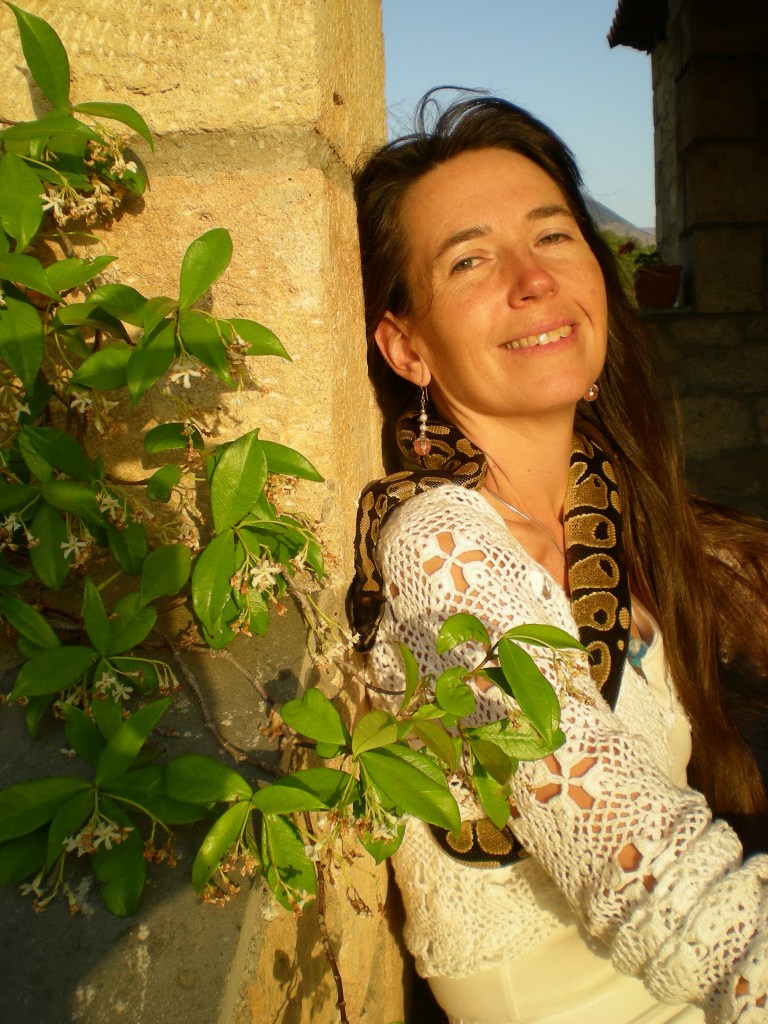
Friends of mine run a yoga retreat centre in Mani, Greece, called The Spirit of Life, where their son keeps a number of snakes including a beautiful Royal Python named Monty. Monty and I have met on several occasions over the years, and whenever I have spent time holding him, I have felt a sense of great peace and calm. More than that, Monty has shown an uncanny ability to move directly to places of tension in my shoulders, and to gently yet firmly massage sore muscles in a soothing way.

Continue reading “From the Archives: Serpent Healing by Laura Shannon”

Crumbs of Our Souls, by Molly Remer

So, what trail of crumbs has your soul been dropping for you? And how might you savor and kiss these fallen crumbs, rescuing them from where they’ve been kicked under the table?

Something that I keep coming back to in recent years is accepting the reality of our lives as they are right now, really inhabiting where we actually are. To be clear, this does not mean settling for injustice or not taking action—it does not mean settling into apathy or turning away from suffering, it means inhabiting our own lives in full, in the present.

My word of the year for this year is attend and with that I mean, pay attention to where you are, pay attention to your life right now, not what you think your life should be, not what you think other people’s lives are, not what you want to pretend to be, but what is your life right now? Can we take an actual unflinching look at the reality of our lives, right now? I invite you to take a brief pause and let yourself inhabit your own life right now, as it is, no need to change anything about it. It is what it is. For example, I hear the distant sounds of my brother mowing. I hear birds. I am looking at full-leafed trees and the drippy little fingers of green pollen on the oaks, the long, green flowers on the mulberry trees. This is the first sunny day and blue sky that I’ve seen in what feels like several weeks (possibly exaggeration). I feel a tightness in my shoulders, but here I am. And, here you are. What do you feel where you are? What do you see where you are? What are you hearing where you are? What is your life like right now?

I feel at strange, tender, and tentative point of reemergence this summer. I know that the pandemic experience has been very different for different people according to your geographic region, according to the culture and climate of the state in which you live, and according to your type of employment or your life’s structure. Many people who are employed in some kind of service industry did not have the luxury of just stepping out of society and retreating to their homes during the pandemic years. For people like me who work at home and who already school their kids at home, it wasn’t that big of a stretch to just further close off my life and just stay home and not go places. It took me practically two years to even miss doing things outside my house externally with other people. So, acknowledging that there are some people who never had the choice of just retreating to their homes and stepping out of society, people who had to keep riding public transportation, people who had to work at restaurants or in stores or in health care, people who are students and had to go to classes. There wasn’t the option to step out and away for some of us. For others of us, the last two years have been almost a kind of hermitage where you’re suddenly just withdrawn from everything and in a type of waiting place. For me, I have in many ways appreciated this withdrawal in its own way, the opportunity become small and closed in. And, now, at the cusp of summer, I’m also starting to recognize that becoming so small and closed in is now beginning to feel tight and confining. As we consider reemergence, we may find it is time for us to decide: What do we want to step back into and what do we want to stay out of?

In Jennifer Louden’s Oasis program (of which I am a long-time member), she spoke of reemergence as a theme and one of the things she noted that I found really powerful is that we may have in some ways forgotten how to exercise our “no” or our boundaries, because we’ve had an automatic built-in, “oh, it’s a pandemic. I’m not going to do whatever.” Now, as we re-emerge, we have to actually say, “No, I still don’t want to do that.” Or, “Yes, I do, let’s try to rebuild that.” What I’m recognizing in myself is that it’s very hard to tease apart what I still actually want to do and what I’ve actually just gotten out of the habit of doing and so actually feel some type of trepidation or anxiety about doing again. For some things that I haven’t been doing, it is not that I truly don’t want to do them again, it’s that I am also holding some kind of fear of stepping back into it. And, these things may be all rolled up together. For example, I am unsure whether I really do not want to have a big summer solstice ritual this year, or whether I just feel nervous about it, because it’s been several years since I’ve had a bigger group ritual and so I’m afraid I don’t know how to do it anymore. Which is it? When is it really your heart or intuition saying, “I laid this down and I want to leave it laid down.” When it is your heart or intuition saying, “This is something I want to pick back up.” What is obligation telling us we should pick back up when inside we know we no longer want it? And, what is fear making us afraid to pick back up that we really DO want to pick back up?

One of the books I just finished this year is A Woman’s Book of Soul by Sue Patton Thoele. It is a book of daily meditations that is a little more Christian in orientation than I usually prefer, but it also has some interesting things in it too. In a section called savoring our souls, Thoele writes: because the demands of day to day life have a way of dulling our spirits and cutting us off from our hearts, it’s essential that we find ways to reinstate solitude into our lives and through it experience the beauty of heart and soul. One day while suffering from solitude starvation, I ran across a poem in which the poet talked about wandering alone through his house savoring and kissing the ‘fallen crumbs’ of his soul. I smiled as I read the poem because it validated the feelings I often have when home alone. I wander. Touching, appreciating, remembering, singing, gathering, and kissing the fallen crumbs of my soul. Very often, this is the time I choose to change the symbols in the miniature Zen Garden given to me by my son, a simple task taking only a few minutes at the most, but nonetheless, a richly replenishing ritual in which I savor my soul. If your soul has been dropping a trail of crumbs as it accompanies your body through its days, how would you like to savor and nourish it? Can you arrange for some solitary time at home in which you sweep up and kiss your soul crumbs? Gently close your eyes and imagine a time in your own home when you are blessed by the renewal of solitude. Cherish it. Wander or sit quietly. Give yourself the gift of enjoying the solitude in ways that warm your heart, fill your spirit, and revitalize your soul. It is a sacred assignment to rescue the crumbs of our souls that have been kicked under the table by too much activity and too little aloneness, to collect and kiss them all better.

The affirmations at the end of this section are: I need and deserve time alone and I am adept at balancing time alone and time with others.

So, what trail of crumbs has your soul been dropping for you? And how might you savor and kiss these fallen crumbs, rescuing them from where they’ve been kicked under the table?

Deep breath, a hand on your heart, let yourself settle into center and then perhaps you may wish to read this prayer aloud:

I dedicate myself to the full living of my own life
in all its joys and complexities.
I dedicate myself to walking my path.
I dedicate myself to being present.
I dedicate myself to brave and joyful wholeness.


May you nourish the crumbs of your soul.

Molly Remer, MSW, D.Min, is a priestess, teacher, and poet facilitating sacred circles, seasonal rituals, and family ceremonies in central Missouri. Molly and her husband Mark co-create Story Goddesses at Brigid’s Grove. Molly is the author of nine books, including Walking with Persephone, Whole and HolyWomanrunes, and the Goddess Devotional. She is the creator of the devotional experience #30DaysofGoddess and she loves savoring small magic and everyday enchantment.
“Calculated Emotional Violence” and Abuse: Memories of ‘Mother Days’ by Sara Wright

I took the above phrase from a post on FAR (published 5/6/22) after it triggered memories of mother abuse. Like Sedna I was a daughter who was thrown into the sea, her fingers cut off one by one (but not by my father). Abandoned and left to die, Daughter sank to the bottom of the sea. The classic Handmaid’s Tale. In the Inuit story the abused daughter survives, transforming into Mistress and Mother of the Animals. As a woman I have followed in Sedna’s footsteps in that I became a dedicated naturalist with a fierce love for all non-human creatures (and plants), but I have yet to transform my unfortunate family history.

With Mother’s Day approaching, I am forced against my will to think about my calculating, deceitful mother who had little use for women in general, and spent her life criticizing and eventually deleting her only daughter permanently from her life. Trashed.

My first crib memory is one of raw terror – a bewildered baby crying out for a mother that never came. Comfort, compassion, love were withheld. Now at 77 I ask myself: what was wrong with this woman?

Continue reading ““Calculated Emotional Violence” and Abuse: Memories of ‘Mother Days’ by Sara Wright”

From the Archives: A Handy Spiritual Practice by Barbara Ardinger

Originally posted on February 7, 2021. You read the original comments here.

Here’s a simple spiritual practice that I’ve been doing for longer than I can remember. During the regime of the Orange T. Rex, I started doing it at bedtime to calm my mind so I could go to sleep. We’re hopefully living in a more optimistic and peaceable time now, but that’s no reason not to add a new spiritual practice to our lives. I hope you’ll like this one and will try it for yourself.

We’re accustomed to seeing people praying with rosaries or reciting mantras and counting repetitions with strings of beads. We can do that, too. But how about using a simpler “tool” to keep track of our mantras and affirmations—our own hands?

Continue reading “From the Archives: A Handy Spiritual Practice by Barbara Ardinger”

From the Archives: Medusa and Athena: Ancient Allies in Healing Women’s Trauma by Laura Shannon

This blog was originally posted on June 24, 2017

Rather than being a bleeding image of female disempowerment, Medusa may be read as…one of the most ancient European symbols of women’s spiritual abilities… [and] an empowering image of feminine potential.’

–Patricia Monaghan, O Mother Sun! (1994:244)

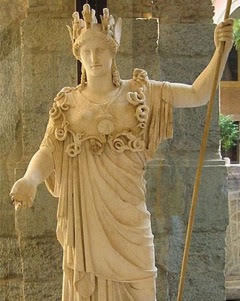
The name Medusa means ‘sovereign female wisdom,’ ‘guardian / protrectress,’ ‘the one who knows’ or ‘the one who rules.’ It derives from the same Indo-European root as the Sanskrit Medha and the Greek Metis, meaning ‘wisdom’ and ‘intelligence.’ (1) Metis, ‘the clever one’, is Athena’s mother. Corretti identifies Athena, Metis, and Medusa as aspects of an ancient triple Goddess corresponding respectively to the new, full, and dark phases of the moon. (2) All three are Goddesses of wisdom, protection, and healing.

Athena with Gorgoneion in her heart. 5th C BCE.

Athena and Medusa are particularly linked: indeed, one may have been an aspect of the other, ‘two indissociable aspects of the same sacred power.’ (3) Their many common elements include snakes, wings, a formidable appearance, fierce eyes and powerful gaze. The serpent, like the Goddess, has been cast as an embodiment of evil in patriarchal retellings; yet as Merlin Stone points out, serpents were ‘generally linked to wisdom and prophetic counsel’, associated with ‘the female deity’ and ‘entwined about accounts of oracular revelation…throughout the Near and Middle East.’ (4) According to Ovid, the poisonous vipers of the Sahara ‘arose from spilt drops of Medusa’s blood.’ (5) Although this is presented as a further sign of Medusa’s horrifying character, the original Berber inhabitants of North Africa – where Herodotus reports that the Medusa myth began – viewed snakes as bringers of luck and portents of joy. (6)

Continue reading “From the Archives: Medusa and Athena: Ancient Allies in Healing Women’s Trauma by Laura Shannon”