Part 1 was posted March 1st. You can read it here. The definition that Carol refers to as well as a link to her original article can be found there as well. Her words are in italics.
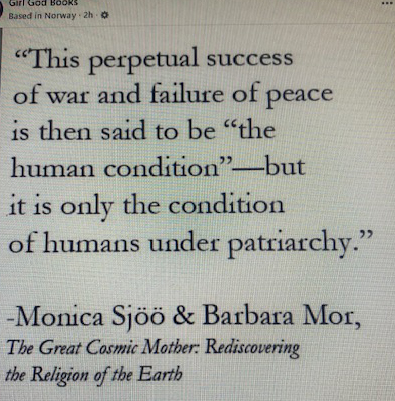
It has long seemed to me that patriarchy cannot be separated from war and the kings who take power in the wake of war. Many years ago I was stunned by Merlin Stone’s allegation that in matrilineal societies there are no illegitimate children, because all children have mothers. Lately, I have been trying to figure out why the Roman Catholic and other churches and the American Republican party are so strongly opposed to women’s right to control our own bodies and are trying to prevent access to birth control and abortion. In the above definition of patriarchy . . . I bring all of these lines of thought together in a definition which describes the origins of patriarchy and the interconnections between patriarchy, the control of female sexuality, private property, violence, war, conquest, rape in war, and slavery.
From the Facebook page of GirlGodBooks
Here Carol lays it all out. I, too, have wondered why the Church, why conservative politicians are so obsessed with women’s bodies and reproductive systems. No wonder abortion, in fact all of the healthcare of women is so on the political radar. Taking away the agency of women when they become pregnant is dehumanizing, reduces women to incubators. And that doesn’t even go into the fear of treating women for any health issues when they are pregnant. Take the tragic case of Tierra Walker who died in Texas, pregnant and facing growing health problems. She had a 14year old son and after weeks of severe distress attempted to get an abortion. She was unable to do due to the strict anti-abortion laws in Texas as she went to doctor after doctor. Here is what they told her: “But the doctor, her family said, told her what many other medical providers would say in the weeks that followed: There was no emergency; nothing was wrong with her pregnancy, only her health.” Its as if there was a cabal to diminish the value of women’s lives that even the doctors, who know better, participate in. And that is the templated of patriarchy. True that the doctors are threatened with loss of license and 10 years imprisonment begin. But when they spout the “party” line, they not only risk their patients, they deepen the already ingrained belief that women and our bodies are without worth.
The Inuit make up about 88 percent of the people in Greenland, and most speak the Inuit language with the remainder speaking Danish.
Up until the present the greatest challenge the Inuit peoples have faced besides the threats to their culture/and massive environmental collapse due to climate change has centered around uranium mining and the ubiquitous Military presence.
Now an American Madman demands that the entire country be taken over to secure homeland security against the ‘enemy’ (himself?) What is rarely mentioned is that Greenland is also so rich in resources (so useful to ‘resource’ hungry America). This lunatic threatens to make everyone that refuses to support the takeover ‘pay’.
What never seems to make it into the news is that should this takeover happen the Inuit people who have subsisted in this harsh but magnificent peace of earth (peace used deliberately) for thousands of years will be destroyed. How is it possible that no one mentions that this is yet ONE MORE Indigenous culture that will go down under the tyranny of the colonizers? I repeat this truth for emphasis because Indigenous peoples are invisible in this culture, regardless of what is said. 500 hundreds year of oppression by foreigners isn’t enough?
Only in November 2025, the following murders were reported:
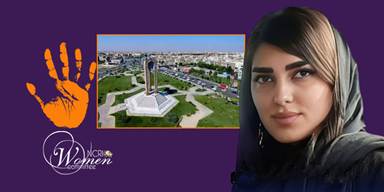
Mobina Zare, age 20, in Islamshahr (a city southwest of Tehran), was killed by her former fiancé. After murdering her, he burned her body in an aluminum-melting furnace at his father’s workshop. Her family searched for her for ten days before finding her half-burned body.
Mobina Zare was burned in analuminum melting furnace
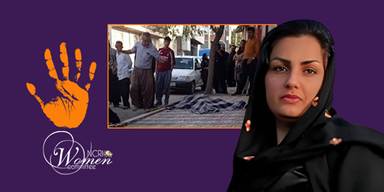
Leila Aliramaii, age 40, in Marivan (in Kurdistan Province, western Iran), was killed with a Kalashnikov rifle because she refused the vile demands of a member of the Revolutionary Guard Corps (IRGC). Leila was married and the mother of a young daughter and son.
Leila Aliramaii, the mother of two young children
Sarina Rostami, age 16, in Sarpol-e-Zahab (in Kermanshah Province, western Iran), was killed by a male relative because she refused accept a forcible marriage.
Sarina Rostami, 16, victim of forced marriage
A 40-year-old woman in Pakdasht (Tehran Province) was suffocated with a blanket by her husband.
Reyhaneh Dorzadeh, age 23, in Nikshahr (Sistan and Baluchestan Province, southeastern Iran), was suffocated by her husband because she opposed his desire to take a second wife.
A 29-year-old woman identified as J.D. was murdered by her father, who then dismembered her body and set it on fire.
Sakineh, age 80, in Tehran, was killed by her son using an iron rod.
Zahra Ghaemi, a women’s rights activist and member of the Women’s Study Group at the University of Tehran, was suffocated by her husband.
Zahra Ghaemi, a member of the Women’s Study Group at the University of Tehran
Shahla Karimani, age 38, mother of two, in Mahabad (Kurdistan Province), was strangled with a scarf by her husband and brother-in-law.
Sajedeh Sand-Kazehi, in Khash (Sistan and Baluchestan Province), was killed with a hunting rifle because her father-in-law wanted to forcefully take a gas regulator that belonged to her. Sajedeh was the mother of two young children.
Raheleh Siavoshi, age 26, in Nahavand, a town in Hamedan Province in western Iran, was fatally stabbed by her husband after participating in a sports camp. She died in the hospital two days later.
Raheleh Siavoshi, a national wushu champion and coach
Justice Has Lost Its Meaning
While women are sentenced to long prison terms for “removing their hijab” or protesting discrimination, men who murder their wives typically receive only a few years in prison. In many cases, they can pay money to buy their way out and return to their lives.
In notorious cases such as Romina Ashrafi and Mona Heydari, the murderers received only two to eight years in prison. Even state-run media sometimes acknowledge this “inverted justice”: “The punishment for beheading one’s wife: 8 years in prison; The punishment for removing one’s hijab: 10 years in prison!”
According to the regime’s laws, the father, who is also the “male guardian and blood-owner (vali-ye-dam),” is exempt from retributive punishment for killing his own child.
Zahra Eftekharezadeh, founder of one of Tehran’s safe shelters, said regarding the absence of deterrent laws: “When the law does not impose a punishment proportionate to the crime, perpetrators realize there is no serious consequence waiting for them. In many cases, the sentences issued by the judiciary are not only non-deterrent but encourage the offender. Romina Ashrafi’s father is an example. He openly said that if he killed his daughter, he would receive at most ten years in prison.” (Shargh newspaper – October 11, 2025)
Atrocities Rooted in Law and Politics
Under Iran’s misogynistic clerical laws, a woman is not recognized as an independent individual but as “subordinate” to a man. Without legal or structural protection, women are forced to endure domestic violence, and each day adds new names to the list of women murdered.
Article 1105 of Iran’s Civil Code assigns family leadership exclusively to men.
Article 1108 makes a woman’s right to financial support conditional on her “obedience.”
Article 1114 gives the husband the right to determine the wife’s place of residence.
In such a system, women seeking divorce must prove their lives are in danger, and their testimony is worth only half that of a man. Judges routinely force women who have been beaten or threatened back into the homes of their abusers.
Through its laws, media, and judiciary, the clerical regime perpetuates these crimes. Violence extends from home to the school, from the street to the courtroom, widening its reach every day.
But beyond the laws, today’s social tragedies in Iran stem from political roots. The misogynistic clerical regime is founded on the subjugation of women. The horrific killings of women are not isolated acts of personal fanaticism; they are the product of a system that authorizes violence against women.
The rising number of honor killings must therefore be understood as the direct result of the regime’s anti-woman policies and the patriarchal culture embedded within its structure. The Iranian people blame not society but the regime itself, an oppressive, misogynistic establishment that preserves its power through the suppression and elimination of women.
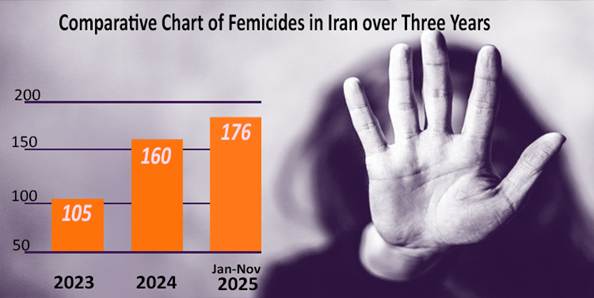
Data compiled over the past three years by the NCRI Women’s Committee shows a sharp upward trend in the number of women murdered under the misogynistic rule of the clerical regime. These figures are drawn entirely from documented and published reports by state-run media and other available sources. They therefore represent a minimum estimate, as the regime deliberately obscures such information, and many families, fearing the perpetrators, avoid publicizing the killings of their daughters and female relatives.
According to these findings, at least 105 women were murdered in 2023, 160 in 2024, and during just the first eleven months of 2025, no fewer than 175 women have been killed in Iran.
INFO: NCRI The NCRI Women’s Committee works extensively with Iranian women outside the country and maintains permanent contact with women inside Iran. The Women’s Committee is actively involved with many women’s rights organizations, NGOs, and the Iranian diaspora.
The NCRI Women’s Committee is a major source of much of the information received from inside Iran with regard to women. Attending meetings of the UN Women, the UN Commission on the Status of Women (CSW), the Human Rights Council, and other international or regional conferences on women’s issues, and engaging in a relentless battle against the Iranian regime’s misogyny are parts of the activities of members and associates of the NCRI Women’s Committee.
The NCRI Women’s Committee is one of the 25 committees of the National Council of Resistance of Iran.
Moderator’s Note: This post has been brought to you in cooperation with the NCRI women’s committee. NCRI stands for the National Council of Resistance of Iran. You can learn more information as well as see this original article by clicking this link. A description of their Council can be found at the end of this post.
Women Are Killed in Iran with Complete Impunity
November 2025 Report: Under the Clerical Regime, Nowhere Is Safe for Women in Iran
Under the rule of Iran’s misogynistic clerical regime, Iranian women, from childhood to old age, are unsafe in all spaces and circumstances. If they manage to escape the brutality of security forces in the streets, they may still fall victim in their homes to so-called “honor suspicions,” resisting forced marriage, requesting a divorce, or even attempting to defend their own rights. Many of these killings take place in front of children or other family members, feeding a cycle of violence across generations. Among the victims are pregnant women or mothers killed alongside their children.
Beatings and torture of women in prisons, firing pellets into the eyes of protesting women, sexual assault in detention centers, and the attacks by morality police patrols enforcing compulsory hijab in public all legitimize and encourage violence against women inside the home and within families.
Andrew Young famously said that ‘anything is legal if 100 businessmen decide to do it.” I would add a more modern take. Nothing is too low, too immoral, too illegal if 5 or 6 Supreme Court justices decide to allow it.
Their recent decisions could fill a book on how corrupt they are. (I’ve discussed this before. But this post is looking at immigration and the cruelty that this administration is fomenting. We have always been a cruel nation. Patriarchy has honed cruelty as its worked to crush women’s bodies while silencing women. How else would women have agreed to our loss of power? Carol Christ has written eloquently about this. Immigration policy has blown the lid off this pot. Perhaps because it is too new, too shocking. Because ICE is in our faces with agents flooding neighborhoods and engaging in unfettered cruelty.
For example, when ICE raided an apartment building in the Bronx on Feb 24th, they arrested 19 year old Merwil Gutiérrez. When they realized they had the wrong person, their response was “take him anyway.” Read that again, “take him anyway.”
Merwil Gutiérrez was then deported to the notorious prison CECOT in El Salvador. For months, his family couldn’t find him. He was eventually sent to his native Venezuela.
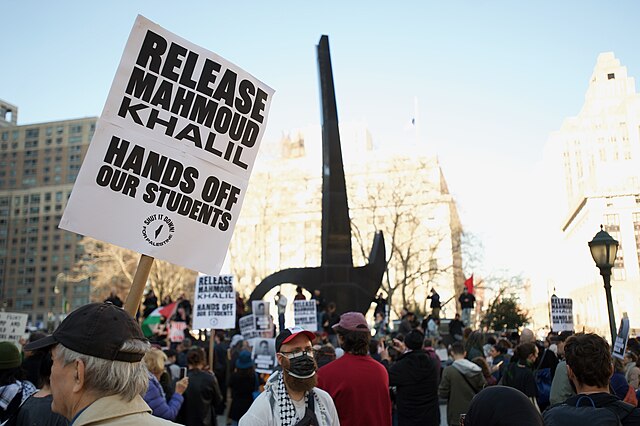
Moderator’s Note: Below is a letter from Mahmoud Khalil in its entirety, dictated over the phone from Immigrations and Customs (ICE) detention in Louisiana. A permanent resident taken by the government for his political speech. The phrase “who has the right to have rights?” was coined by Hannah Arendt who escaped Nazi Germany and wrote poignantly and pointedly about the rise of fascism. While on the surface, this letter doesn’t have an obvious link to FAR’s mission, we feel it is deeply intertwined. Who has the right the have rights? Women once had no rights and it appears we are losing them again at breakneck speed. Immigrant’s rights in this country are being stripped also at breakneck speed. And that is just the tip of the iceberg. If we can’t answer “EVERYONE” to Arendt and Khalil’s question, then human rights mean nothing for any of us.
Wikimedia Commons: Protests in Thomas Paine Park against the detention of Palestinian activist and Columbia student Mahmoud Khalil. [SWinxy]
My name is Mahmoud Khalil and I am a political prisoner. I am writing to you from a detention facility in Louisiana where I wake to cold mornings and spend long days bearing witness to the quiet injustices underway against a great many people precluded from the protections of the law.
Who has the right to have rights? It is certainly not the humans crowded into the cells here. It isn’t the Senegalese man I met who has been deprived of his liberty for a year, his legal situation in limbo and his family an ocean away. It isn’t the 21-year-old detainee I met, who stepped foot in this country at age nine, only to be deported without so much as a hearing.
Justice escapes the contours of this nation’s immigration facilities.
On March 8, I was taken by DHS agents who refused to provide a warrant, and accosted my wife and me as we returned from dinner. By now, the footage of that night has been made public. Before I knew what was happening, agents handcuffed and forced me into an unmarked car. At that moment, my only concern was for Noor’s safety. I had no idea if she would be taken too, since the agents had threatened to arrest her for not leaving my side. DHS would not tell me anything for hours — I did not know the cause of my arrest or if I was facing immediate deportation. At 26 Federal Plaza, I slept on the cold floor. In the early morning hours, agents transported me to another facility in Elizabeth, New Jersey. There, I slept on the ground and was refused a blanket despite my request.
I walk my dog at night—usually after midnight I walk in my neighborhood with my dog, Zuma, a dead ringer for Toto from the Wizard of Oz. We are both quiet. I have a small flask of chardonnay I keep in my breast pocket. I might photograph the moon. I might do Wordle and send my result to my wife. Answer a few emails, but I don’t stay on the phone.
I say my “gratitudes” out loud – at least ten of them before I even look at my phone…I say, “I’m grateful for…” (fill in the blank)—the fact that my truck has a moon roof, and I opened it on the way home; My wife is cooking chicken soup; I saw a former student at the coffee shop; I wrote the web footnotes to chapter 12 of the 2nd ed. of my book; due to the publisher this spring – these are all real gratitudes I said out loud yesterday.
ICE has been doing mass round-ups of anyone who looks like “the other.” The people cheered. “This is my country,” they shouted to the deportees. “Go back where you came from.” The people are flush with excitement thinking this is what we voted for, meanwhile ignoring that they came from someplace too. We know this is a publicity stunt. How? Dr. Phil tagged along on one of round-ups. Newly minted secretary Kristi Noem also took her role in the spotlight attending one in NYC and saying dehumanizing words I will not repeat here.
We’ve seen this playbook before. Creating chaos, disorientation and suffering for political points, TV or other publicity ratings. It doesn’t end well – EVER!
The NY Times had a report of how deportees were treated in a dehumanizing manner, being held on a broken plane in the Amazonian heat with no AC, people shackled, children were on board. There are always people available to treat other people as less than human. “I was just doing my job.” “I was only following orders.”
We’ve seen this playbook before. It doesn’t end well – EVER!
Quite a number of years ago I had a conversation with one of my professors, a feminist theologian, who posed the question “Why do I need a man to purify my baby with the waters of baptism? Is there something wrong or impure about the blood and water from a mother’s womb – my womb?” Before you jump and shout the words Sacrament or removal of original sin, this question bears merit in exploring, especially in today’s world where women are taking a serious beating religiously, politically, and socially. In today’s world, violations and rants are causing women to stand up and say STOP! This is MY Body. This outcry was provoked by chants of ethical slurs against women– Slut! Prostitute! Whore! The cry got even louder when the issue of religion and government was raised in the fight of healthcare coverage of contraception. The cry got even louder with the enactment of the laws in Virginia and Texas (and many other states to follow suit) that forces women to undergo transvaginal ultrasounds in early stage abortions. The mandatory insertion of a wand into a woman’s vagina (mandated by the government, mind you), is a violation and has women crying RAPE!
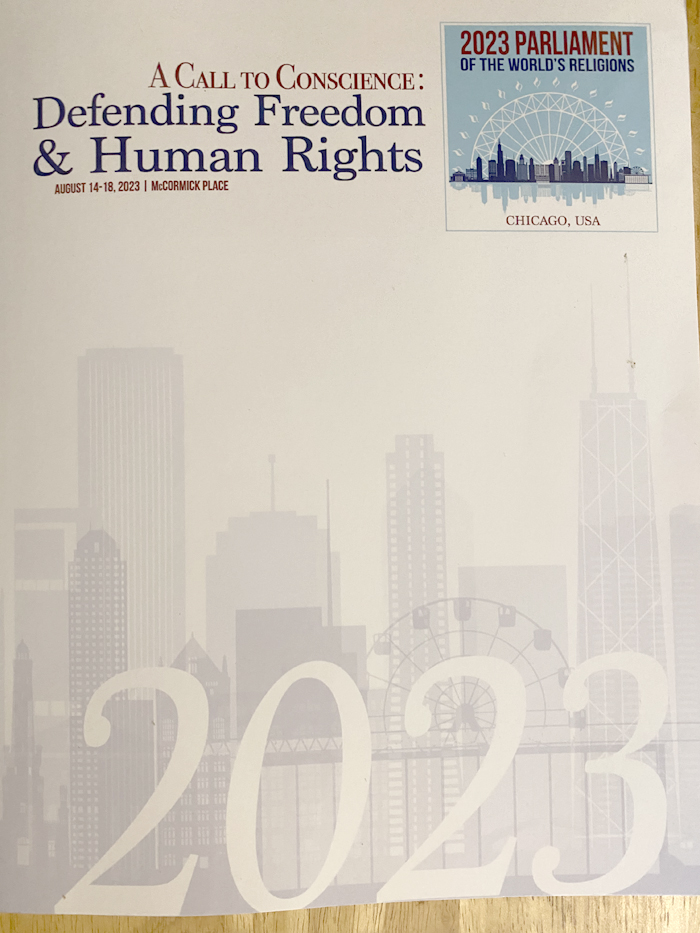
The Parliament of World Religions ran from Aug 14th to the 18th in Chicago. I returned with my head spinning having met new people, connected with inspiring beliefs, discussed fascinating ideas, watched meaningful performances, engaged in sacred play, danced, sang, cried, ate, and mostly experienced . . . just experienced. It is still overwhelming to sort out individual experiences. I am going to write up a few of my impressions, snapshot style. They scratch the surface, not only of my individual experience but of the Parliament in general where upwards of 7,000 people attended. It was incredible
Setting the tableau: As I was going down the escalator, a woman was followed by 2 groups were heading up. The woman was beautiful and young in full Mayan dress with white blouse, long orange skirt along with headdress and belt with Mayan symbols. Her thick dark hair was flowing down her back.
She was followed by five Sikh men who were dressed head to foot in white. Their heads and hair were covered by white turbans.
They were followed by two Buddhist nuns dressed in grey robes carrying beads. Their heads were shaved.








 Feminism and Religion