Does Islam need a reformation? The ever-controversial Ayaan Hirsi Ali’s new book Heretic: Why Islam Needs a Reformation Now argues that it does. Do you agree with her? Or do you find problems with the way Ayaan Ali frames the discussion?
According to their website, International Women’s Day (March 8) is a “global day celebrating the economic, political and social achievements of women past, present and future. In some places like China, Russia, Vietnam and Bulgaria, International Women’s Day is a national holiday.” The day was established to honor the work of the suffragettes who campaigned for women’s right to vote. (Note that the word “suffragette” is derived from “suffrage,” the right to vote. Today some women prefer to lose the “-ette” syllable, which diminishes any word it’s added to, and say “suffragist.”) “Great unrest and critical debate,” the website continues, “was occurring amongst women [at the beginning of the 20th century]. Women’s oppression and inequality was [sic.] spurring women to become more vocal and active in campaigning for change. Then in 1908, 15,000 women marched through New York City demanding shorter hours, better pay and voting rights.”
On March 19, 1911, the site continues, “more than one million women and men attended IWD rallies campaigning for women’s rights to work, vote, be trained, to hold public office and end discrimination. However less than a week later on 25 March, the tragic Triangle Fire in New York City took the lives of more than 140 working women, most of them Italian and Jewish immigrants. This disastrous event drew significant attention to working conditions and labour legislation in the United States that became a focus of subsequent International Women’s Day events.”
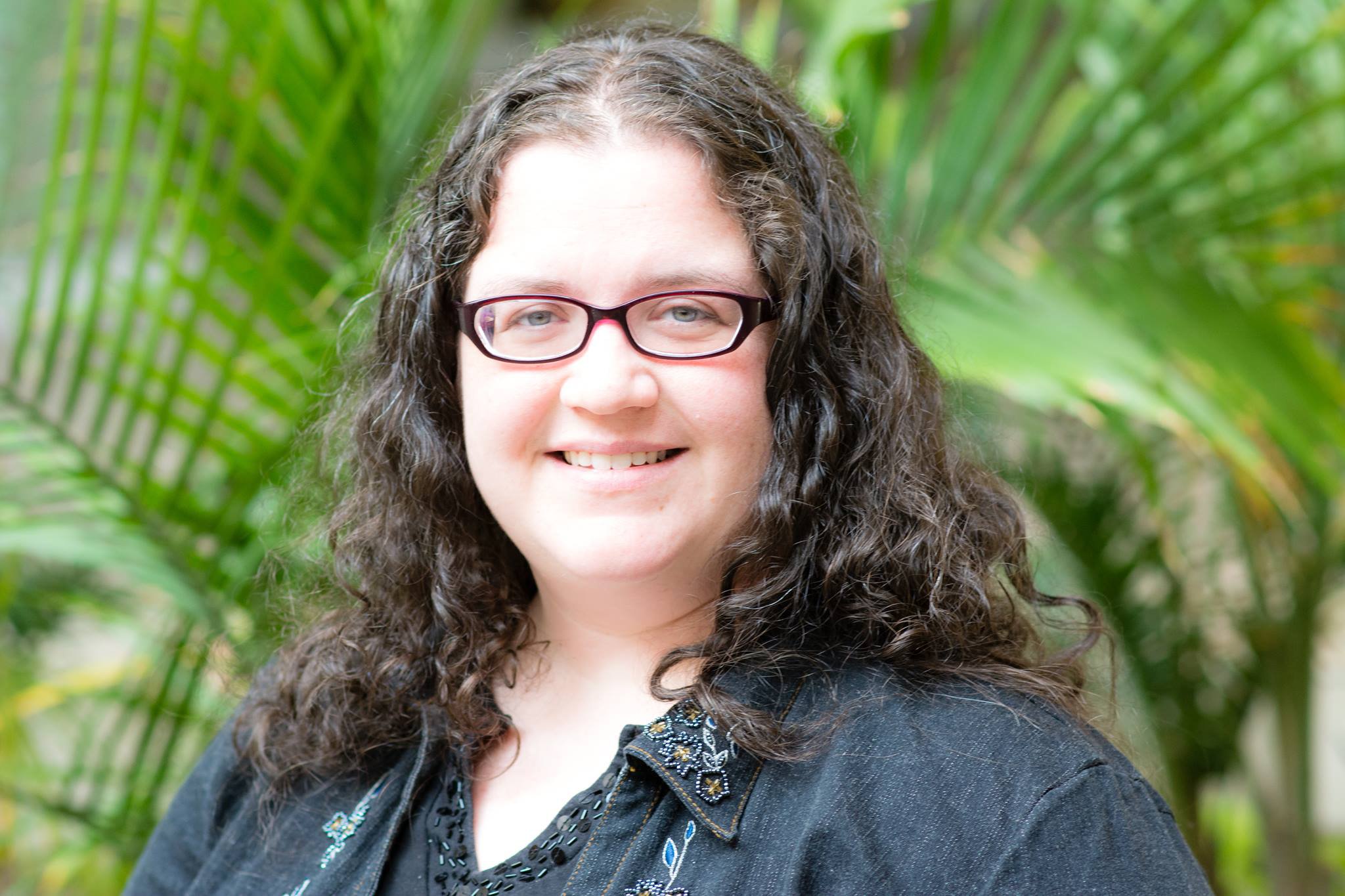
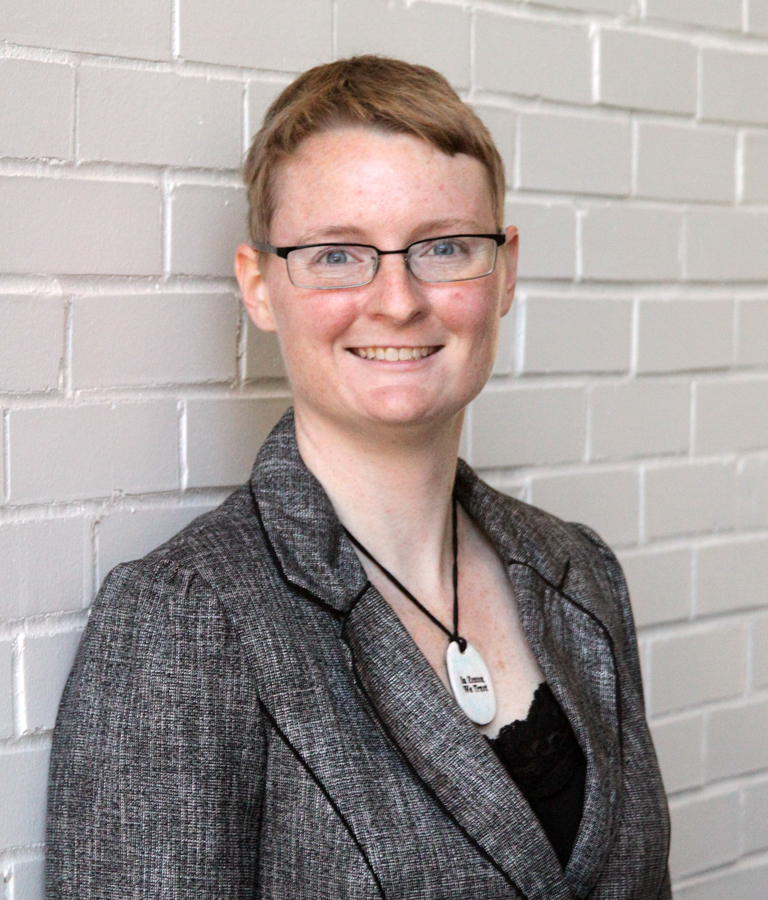
Two thousand years earlier in Rome, the month of March began with the Matronalia, or Festival of Women, when the Vestal Virgins entered a sacred grove and hung offerings of their hair on the oldest tree. Some historians say that Roman matrons served their female slaves at this feast. For every baby born in Rome, a coin was deposited in the temple of Juno Lucina, “Light,” to give thanks to the goddess for a safe birth. Continue reading “Today is International Women’s Day—Let’s celebrate! by Barbara Ardinger”
My partner is a lawyer who works with asylum seekers and other immigrants here in the Czech Republic (ČR). She’s amazing at her job and I’m constantly in awe of her passion and commitment along with her righteous anger at systematic injustices. In fact just last week, her workplace, together with a consortium of other immigration organizations in the ČR, helped organize a demonstration in the center of Prague to protest the Czech Republic’s refusal to admit Syrian children and their families into the country. She invited me to attend the event with her. I went.
It was my first time attending a public demonstration in Europe. It was moving to see many of her co-workers there and inspiring to listen to the passionate speeches against xenophobia, Islamophobia, racism, the plight of the Roma people as well as the need to come together and welcome diversity. In addition, there were signs in Czech, German and English saying “No One is Illegal,” “End Xenophobia,” “Do Syrian Children Have to Wait for their (Nicholas) Winton?” “I want to have a Syrian Friend!” and “Refugees Welcome!” I wanted to hold each one of those signs! Continue reading “Being Scared: Fear and Authenticity by Ivy Helman”
Social justice. Progressive politics. Improper media depictions. What exactly is the F-word (feminism) about?
I have always understood feminism as a project that casts a very wide net, the goals and values of which can keep quite a few people dry under the shade of its umbrella. But more and more, I see a narrowing of who can count as a feminist. There are a few reasons for this constriction. First, the more the F-word becomes a pejorative in contemporary society, the greater the need is to circle the bandwagons and set up camp. Second, when a particular group has elevated levels of in-fighting occurring, it makes sense to start psychologically splitting people into “feminist” and “not feminist.” Or, on a spectrum, “strong feminist” vs. “weak feminist.” Third, there is a pragmatic need for groups to find an optimal tension with society. When social groups are too counter-cultural or revolutionary, they get branded extremist and fanatical, but when they are wishy-washy and lukewarm, they become another extension of the status quo and lose their prophetic fire.
As an atheist, I see all of this occurring in non-believing circles as well. And I’m not really sure how to navigate it. There is also no shortage of men in this social group–from Dawkins to Boghossian–who think of feminism in the negative. All of this has to do with what they think the F-word amounts to. Continue reading “What is the F-word Anyway? by Kile Jones”
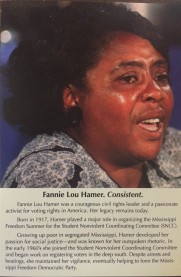
A few weeks ago, I came across a postcard that I was given at a conference last year. I got the postcard (advertisement?) because it has a picture of Fannie Lou Hamer on it, and in my home and office, I like to display images and quotes from inspirational women, especially black women. Hamer was a sharecropper from rural Mississippi who became a leader within the civil rights movement in the United States. I was happy to have something with her likeness on it. It was only later that I looked at the text on the front and back of the card, which read in part, ”Often called the ‘spirit of the Civil Rights Movement,” Hamer worked tirelessly on behalf of the rights of others—including the unborn. [She said,] ‘The methods used to take human lives such as abortion, the pill, the ring, etc. amounts to genocide. I believe that abortion is legal murder.’” I realized then that the card was distributed by an organization called Consistent Life, who, in support of a “consistent ethic of life,” is “committed to the protection of life threatened by war, abortion, poverty, racism, capital punishment and euthanasia.”
I was conflicted about the use of Hamer’s image for this organization’s purposes. It is true, Hamer did have those views about abortion and birth control. But I did not know if her image and story was being manipulated for a particular political and religious agenda—one I do not align myself with. I put the card in a box of other images and quotes. I didn’t display it, but I didn’t throw it away, either, which is why I came across it again a couple weeks ago as I was cleaning and decorating my home office. I had the same misgivings about the image as before, and I set it aside again. Continue reading “Fannie Lou Hamer’s Commitment to Life by Elise M. Edwards”
Roughly seven hours prior to my composing this blog, a report was disseminated across the Internet offering what is being called a first-hand account of Mosul women’s prison currently in Iraq where possibly thousands of Yazidi, Christian and Muslim women are being held. After these women are rounded up and sent to various prisons across Iraq and parts of Syria, they are given a choice to either abandon their religious tradition and convert to Islam or be sold to ISIS soldiers for roughly 30 dollars whereafter they will be raped, forced into marriage, and in some cases will later be tortured to death. After the women have been sold they are forced to call their families and offer detailed descriptions of what has just occurred. This sort of psychological warfare is why many UN aid workers are calling ISIS more diabolical than al-Qaeda.
Let me back up here. A couple of years ago, while researching religious freedom abuses in Iraq, I came across a small religious group called the Yazidi. Having never heard of this religious sect before, I took interest in why the United States Commission on International Religious Freedom, USCIRF, was highlighting specifically this group, naming religious persecution by Sunni militants in Iraq against the Yazidi as a reason for citing Iraq as a CPC, or Country of Particular Concern, making Iraq uniquely vulnerable to U.S. government sanctions. The Yazidi have been given the unfortunate nickname, “Devil Worshippers” in Iraq because their God is known as both Malak Taus and Shayton (or Shaitan), the latter meaning Devil in Arabic. The Yazidi are known to be highly secretive regarding their religious praxis which allegedly incorporates elements of Islam, Judaism and Christianity; hence, there is much confusion about who the Yazidi are and what they stand for. Articles from the BBC’s World Report and the Daily Mail in the UK have both pointed out that one of the few known cornerstones of the Yazidi faith is that one cannot be converted to the faith – one must be born a Yazidi and one may not ever denounce one’s faith. If a Yazidi woman were to claim another religion, she would be expelled from her community not only for the rest of her life, but eternally. This should help elucidate why imprisoned Yazidi women refuse to convert, choosing instead rape, slavery and ultimately death.
Now, who and what is ISIS and why is ISIS targeting the Yazidi among other minority groups in Iraq and Syria? ISIS or IS represents the Islamic State of Iraq and Syria or the Islamic State of Iraq and the Levant. The leader of this militia goes by the name of Abu Bakr al-Baghdadi. A religious fundamentalist, al-Baghdadi is fighting for the systematic removal of the Yazidi along with all other religious minority groups in Iraq and Syria. ISIS controls major cities on both sides of the Iraqi border which have allowed them to mobilize and procure enough weaponry to arm their fight across the entire region. The Huffington Post has reported several incidents of Sunni Muslim insurgents celebrating mass murders of the Yazidi and other minority religious groups by shooting massive weaponry in the air and parading through the streets.
The United Nations, along with Human Rights Watch, released a statement calling the current systematic murder of Yazidi men and the imprisonment and rape of Yazidi women, “religious extermination” and an “ongoing genocide”. An official spokesperson for Iraq’s Human Rights Ministry has said that, “the terrorists by now consider [the women] sex slaves and they have vicious plans for them…these women are going to be used in demeaning ways by those terrorists to satisfy their animalistic urges in a way that contradicts all the [sic] human and Islamic values.” The U.S. and France have been delivering aid to those minority groups that have fled to and are attempting to survive the harsh Mt. Sinjar climate. U.S. drone attacks along with missile strikes have flooded the areas where the ISIS militia is fighting. But is this enough?
The U.S. has an inarguably complicated political history with Iraq and many, including some UN representatives, wonder if the U.S. and its allies are truly doing enough to help the Yazidi women. There are multiple reports across social media, claiming family members in Iraq and in the U.S. are receiving phone calls from female relatives who have managed somehow to retain their cell phones. The women detail similar accounts of being captured, separated from their husbands and children, forced onto trucks and taken to abandoned schools and mosques. Some have witnessed other women being sold in the marketplace to ISIS men. One woman describes witnessing a pregnant woman being shot on sight for refusing to get into a truck headed to the now infamous Mosul prison. Certainly, the U.S. has many decisions to make regarding how and to what extent the U.S. government should help the plight of a religious minority in Iraq. The Yazidi community is being targeted directly, but so are many other religious minority groups in Iraq. The Yazidi specifically have been targeted by Islamic extremists for centuries in Iraq and many Yazidi have found refuge in Syria, until now. Women are undoubtedly being targeted by ISIS in this genocide as women are so often the target in religious conflict across the globe.
The USCIRF has named Iraq a CPC since 2008 and has detailed the ongoing Yazidi religious persecution in almost every annual report. What more can the U.S. government and U.S. allies do for the minority citizens of Iraq? They must take the threat of religious persecution seriously and understand that when religious freedom is not equally protected and valued by the government then basic, universal human rights are equally disvalued. When women’s rights are not protected, basic human rights are not protected.
Michele Buscher, PhD, received her degree from the Claremont Graduate University in 2013. Her PhD is in Religious Studies with an emphasis on Theology, Ethics and Culture. Her dissertation titled, Commission Impossible: The International Religious Freedom Act and its Impact on U.S. Foreign Policy with Particular Reference to Iraq and Burma, 1999-2012 explores the relationship between the International Religious Freedom Act of 1998 and current U.S. foreign policy abroad. She is interested in the role religion plays in the development of U.S. foreign policy particularly in the Middle East and how this contributes to human rights. Additionally, her scholarly interests include Feminist Theologies and Modern Catholic Studies. She received her BA from Seattle University in Creative Writing and her MA from Union Theological Seminary in Theological Studies. Michele works at Pitzer College as the Language & Cultural Lab Coordinator, Instructor for the International Fellows Program and Program Coordinator for the Kobe Women’s University visiting Cultural Program.
1. States Parties recognize that every child has the inherent right to life.
2. States Parties shall ensure to the maximum extent possible the survival and development of the child.
Article 37 States Parties shall ensure that:
(a) No child shall be subjected to torture or other cruel, inhuman or degrading treatment or punishment. Neither capital punishment nor life imprisonment without possibility of release shall be imposed for offences committed by persons below eighteen years of age;
(b) No child shall be deprived of his or her liberty unlawfully or arbitrarily. The arrest, detention or imprisonment of a child shall be in conformity with the law and shall be used only as a measure of last resort and for the shortest appropriate period of time;
(c) Every child deprived of liberty shall be treated with humanity and respect for the inherent dignity of the human person, and in a manner which takes into account the needs of persons of his or her age. In particular, every child deprived of liberty shall be separated from adults unless it is considered in the child’s best interest not to do so and shall have the right to maintain contact with his or her family through correspondence and visits, save in exceptional circumstances;
(d) Every child deprived of his or her liberty shall have the right to prompt access to legal and other appropriate assistance, as well as the right to challenge the legality of the deprivation of his or her liberty before a court or other competent, independent and impartial authority, and to a prompt decision on any such action.*
Islam has taught me so many things over the years. One lesson, in particular, plays in my head throughout the day as a constant and necessary reminder: My soul has rights over my ego. I still remember the first time I read that. Over the years, I have expanded it to include the idea that my body has rights over my mind, my mind has rights over my body, and even that my inner child (she’s six) has rights over me (the 12-year old me and the adult me).
I was crushingly self-critical and dealt with devastating self-loathing for many years, but learning how to be compassionate helped me to be much kinder to others, and eventually, to myself. I had not really thought about making myself a recipient of my own kindness and compassion before. It was so natural to judge that kid in me who just wanted a chocolate chip cookie, to jump in a dirty puddle, to stick my tongue out and make faces at other little kids, and all the other odd things I felt urges to do as an adult. Continue reading “Seeing the Humanity in the Inner Child by Jameelah X. Medina”
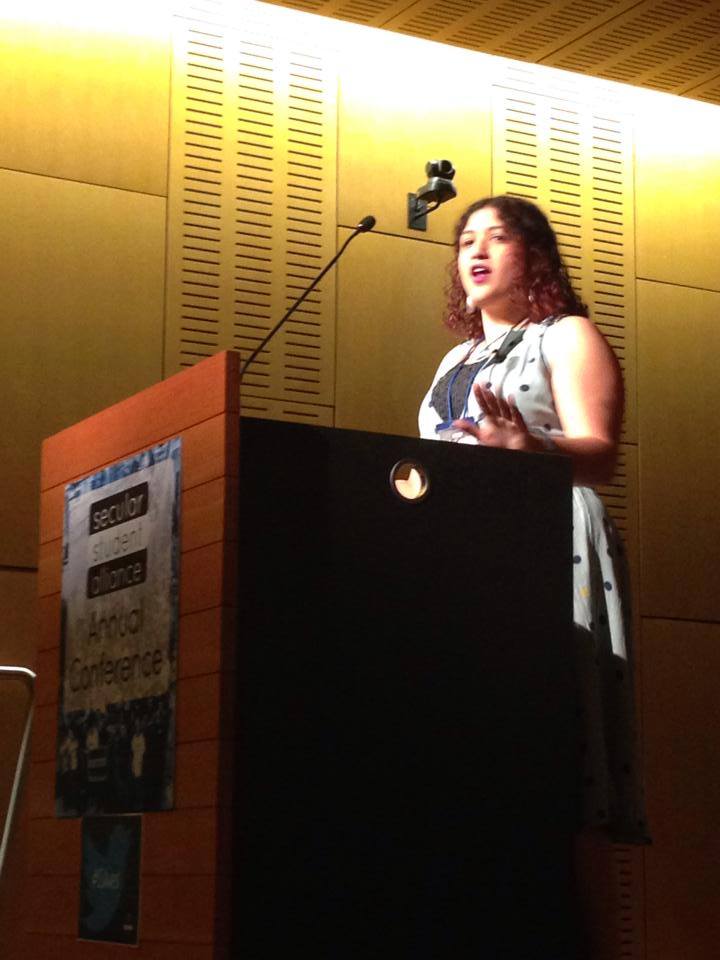
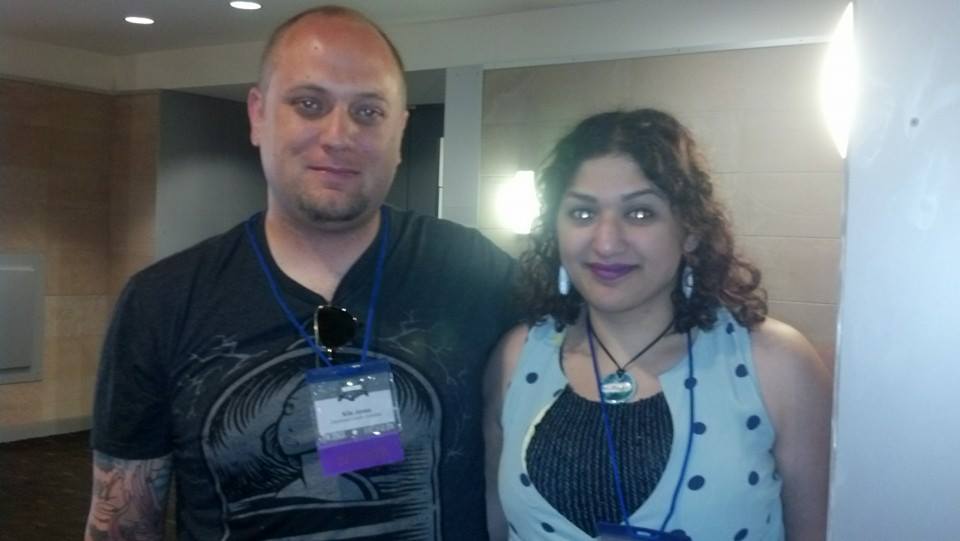
A few days ago I had the pleasure of giving a talk at the Secular Student Alliance Conference on how non-believing persons can work with Churches. Amidst the chaos of conferences–managing your time, deciding which talks to attend, and making sure you have enough water (it was a Burning Ring of Fire outside in Tempe, AZ)–I got to meet some pretty incredible secular women.
One of them was Heina Dadabhoy.
Heina speaking at SSA.
Former Muslim, blogger at Freethought Blogs, and overall bad-ass, Heina spoke about ways in which secular groups can create a more welcoming environment for ex-Muslims and Muslims beginning to doubt. Her talk, “Of Murtids and Muslims,” (a “murtid” is a public apostate) was not only about her experiences coming out as a secular humanist, but considered some of the absurd questions people ask her (and other ex-Muslims) about leaving Islam. “So did your parents try to honor kill you?” “Have you gone through FGM?” It was disturbingly humorous.
What I considered to be Heina’s main point, was that we should respect each others’ individual differences and not generalize and caricature all Muslims with the depictions of some. “Just because you read Ayaan Hirsi Ali’s book,” Heina notes, “does not make you an expert on Islam.” Heina made sure to emphasize the radical diversity that exists in Islam. She also spoke of the some of the issues that people go through when they leave Islam: How do I create a new identity when my old one was intricately tied up in my Muslim community, family, and culture? How do I navigate popular culture when I have missed a bunch of it? How do I find myself in this new secular world? Heina’s answers were refreshingly honest and insightful.
P.S. Aisha (one of Muhammed’s wives) should not simply be reduced to the young person Muhammed married; she was also a war leader, influential Muslim thinker, and someone who contributed greatly to early Islam. This is, of course, Heina’s insight.
Me and Heina at SSA
Another awesome secular woman I met, was Sarah Morehead.
Sarah. Photo from Apostacon.
Sarah is a former evangelical Southern Baptist, Executive Director of the “Recovering From Religion” project, and another overall bad-ass. She spoke on how to start up a Recovering From Religion group on your campus. Here is a blurb about Recovering From Religion,
“If you are one of the many people who have determined that religion no longer has a place in their life, but are still dealing with the after-effects in some way or another, Recovering From Religion (RR) may be just the right spot for you. Many people come to a point that they no longer accept the supernatural explanations for the world around them, or they realize just how much conflict religious belief creates. It can be difficult to leave religion because family and culture put so much pressure on us to stay and pretend to believe the unbelievable. If this is you, we want to help you find your way out. Don’t let people convince you that you just didn’t have ‘enough’ faith, or that you just haven’t found the “right” religion.”
Sarah and I chatted (and often laughed) about our old experiences as conservative Christians. We discussed some of the funny language (Christian-eze) we used to use, the various levels of guilt and shame that were cast upon us, and how science helps explain some of the interesting displays of piety often seen at Pentecostal services. Sarah’s jovial and welcoming demeanor was calming, and as an Executive Director for a project aimed at helping people “recover” from religion, I cannot think of a better person for the job.
Lyz. Photo by SSA.
The last woman I have in mind is Lyz Liddell.
Lyz is the Director of Campus Organizing for the Secular Student Alliance. I have an interview I did with her a while back, on this very blog! Besides running around with her headset on, standing on chairs for announcements, and generally keeping the world of SSA from not crumbling into oblivion, Lyz is a great motivation and example. If you are ever interested in starting a SSA group on your campus, talk to her.
To all those who attended this years SSA West, or who are involved with helping secular students: Unite!
Kile Jones holds a Bachelors of Theology (B.Th.) from Faith Seminary, a Masters of Theological Studies (M.T.S.) and a Masters of Sacred Theology (S.T.M.) from Boston University, and is a current Ph.D. in Religion student at Claremont Lincoln University. He also holds a Certificate in Science and Religion from the Boston Theological Institute. Mr. Jones has been published in Zygon: Journal of Religion and Science, Philosophy Now, Free Inquiry, World Futures, Human Affairs, and the Secular Web. He is the Founder/Editor-in-Chief of Claremont Journal of Religion (www.claremontjournal.com), and is the Founder/Director of Interview an Atheist at Church Day (interviewatheists.wordpress.com).
#YesAllWomen proved that although not all men commit horrible crimes against women, the men that often get the headlines and create the most controversy are the ones that need to be watched out for.
The one thing I typically will choose to do on the rare occasion that I’m able to sit down and relax is to watch a documentary. While some people may go to the gym, read a book, or hang with friends, I typically choose to stay in, nestle up on my couch, and learn. While on my last bout of relaxation, I chose to watch the HBO documentary Questioning Darwin. Although it offers very little new insight into the evolution vs. creationism debate, it does offer an interesting new way to look at the recent social media hashtag war feminists, allies, and supporters found themselves in over the #YesAllWomen movement that took the world by storm.
Now, before I discuss #YesAllWomen, I have to admit that I did not enter into the safe space women created for themselves to tell tales of the horrible things they have and have had to face on a daily basis. I firmly believe that men should not have entered into the digital space Continue reading “#YesAllWomen, the Darwin Debate, and the God Complex by John Erickson”
Three weeks ago, I played a video entitled “Kingdom of David: Rivers of Babylon” from the PBS Empires series. The series first aired in 2003. For the first time, and I’ve played the video in class for probably six semesters in a row, I noticed that all of the biblical scholars, archaeologists and rabbis interviewed to discuss the Torah, the history of the Jews, the Talmud, the exile and the prophetic tradition were men. This reminds me of a few months back when a female colleague of mine discussed about an encounter she had had with the producers of another documentary about the Hebrew Bible. They had only interviewed one woman. When asked about this decision, the producers told her that their audience finds men more authoritative than women when it comes to explaining topics of a religious nature.
***
Two weeks ago, on a Wednesday, an older woman walked into the liquor store where I work. She wandered around for awhile and then appeared somewhat overwhelmed, which is usually my cue to inquire if the customer needs help. She said she was just fine. Five minutes later she was still wandering the store apparently unsure what to purchase so again I approached her and asked if she’d like some help. She seemed somewhat desperate at this point and asked for my opinion on the Irish Cream Liquors and which one tasted the most like Bailey’s. I told her I wasn’t exactly sure. I had not tried them all but the one she was holding in her arms was very popular and we sell quite a bit of it. She continued to hem and haw explaining to me that she was having a bunch of old ladies over for lunch. She intended to offer them sips of Irish Cream afterwards. Then out of the blue she looked at me and said that she still couldn’t decide so she was going to ask a man for his opinion. This man also happened to be my boss. He said that he hadn’t tried it, but that it was very popular. His words, exactly the same as Continue reading “Sexism and “Jerusalem” by Ivy Helman”