What Happened When I Dared to Wear a Kippah by Ivy Helman

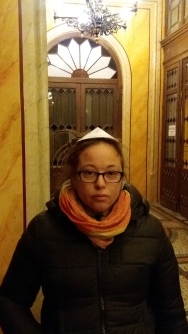
20171203_124919Last week Sunday, my partner and I were in Budapest, Hungary.  We stopped at the Dohany Street Synagogue, the second largest synagogue in the world and the largest in Europe.  After we bought our tickets and proceeded through security, we decided to go into the synagogue first and then the museum.

We walked into the synagogue.  A younger man (maybe 20) was handing out paper kippot (yarmulke in Yiddish).  My partner and I both put our hands out but were refused.  There was an elderly man there who said that the kippot were only for men.  That didn’t surprise me initially as I take my students to the Jewish Museum in Prague and I often argue with the elderly ladies over the right and acceptability of women wearing kippot.  They begrudgingly give my female students kippot saying “only as souvenir,” which boils my blood.  Usually, by the time they give the women kippot even those who traditionally wear them are too shamed to do so.   Continue reading “What Happened When I Dared to Wear a Kippah by Ivy Helman”

Jewish Folklore and Women’s Clothing: When Things are the Text by Jill Hammer

Two weekends ago, I had the pleasure of visiting the Jewish Museum on Fifth Avenue in Manhattan.  The Jewish Museum has long been a favorite museum for me.  My wife and I took our daughter to this particular exhibit because we knew she’d like it.  The exhibit is entitled “Veiled Meanings: Fashioning Jewish Dress from the Collection of the Israel Museum, Jerusalem.”  It consists of many, many garments created and worn by Jews, from Moroccan wedding clothes to German prayer shawls to Yemenite amuletic (meant to protect the wearer) dresses.  Accompanying the garments were placards explaining the folk traditions giving rise to the various garments.  What I realized (again) after viewing the exhibition was how much I could learn about the culture of Jewish women, and Jewish culture in general, by looking at things, not texts.

The sacred texts and laws central to Jewish life, while they certainly discuss Jewish women, tend not to be created by or for Jewish women.  This means many aspects of how Jewish women thought or acted (before the present day) are obscured. However, these garments were created by and often for Jewish women, and their shapes and symbols tell a great deal.  For example, the Moroccan Jewish wedding clothes I mentioned were embroidered with spirals, representing (according to the accompanying written material) the spiral of life.  These spirals were also found on Jewish tombstones. The spirals resembled, to me, the spirals I’d seen carved on stone at Newgrange and Knowth in Ireland—the ancient symbols of life and journey.  I was amazed to see them in a Jewish context.  Another dress that mixed Sephardic and Moroccan style also had spirals featured prominently.

Continue reading “Jewish Folklore and Women’s Clothing: When Things are the Text by Jill Hammer”

Of Monument(al) Importance by Esther Nelson

I remember being blown away when I read Judith Plaskow’s book, Standing Again at Sinai: Judaism from a Feminist Perspective, shortly after it was published in 1990. She writes, “The need for a feminist Judaism begins with hearing silence.” She notes it’s a “silence so vast [it] tends to fade into the natural order….”  Women’s presence throughout Judaism has not been reflected in Jewish scripture, Jewish law, or in liturgical expression.

Plaskow zeroes in on the story in Exodus where the entire Israelite congregation, gathered at the base of Mt. Sinai, eagerly anticipates entry into the covenant, “the central event that established the Jewish people.” Before this communal event, the covenant had been entered into by way of the individual patriarchs—Abraham, Isaac, and Jacob.  The particularly disturbing verse for Plaskow is Exodus 19:15: “Be ready for the third day; do not go near a woman.”

The specific issue Moses addresses is ritual impurity since the emission of semen renders both parties that engage in coitus temporarily unfit to engage with the sacred.  Both women and men need to be ceremonially purified before approaching the holy.  However, Moses does not say “Men and women do not go near each other.”  At this crucial juncture in Jewish history, “Moses addresses the community only as men.” The text makes women invisible. Clearly it was men’s experience that shaped Torah.

Plaskow writes that “[Jewish] women have always known or assumed our presence at Sinai.” Exodus 19:15 “is painful because it seems to deny what we have always taken for granted. Of course we were at Sinai; how is it then that the text could imply we were not there?”

Why make a big deal of this? Can’t the text, asks Plaskow, be relegated to a time in history “way back then” when people and communities accepted gender inequality as the natural order?  Why not just accept the past for what it was and get on with things?  Because Torah (Hebrew Bible) is not “just” history, “but also living memory.” When the story of Sinai is read and recited in services as part of the lectionary reading over and over again, year after year, “women each time hear ourselves thrust aside anew, eavesdropping on a conversation among men and between men and God.” Continue reading “Of Monument(al) Importance by Esther Nelson”

B’tzelem Elohim and Embodiment by Ivy Helman

studyIt is quite common, I think, for Jewish feminists to gravitate to the first creation story of Genesis/Bereshit as an example of human equality but struggle to claim this same passage as an example of the goodness of embodiment.  Genesis/Bereshit 1:27 reads, “So G-d created humankind in the divine image, in the image of G-d, the Holy One  created them; male and female G-d created them.”  In this passage, we have not only equality between men and women, in direct contrast to the second creation story, but also a description of human nature.
Our Creator made us in the divine image: b’tzelem Elohim.  The most traditional explanations of b’tzelem Elohim describe our divine-likeness to mean: our intelligence, our capacity for goodness, our creativity as well as our inner divine spark.  Most traditional teachings also understand this description as a prescription for action: since every single human being is made in the divine image, we must treat every single human being with respect, dignity, concern and so on.  Continue reading “B’tzelem Elohim and Embodiment by Ivy Helman”

Reflections on Marriage by Ivy Helman

studyMy partner and I are getting married in a little over a month.  She, a lawyer, and I, a professor, live in the Czech Republic.  Technically, we aren’t getting married because the Czech Republic doesn’t have marriage equality.  Our relationship will not be recognized in the U.S.  For that, we need to be married in a state or nation that has marriage equality.  Germany might soon.  Other options would be a number of EU countries or the United States, but that doesn’t affect our status in the Czech Republic.  Finally, our marriage will also not be recognized by some in Jewish circles as well since the ketubah, the Jewish marriage document which possesses legal status in Jewish courts, is between two women.
There is nothing legal about our Jewish wedding except one could argue its Jewishness. So, the day after our wedding our relationship will have the same recognition as it had the day before and the day before that.   This would not be the case if we were a heterosexual couple.  It reminds me of the countless commitment ceremonies that took place before marriage equality in the United States.  They were not prohibited (like the marriages that slaves had because slaves weren’t considered people under the law or eligible to enter into legal contracts while in bondage (see pages 301-302).  Yet, similar to the “contubernal relationships” of slaves performed by their masters or other slaves (page 302), they weren’t particularly legal either.  Despite the ceremony, there was no change in status of the couple within society.  Yet, recognition was and still is an important component of both struggles for rights.  In fact, according to Darlene Goring in “The History of Slave Marriage in the United States,” (345-346), the process of gaining legal recognition was very similar for both ex-slaves and the marriage equality community in the United States. Continue reading “Reflections on Marriage by Ivy Helman”

Sirens, Thunderstorms, and Bowling: The Divine on this Mother’s Day by Ivy Helman

untitledLet’s see if the following course of events makes sense.  A few Wednesdays ago, I was thinking about possible topics for this post considering it would be Mother’s Day.  In the midst of thought, the warning sirens in Prague began.  They were only being tested but, nontheless, I immediately thought of tornados.  You see tornados, as awful and devastating as they are, make me think of thunderstorms and lightning.  I love a good thunderstorm, the louder the better.
A Wisconsin childhood supplies plenty of thunderstorms.  I cannot tell you the number of times as I was growing up that I stood outside watching the sky turn into that distinctive greenish-purple and smelling the storm on the breeze.  Nor could I count the umpteen times we gathered in the basement as the tornado sirens blared and the radio advised its listeners in no uncertain terms to seek shelter.  Nor could I recall how many times I sat with my mom during more recent summers watching the storms come in or the lightning blaze across the sky like a spider’s web.  We’ve been lucky.  Never once did a tornado hit our neighborhood although a house or two has been hit by lightning. Continue reading “Sirens, Thunderstorms, and Bowling: The Divine on this Mother’s Day by Ivy Helman”

The Coming of Spring: Reflections on Pesach and Judaism by Ivy Helman

meandminiIt is, I think, quite common knowledge that most Jewish holidays relate to the seasonal cycles of the Earth.  Sukkot celebrates the fall harvest.  Chanukah sheds light on the winter darkness.  Tu B’Shevat marks the end of the dry season and so begin the prayers for rain in Israel.  For Purim, we throw off our winter doldrums and let off a little steam to settle our cabin fever.  Pesach is no exception: welcome spring: birth, renewal and even creation.  The leaves return to the trees, baby animals are born, flowers bloom, warmer weather arrives and somehow the possibilities of the coming summer are endless.

In fact, the associations between Pesach and spring are many.  Arthur Waskow in Seasons of Our Joy explains the origins of the connections (pages 133-139).  There were probably two different seasonal celebrations – one of shepherds and one of farmers – that came together around the time of the Babylonian exile into one festival which we can see in Exodus 12 – 13: Pesach.  Farmers in preparation for the harvest of spring wheat cleared out the old crumbs and fermentations of the last year to make room for the new.  Shepherds celebrated the arrival of baby sheep and their flock’s fertility in general by slaughtering a sheep, putting its blood on their tents and dancing around a fire.   Continue reading “The Coming of Spring: Reflections on Pesach and Judaism by Ivy Helman”

Miriam the Prophetess as Guardian and Healer by Jill Hammer

jill hammer cropped

The biblical traditions of Miriam the prophetess have captured the imaginations of Bible-readers throughout the ages.  Miriam, Moses’ sister, watches over Moses in his cradle (Exodus 2), and leads the Hebrew women in dance at the shore of the Sea of Reeds to celebrate redemption  (Exodus 15).  Rabbinic lore identifies Miriam with Puah, the midwife who saved Hebrew babies from Pharaoh, and depicts her as the herald of Moses’ birth (Exodus Rabbah 1:13; Babylonian Talmud, Sotah 12a). Contemporary Jewish feminists have established traditions of singing to Miriam the prophetess on Saturday night, parallel to the tradition of singing to Elijah the prophet at that time.   It has also become popular among some feminist/egalitarian Jews to place a cup of Miriam on the seder table at the time of Passover.  This cup is usually filled with water in order to recall the ancient legend that a well of water followed Miriam through the wilderness, quenching the thirst of the wandering people (cf: Babylonian Talmud, Taanit 9a).  It was even said that healing herbs grew near this well, so that Miriam’s prophetic power became a source of healing.

The veneration of Miriam is especially deep in Sephardic Jewish traditions—those Jewish traditions stemming from the Spanish Jewish diaspora, which may be found everywhere from North Africa to Holland to Greece and Bulgaria.  Sephardic women used incantations along with various rituals involving salt, herbs, and other substances, as healing for various ailments and troubles; women skilled in these practices were called precanteras or precantadoras.  Some of their healing incantations invoke Miriam as the ancestress of all women healers, as in the following prayer:

Continue reading “Miriam the Prophetess as Guardian and Healer by Jill Hammer”

Reflections on Trauma, Part II: YOLOCAUST by Stephanie N. Arel

stephanie-arelIn light of the recent attacks on Jewish cemeteries —the desecration of Mount Carmel Jewish Cemetery in Philadelphia and the toppling of more than 150 gravestones at Chesed Shel Emeth Cemetery in Missouri — along with my reminiscing that a year ago today (March 1 as I am writing) I was en route to Jerusalem to work with a group of scholars for the Intercontinental Academia on Human Dignity, I wanted to once again confront trauma (building on Part I of this topic). In this case, I consider trauma as an affront to the dignity of ALL bodies and their memories, while simultaneously questioning how those who have not experienced trauma develop respect for its proximity – in individual lives, in sacred spaces, and in memorials.

The desecration of memory alive in the space of the cemetery presses me to repeat what I have said before: that the violation of bodies lies at the heart of traumas caused by human design — even if those bodies are inhumed. Continue reading “Reflections on Trauma, Part II: YOLOCAUST by Stephanie N. Arel”

Meeting Phrike: Feminist Theology and the Experience of Horror by Jill Hammer

Myself, I saw the numb pools amidst the shadows; myself, the wan gods and night in very truth.  My frozen blood stood still and clogged my veins.  Forth leaped a savage cohort… Then grim Erinys (Vengeance) shrieked, and blind Furor (Fury), and Horror (Phrike), and all the forms which spawn and lurk amidst the eternal shades.

Seneca, Oedipus (trans. Frank Justus Miller)

Horror is not a cognitive but a physiological or affective extra-discursive state of being. Not unlike the state of, say, feeling nausea, horror is a state of being, whose manifestation, based on the etymologies of the Greek φρiκη [phrike] and the Latin horror, may be described, as Adriana Cavarero writes, as “a state of paralysis, reinforced by the feeling of growing stiff on the part of someone who is freezing,” and further, through her mythological reference to the prototypical figure of horror, Medusa, as a state of “petrification” …

205. Kiarina Kordela, “Monsters of Biopower: Terror(ism) and Horror in the Era of Affect”, Philosophy Today 60(1), 2016, p. 193-205.

Surging anti-Semitism in the United States, as witnessed by many news reports and also anecdotes related by friends and acquaintances, holds a particular horror for Jews of my generation.  Some of us thought that we were relatively safe from that age-old bigotry.  It’s disorienting to be reminded that we are not.  My wife, whose father (alone of all his relatives) survived Auschwitz, has the skin-crawling sense as she reads the news that somehow we have gone back to that time.  Twenty-eight Jewish community centers have been evacuated in the last two weeks because of bomb threats, and a rabbi in the Midwest has received death threats for protesting neo-Nazi activities. A midwife/rabbi friend in Toronto had her house vandalized with swastikas.  A judge of my acquaintance in the New York area saw a statue of Martin Luther King vandalized with Nazi symbols.  Walking down the street in New York City, I myself heard someone exclaim gleefully: “Trump is going to get rid of the Jews!”  

While I hope that is not anywhere near true, the horror evoked by hearing such words is a real entity: a physiological state of being.  The Greeks personified the feeling of horror as a daimona (spirit) or goddess called Phrike.  The word phrike implies shivers, goosebumps: a physicalized emotion. The Romans called her Horror.  There are no stories about her, but the ancient Greeks used the word phrike when speaking about theater, believing that the pity and terror evoked by a play effected a catharsis for the viewers.  Via their beliefs about theater, the Greeks gifted Phrike to the world.  Lately I feel that Phrike is living in my house.   Continue reading “Meeting Phrike: Feminist Theology and the Experience of Horror by Jill Hammer”