 Asked the secret of her long and happy marriage, Dorothy Hartshorne, wife of the philosopher Charles Hartshorne, posed a question: “What do you think you must never do in a marriage?” The young woman thought for a moment and replied, “Never hurt each other?” “Oh no,” Dorothy responded, “you will hurt each other all the time. What you must never do is bore each other.”
In the years since I first heard this story, I have come to understand that a good marriage requires that both partners have their own interests and be willing to share them, and that each partner be interested in at least some of the interests of the other. Happy people share an interest in life in all of its diversity and difference. A person who is interested in life may ask herself why her neighbor is so unhappy and offer an ear to listen to her story. Or he may ask about the birds that come into his garden—learning their names and behaviors, while delighting in their beauty. It doesn’t matter if the things you are interested in are large or small, but you must be interested in life.
Second, each you must be interested in yourself and in your partner. If conflicts are to be resolved, if hurts are to be assuaged, you must always be willing to ask: why was I angered or hurt in this situation, and why did my partner act or react in a particular way? This will not always be easy. Often one of the partners will feel more comfortable talking about feelings. Patience and deep listening may be required of one of you, and moving into unfamiliar territory of the other. If you are not interested in your own feelings and those of the other, your relationship is likely to founder—not only in hurt and anger, but also in boredom.
Dorothy’s husband Charles Hartshorne was fond of saying that the golden rule to love your neighbor as yourself implies that you love yourself. This is wise counsel. We are often told that marriage involves loving another, but less often that it requires loving yourself as well.
As you, Shelby and Mark, enter into marriage, I offer you these blessings:
May you always retain your interest in life.
May love yourself as well as the other.
May you never bore each other.
May you have many long and happy years together.
* * *
 Carol gave this blessing at the wedding of Shelby Carpenter and Mark Miller on August 3, 2017 in Molivos, Lesbos.
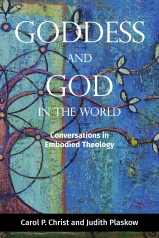
Carol’s new book written with Judith Plaskow, is Goddess and God in the World: Conversations in Embodied Theology.
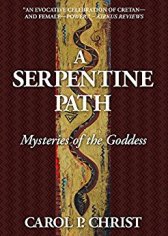
FAR Press recently released A Serpentine Path: Mysteries of the Goddess.
Join Carol on the life-transforming Goddess Pilgrimage to Crete. Space available on the fall tour.




 I was in graduate school when I first read

 My partner and I are getting married in a little over a month. She, a lawyer, and I, a professor, live in the Czech Republic. Technically, we aren’t getting married because the Czech Republic doesn’t have marriage equality. Our relationship will not be recognized in the U.S. For that, we need to be married in a state or nation that has marriage equality. Germany might soon. Other options would be a number of EU countries or the United States, but that doesn’t affect our status in the Czech Republic. Finally, our marriage will also not be recognized by some in Jewish circles as well since the
  One of the first things my American friends and family ask me when they learn I used to be married to an Indian man is: was it an arranged marriage? I understand the intrigue, the bewilderment and even horror that the phrase “arranged marriage” can conjure up in unfamiliar Western minds. Images of forcing women to marry strangers encountered upon the street or child betrothals or women being dragged to the wedding site to be married off to mustachioed men are likely to flash before one’s eyes. While such incidents may have occurred from time to time, and in the past, as with child marriages, the long-established concept of “arranged marriage” is very different and not as frightening as may seem.
 I’ve been married for most of my life. Marriage, along with all our institutions, is influenced by and therefore takes shape from the culture/society in which it exists. When I got married, I had certain expectations that I’d absorbed from my environment. Attaining “marital bliss” by achieving an indistinguishable oneness with my spouse was part and parcel of it all. Popular thought tells us that marriage (especially heterosexual marriage) brings about the completion of two individuals. How often do we hear about people searching for, and sometimes finding, a person they label as their soulmate? People seem to long for that one human being they think will make them happy.
 Recently, a commercial made by the clothing line, BIBA, hit the Indian market. Its significance lay in its “Change the Convention, Change is Beautiful” tag. The message was straightforward – we need to change Indian attitudes regarding gender roles. At the outset, let me say there are many things wrong with the ad, especially when one stops to think how it could possibly bring about a change when the young woman in question is voiceless. In fact, when I first watched it, my own reaction was: “And just what change are we talking about here?” Upon deeper reflection, however, I realized why the commercial may indeed be a step forward, albeit a tiny one.
  Feminism and Religion