
Transforming the Church from Within or Without? by Xochitl Alvizo

“Power belongs to those who stay to write the report!” stated Jeanne Audrey Powers during her presentation at the Religion and the Feminist Movement conference at Harvard Divinity School back in 2002. Though the statement sounds a little funny, it does raise a good question about how one participates in creating change. Where does the power for change and transformation lie? Is it in the writing of reports; is it from within institutions; from without? This question seems to be of particular relevance to those of us who have feminist visions and commitments and also remain involved in Christian churches – churches of a tradition with deeply embedded patriarchal habits and practices.

Recently, this concern was raised in a class for which I am a TA. We were talking about the fact that some feminist theologians develop feminist systematic theologies; by definition a cohesive theological system done from a feminist perspective. In part, the motivation is to reclaim the systematic way of doing theology and have it stand alongside other widely recognized theologies – but do so in a feminist way. Additionally, the traditional systematic format gives it validity and may serve to temper the prevailing habit of teaching feminist theologies as so-called ‘contextual’ theologies (as if other theologies are not also contextual, but that’s a topic for another post). A critique of this development, of course, is that by writing systematic theologies feminists are simply reinforcing patriarchal forms and patterns of academentia instead of expanding and creating new ones. Continue reading “Transforming the Church from Within or Without? by Xochitl Alvizo”

On Reading, Not Reading, and Disagreeing by Linn Marie Tonstad

Linn Marie TonstadThe theology blogosphere in all its glory has been alive in recent days with furor sparked by a blog post from Janice Rees at Women In Theology, where she discusses not reading Karl Barth, the heavyweight German 20th-century Protestant theologian, as an act of resistance against his dominance in the theological academy and his status as a litmus test for serious scholarship. Reminding myself repeatedly of the great xkcd comic, I’ve resisted my urge to comment on this and a number of other recent debates. (See here for a list of links if you wish to catch up on the discussion, however.) So this is not a post on whether to read Karl Barth.* Rather, the debate made me take a look at some of my own reading practices, and the visions of theological discussion that they encode. It also brought me back to the question of feminist disagreement, which continues to lurk in the back of my mind as I pursue disagreements with some prominent feminist theologians in my current book project.

I’ve written here before about reading authors that I disagree with, and indeed working on theologians I think are wrong about certain issues. On the simplest level, as a feminist and queer theologian, many of the theologians I work on would have questioned or outright resisted my participation in the discipline to begin with – although we cannot always know whether and how they would have done so today (since many of them are dead – yes, the dreaded dead white European males). But I often – not always – find projects that I sincerely disagree with utterly fascinating. From what perspective does the system being developed in such a project make sense? Where would one have to stand to see what that author sees? What do I come to understand about my current context, or the author’s context, from the perspective of the debates and decisions that the author finds pressing? One fairly trivial example: any interest I might once have had in historical Jesus debates was settled forever by reading Albert Schweitzer as an undergraduate. I simply do not find such debates compelling in themselves. (That does not mean I think they are valueless, of course!) But reading theologians who were engaged in such debates teaches me a great deal about how the commonsense assumptions many of us today operate with came to be. And seeing how such debates accompany disagreement over right social relations, over the nature of transmission of Christian traditions, and over what counts as scholarship in theology and religious studies is simply fascinating. Continue reading “On Reading, Not Reading, and Disagreeing by Linn Marie Tonstad”

The Hot Seat by John Erickson

Being a man in feminism isn’t easy and that’s how it is supposed to be.

men_feminist_mainI’ve been thinking a lot about what it means to be a male feminist lately.  As the only man to be a permanent blogger on this very site until my colleague and friend Kile Jones came on board, I took my role, as a man in a traditional feminist (online) space very seriously.  Although the ongoing struggle to be a male feminist is one continually wrought with dialogues about power and positionality (amongst a host of many other topics), I am often conflicted when I see male feminists take advantage and destroy the hard work that many, specifically on this site and beyond, worked hard to build and defend.
Not wanting to reopen old wounds or start new online battles, men have been involved in feminism for quite some time.  From James Mott chairing the first women’s rights convention, to radical feminist Andrea Dworkin’s life partner John Stoltenberg, to Michael Kimmel and Michael Kaufman’s life long work to legitimize not only men in feminism but also what it means to be a man who works for gender equality, being a man in feminism isn’t easy and that’s how it is supposed to be. Continue reading “The Hot Seat by John Erickson”

Feminism and My Existentialist Leanings by Xochitl Alvizo

In light of so much destruction in our world – from the violence inside individual homes to beyond and between national borders – how is it still possible to hope for and to live toward a vision of beauty and peace for the world?

It was at a community college in LA in my Psychology 4 class that I first formally encountered existentialism. When it came to the time of the semester to teach on that topic, our professor, Eric Fiazi, came alive in a new way, energetically teaching us about existentialism and Jean-Paul Sartre. Professor Fiazi dramatically gestured and sketched on the board as he explained the concept of ‘nothingness’ and Sartre’s well-known proposition that “existence precedes essence.”  Teaching psychology was for him a means of teaching what he truly loved, art and existentialism. He believed these subjects helped expand students’ horizons and helped make them happy and productive members of society. And so these class sessions were his favorite to teach – and mine to experience. Immediately, I was hooked.

I remember the moment he hit the chalk to the board – leaving a speck of a mark – telling us that the tiny little mark left on the great wide chalkboard was like our galaxy, tiny  against the great vastness of the universe; the earth, a particle of chalk-dust in comparison, and our individual lives, imperceptible in its midst (it now reminds me of Carl Sagan’s pale blue dot monologue). Engaging the students, he countered each one of their assertions that humans indeed have an essence, a meaning. “Humans are good by nature” – “Humans are inherently selfish beings” – “Humans are created in the image of god” – “We are each created for a purpose”; for each of these he gave a clear and logical retort. I was fascinated! What would it mean to live a life with no inherent meaning – with no essence to determine or guide our existence? How might it be different to live my life stripped of any assumed or inherited sense of meaning or purpose – to instead give these up and start from a presupposition of nothingness? Continue reading “Feminism and My Existentialist Leanings by Xochitl Alvizo”

Re-membering the Revolution by Xochitl Alvizo

This post includes information about a conference scheduled for next spring at Boston University: A Revolutionary Moment: Women’s Liberation in the late 1960s and early 1970s. The Call for Papers is due July 1st – just two days away!

I remember how Mary Daly used to ask me where the feminists were – what were they up to today? I would try to update her on the things I was aware of here in Boston, events at the Women’s Center in Cambridge, conferences by Women, Action, and the Media, the latest publication of Rain and Thunder: A Radical Feminist Journal of Activism and Discussion, and the myriad of things happening within feminist theology with which I was most familiar. Nonetheless, Mary was never satisfied with my responses, “Where is the revolution?” she would ask. At the time, I didn’t quite understand her disappointment. I could tell she wanted me to update her on something big – she wanted to hear of sweeping changes, lots of them. I often thought that the changes were already there, that big things had taken place and were incorporated into the daily life of society. I was always vexed that I couldn’t give her the answer she was looking for – but also, I didn’t know exactly what she was looking for. Then one day she asked me to find her a book that was on one of her shelves – she didn’t know which shelf – so I went searching, and in that search I discovered a world that gave me a glimpse of the revolution Mary wanted and I understood a little bit more  why Mary was dissatisfied with feminism today. Continue reading “Re-membering the Revolution by Xochitl Alvizo”

When Feminists Disagree by Linn Marie Tonstad

Linn Marie TonstadA while back I gave a talk on feminist trinitarian theology to an audience of mostly progressive academics, including feminist and womanist scholars of religion. In the course of analyzing what I called the ‘trinitarian imaginary’ in Christianity and its often-patriarchal and masculinist forms, I suggested that transforming that imaginary might require recognizing the hypothetical character of theological statements until the eschaton, a theme that has been developed in depth by a German theologian named Wolfhart Pannenberg. Now, Pannenberg is decidedly neither a feminist nor a progressive theologian. To name just one example: in his three-volume Systematic Theology, his few explicit references to feminist or female theologians include a brief mention of Mary Daly (volume 1, p. 262) in connection with a critique of feminist theologians for projecting (!) masculinity into God in their readings of divine fatherhood, and a critique of Valerie Saiving and Susan Nelson Dunfee’s positions on the traditional Christian doctrine of sin as pride (volume 2, p. 243). So when I mentioned Pannenberg as a resource in my talk, one of the feminist scholars in the audience audibly gasped and flinched – it became clear in the Q&A that she had significant concerns about whether I could count as a feminist at all. After all, to mine someone like Pannenberg for constructive feminist theological work might imply an endorsement of his other positions, or might entail taking over aspects of his system that would taint my own project in anti-feminist directions – all legitimate concerns.  Continue reading “When Feminists Disagree by Linn Marie Tonstad”

The Wit of the Labrys by Xochitl Alvizo

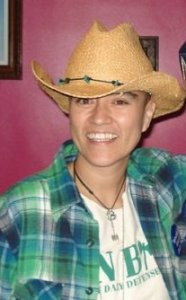
Always wearing my Labrys

Sometimes I wish I were wittier. Or more precisely, there are moments when I become acutely aware of my underdeveloped wit – and I long to know how to sharpen it!

I have some pretty witty people in my life – my dad, my feminist mentors, my best friends.  They generally fall into two categories, radical lesbian feminists and women-identified men.  The interesting thing about these friends and family members of mine is that they have something very important in common – they all live their lives going against the grain. They are not people content or resigned to the status quo. They are not satisfied with the default ways of the world – the violence, exploitation, hierarchies of valuing various people differently. They understand that all of this is brokenness, and at the same time, they know that all of this is very much part of our reality. I think this is where their wit comes in. For how does one live with a vision for a more beautiful and just world while also daily facing and struggling through the reality of the world as it is? I think their wit is a key factor in sustaining their Wild unstilted spirits. Continue reading “The Wit of the Labrys by Xochitl Alvizo”

The Mago Hedge School: Why Remember Mary Daly? By Helen Hye Sook Hwang

Prologue

By writing this, I do not intend to defend Mary Daly’s position in any dispute. A controversial figure, Mary Daly never let go of her fight with those whom she thought on the other side of her feminist war. Like anyone else in history, Mary Daly belonged to her time and culture, and I leave her unresolved issues up to her. What I write here is my fond memory of her, whose feminist thought left an indelible mark on my being as well as humanity as a whole. Daly’s contribution remains to be reassessed from the fresh eye of new generations. In the meantime, I begin to speak for my part. Without Mary Daly’s thought, I would not have been in this place where I stand right now. It has empowered me to actualize my dreams to the fullest as a wo/man who was born and raised in Korea but had come from the One Home in origin.

I first hear of the hedge school
“Have you heard of the hedge school, Hye Sook?” asked Mary. “No, I haven’t heard of it,” I answered. This conversation took place during the conference called the Feminist Hullaballoo held in Santa Fe, New Mexico in 2007. We met there and spent three days as chums. Mary was with another friend, Yvonne Johnson, so the three of us hung out together. It was a very special time for me – I felt as if I were wrapped up in the eye of the storm. (In fact, my life feels so.) At the conference, someone asked me how I came to be invited as a featured speaker. I was among such renowned feminist speakers as Sonia Johnson, Paula Gunn Allen, and Mary Daly herself. They felt like giants to me. I told her that Mary Daly invited me. Mary had asked me if I would like to go and speak at that conference. I did not have an inflated ego. I would not have been hurt if I were not chosen. But I said “Yes” without hesitation. At the time, it felt like another one of the many “outlandish” adventures that I had undertaken throughout my life. In retrospect, however, this was a very special “Yes” to the beginning of my life’s new phase.   Continue reading “The Mago Hedge School: Why Remember Mary Daly? By Helen Hye Sook Hwang”

Process Thought: Feminist Friendly Metaphysics by Xochitl Alvizo

To be is necessarily to be in process and engagement with the lure of creative advance (that is, with God). In this sense, God is the poet of the world continually luring the world toward its full be-coming.

“It all goes back to one’s metaphysics.” That is what my TA said in the first theology class I took during my masters program. We were discussing our theological statements in class – a statement that outlines our individual understanding of God, humanity, sin, etc. – presenting them to one another for feedback and discussion.  As we argued  and discussed (“How can you possibly believe that?”) our TA made the case that our theological statements and the varying differences among them were largely determined by our particular metaphysics – that is, they are determined by whatever we hold to be the nature of existence.  That is to say, if science studies the physical world, metaphysics is the result of asking questions about the underlying reality of that physical world – about the nature of the physical world and by extension all of existence. As one can imagine, not all metaphysics are created equal, but all of them are theories with enormous implications. Continue reading “Process Thought: Feminist Friendly Metaphysics by Xochitl Alvizo”

Imaging God by Tiffany Steinwert

There are some words a mother never wants to hear. For me, those words came one evening as I tucked my 3 year old son, G, in to bed. We had just finished reading  God’s Dream, a children’s book by Bishop Desmond Tutu, and were discussing what God might want us to do. The conversation went something like this:

G:           “I think God wants me to share.”

Me:        “I think so too.  God likes sharing.”

G: “        “Yeah, He likes it when I share.”

SCREEEEECH!!! Insert here the sound of the needle suddenly scratching and falling off the record.

He?

Where did G get that? With two theologians as parents, G’s religious world has been carefully and intentionally constructed since birth. Nowhere ever did we refer to God as “He.”

Perhaps it was just a slip of the tongue, a mistaken pronoun, an unintentional lapse. God/dess knows I pride myself on my child’s gender fluidity. I take his vacillating male and female pronouns as a sign of early queer, gender non-conformity. Though, I suspect others might interpret that as part of normal verbal development. You choose.

Whether intentional or unintentional, I decided to nip this in the bud once and for all. Continue reading “Imaging God by Tiffany Steinwert”