

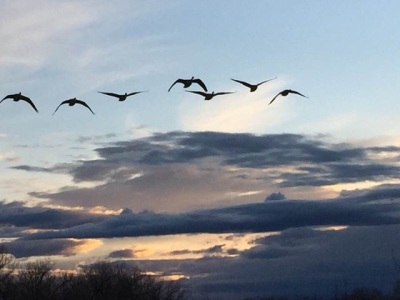
 Every morning I walk to the river in the velveteen hour between the vanishing blue night and the coming of the first scarlet, pink, lavender, purple or golden ribbons that stretch across the horizon. Sometimes clouds with heavy gray eyelids mute first light. Either way all my senses except that of sight are on high alert; a deep peace embraces me in the dark. My body knows the way. I murmur to the willows as I pass through the veil and under their bowed bridge. Their response is muted, a song beneath words.
At first my footsteps are barely audible on the narrow serpentine dirt path but as I pass by the river I note that she too is singing; and my senses quicken. If the Crane spirits are with me I hear the first brrring of Sandhill cranes as they take flight. “Freezing” I am crane struck; the involuntary need to stand still is overpowering. Body -mind viscerally absorbs Oneness as I breathe in a multitude of crane songs or perhaps only that of a few. Now my eyes are suddenly open, straining to see the familiar brrring materialize into startling graceful heads, necks, and stream lined bodies…. I note the shimmering waters beginning to mirror blushing pastels or the gray smoke that stains the horizon. Sometimes these hues deepen into rose, blood orange, or scarlet. Continue reading “The Portal: How Do We Know What We Know? by Sara Wright”
 I first discovered Rupert Sheldrake’s work by reading his first two books: “A New Science of Life” written in 1981 followed by “The Presence of the Past.” These two books changed my life because they validated my experiential reality and demonstrated that my personal experiences were located in a much larger context. I was not imagining things I felt or dreamed!
 Scientist Susan Simard is a professor of forest ecology at the University in Vancouver, British Columbia, who has been studying the below-ground fungal networks that connect trees and facilitate underground inter-tree communication and interaction. Over a period of more than thirty years this field scientist and her students have learned how fungi networks move water, carbon and nutrients such as nitrogen between and among trees as well as across species. Her research has demonstrated that these complex, symbiotic networks in our forests — at the hub of which stand what she calls the “mother trees” — mimic our own neural and social networks. This groundbreaking work on symbiotic plant communication has far-reaching implications that include developing sustainable ways to ‘manage’ forests, and to improve tree and plant resistance to pathogens. Although much of Simard’s research occurs in forests, she has also studied the underground systems of grasslands, wetlands, tundra and alpine ecosystems.
 When I walked into the space a bolt of
  It’s between semesters and as I’ve done for the past three or four years, I’m back in Las Cruces, New Mexico, for the winter break. I only spend a month here at this time of year and find myself thinking about the time I’ll move here permanently if things go according to plan.
 [
[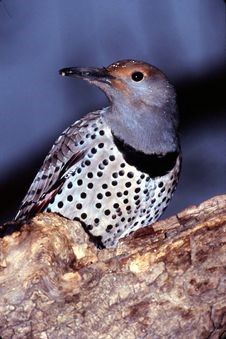 January 1st dawned clear and cold as I meandered through the frosted scrub and under the graceful Cottonwoods that line the Bosque by the river. I hadn’t planned on a walk because it was so frigid but the ethereal light that precedes the dawn often becomes a “calling” I cannot resist, pulling me towards the river regardless of practical intentions.
 Feminism and Religion