When Every Day Will Be Tu B’Shevat by Ivy Helman.

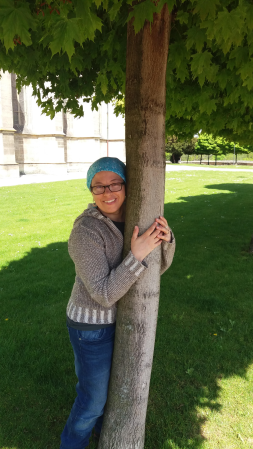
ivy tree huggingTomorrow is Tu B’Shevat, the New Year of the Trees, or their birthday.  It is the day of the year when all trees, regardless of when they have been planted, turn another year older.  The rabbis standardized this day in an effort to minimize complexities, since in the land of Israel, fruit can only be eaten from trees that are four or older (Leviticus 23-25).  Tu B’Shevat, then, on a practical level, marks how old fruit bearing trees are.   

The holiday has evolved since then.  In the 16th century, Kabbalistic mystics developed a seder to celebrate the holiday, which involved eating certain fruits, drinking both red and white wine, saying blessings, and reading certain mystical texts.  Each type of fruit one eats has a specific mystical meaning whether the fruit is completely edible (i.e. apple), has an inedible pit (i.e. olive), has an inedible shell (i.e. pistachio) or has a covering one generally wouldn’t eat, but could (i.e. orange). To this day, many congregations observe the holiday by hosting their own Tu B’Shevat seders often ripe with such kabbalistic overtones.  Continue reading “When Every Day Will Be Tu B’Shevat by Ivy Helman.”

The Matricide Basic to Patriarchy’s Birth by Carol P. Christ

About 20 years ago I witnessed a performance of the 3 plays of the Oresteia (the Orestes plays) by Aeschylus. I was stunned. Watching them in sequence, I understood that the plays were one of patriarchy’s “just so stories” and that their continuing performance was part and parcel of patriarchy’s perpetuation and legitimation.

According to the myths, Helen, the wife of King Menelaus of Sparta, ran off to Troy with its prince, Paris. In revenge for his lost honor, Menelaus called the Greeks to attack Troy and bring her back. Agamemnon, brother of Menelaus and king of Mycenae, assembled his ships, but the wind refused to fill their sails. He was told that his army would be allowed to depart only if he killed his daughter Iphigenia. He lured his daughter and her mother Clytemnestra to the place where his ships were waiting with the promise of marriage to Achilles. When they arrived, he killed his daughter and the ships sailed.

The myths do not tell us that in matrilineal and egalitarian matriarchal cultures the mother-daughter bond is the sacred because it represents the continuation of life. Continue reading “The Matricide Basic to Patriarchy’s Birth by Carol P. Christ”

Vayera and Women’s Agency by Ivy Helman

imageThis week’s Torah parshah is Vayera (Genesis 18:1– 22:24).  The parshah contains the the destruction of Sodom and Gomorrah, the questionable hospitality of Lot, the incestual sexual relationships between a drunken Lot and his daughters, the revelation of Sarah’s pregnancy, the birth of Issac, the expulsion of Hagar and Ishmael from Abraham’s family, and the legendary story of the binding of Isaac.  Needless to say, there is much that can be said, but today I want to focus on the women from Lot’s and Abraham’s families.

Women figure prominently in Lot’s family.  In the parshah, we first meet Lot as host. Two male visitors (angels) come to stay at Lot’s house.  When some of the male inhabitants of Sodom learn of this, they come to Lot’s door wanting to harass and sexually assault the guests.  To protect his guests, Lot offers his unmarried daughters to the men instead. Later in the text, we learn that Lot can safely leave Sodom because he is righteous (although what may have spared his life more is the fact that Abraham is his uncle). Continue reading “Vayera and Women’s Agency by Ivy Helman”

Untapped Communal Potential and Yom Kippur by Ivy Helman

imageYom Kippur, the Day of Atonement, was the 9th of October 2019.  On this day, Jews typically attend shul, offer various prayers, and participate in some form of fasting.  The day is meant to be a reflection on the ways in which we, as individuals and as a community, have not been our best selves.  In this reflection, we speak aloud our objectionable behavior and ask for the Divine’s forgiveness.

In some Jewish communities, the ashamnu prayer, which we use to acknowledge our harmful and destructive behavior, has been the same for centuries.  Its particular form and composition is a stylized, alphabetized list of misdeeds. For example, one can find on the list stealing, lying, being rude, disobeying the Torah, participating in abominations, turning away from G-d and so on.  

That being said, many communities have rewritten the prayer to speak to modern-day failings.  For example, one can find concern for racism and anti-Semitism.  Another ashamnu highlights the need to end war.  I even found an ashmanu that was considerably more personal in its reflection.  It problematized self-doubt and supported self-care. Continue reading “Untapped Communal Potential and Yom Kippur by Ivy Helman”

On Va’etchanan: Do Not Murder, Rather Love by Ivy Helman

29662350_10155723099993089_8391051315166448776_oVa’etchanan (Deuteronomy 3:23-7:11) gives us pause for thought in its contradictions.  First, the parshah (Torah portion) contains the aseret hadibrot (Ten Commandments), among which is:  you shouldn’t murder (5:17). Then, pasukim (verses) 6:4-5 contain the shema (Hear O Israel! The L-rd is Our G-d.  The L-rd is One!) followed by the admonishment to: “love the L-rd, your G-d, with all your heart and with all your soul, and with all your might,” (Deut. 6:4-5).  Finally, pasuk 7:2 instructs the Isrealites, upon entry into the Promised Land, to kill and “utterly destroy” the various groups of people living there.   

In other words, one is supposed to not murder.  One is reminded to love G-d.  And, then, G-d commands the Israelites to commit mass murder. I can’t help but think about the mass murders in the United States. Continue reading “On Va’etchanan: Do Not Murder, Rather Love by Ivy Helman”

How Can Change Happen If We Can’t Imagine It First? by Darla Graves Palmer

More than one hundred years ago, a small group of women joined together and decided to create their own village, one rooted in relationship and guided by spirit. They weren’t the first such women-led town in the country – there was a web of sister villages throughout America, some formed as early as the seventeenth century – but Chantilly Lace was unique. Rising out of the dust of an abandoned Gold Rush era in the Rocky Mountains of Colorado, a time when many women were abandoned by men seeking further adventures or widowed when husbands lost their lives in the mines, this mostly female community determined its own fate. Now the modern women (and a minority of men) faced new challenges in the twenty-first century: how would they adapt and thrive?

If this had been true, how might things be different now for all of us?

The above sets the stage for a fictional series of books I’ve been writing (the first book is complete). The locale was always going to be a small town in the Rockies (because I’ve lived there), but the broader ideas about the town’s development have been evolving steadily, especially since the last presidential election. I keep asking myself how a culture based upon principles of peace and values of belonging, established firmly upon a spiritual core, might function in our capitalist patriarchy.

How can change happen in real life if we can’t imagine it in fiction? I’m challenging myself to make it happen.

Continue reading “How Can Change Happen If We Can’t Imagine It First? by Darla Graves Palmer”

Patriarchy is a pedophile – Why else does “feminine” always mean “sexualized little girl”? **TW rape** by Trelawney Grenfell-Muir

I used to love to wear makeup. My mother (Goddess rest her wonderful soul) wore a ton of makeup; she was known as a beauty – compared by friends and acquaintances to Elizabeth Taylor her entire life. So when I neared puberty, I happily reached for the mascara, eyeshadow, and lipstick, assuming this was just a natural and fun part of growing up. It being the 80’s, eye shadow was plentiful… much of it blue.

I got better at making my painted face look more “natural” throughout the 90’s, but I still wore makeup almost every day, as a routine part of getting dressed. It seemed fun, but harmless. Then I dated an abusive man for four years in college, and he encouraged (pressured, shamed) me to wear yet more makeup, in much more dramatic (sleazy) styles. To please (appease, placate) him, I was soon sporting shiny red lipstick, long red-polished fingernails, high spiky heels, bleached hair, and tiny dresses from the Frederik’s of Hollywood catalog. And lots, and lots of makeup. I perfected the posture of chin down, eyes looking up through my lashes, dainty steps and swaying hips, voice soft and high pitched. I knew at the time that he demanded I look and act that way for two reasons: Continue reading “Patriarchy is a pedophile – Why else does “feminine” always mean “sexualized little girl”? **TW rape** by Trelawney Grenfell-Muir”

Ruminations on Emor by Ivy Helman

29662350_10155723099993089_8391051315166448776_oThis week’s Torah portion is Emor, or Leviticus 21:1 – 24:23.  It details purity and the priesthood including whose funeral a priest can attend, who can marry a priest, bodily blemishes and temple services, and under what circumstances daughters of priests can still eat temple food.  Emor also discusses the treatment of animals. A baby animal must be 7 days old before it can be sacrificed and cannot be killed the same day as its mother. In addition, the parshah describes the holiday calendar, including the counting of the Omer, how to harvest fields, and what type of oil should be used in the Temple’s Menorah.  Finally, it outlines punishments for various crimes including blasphemy and murder.

To say that there is a lot there would be an understatement.  In fact, a good question about this parshah is where does one begin?  An obvious place would be the mention of the named woman, Shelomit bat Dibri of the tribe of Dan, almost at the end of the parshah.  First, it is remarkable that a woman has been named and more so that her name has been remembered as significant. It begs the question of who was she?  Why remember her name? Why mention her at all? The discussion about her son’s crimes could easily not have needed any mention of her name! So why is it there? Continue reading “Ruminations on Emor by Ivy Helman”

Vaginas Matter by Trelawney Grenfell-Muir

I’ll never forget the first time I heard Eve Ensler say those famed opening words, “I’m worried about vaginas.” As she went on to speak about the way our culture talks about and treats vaginas with terrible violence and shame, that phrase vibrated through me like the chime of a deep, deep bell… she said it. She really said it. She said it ALL.

I was working hard in intensive trauma therapy at the time, working on all the trauma stored in my body from the times various men had molested, raped, and abused me, and let me tell you – it was only through years of mind-body therapy focused on the trauma stored in my vagina that I was eventually, finally able to have a happy and fulfilling sexual life. Years of EMDR therapy, countless occasions in which I missed work, huddled under my bedcovers trembling and weeping due to the depth of agony uncovered by the therapy, screaming so hard I vomited, repeating to myself every single night for hours, “I, Trelawney, am safe. I Trelawney can relax and go to sleep. You, Trelawney, are safe. You, Trelawney, can relax and go to sleep. She, Trelawney, is safe. She, Trelawney, can relax and go to sleep.”

All because I was born… with a vagina. Continue reading “Vaginas Matter by Trelawney Grenfell-Muir”

Storytelling as a Spiritual Practice by Nurete Brenner

“The master’s tools will never dismantle the master’s house.” Audre Lorde

Question: What tools do we have that are powerful enough to dismantle the Master’s house?

Answer: Storytelling.

Storytelling does not belong to the “master.” Storytelling is subversive because it belongs to the collective and not to the individual; it gives agency to the powerless; it is not dependent on time or money, and it makes visible those who are overlooked and ignored in our globalized industrialized system. Continue reading “Storytelling as a Spiritual Practice by Nurete Brenner”