
The Return of the Exile by Mary Gelfand

A few years ago I encountered a Norwegian folktale titled “Prince Lindworm.” This tale was completely new to me and aspects of it have lingered as I contemplate the future of my country.  

In “Prince Lindworm,” a childless Queen wants an heir and follows the advice of the Wise Woman she meets in her garden.  The Wise Woman tells the Queen where to find two magical roses, instructs her to eat only one, and warns that she “will be sorry” if she eats both.  The Queen, of course, eats both and gives birth to twin boys.  The elder child emerges as a serpent or lindworm and immediately disappears into the forest.  Only the Queen witnesses this birth and, as this is not the child she wants to parent, she remains silent.  The second boy is beautiful and healthy and grows into a fine young man.  When he is of age to seek a wife, his path is blocked by his unknown exiled brother, Prince Lindworm, who has grown into a massive, repulsive serpent and claims his right to have a bride first.  The Queen admits her failure to follow the Wise Woman’s advice and the kingdom must cope with the knowledge that the heir to the throne is an exile.

Continue reading “The Return of the Exile by Mary Gelfand”

Star Trek: Discovery Season Two: On Characters, Action, and Faith by Ivy Helman.


Season two of Star Trek: Discovery incorporates religion differently than season one.  While there are religious overarching themes running throughout, like how actions to shape the future and faith not as convictions but as empowerment, a more fitting and interesting way of addressing religion throughout this season is to look at the individual characters and what their stories have to stay about religion.  

Captain Pike knows and understands religion.  He also often believes.  Michael is the persistent skeptic.  The Red Angel plays many roles: an illogical mystery, a revelation, a savior or a intentional sign. Saru is the convert, physically transformed with a newfound confidence and power, while Hugh is the reincarnated, whose bodily existence begets loneliness and struggle.  Spock is the logic wrestler, who as Pike says asks “amazing questions.”  Finally, not a character per se, episode two, entitled “New Eden,” represents a typical Western understanding of organized religion, replete with sacred writings and a church.  

Like season one, religion is present in the opening scene of the season, this time in the form of mythology, as Michael tells a tale of an African girl who threw embers from a fire into the air creating the Milky Way.  Michael says that she left a message in the stars if one was willing and open to receiving it.  

Continue reading “Star Trek: Discovery Season Two: On Characters, Action, and Faith by Ivy Helman.”

The Via Feminina: Revisioning the Heroine’s Journey by Mary Sharratt

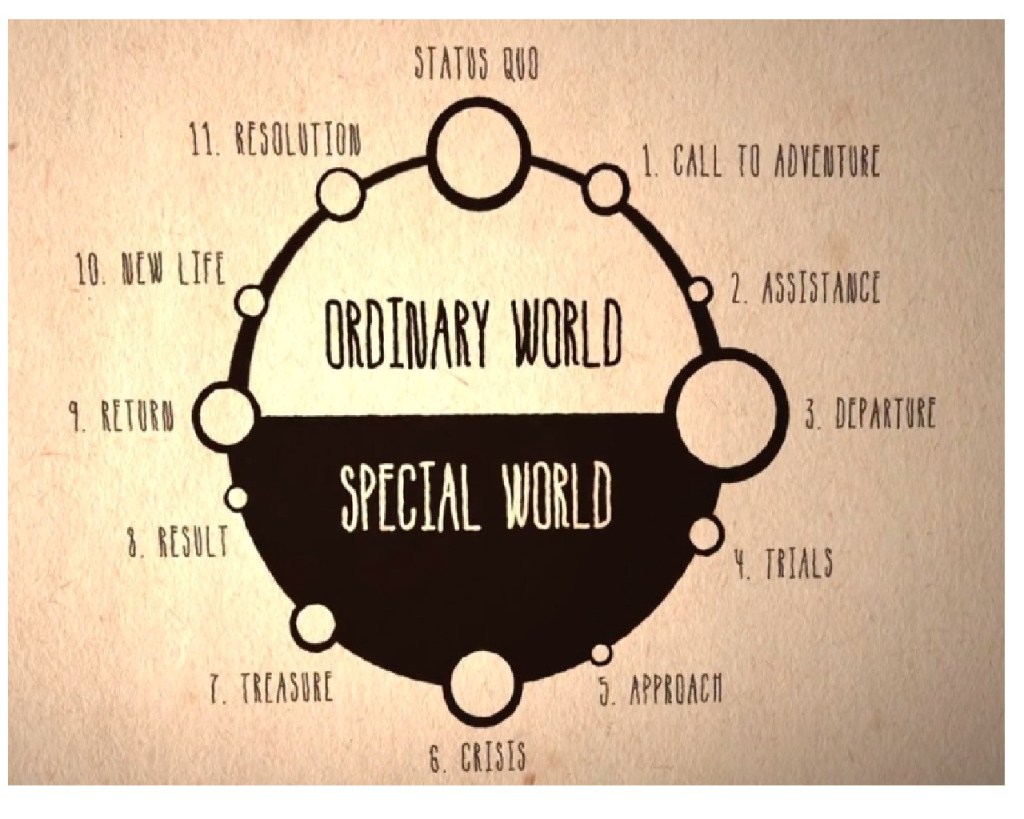
Campbell’s Hero’s Journey

Joseph Campbell’s monomyth, the Hero’s Journey, is outlined in his 1949 book, The Hero with a Thousand Faces. Drawn from his studies of comparative mythology and Jungian psychology, the Hero’s Journey has become a foundation myth of modern culture. The hero, generally young and vigorous, sets off into the unknown to battle antagonistic forces and returns transformed, a hero and guide to his people.

As Campbell writes in The Hero with a Thousand Faces:

A hero ventures forth from the world of common day into a region of supernatural wonder: fabulous forces are there encountered and a decisive victory is won: the hero comes back from this mysterious adventure with the power to bestow boons on his fellow man.

The Hero’s Journey has served as the go-to template for Hollywood screenwriters and bestselling novelists. We see this mythic pattern of the conquering male hero played over and over again in popular culture. Think Luke Skywalker in the original 1977 Star Wars—or any protagonist in a George Lucas or Steven Spielberg movie. Creative writing teachers encourage their students to pattern their story arcs on the Hero’s Journey to give a sense of archetypal depth and resonance. But this technique has been overused to the point of becoming a cliché. A deeply sexist cliché. Continue reading “The Via Feminina: Revisioning the Heroine’s Journey by Mary Sharratt”

Netflix Pandemic Show binge-a-thon by Anjeanette LeBoeuf

Given the progressively dismal state of affairs in the nation currently, I have relied heavily on binge watching shows on Netflix. One of my coping strategies I started using in graduate school was having tv shows or movies playing in the background. More often then not, it was something I had already watched or something I was not truly invested in so it would become a form of white noise while I did work. During this pandemic, I have found not only have I continued using Netflix as my white noise, it has also become a source of coping, self-care mechanism. From watching the ridiculous “Tiger King” docuseries, re-watching the “Great British Bake Off”, and the hilarious movie “Eurovision Song Contest: The Story of Fire Saga.”

Continue reading “Netflix Pandemic Show binge-a-thon by Anjeanette LeBoeuf”

A Case for Context by Sara Frykenberg


I have a close family member who is staunchly Republican and frequently posts videos from the conservative platform PragerU or “Prager University.” Video topics include: why the Democratic Party is the “real” racist party (as though either party is innocent of racism), the “war on boys” and masculinity, and how feminists don’t care about Muslim women (as though some Muslim women aren’t also feminists), among other issues. You get the picture. It is a propaganda media source founded by radio talk show hosts which creates short videos on every topic there is, presenting the conservative viewpoint as the simple “God’s honest truth” about the issue.

I’ve seen some of these videos. They are as offensive as they are misleading. But one element that is particularly egregious to me is their complete disregard for larger context. Continue reading “A Case for Context by Sara Frykenberg”

TikTok, the Pandemic platform for community, resistance, and activism by Anjeanette LeBoeuf

AnjeanetteIt’s July which means we have collectively endured 7 months of uncertainty, turmoil, darkness, and light. America, we are still battling all aspects of the virus: rising numbers of infected, those that deny its existence, those refusing to wear masks to help to stop the spread, and everyone else doing their duty by staying at home, washing their hands, and wearing masks. Yet, something else has added to the mix and the COVID19 pandemic; social media. Social media has taken on a whole new level for activism and resistance.

Continue reading “TikTok, the Pandemic platform for community, resistance, and activism by Anjeanette LeBoeuf”

When Life Hands You Lemons… by John Erickson

“When life hands you lemons, sometimes you have to make applesauce.”

I’ve been thinking a lot about something my grandmother would always tell me: “When life hands you lemons, sometimes you have to make applesauce.” I know, it sounds crazy, but life right now appears to be more on the crazy than the sane side.

We’re all in a state of uncertainty right now. The news is scary. Twitter is scary. Heck, even TikTok is losing parts of its humor. Everywhere we seem to turn, it’s more information about COVID-19, new cases, new lockdowns, and new things that we shouldn’t do for the foreseeable future. Continue reading “When Life Hands You Lemons… by John Erickson”

Reviewing Current Holocaust Popular Culture Materials By: Anjeanette LeBoeuf

AnjeanetteI contemplated doing a post on the current rising issues of the Coronavirus but as so much of life has been stopped, altered, and/or rearranged, that I figured I would embody the proverbial statement of “Just Keep Calm and Carry On.” So, this month’s post is a mixture of observation/product review on recent Holocaust narratives, especially found in movies, TV shows, and books.

Continue reading “Reviewing Current Holocaust Popular Culture Materials By: Anjeanette LeBoeuf”

Let’s Talk about Frozen 2 by Anjeanette LeBoeuf

AnjeanetteWhile facetiming my brother, I heard my two-year-old niece shout at the top of her lungs that she was “Queen Elsa” and was coming to save me. I had started writing about the Frozen films, when Sara posted on them. So let us continue on this Frozen journey.

Continue reading “Let’s Talk about Frozen 2 by Anjeanette LeBoeuf”

Beth March and the Courage of the Gentle Giver by Cathleen F

As someone who spent my prepubescent years watching director Gillian Armstrong’s “Little Women”, I was eager to see Greta Gerwig’s newly released version. Previously unexplored contours of each character, and of my changed perceptions, were made visible through this iteration. The most difficult and touching part of the film that lingers with me is the story of Beth, pianist and caretaker. Beth’s untimely death brings grief into the center of the March family narrative, and Gerwig’s portrayal brought up grief in me about my experiences with invisibility as a paced introvert in a culture that celebrates speed and extroversion.

I grew up wanting to be like Jo March, the outspoken, reactive protagonist. Jo was the rebel, the obvious feminist, and, mostly importantly to me, the brave one. Beth seemed to me to be boring, relegated to a life at home, bound by illness and a preoccupation with the needs of neighbors. Her steadiness looked to me like obedience; she could not fight away the disease that eventually killed her, and I wished to be everything besides her, the introvert who observed and cared and loved music and then died. As I grew into my own introverted, observant, caregiving tendencies, I began to wonder if I had been tricked by my culture, by my upbringing, to think I was Beth when I was really Jo! While social pressures certainly influenced my personality, as they do for us all, I didn’t want to believe that perhaps I was growing into my natural temperament, endowed by the Universe, expressed in my mind and body. As a woman in the 21st century, as a feminist, I was supposed to be like Jo, not the way I was (am). To have a deliberate or tender nature was, in my subconscious perception, to betray the spontaneous, assertive natures of those more worthwhile feminists who got things done. Continue reading “Beth March and the Courage of the Gentle Giver by Cathleen F”