I recently (July 2023) watched “Barbie,” the popular summer, blockbuster movie directed by Greta Gerwig. I liked the film enough to see it twice! Among other things, it seemed to be a narrative where women struggle to become fully human in spite of our patriarchal social system. I am not going to review the movie. American film critic for the New York Times, Manohla Dargis, has done that quite well already.
What I will do is explore parts of the film that were meaningful to me.
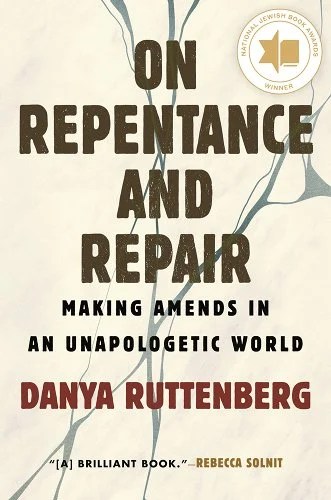
This is an excerpt of Rabbi Danya Ruttenberg’s On Repentance And Repair: Making Amends in an Unapologetic World, which comes out in paperback on September 12th. Called “A must-read for anyone navigating the work of justice and healing.” by Congresswoman Ayanna Pressley, it applies Maimonides’ Laws of Repentance to contemporary personal and systemic issues. This is an excerpt from Chapter Four, which addresses institutional repentance.
Most of us are part of many institutions—places of work, our own and/or our children’s schools and universities, houses of worship, co-working spaces, community organizations, sports leagues, social networking websites, the list goes on. And these institutions can and do perpetrate harm. Sometimes, that harm impacts us as individuals—as stakeholders or beneficiaries of those institutions, or as those excluded or hurt by them—and sometimes it can impact our local or national culture.
When I first heard a Barbie movie was going to be released this summer I groaned. Like the awful complements of GI Joe, American Girl, and Trolls, I assumed that the content of this film would be designed to fleece parents out of the cost of tickets and popcorn. I am delighted to report that I was completely mistaken. Not only does Barbie enchant, she also delivers a complex message about idealism and womanhood.
But Barbie’s most important revelation is in her role as a psychopomp between the world of the ideal and the world of the real. Barbie Land is like a patriarchal heaven. Women are ideal, they don’t have flaws. They get shit done without breaking a sweat or wearing comfortable shoes, and the men are the accessories. It is what I imagine all the men who struggle with patriarchy idealize about what it would mean to be a beautiful, flawless woman- all of the power, where men can relax and be accessories for a change.
Literally, you did not count on my astuteness. Or in other words, you underestimated my intelligence. It is the perpetual trick of arrogance that white supremacy and classism plays on racially and ethnically minoritized people and the joke/yoke these people carry. It is the most frequent microaggression I experience in academia in the supposed –– disque–– compliment of “you are so articulate!”
Source: Yahoo News
El Chapulín Colorado (The Red Grasshopper) is a Mexican comedic superhero character created by artist Roberto Gómez Bolaños, better known as Chespirito (little Shakespeare), in the 1970s. Whenever Chapulín untangles a mess, whether on purpose or by chance, he says “¡No contaban con mi astucia!” The movie Blue Beetle, which pays homage to this beloved character across Latin America and Latinx people is ––entre otras cosas–– exactly that, astute! Puerto Rican director, Angel Manuel Soto, and Mexican writer, Gareth Dunnet-Alcocer, take the DC comic book story of Jaime Reyes’s Blue Beetle (2006) and transform it into a film that, more than responds to a Latino superhero gap, it takes representation, impact, and issues of capitalism seriously. The truck, the heart-shaped shield, the tools, and the crickets playing in the background of the outdoor scenes ––to name a few–– are an extension of the characters’ parallelisms and the possibilities of what it means to have higher numbers of representation in mass media-produced films with integrity and astucia. ¡Awiwi!
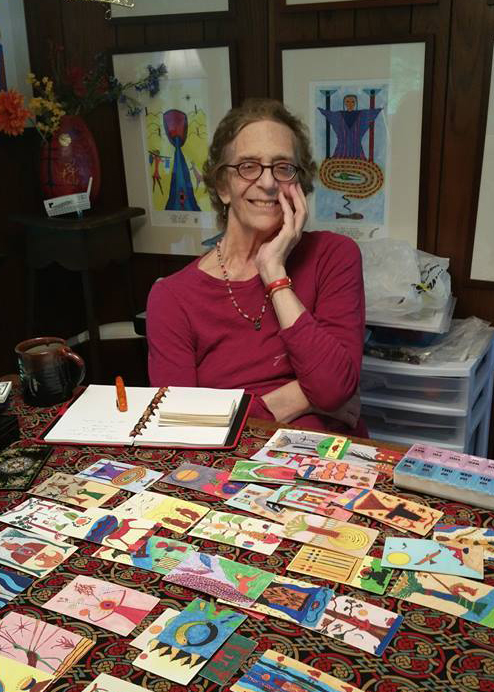
How do you speak about someone who not only rocked your own world, but those of countless others? Whose fertile imagination and generous nature inspired and transformed so many lives? My friend, teacher, and mentor Rachel Pollack died in April. It’s hard to wrap my head around what a huge loss this is, not only for me, but for the world. She had an encyclopedic knowledge at her fingertips of mythology, tarot, historical trends, cultural trends, ancient civilizations. She was a storyteller at heart, using personal stories, universal stories to teach. She encouraged and guided each of us to discover and tell our own stories. Her stories won both the Arthur C. Clarke and the World Fantasy Awards. I call her the Grandmother of the Tarot because her work in that area has been so ground-breaking, far-reaching and depthful.
I write JIA, instead of RIP, special for Rachel. JIA means Journey In Adventure. Rachel was adventurous to her core. Rather than resting in peace I see her continuing her immensely adventurous journey just now on the other side of the veil. I see it as a continuing wondrous, magical ride that she has earned.
I was excited and thought I knew what to expect. I know what happens in the game after all. But after watching episode three, Long, Long Time (aired Jan. 29, 2023), I found myself considering what seems like something new in a zombie story as well.
Warning: Contains spoilers for The Last of Us video game and HBO series! (Oh, and for The Walking Dead… And maybe a few other zombie films too.)
I remember when Naughty Dog released the first iteration of its popular game, The Last of Us (2013) because a friend of mine worked with the sound design team for the game. This friend started out as a game tester and through years of effort, was eventually creating game sound and dialogue. The release was a BDF for his personal success and at the time, felt like something new in gaming: it was realistic, cinematic, and emotional. (And incidentally, it was reviewed very, very well.) This past month HBO released The Last of Usas a TV series. I was excited and thought I knew what to expect. I know what happens in the game after all. But after watching episode three, Long, Long Time (aired Jan. 29, 2023), I found myself considering what seems like something new in a zombie story as well.
***In light of the recent passing of Queen Elizabeth II and the continual attacks on Harry and Meghan, it seems fitting to revisit this post***
For as long as I can remember I have been fascinated with all things Royal. On March 7th, the world sat enraptured as two members of the British Royal Family had a tell-all interview about their experiences over the last 3 years. There is so much to deconstruct, digest, and explore in this interview and why it matters. There is so much about the March 7th interview that is compelling. The interview hosted by Oprah is the first sit down for Prince Harry and Duchess Meghan. For many, this interview was a bombshell, revelatory, and earth shattering. For me, it was mainly a confirmation of things that I had read into over the years, confirmation over the fact that Meghan was pushed out by the British Crown, and that Diana’s ending could very likely have happened again.
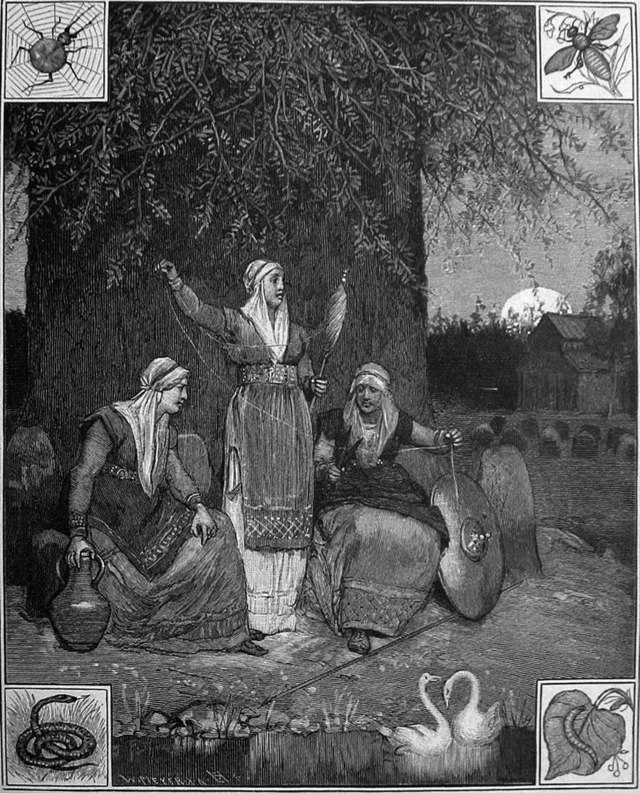
Part 1 was posted yesterday. You can read it here. The Norns were explaining the mess they had made when they got drunk at a Valhalla party.
The Norns looked at me with sadness. “We knocked over one of our looms/templates/arrangements”
Their tone changed, they looked at each other and I thought I could see emotion churning. They were arguing and then they stopped. They turned toward me and looked sheepish, that is if divinities can look sheepish. “It was a disaster/calamity/debacle.”
“Tell me then,” I was growing impatient.
Verdandi: “Well you see the loom we knocked over was . . .”
“What?” I almost shouted at them.
Urd: “It was the loom holding the pattern from Salim/Jerusalem.”
I am a great evangelist. I used to evangelize in Pentecostal settings until I was 22. Then, I left my church to evangelize about feminist issues to every woman that crossed my path. Rhetoric is a gift I received when I was a kid and that I inherited from my grandpa and my dad. But during the COVID lockdowns, it was hard to socialize, and my evangelization skills turned toward making my friends and family join the privileged fan base of Ru Paul’s Drag Race. One by one, I convinced my sister, cousins, neighbors, and best friends to watch the reality show, and they did with astonishing devotion. Every week, two or three of us gather in someone’s living room wearing masks to watch episode after episode after episode. Our debates about the queens in the show could last all night long. Who had the best performance? Did you like their lip-synching? “That elimination was so fair/unfair!”