

 I’m going to do something I’d never thought I’d do: fill your newsfeed with yet another article pertaining to the 2016 United States Presidential election and yes, I’m going to talk about former Secretary of State Hillary Clinton (hint: I’m emphatically supporting her and I’m unapologetic about it.)
Let me start off with my central point: a vote for Hillary is a vote to change history and the world. No, not because she’ll hail in some type of new economic stimulus (although I’m sure she’ll do just fine with our economy #ThanksObama) or because she’ll save us all from the evils of the GOP (looking at you Trump/Cruz/and the “moderate” Kasich) but because she’ll do one thing that’s never been done before: become the first female President of the United States, ever.
While I have tried not to get into “it” (read: online trysts with my friends on social networks who are #FeelingtheBern) the question I beg to ask is: what’s so wrong with wanting the right woman to be the President? This is one, but not my only reason, I will cast my vote for her both in the Democratic Primary in California in June as well as in November (and, if you haven’t guessed, I do not believe or promulgate the reasoning or rhetoric that Bernie Sanders will come from behind and win the Democratic Party’s nomination because I passed 5th grade level Math.)
 At the time of climate change and crises of capitalism we need to drop our sense of entitlement to comfortable life or even to life at all. Nature will not spare us just because we are humans. When the meltdown of economic and environmental systems occurs, we are all going down: humans and non-humans, women and men, spiritual or not. We have
 It starts with the main character, a Chinese Buddhist Were Fox who lives in present-day Moscow, consoling herself: “What else (or What the fuck) did you expect from life, A Huli?” A Huli is her name, supposedly meaning Fox A in Chinese. It is also a swear phrase in Russian, meaning “What the fuck?”
 She appeared on a hill on December 9, 1531. She spoke to Juan Diego in his native tongue of Nahuatl; the language of the Aztecas. She asked for a church to be built at that very site in honor of her, the Virgin Mary. Juan Diego took the request to the local priest, but his story was not believed. On December 12, following further instructions from La Virgen, Juan Diego was able to find and pick roses not native to Mexico. He rolled them up in his tilma and returned to the priest. When he unrolled his tilma to present the roses, there on the tilma was the image of La Virgen de Guadalupe; she was as dark as the natives themselves.
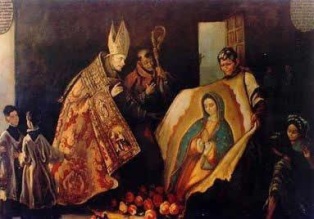 La Virgen de Guadalupe
 Pope Julian I in 350 C.E. set December 25th as the official day of observance for Christmas. It wasn’t until 1834 that it became a public holiday in the United Kingdom and it was declared a national holiday in the United States in 1865.

