Like most Americans, I hold the overblown belief that a book about my life would be worth reading. And, like most Americans, I have had the gumption to title it before I’ve even lifted a finger. It’s called “Should I Be Praying Now?”
As if you’re surprised, it has an obnoxious subtitle that helps marketers at Barnes & Noble know whether to put it on the Christian living shelf with the likes of Beth Moore or drop it behind the David Sedaris memoir with the naked barbie on the cover. It will read, “Moments of indecision during mealtime, bedtime, teeth-brushing, love-making, test-taking, baptisms, funerals, and the opening few minutes of small group.” It’ll be like Anne Lamott’s “doesn’t that make you feel better about your own spiritual life” kind of writing but more pedestrian. Continue reading “This is Why I Don’t Pray by Erin Lane”
(I offer here an abridged version of the sermon I gave on Yom Kippur (5773) at Temple Emanuel in Lowell, MA. The full version will be available on their website soon. The book of Jonah is always read on Yom Kippur in the afternoon service as the Haftorah. It is rather traditional that someone (usually the Rabbi) offer an interpretation of it. Temple Emanuel asked me this year. I thank the congregation for the honor and I hope my words offered them, and now you, food for thought.)
Scholars believe the Greek philosopher Plato lived between 428 BCE and 348 BCE. The Allegory of the Cave is one of Plato’s most famous stories. It illustrates the effects of a change in knowledge, education and experiences on the human being. Some of you may know it or have read it at some point but for those of you who don’t, let me offer a very brief summary.
“I never told my grandmother I was gay. I’ve often wanted to visit her grave, clench my hands together, and pray that she forgive me for betraying the trust she instilled upon me long ago. However, even today, I cannot bring myself to make that trek, up the hill into the countryside where her ashes lay below the ground.”
I haven’t dreamt of my grandmother since her passing one hot summer July evening.
The night, and the days that followed, continue to be a blur. However, as my family members continue to see her in their nightly visions, I, go on unabatedly longing to see and hear the voice of a woman who made me feel the presence of the divine with each passing story.
My sister saw her in a dream when she was buying shoes, my mother has seen her multiple times when she would be undergoing a particularly stressful situation, and I, left alone and oftentimes wondering through an abyss of loneliness and disarray, wake up each morning wondering why, I am left all alone. Continue reading “Visions of My Grandmother by John Erickson”
Spiritual Power is arguably the most dangerous power of all. In the wrong hands, it gives the power to make judgments even about the eternal fate of another person. It needs a sign on it at all times saying, ‘Handle with extreme care.’ The greater the power a person exercises, the more need there is for checks and balances before it is used and accountability after it is used.” – – Bishop Geoffrey Robinson
May 6th, I addressed the issue of abuse of power in the Catholic Church and how we seem to be unraveling any kind of progress made since Vatican II. Since writing that article, the Leadership of the LCWR met with Vatican Officials and expressed their concerns openly. A dialogue occurred and left no resolution, just information that the leadership will discuss with the community at their August meeting. That meeting will reveal their next step in this controversy – concede and follow the conditions and rules sets forth by the CDF or disband and form a new religious community or maybe there will be another option revealed.
I have to ask though – Was this a meaningful meeting or was it meant to pacify the Sisters and their supporters? Will the Vatican change its stance? Certainly, the U. S. Catholic Sisters have not been
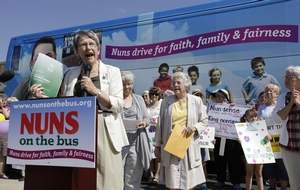
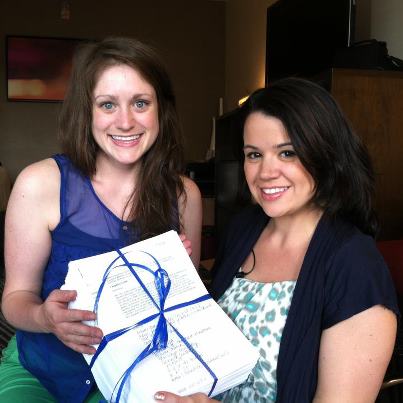
pacified, nor have their supporters. For example, there is a “Nuns on the Bus” tour traveling around the United States, prayer services for the Sisters, #nunjustice and #whatthesistersmeantome campaigns on Twitter. Even the Women’s Ordination Conference delivered a petition containing over 57,000 signatures to the Vatican in support of the Sisters. Certainly, the support for the sisters and their mission is not dwindling, but growing stronger every day.
As for the Vatican, a change in their position is doubtful, but we can continue to pray. I am, however, very discouraged by a statement attributed to Pope Benedict that indicates a desire to have a smaller more faithful Church of Catholics then a large Church of people who do not adhere to Church Teaching – seeking out a small, strong, holy community.
Obviously, it is my hope that this statement was taken out of context, but I have to be honest and say
Women’s Ordination Conference delivering Petition Picture reprinted from WOC’s page on Facebook
that my hope is filled with doubt. This is not the first time I have heard clergy make this statement. Priests have made this statement in my presence – wanting a more faithful flock and dismissing those that do not adhere to their interpretation of Church teaching. This stance does not bear fruit, but is rather a power play – a play that can be called many things – misogynist, arrogant, non-pastoral, cold-hearted, and frankly un-Christian. It also plays with a person’s spiritual fate and in many cases their soul. The psychological impact of something like this is dangerous for some. Some ordained will go so far as to withhold sacraments or even compromise the person’s status in the Church, including their role in ministry, for the sole purpose of inducing compliance – a tactic that dates to the medieval period.
I have a beautiful picture of vagina hanging on my wall. However, for the longest time it was in the back of my closet, with a plastic bag covering it. I wasn’t ashamed of it but my ex-boyfriend, like most gay men, refused to have it on the wall where he could see it. He is now long gone; the vagina is now out and proud.
I bid on the picture one fall during a showing of the Vagina Monologues at Claremont School of Theology. One of my best friends was in the show and I had always loved its powerful message. I walked out of the theatre, waiting for my friend, and there it was: the picture of the vagina. I found myself caught up in its beauty. Its gaze had mesmerized me. The outlying layers of red, the contours of its shape, they all began to mold into a figure before my eyes. While I have never thought of myself as a religious person, I realized that at that moment I was no longer looking the old photo but rather I was staring at the outline of the Virgin Mary. At that moment, I realized that I had to have the picture.
My ex boyfriend was ashamed of the photo. I let him shame me into putting it in the back of my closet and cast it away like it was nothing. Like the experience, call it religious or not, had never happened. When we ended our relationship, I found myself inconsolable and pacing up and down my stairs in a never-ending cycle of sadness and downheartedness. As I was pilfering through our items, I came about the picture. I saw it and for a split second, I was no longer sad. Continue reading ““Vaginas are Everywhere!”: The Power of the Female Reproductive System by John Erickson”
My simple daily rituals and spiritual practices are what keep me mindful of G-d and G-d’s presence in my life. They also remind me of G-d’s call to justice, care, compassion and love.
“I find by experience, not by reasoning,
but by my own discovery that G-d is near me,
and I can be near G-d at all times.
I cannot explain it but I am as sure of my experience
as I am of the fact that I live and love,
but I know I do.
In the same way, I know I am in contact with G-d.”
This poem by Lily Montagu speaks to me. I read it most mornings as I say my morning prayers, and it is one of those mantras I try to live by. I have found that contrary to popular belief, sustained religious practices can be just as transformative as instantaneous conversion experiences. This is why I have developed certain spiritual and specifically Jewish practices (For more about my joinery to Judaism, see one of my previous blogs “Reflections on my Spiritual Journey: Claiming Judaism”). I find that they help me develop and cultivate a strong relationship with G-d. For example, I keep a kosher home; wear a kippah daily; try to pray at least twice a day andbefore snacks and meals; practice the principles of Mussar; attend regularly Shabbat services Friday evenings at my Reform Congregation in Lowell and Saturday morning services at a Conservative congregation in Nashua, NH; light Shabbat candles; try not cook or create on Shabbat; make Havadalah to mark the end of Shabbat; give tzedakah as much as I can and study Torah with my friends. This list is not all encompassing and there are quite a few areas of my practice I wish were more disciplined as well.
“As we approach Memorial Day Weekend (and the militaristic patriotism it promotes), as the 2012 election cycle heats up, and as I meditate more deeply upon my and my country’s many riches, one of [Walter] Brueggemann’s prayers in particular spoke to me.”
One of the three books I took with me on vacation is by the world’s leading interpreter of the Old Testament, Walter Brueggemann. It’s not actually on the Bible, but something he published in 2008 called Prayers for a Privileged People.
Time. We mark years, months, days, hours, minutes and seconds. We mark seasons. We mark life events. We live our lives in time: both circular and linear. Time began before we did and time will continue after we cannot experience it any further. Some say we repeat time with rebirth. Others suggest that we only have one lifetime of which we should make the most. Still others suggest there is existence outside of time with concepts like infinity and eternal life. We sure do write, discuss and ponder time a lot, but do we ever really experience it? Meaning: what would it be like to live in the moment, to be aware of and completely conscience within an instance of time, not thinking of the past, not worrying about the future, but being fully present in the here and now?
Sci-fi geek that I am, I often recall the Star Trek: The Next Generation movie entitled Insurrection when Captain Picard and Anij discuss experiencing a moment of time. Anij explains to Captain Picard, “You stop reviewing what happened yesterday. Stop planning for tomorrow. Let me ask you a question. Have you ever experienced a perfect moment in time?” A few lines of dialogue later, she picks up the topic again by describing what being present is like. ”We’ve discovered that a single moment in time can be a universe in itself. Full of powerful forces. Most people aren’t aware enough of the now to even notice.” The visual effects show water stopping and a butterfly’s slow flight if I remember correctly. Captain Picard is obviously caught up in these moments of time as well as being mesmerized by Anij herself. The power of both the moments of time and Anij herself is palpable. Continue reading “On Being in the Moment By Ivy Helman”
It is our moral responsibility, whether we identify as Christians or not, to pray for not prey on the victims of tragedies.
Over the last month, dare I say years, society has witnessed or been subjected to an all out war from radical Christians across America deploying the wrath of God and reveling in the tragedy of others to perpetuate their apocalyptic message of rhetoric and terror. As I hear the news over the last few months, an old Billy Joel song starts to play in my head “We didn’t start the fire.” Whether we started the fire or not, we should not feed the flames of hatred but figure out a way to extinguish it.
Here is a brief synopsis of current events that reflect this hatred and radicalism perpetuated in the name of God – examples of Christianity terrorizing or preying on victims through their actions.
The Westboro Southern Baptist Church: Preying on Victims at Funerals and Thanking God for their Tragic Deaths
Their web address says it all: www.godhatesfags.com. This group, which one cannot call Christian but rather “hate-mongers,” threatened to burn the Qur’an, was banned from Facebook for spreading hatred against homosexuals, and recently had the audacity to picket funerals of Americans killed in natural disasters, most recently, a teen-age shooting victim, Daniel Parmertor (age 16), from Chardon, Ohio. Thankfully, volunteers across Ohio and a local group of bikers formed a human barricade to keep these people away from the funeral and grieving family and community.
I attended a service at Congregation Shalom in Chelmsford, MA two Fridays ago. During the service, Rabbi Shoshana Perry spent a few minutes addressing the last word of a Hebrew prayer found in the Reform siddur, Mishkan T’filah. It was translated in the siddur as “God rested” but the Hebrew word used was vayinafash, which comes from the word nefesh, or soul. The prayer emphasizes on the seventh day that God did not rest as much as God took time out to re-soul. Rabbi Perry believes that our Shabbat should be spent doing things that help us also re-soul.
Initially, I spent quite a long time considering why God would need to re-soul and what exactly God would do to re-soul. When I realized the futility of trying to sort that out, I moved a little closer to home: what do I do on Shabbat to re-soul? I was quite overwhelmed trying to answer this question as well.
Traditionally, Shabbat is about study, rest, prayer and family among other things. In fact, many Jews avoid creative processes like writing, cooking, painting, driving and working because God rested from creative work on the seventh day. (Incidentally, our creativity is also how we are considered to be made in the image of God). Part of the reason this idea struck me so deeply is because I often find painting, cooking and writing rejuvenating. Continue reading “RE-SOULING ON SHABBAT BY IVY HELMAN”