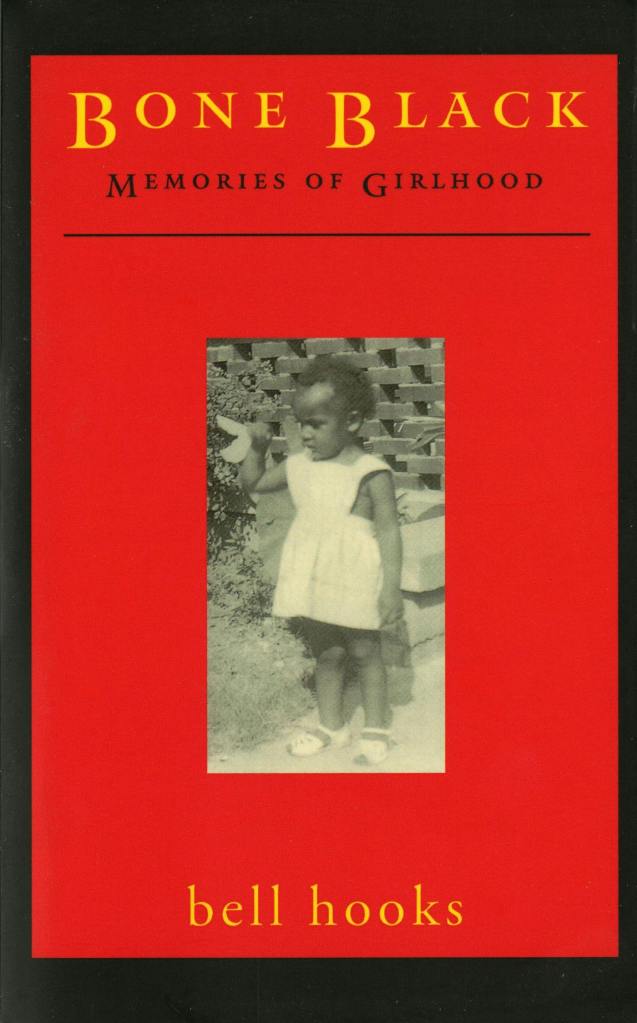
Reflections On Bone Black: Memories Of GirlHood by Zoe Carlin

Bell Hooks explores in the memoir Bone Black: Memories of Girlhood the extreme effects of race, gender, and class on her identity and self esteem as a Black woman. Each chapter of Bone Black showcases stories of Bell Hooks’ childhood experiences growing up in a racially segregated environment. Through these experiences, she shares how the mainstream beauty standard, the racism towards Black people, and the limitations imposed by class and gender have shaped her perceptions of herself and her worth. Hooks also discusses how white supremacy, the patriarchy, and societal neglect intertwine.

What particularly stood out to me is how her story and the themes mentioned connect to spirituality and are offering further ideas on resistance and empowerment. It also touches on connections with identity formation and our sense of self. For example, the memoir shared insight of how the beauty standards at the time were typically associated with being white. As a Black woman, Hooks shared how she had felt undesirable due to not being included in these standards that were set in place. She does not just reflect on the pain of being marginalized but she also delves into the complexity of being a Black woman in a masculine dominated world. Hooks had to navigate both the oppression of racist behavior by others around her and the misogyny of a patriarchal system that was determined to define her worth based on her appearance.

Continue reading “Reflections On Bone Black: Memories Of GirlHood by Zoe Carlin”
Memoirs of a Cult Survivor by Chasity Jones

This blogpost is a reflection on my experience creating a podcast series concerning religious trauma experienced in cults as well as how to heal from traumatic cult experiences.

Firstly, I had to be very intentional about the word survivor as opposed to victim. Survivor was the obvious choice because I used to cringe when thinking of myself as a victim. However, As I heal, I can honor both the survivor and the victim, for they are the same. I cannot forget to acknowledge though that some victims do not survive and this is the same concerning cults. Many people at this very moment are in exile or in hiding from their cults when they escape and for that reason some of the people who engaged in this series were forced to engage anonymously.

Continue reading “Memoirs of a Cult Survivor by Chasity Jones”

We Are Not Oppressed Because We Remember pt. 3: Sowing Seeds and Braiding Hair by Chasity Jones

Today, once again, I got to touch the earth!

While planting and constructing my indoor container garden, I thought about how my ancestors put seeds into their children’s hair so that in case they were taken away to live and die in chains, they would at least be able to sustain themselves with a piece of the motherland. Rice, okra, yams, watermelon, and so MANY more crops that would go on to make white slaveholding Americans so rich (passing their wealth to their descendants and zero reparations for the descendants of enslaved Africans), that they were willing to fight a war to sustain their evil practices of owning human beings as chattel (Check out High on the Hog Netflix documentary which was adapted from a book by Dr. Jessica B. Harris). Enslaved Africans brought these foods to the new world, a direct result of slavery.

As I wash my daughter’s hair (which for Black women and girls is a PROCESS!!), as I moisturize her hair, and as I braid my hair, I am thankful that no one has a right to my child and that I do not need to fear her enslavement. Instead, I manifest her revolutionary future to carry the torch of our ancestors. A Torch and a commitment to elevate our community and move the community forward. I leave it up to her to choose how she will carry that torch forward!

Continue reading “We Are Not Oppressed Because We Remember pt. 3: Sowing Seeds and Braiding Hair by Chasity Jones”

Stand Your Ground: An Interview with Kelly Brown Douglas by Gina Messina

Following the murders of Trayvon Martin and Tamir Rice, Kelly Brown Douglas released her book, Stand Your Ground: Black Bodies and the Justice of God. In this critical work, she details the embedding of structural violence within the doctrine of American Exceptionalism and the deep rooted racial injustice that our nation was founded upon.

Over the last several months, our world has changed. We’ve witnessed great tragedy and there is so much to grieve. COVID-19 intruded upon our lives abruptly forcing the realization of our misplaced priorities. However, systemic racism has always been here, tightly woven into the fabric of our society; yet privileged voices have failed to answer the call for justice. 

As so many risk their health and safety to march for racial justice; to exclaim that Black Lives Matter and that George Floyd’s life was indeed sacred (as was Raychard Brooks, Breonna Taylor, Freddie Gray, Sandra Bland, Philandro Castile, Alton Sterling, Eric Garner…#SayTheirNames), we must consider our own responsibility in perpetuating oppressive structures that condone the trend of public lynchings. 

Following the murders of Trayvon Martin and Tamir Rice, Kelly Brown Douglas released her book, Stand Your Ground: Black Bodies and the Justice of God. In this critical work, she details the embedding of structural violence within the doctrine of American Exceptionalism and the deep rooted racial injustice that our nation was founded upon. She explains it was not a book that she wanted to write; rather, as a mother of an African American son, it is a book she was compelled to write. In doing so, Kelly has laid bare the sin of our nation. Five years later, her witness continues to demand our attention.

I reached out to Kelly and asked if she would be willing to talk with me about her book and she graciously agreed. Thus, for this post, I am sharing the wisdom of Kelly Brown Douglas, vlog style, knowing that, in this moment, it is her words that we all need to hear.  


Gina Messina, Ph.D. is an American feminist scholar, Catholic theologian, activist, and mom. She serves as Associate Professor and Department Chair of Religious Studies at Ursuline College and is co-founder of FeminismAndReligion.com. She has written for the Huffington Post and is author or editor of five books including Women Religion Revolution. Messina is a widely sought after speaker and has presented across the US at universities, organizations, conferences and on national platforms including appearances on MSNBC, Tavis Smiley, NPR and the TEDx stage. She has also spoken at the Commission on the Status of Women at the United Nations to discuss matters impacting the lives of women around the globe. Messina is active in movements to end violence against women and explores opportunities for spiritual healing. Connect with her on Twitter @GMessinaPhD, Instagram: @GinaMessinaPhD, Facebook, and her website ginamessina.com.

Blinded by the White by Marcia Mount Shoop

mms headshot 2015White supremacy culture is on full display day in and day out in America.  You don’t have to strain to see it—the President’s recent comparison of the impeachment proceedings to a lynching is the latest example.
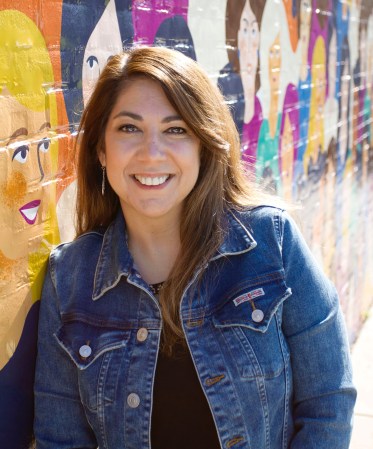
Of course, even such an extreme example is still defended by white people of all shapes and sizes: senators, voters, talking heads, and the offender himself.  The grotesquery of such a distorted perspective is emblematic of a sickness in our country to be sure.

But there are even more sinister forms of white supremacy that afflict our collective lives.  They are harder for many white people to see. And they are, therefore, harder for us to believe. This kind of whiteness is the whiteness that blinds us. This is the whiteness that creates the conditions for the extremes to be mistaken for the whole problem.  But more importantly, this is the kind of whiteness that creates the conditions for whiteness to be even more tenacious in some dangerous and annihilating ways.

Continue reading “Blinded by the White by Marcia Mount Shoop”

Where’s the Love by Gina Messina

In a recent post I wrote about finding God in music. I confess, I cannot remember the last time I set foot in a church. As a woman, I continually grapple with the foundational messages of Jesus and Catholic Social Teaching and the disconnect with the power structures that seek to control the ways we love and find justice. I long to participate in the culture I grew up in, but cannot support the weaponization of the tradition. 

Lately, I’ve come to realize that the messages I connect to I find in music. There are particular songs that offer me the guidance, philosophy, and ideas around meaning and purpose that I resonate with. One of those is “Where’s the Love?” by the Black Eyed Peas.  

I’ve been listening to it on repeat lately because it is the sermon I need to hear; it speaks to me and even though it was recorded quite a while ago, it is still relevant. I think it is fair to say that in our current socio-political culture, people are “acting like they got no mamas.”  And by the way, I include myself in that statement. Like anyone, I sometimes get so caught up in believing that my way is the only way, I forget to listen to what others have to say.

We are in the midst of a political civil war and are so busy yelling past each other, we’ve forgotten how critical unity is to shaping a healthy government that serves its purpose – caring for the people. Continue reading “Where’s the Love by Gina Messina”

On Not Eating Gefilte Fish by Joyce Zonana

What does it mean to be an Arab-Jew in the twenty-first century? For me, it means recognizing and honoring Arab culture: the music, food, language, and customs my parents brought with them when they emigrated from Cairo in 1952; it means feeling a strong bond with other Egyptians, North Africans, and Middle Easterners, refusing efforts in the U.S. and elsewhere to demonize and “other” any of us. It means respecting the claims of displaced Palestinians and protesting Israeli occupation of Palestinian territories. It also means not seeking to equate our displacement with Palestinian displacement, as some Jews from Arab countries have sought to do, in a transparent effort to discredit Palestinian suffering.

jz-headshotWhen I was growing up in 1950s Bensonhurst, in Brooklyn, NY, my identity as a Jew was often called into question. “You mean you’re Jewish? And you don’t know about gefilte fish?” my best friend’s Eastern European (Ashkenazi) Jewish mother asked, shocked to discover that our family ate stuffed grape leaves rather than stuffed cabbage. “What kind of a Jew are you?” schoolmates challenged. When I answered “Sephardic . . . from Egypt,” they would reply. “But all the Jews left Egypt a long time ago, isn’t that what Passover is about?”  “No,” I would say, having been taught the words by my father. “Some Jews returned to Egypt when they were expelled from Spain.” [Later I would learn that some Jews actually lived in Egypt for millennia, never having left.] “There are no Jews in Egypt,” my little friends would retort. “We never heard of any Jews in Egypt. You can’t be Jewish.”
It was puzzling, I knew, but I could find nothing further to say. Aside from a handful of relatives, I did not know any other Jews from Egypt either. An Egyptian Jew. To my neighbors, it seemed a contradiction in terms, an oxymoron. To myself as well. What was the Egyptian part, what the Jewish? How did they fit together? Maybe I wasn’t really Jewish. Later, when acquaintances continued to wonder about my identity, I was similarly stymied. “You mean you don’t speak Yiddish?” they would ask after I had painstakingly explained that my grandparents spoke Arabic and French.

Continue reading “On Not Eating Gefilte Fish by Joyce Zonana”

Celtic Myth, Moon Blood, and the White Beauty Standard by Marisa Goudy

My woman’s body is entering the dark time of the moon, even with blinding white snow lashing the windows, even with a full moon tracing its way far above thick clouds. My mood is black and soon I’ll be flowing red, and the snow will just drive on white, white, white.

In The White Goddess, Robert Graves tells us: “…the New Moon is the white goddess of birth and growth; the Full Moon, the red goddess of love and battle; the Old Moon, the black goddess of death and divination.”

The Celt in me feels cradled by this imagery, even if, as Judith Shaw and Carol P. Christ have pointed out elsewhere on this site, the idea of maid, mother, and crone is a modern invention, not gift from the past. I agree with Christ:  “My suggestion is that we give up the idea that the details of contemporary Goddess Spirituality are rooted in and authorized by tradition. We can instead acknowledge that though we are inspired by the past, we are the ones who are creating contemporary Goddess Spirituality.”

Continue reading “Celtic Myth, Moon Blood, and the White Beauty Standard by Marisa Goudy”

Considering Our Spaces in the Pursuit of Justice by Elise M. Edwards

This past summer, my friend and I were perusing the exhibits at the National Museum of African-American History and Culture when she urgently called for my attention.  “Psst… Isn’t this where you are from?” she asked, pointing at a placard titled African American Life in Montgomery County.  Yes!  I grew up, I was educated, and I was churched in Montgomery County, Maryland.  So I eagerly read the exhibit’s description:

By 1900 there were at least eight African American communities in Montgomery County, Maryland. Unlike many rural African Americans, the residents were not tenant farmers—they owned their property and homes.  This gave them greater control over the land and the crops they produced.  They also directly benefited from improvements to their homes, which was an incentive to make additions and to stay in place.  Descendants of these early settlers still live in these communities today. Continue reading “Considering Our Spaces in the Pursuit of Justice by Elise M. Edwards”

Exploring Muslimness in the Aftermath of September 11, 2001 by Stephanie Arel

In my last post, I addressed the deeply personal accounts of Haroon Moghul’s self- and religious exploration in his memoir How to be a Muslim: An American Story. This post will broaden that reading to consider an October 2017 interview with Moghul at the 9/11 Memorial & Museum in New York City.

The interview echoes themes relevant to current global crises which implicate religion including how religious rhetoric circulates to support extremist violence and Islamophobia. Exploring how the events of 9/11 intertwine with such crises adds depth to understanding Moghul’s individual experience.

Continue reading “Exploring Muslimness in the Aftermath of September 11, 2001 by Stephanie Arel”