“There are years that ask questions and years that answer.” from Their Eyes Were Watching God by Zora Neale Hurston
In my previous two posts, I’ve discussed the wisdom that can be found in black women’s literature. Continuing this series, I’m sharing a statement from the most well-known novel written by Zora Neale Hurston. Hurston was an American novelist, folklorist, anthropologist, and cultural critic whose work was first published in the 1920s-1940s. Their Eyes Were Watching God was published in 1937 and has since been reissued and adapted into film.
“There are years that ask questions and years that answer.” This quote is one that has circled around my mind every New Year and every birthday for many years. These times of year are when I’m likely to reflect on the previous year and wonder what has come from it.
E pluribus unum (‘EPU’), which first began to be used by the U.S. in the 18th century, comes from a poem entitled Moretum that until well into the 19th century was generally attributed to Vergil. During those centuries Latin would have been studied from what was the equivalent of today’s elementary school through at least high school. Because Vergil is to the study of Latin what Shakespeare is to the study of English, Moretum would have been read by anyone lucky enough to receive formal education in those centuries–mostly boys–including the white sons of slave owners.
Those boys, however, would have been motivated not just to read, but to memorize Moretum. That is because Moretum, through a variety of clues, encourages allegorical interpretations, one of which is that it celebrates the sexual intercourse of a single white farmer and his sole companion, his black female slave. Such an interpretation requires ignoring the clues that the author thinks of such sex as rape (as anyone other than a male slave owner would); those clues lead me to think the author may have been a woman.
Illustration of Moretum from a 1558 edition of the works of Vergil available here.
On Monday, the picture was on my Facebook feed again: The picture of a girl lying face down in the grass under a police officer pressing his knee in her back. It was from the video of an African-American teenager being pinned to the ground by Eric Casebolt, the police officer in McKinney, Texas who was responding to calls about a pool party. When I saw the picture this time, it was in a screenshot with these words below it:
“Funny how a 14 year old bikini-clad black girl being publicly assaulted by an adult male does not accrue mainstream feminist outrage.” – Yohanna
The screenshot was taken of a post to Yohanna’s Twitter account (@maarnayeri). I don’t know her, but she troubled me.
If you haven’t seen the images we’re talking about, you can view the video here with a description of what is concurring or below from YouTube. I was reluctant to watch the video. It seems voyeuristic to view this young woman’s suffering and screaming. And, if I am honest with myself, it also seems useless. Viewing this from my computer screen, I’m in no position to help her. I hear her cries and it make me cry too. But I can’t push him off of her. When other teens tried to come to her defense, Casebolt pulled a gun on them and chased them. I don’t even have the power to get him fired from his position of authority immediately. No, we must have the investigations and inquiries and due process that seems so indiscriminately afforded to the privileged. Casebolt was put on administrative leave on Friday, and on Tuesday June 9, he resigned.
So how should I respond?
I had a conversation with one of my closest friends a couple days ago that provoked me to reflect on what to do when I’m conflicted about how to respond. Her background is in acting and theatre, and now she is a pastor and artistic director of a Christian church and arts initiative who believes in supporting arts, imagination and creativity. In our conversation about discerning the next steps in our lives, she was reminded of a book by Samuel Wells that proposes “theatrical improvisation as a model for Christian ethics.” That reminded me of books I’ve read that talk about musical improvisation or call-and-response as model for living, and some pieces I’ve written about that. Inspired by ethicists and theologians including Emilie M. Townes and H. Richard Niebuhr, I believe that to answer the question of how I should respond, I must first answer ‘What’s going on?” An improvised response or a fitting response is the response to what is already occurring. We must look at the situation critically to respond appropriately.
What’s going on in this video and the controversy surrounding it? I am certainly not an impartial or all-knowing observer, but here’s what I see:
A white man forcibly throws an unarmed, African-American teenager to the ground yelling “On your face!” We can see that she is unarmed because she is wearing a bikini.
The man is a police officer. He is upset that his authority is being challenged. Other officers are present and seem to be asking questions, but the violent one seems out of control and frantic, running around and yelling. He escalates the situation when he throws the girl to the sidewalk, which causes an outcry in the crowd.
As the video went viral, there were many protests and online statements against this violent event, but also statements of support for the officer. And sadly, I agree with Yohanna’s assessment. I may have missed it (and I hope I did), but I didn’t see a broad, mainstream feminist response against this violence.
I’m a feminist. I’m a black feminist. I’m a Christian feminist. I may not be a mainstream feminist (depending on your definition), but I’ll express my outrage anyway. It is sickening to watch his treatment of this teenage girl. This man’s mistreatment of a young black girl’s body is chilling. It is wrong and he should be held accountable for it.
I don’t think outrage is enough. But outrage does express that our moral sensibilities have been awakened and that we recognize that something profoundly wrong has occurred. In the face of comments that say she deserved this treatment, we as feminists must insist on the officer’s wrongdoing. “She had it coming.” “She incited him.” As feminists, we know that these kinds of statements are used in cases of rape and intimate partner violence to explain away violent actions and to shift the guilt from perpetrator to victim. The backlash against feminists and others who oppose these explanations argues that we ignore the victim’s responsibility or agency.
Bloggers and social media users know all too well the horrific statements that often appear in the comments section of online posts, videos, and articles. One comment I saw about the McKinney video says that the girl was “sassing back” at the police and that “if she wants to talk like adult then she’s going to be treated like an adult.” This kind of justification makes my blood boil! Sassing back is speaking up and saying something to an authority figure when you are expected to be silent. While the term sassing back doesn’t exclusively apply to women and girls, it is nonetheless a phrase with gendered connotations. How many boys are called “sassy”? Is it that no one had the right to say anything to this officer running around yelling at black teen boys to sit on the ground, or is it that this black female should have kept quiet? Regardless, throwing an unarmed person to the sidewalk for supposedly saying something disrespectful is not justifiable behavior to adults or children.
I wish I knew more about what’s going on and how to respond to the violence I see in the world. I know these perennial questions subvert easy answers. I only have a partial response. I am responding with outrage and questioning and take this to my feminist community and into my spiritual practice. “What’s going on?” and “How should I respond?” are questions I ask God. I pray for justice. I pray for God’s presence in the outrage and in the investigations, and in the lives of those children who were violated.
Elise M. Edwards, PhD is a Lecturer in Christian Ethics at Baylor University and a graduate of Claremont Graduate University. She is also a registered architect in the State of Florida. Her interdisciplinary work examines issues of civic engagement and how beliefs and commitments are expressed publicly. As a black feminist, she primarily focuses on cultural expressions by, for, and about women and marginalized communities. Follow her on twitter, google+ or academia.edu.
In a repetitive culture of abuse and silence, is it really shocking to find out that an individual who preached such hate and discontent for others actually perpetuated other forms of heinous abuse against others?
In 2013, I wrote an article about the then latest reality TV scandal featuring A&E’s Duck Dynasty’s Phil Robertson and his rampant foot-in-mouth disease that caused him to express, in the pages of GQ, his true distaste for the LGBT community and specifically for the sexual proclivities of gay men.
Now, two years later in another reality TV show, TLC’s ’19 Kids and Counting’, it isn’t star Josh Duggar’s anti-LGBT statements getting him into trouble but rather his sexual assault and molestation of 5 girls, including two of his sisters. However, while the Internet explodes with attacks against Josh Duggar and his Quiverfull background, it is vital to remember that the silence that he and his family inflicted upon his victims since 2006 has not only been ongoing since then but is also being reemphasized today with each keystroke focusing on the assailant rather than the victims. Continue reading “The Religiosity of Silence by John Erickson”
Whenever the epidemic of rape in Egypt makes the news, I am destined to think of Joyce Carol Oates.
Last summer, the author took to twitter to question whether Islam was responsible for the widespread incidence of sexual assault in Egypt, an argument people continue to make today. As a Muslim woman, I desperately wanted to respond to Ms. Oates’ tweets. I held my cursor over the “reply” button countless times. But I’ve been silent about the things I would have said, about why I follow Dennis Rodman on twitter, and why Pearl Jam is my favorite band, and how my heart shattered for women in Syria who felt like they had to be silent, too.
WARNING: This article or pages it links to contain information about domestic abuse and sexual violence which may be triggering to survivors.
No matter what you call it abuse is abuse. This is highlighted in the popular book and now movie Fifty Shades of Grey. Because of the stir this book caused, I delved into the first book and my initial reaction was that of repulsion and wonderment. How could a woman let a man control her like that? Why would she let him do things like that to her and continue to come back to him? Why is this book so popular?
Are women sexually repressed in a way that their own sexual experiences are routine and boring (the book is full of BDSM) or they have never orgasmed (every time they have intercourse, Anastasia is guaranteed to orgasm)? Why do we find it okay to label body parts as “love boxes” or “considerable length” or the multitude of references to a man’s penis or woman’s vagina that is meant to sound sexy or romantic? Why does he announce “I am going to f*** you now” every single time they have intercourse? Can’t the reader figure out what is going on without making this announcement?
However, after I got beyond my initial reaction (or shock), I took a step back and became upset and outraged. In essence, the overall issue with the book can be summed up in one word: control. Some women argue that the awkward doe-eyed virgin journalist exercises control over the sexually deviant
Picture from fanpop.com
billionaire that keeps him coming back to her – I disagree. I see control exercised by the sexually deviant man over a woman enamored by him in such a way that is sexually, physically, and psychologically exploitative and abusive. Yes – I understand this is fiction, but this type of writing causes immense problems.
In a culture that embraces “Blurred Lines,” money and power, and “the bad boy persona,” this storyline fuels the fodders of the fire with a sensationalism that plays on sexual fantasies and/or those wishing prince charming will sweep them away. One needs to look no further than “The Bachelor” or Bret Michaels’ “Rock of Love” television shows that promote the exploitation of women’s desires to be with the rich handsome man at any cost to self and dignity. In fact, an article posted about the movie stated that if Christian Grey was not a billionaire and behaved in the same way, he would be arrested and labeled a sex offender. So again, is the message we want to send to our daughters, nieces, and friends is that the rich can do whatever they want and you should let him? I think not.
The story of Jephthah’s daughter – found in the Hebrew Bible, Judges 11:29-40 – is a difficult story to read. The first time I read it, I was in my Christian high school Bible class and I could not understand why our teacher did not address the violence done by a father to his daughter. In my experience, Christians dismiss much of the violence done to women in the Hebrew Bible as evidence that ancient fathers, brothers, and husbands really did not care for their daughters, sisters, and wives. Since today men love the women in their lives, the ancient problem is no longer an issue, and we can continue with more pressing issues – or so the unspoken logic goes.
However, some feminist scholars – such as myself and Dr. Tammi Schnider – argue that it was common for fathers to love their daughters in the Hebrew Bible, and Jephthah is no exception. His daughter is his only relative in the text, and presumably the only person impatiently waiting for him to return from the war he led. Yet, because of the vow he makes to the deity – a vow the deity does not request or acknowledge – he sacrifices his only loved one. Why would he make such a vow? Why would his daughter go along with it? These are two of the questions I could not help but yell as I struggled with the text. Continue reading “Painting Women from Judges – Part 1: Jephthah’s Reflective Daughter by Melinda Bielas”
My last article for Feminism and Religion had a very brief reference to an episode of sexual violence; since its publication I have received emails from women who decided to tell me their experiences with rape and abuse.
I am deeply grateful, ladies. I read each one of your stories. I am honored by the trust you placed in me to open your heart and let me go in to see your sorrow and hopes. My soul found solidarity in your words and I recognized myself in your struggle with physical and emotional scars, with your courage to pick up the pieces and coming back from the ashes to pursue justice, inner peace and build new self confidence.
Breaking the silence is not easy. We live in a culture where “women are prettier the more they remain quiet.” We’re taught rather to accept violence without complaints; if we talk, we will be blamed and vilified, isolated, ashamed or mocked. Rape is frequent topic of jokes and the medicine many males recommend for disciplining women who don’t behave “as a woman should.” Continue reading “Breaking The Silence About Sexual Violence by Vanessa Rivera de la Fuente”
Feeling safe again is often the healing and elusive aspiration of a person like me.
I have been living with the deep and cellular residuum of sexual trauma for most of my life—over thirty of my going-on forty-six years.
For many years, the grief and shame of losing my innocence cultivated an intense orientation to life’s doing. Safety for me back then was activity, noise, frenetic schedules, and a constant soundtrack to my life that meant I never had to be quiet with myself. Safety was in the predictable metrics of success that I could use to measure my self worth. I never had to stop and admit that I didn’t feel safe, ever.
I got a lot done all those frenetic years and my diligent efforts were affirmed with everything from scholarships to awards to pay raises.
But, trauma does not allow itself to be ignored. It demands attention. Its cellular ghosts haunt their host. They must be acknowledged, sometimes cast out, sometimes befriended, other times adapted or transformed. My trauma is tethered to the violence of a dangerous world, a world that knows no boundaries when it comes to annihilating innocence.
Last week, Amina Wadud wrote an important post, “Justice for Mike Brown,” discussing Mike Brown’s death in light of Brown vs. The Board of Education, Plessy vs. Ferguson and the injustice faced by African American Communities, particularly in the US legal/ criminal justice system. She highlights the dehumanizing practices that lead us to criminalize black bodies, beginning in childhood.
Considering her post and many, many other articles and news reports over the past several months, and particularly this last week, since the Grand Jury failed to indict Darren Wilson, I felt compelled to speak about a certain quality of kyriarchal oppression: that of rendering the oppressed “unbelievable.” I will not recount the details of the case here (please see the link above for links to court documents through NPR), nor will I try to “speak for” African American communities– nor can I. However, I think it is important that we bloggers and readers at feminismandreligion.com continue to consider the recent verdict and the critical justice issues it raises, as well as remember the tragedy of Mike Brown’s death, and so many men and women like him.
Actor and activist Jessie Williams, who many know from the popular TV show Grey’s Anatomy, gave a passionate and salient interview on CNN’s “State of the Union,” back in August after Michael Brown was killed. You can watch most of the interview with Williams, LZ Granderson and Tara Wall here; you can watch here for the clip I mention below. Like Wadud, he too discusses the criminalization of black bodies, drawing from the everyday experience of Black men in the United States to make his case. At the end of the interview, Williams powerfully asserts, “We’re not making this up.” Continue reading “On Believability, Oppression and Ferguson by Sara Frykenberg”


“There are years that ask questions and years that answer.” from Their Eyes Were Watching God by Zora Neale Hurston


 In 2013, I wrote an
 No matter what you call it abuse is abuse. This is highlighted in the popular book and now movie Fifty Shades of Grey. Because of the stir this book caused, I delved into the first book and my initial reaction was that of repulsion and wonderment. How could a woman let a man control her like that? Why would she let him do things like that to her and continue to come back to him? Why is this book so popular?
 The story of Jephthah’s daughter – found in the Hebrew Bible, Judges 11:29-40 – is a difficult story to read. The first time I read it, I was in my Christian high school Bible class and I could not understand why our teacher did not address the violence done by a father to his daughter. In my experience, Christians dismiss much of the violence done to women in the Hebrew Bible as evidence that ancient fathers, brothers, and husbands really did not care for their daughters, sisters, and wives. Since today men love the women in their lives, the ancient problem is no longer an issue, and we can continue with more pressing issues – or so the unspoken logic goes.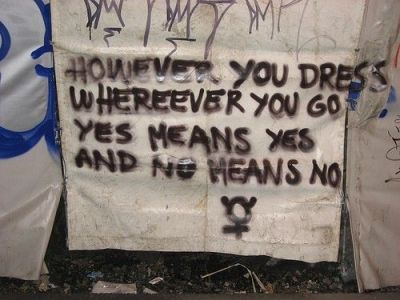
 Feeling safe again is often the healing and elusive aspiration of a person like me.
 Last week,
  Feminism and Religion