Last year many of my actions, choices and emotions could have been characterized as a part of my ongoing efforts towards what I recognize as survival: I was often ‘trying to make it through,’ live ‘despite,’ exist ‘even though,’ grapple with violence or choose in such a way that I could continue to live in the midst of chaos.
Survival is an extremely important skill, practiced by many people for many different reasons. And before I continue here, I would like to say that in all of my struggles last year, I always had the basic necessities required to live my life. Many people do not; and for many, survival is an everyday practice that may or may not be achievable, requiring access to necessities that may or may not be accessible. No one tried to kill me last year. I had access to food. I did not lose my home or livelihood; though I felt these things threatened. I am privileged to live where and how I do, with many resources available to me. These resources helped me to make it though, where other people survive with far, far less. I choose to share my own feelings of survival because I want to decry the self-dehumanizing shame that tells me I am bad or wrong for feeling my own experience. I identify my survival in an attempt to also, thrive. Continue reading “Surviving and Thriving: For My Defender by Sara Frykenberg”
Feminism has a “brand”? A recent contest – still running, if you want to get in on it! – asks for suggestions about how to “rebrand feminism.” The contest has corporate sponsors. Saying that although feminism “has brought us the right to vote, drive and have our own bank accounts,” it is nonetheless the case that “Feminism has been given a bad rap, and gotten a bad rep.” Elle UK’s November issue does the same, claiming to rebrand “a term that many feel has become burdened with complications and negativity.”
I suspect that most readers here at Feminism and Religion will have similar reactions to this development: disgust and distaste. Why do feminists need to overcome the negative stereotypes and reactions that are used to dismiss them by anti-feminists? Most of us have heard the usual derisive responses, I suspect, and are tired of being instructed that it is our responsibility to overcome stereotypes we have done nothing to earn. I once wrote the words “feminist” and “Christian” on the board in an introductory theology class, and asked students what the first word that came to mind was in each case. Predictably, the first response for “feminist” was “femi-Nazi.” The student wasn’t intending to imply that such a designation was fair, but the immediacy of the reaction was telling. So why should feminists subordinate our political and social aims to corporate self-promotion? And is feminism really just about getting the vote, being able to drive, and having bank accounts? This list of issues brings together the trivial (when were women unable to drive in the UK or USA?), the liberal status quo (voting), and the assumption that feminism means the full ability to participate in the capitalist system. That’s not to suggest that these concerns are unimportant. But all of them involve acceding to an already-constituted public, financial, political, and social space. Is feminism simply about, as so many popular invocations have it these days, equality and giving women the same opportunities as men? Continue reading “Rebranding Feminism by Linn Marie Tonstad”
The theology blogosphere in all its glory has been alive in recent days with furor sparked by a blog post from Janice Rees at Women In Theology, where she discusses not reading Karl Barth, the heavyweight German 20th-century Protestant theologian, as an act of resistance against his dominance in the theological academy and his status as a litmus test for serious scholarship. Reminding myself repeatedly of the great xkcd comic, I’ve resisted my urge to comment on this and a number of other recent debates. (See here for a list of links if you wish to catch up on the discussion, however.) So this is not a post on whether to read Karl Barth.* Rather, the debate made me take a look at some of my own reading practices, and the visions of theological discussion that they encode. It also brought me back to the question of feminist disagreement, which continues to lurk in the back of my mind as I pursue disagreements with some prominent feminist theologians in my current book project.
I’ve written here before about reading authors that I disagree with, and indeed working on theologians I think are wrong about certain issues. On the simplest level, as a feminist and queer theologian, many of the theologians I work on would have questioned or outright resisted my participation in the discipline to begin with – although we cannot always know whether and how they would have done so today (since many of them are dead – yes, the dreaded dead white European males). But I often – not always – find projects that I sincerely disagree with utterly fascinating. From what perspective does the system being developed in such a project make sense? Where would one have to stand to see what that author sees? What do I come to understand about my current context, or the author’s context, from the perspective of the debates and decisions that the author finds pressing? One fairly trivial example: any interest I might once have had in historical Jesus debates was settled forever by reading Albert Schweitzer as an undergraduate. I simply do not find such debates compelling in themselves. (That does not mean I think they are valueless, of course!) But reading theologians who were engaged in such debates teaches me a great deal about how the commonsense assumptions many of us today operate with came to be. And seeing how such debates accompany disagreement over right social relations, over the nature of transmission of Christian traditions, and over what counts as scholarship in theology and religious studies is simply fascinating. Continue reading “On Reading, Not Reading, and Disagreeing by Linn Marie Tonstad”
July 2008 the United States House of Representatives passes a resolution apologizing for the more than two hundred years of slavery and the decades of Jim Crow that followed.
June 2009 the United States Senate passes a resolution apologizing for slavery and Jim Crow.
October 2007 Tallahatchie County Mississippi Board of Supervisors and Sheriff William Brewer, Jr. sign a resolution apologizing to the surviving family of Emmett Till for his murder and for the acquittal of the two men who murdered him.
March 2013 Montgomery Alabama police chief Kevin Murphy apologizes to Congressman John Lewis for the failure of police to protect Lewis and other Freedom Riders from mob attacks when they rode through Montgomery in 1961.
In light of so much destruction in our world – from the violence inside individual homes to beyond and between national borders – how is it still possible to hope for and to live toward a vision of beauty and peace for the world?
It was at a community college in LA in my Psychology 4 class that I first formally encountered existentialism. When it came to the time of the semester to teach on that topic, our professor, Eric Fiazi, came alive in a new way, energetically teaching us about existentialism and Jean-Paul Sartre. Professor Fiazi dramatically gestured and sketched on the board as he explained the concept of ‘nothingness’ and Sartre’s well-known proposition that “existence precedes essence.” Teaching psychology was for him a means of teaching what he truly loved, art and existentialism. He believed these subjects helped expand students’ horizons and helped make them happy and productive members of society. And so these class sessions were his favorite to teach – and mine to experience. Immediately, I was hooked.
I remember the moment he hit the chalk to the board – leaving a speck of a mark – telling us that the tiny little mark left on the great wide chalkboard was like our galaxy, tiny against the great vastness of the universe; the earth, a particle of chalk-dust in comparison, and our individual lives, imperceptible in its midst (it now reminds me of Carl Sagan’s pale blue dot monologue). Engaging the students, he countered each one of their assertions that humans indeed have an essence, a meaning. “Humans are good by nature” – “Humans are inherently selfish beings” – “Humans are created in the image of god” – “We are each created for a purpose”; for each of these he gave a clear and logical retort. I was fascinated! What would it mean to live a life with no inherent meaning – with no essence to determine or guide our existence? How might it be different to live my life stripped of any assumed or inherited sense of meaning or purpose – to instead give these up and start from a presupposition of nothingness? Continue reading “Feminism and My Existentialist Leanings by Xochitl Alvizo”
Tomorrow is a special day for me. It is Juneteenth. On June 19, 1865, news finally reached Galveston, Texas that slavery had been abolished. This was of course two and a half years after Lincoln issued the Emancipation Proclamation. While the actual impact of the emancipation for the enslaved remains a source of historical discussion if not debate, the fact of the matter is that the proclamation of emancipation and the reality of freedom for black women and men did not necessarily coincide. To be sure, for a variety of reasons, the Emancipation Proclamation did not have an immediate impact on the daily lives of enslaved women, men and children. While the “official” historical records marks January 1, 1863 as a day of emancipation, the historical record for the descendants of enslaved men and women marks June 19, 1865 as the day of freedom. For, it was on this day that the last slaves were free.
While the celebrations of Juneteenth have waxed and waned over the years, it remains a day in which African Americans reflect upon the “mighty long way” we have come as well as the “mighty long way” we have left to go on the pathway toward freedom. As I celebrate Juneteenth, in the words of a black gospel song, “My soul looks back and wonders how they got over.” And so it is that my theological imagination is stirred, for it is clear that it was by faith that they (the enslaved) got over. And so I ask, what kind of faith was it that allowed them to get over, that is, to survive a life of bondage? This question is even more pressing to me each time that I am reminded that there were those who were born into slavery and died in slavery, and thus, as Toni Morrison once exclaimed, “never drew a free breath.” So, what kind of faith was it that carried these people through life? Continue reading “The Story of Juneteenth by Kelly Brown Douglas”
Her name was Tricia Meili. Their names were Yusef Salaam, Raymond Santana, Antron McCray, Korey Wise and Kevin Richardson. On April 19, 1989 all of their lives were irrevocably changed. They would never meet, but their lives would become forever linked. When they entered into Central Park on that night, did they know that they were stepping into a haunting history of dismembered bodies? Tragically, their bodies would become another story to be told in that history.
On that April day in history some 34 years ago one white female body went into Central Park for her routine jog. Five black and brown male teenage bodies went into Central Park to hang out, but soon became a part of a crowd engaged in mischievous if not dangerous and out-of-control harassment of other park visitors. As the night wore on, police were called and arrests were made. It would later be discovered that Tricia was brutally and sadistically raped, but not by Yusef, Raymond, Antron, Korey or Kevin. Yet, the five young teenagers were badgered into confessions, charged with the rape and sentenced to prison. Continue reading “Betraying Bodies by Kelly Brown Douglas”
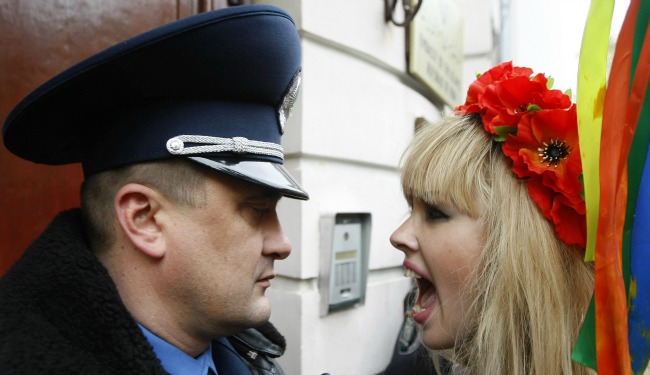
As most of us are aware by now, there is a “feminist-sextremist” group from Ukraine called “Femen.” This group has been very controversial by their public demonstrations of nudity, the words they paint on their bodies, and their explicit condemnations of political structures and organized religions. They were started by Anna Hutsol in 2008 and have now spread throughout Europe and the Middle East. The question I pose for this post is: Does Femen harness or hinder the power of the feminist critique?
Image from Konstantin Chernichkin/Reuters
Femen is precisely the kind of movement that pushes us in our understanding of feminism, the means by which it is best expressed, and the issues surrounding moral condemnation and religious sensitivity. Continue reading “(Femen)ism? by Kile Jones”
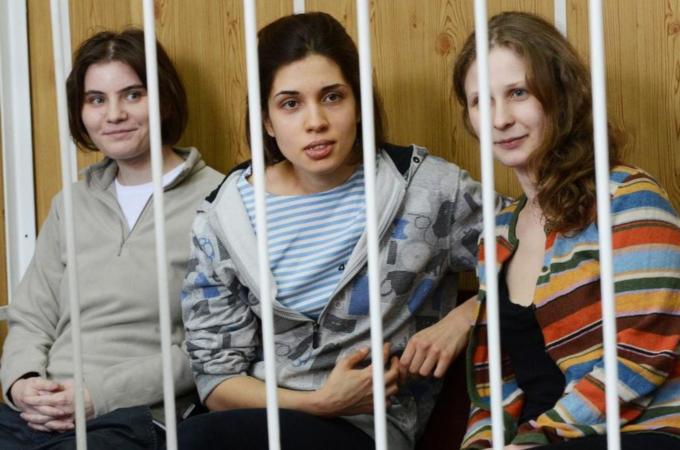
In a country that was willing to [sic] its secular court on a “religious” cause, Pussy Riot are true revolutionaries. Nonetheless, it was not until they delivered these closing statements that their supporters—and opponents—heard what these three brave women stand for. Although they are being crushed in the jaws of the system—and know it!—their courage and steadfast sincerity are sufficient cause for (impossible) hope. If not for the Russian state, then at least for the Russian people. —Bela Shayevich
“When religion puts people in jail it’s unjust” – David Gross
The intermix of religion and politics are familiar, especially after this year’s presidential election. Many supported Mitt Romney out of concern for religious freedom; a stance that had the potential to marry religion and politics in a dysfunctional union. We also witnessed a veiled attempt by the Catholic Church to emphasize and sway the faithful to vote for the one true moral candidate; a stance contradicted by Obama’s ability to carry the Catholic vote. I believe what we see in Russia is a shining example that shows what happens when regulations and laws do not segregate between secular law and church law. Freedoms do not exist, rather, rules and restrictions are imposed creating an institutional prison.
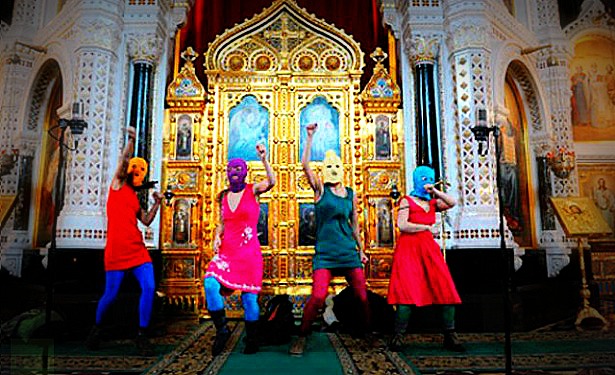
The prosecution of an all girl punk band named Pussy Riot [i] demonstrates a “complete fusion of the institutions of the state and church,” which devalues “women’s rights and freedom of speech.”Members of Pussy Riot are serving a two year sentence of hard labor for “hooliganism motivated by religious hatred.” What was their crime? They went into a Cathedral in Moscow and started singing a punk prayer – “Mother of God, Chase Putin Out!”
They danced, kneeled, and crossed themselves in front of the Church’s high altar. This occurred the day before the re-election of Vladimir Putin. While I do not support going into a sacred space with relics to make a protest, what I find problematic is their harsh sentence. However, it should be noted that with the coverage of the trial and the outpouring of support received from many organizations, and musicians, they did manage to bring to the forefront issues surrounding the government and the Church.
Male feminists must be aware that we not only engage in an ongoing struggle against sexual and gender inequality, but more importantly an ongoing fight with ourselves.
I have often struggled with that little voice, call it my conscience if you will, that speaks to me during times of distress. Although I consider myself a proud feminist, I still struggle with aspects of what I call, internalized misogyny, or more aptly defined as a male born characteristic trait that imparts the idea that men are not only dominant but also more powerful than the other 50% of the species.


 Last year many of my actions, choices and emotions could have been characterized as a part of my ongoing efforts towards what I recognize as survival: I was often ‘trying to make it through,’ live ‘despite,’ exist ‘even though,’ grapple with violence or choose in such a way that I could continue to live in the midst of chaos.





 Feminism and Religion