

 In November, my paternal grandmother passed. She was five days away from her 93rd birthday. As I was/am going through the grieving process, I started to actively recall all the studies I have done regarding death and grieving practices across the globe and throughout the centuries. Mixed with the grieving process was constructing a January term class called “Goddesses Around the World.” As I marked each culture, religion, and goddesses we would be studying I kept coming back to an interesting fact. In many ancient cultures, it was the divine feminine who oversaw death, not only at times as the bringer of death but more importantly, as the guardian of the dead, the protector of all those that have gone from the earthly realm. Continue reading “The Goddesses Ereshkigal and Epona and Their Help in My Grief by Anjeanette LeBoeuf”
Category: Spirituality
2019: Hopefully a Happier New Year by Barbara Ardinger
 We’re nearly a week into the new year. I almost wish I were a prophet and could predict with assurance that 2019 will be better than 2018—less filled with hate, name-calling, lies, and all-round trumpery (pun intended: “trumpery” is “worthless nonsense”).
When I wrote my daybook, Pagan Every Day, here’s how I began today’s essay:
The Saxons of northern Europe called the first Monday after January 6 Plough Day and honored Freya, “the Venus of the North.” As a goddess who engages in indiscriminate sex, Freya is the spirit of the earth’s fertility. Like Persephone, she is in the underworld during the winter, but early in January we already see hints that she might be rising. We’ll soon set our ploughs into the earth and plant our crops.

We can think of planting our crops in both literal and metaphorical ways, but my best guess is that we’d best think of them metaphorically, at least in the so-called developed world, because our part of the world is mostly urban now and if there’s literal planting, it seems to be mostly done by agribusiness. If we’re not farmers literally broadcasting seeds, how do we plant metaphorical crops for 2019?
We can start with numerology, which I studied back in the early 1980s about the same time I was reading books on metaphysical and occult topics, learning the tarot, and reading every book about the Goddess I could find. (There were already lots of them.) As you no doubt know, numerology is based on the meaning of numbers. Whether we’re working with a name, a birth date, or a situation, we use a chart (which you can find online) to convert letters to numbers, then we add the numbers and reduce them to one number that becomes a kind of prediction. It’s important to remember, of course, that true divination does not forecast a fixed and permanent future. Instead, it notes what is likely to happen if things keep going along the path they’re on.
According to my numerology teacher, 1 means creation and individualization; 2 means love, gentleness, service, harmony; and 3 means self-expression, personal creation, optimism, inspiration. One is also the beginning of a new cycle (year, life, experience, adventure), and 9 is “complete expression,” or the end of a cycle, life, experience, or adventure. It’s interesting that 9 + 1 = 10 = 1. The end always leads to what we call a new beginning.
So let’s do some numerology with 2019. We add the numbers and reduce them to one number that will characterize the year: 2019 = 2 + 1 = 3 + 9 = 12 = 1 + 2 = 3. This means that 2019 is a “3 year,” which can (and may) lead to self-expression, optimism, inspiration, talent, sociability, friendliness, and kindness. (Note that there are two 3’s in the calculation; maybe they reinforce the idea of 3-ness.)
Self-expression, optimism, etc. are good crops to be planting this month! These are crops that need to be growing here. If we think politically, as so many of us have been doing for two years, we can hope that the new diverse and Democratic majority in the House of Representatives will grow and harvest these crops and bring an end to trumpery. What do you think might happen this year? Where are these metaphorical crops best planted? How will we feed and fertilize them? How and where will they grow?

Several years ago, I moved into what I call tarot numerology. Our new year’s 3 corresponds to Card III of the major arcana: The Empress. You know of course that there’s a nearly infinite number of decks with their own illustrations, but most of them show Card III as The Empress. She is the Earth Mother, Mother Nature, the Great Goddess. My tarot teacher said The Empress advises, among other things, “as above, so below,” and when we get The Empress in a reading, she’s usually telling us that new things will be born, there will be productivity and creativity, there will be good crops.

Our reading of 2019, therefore, is that we are possibly entering a new year of good crops—those metaphorical ones I listed earlier: self-expression, optimism, inspiration, talent, sociability, friendliness, and kindness. A couple months ago, we elected 100 women to a U.S. Congress that is more diverse than any Congress has ever been before. Can these women, perhaps individually, more likely collectively, embody the Goddess?

I’m going to stop writing now because I want you all to finish this post for me. Give me—give us—your ideas and plans for planting new crops in 2019. How can we bring self-expression, optimism, inspiration, talent, sociability, friendliness, and kindness into our weary society? We can keep voting, of course, but what else? Organizing? Marching? Writing? Please think about this new year and then tell us what you’re thinking. What’s gonna happen??
Note: The cards are from the Tarot of Meditation, drawn by Marty Yeager; the Motherpeace Tarot, created by Karen Vogel and Vicki Noble; the Gaian Tarot, drawn by Joanne Powell Colbert; and the Rider-Waite-Smith Tarot, drawn by Pamela Coleman Smith (who did not receive any credit for her work for nearly a century. Oh, look—it’s the patriarchy in action again).
Barbara Ardinger, Ph.D. (www.barbaraardinger.com), is a published author and freelance editor. Her newest book is Secret Lives, a novel about grandmothers who do magic. Her earlier nonfiction books include the daybook Pagan Every Day, Finding New Goddesses (a pun-filled parody of goddess encyclopedias), and Goddess Meditations. When she can get away from the computer, she goes to the theater as often as possible—she loves musical theater and movies in which people sing and dance. She is also an active CERT (Community Emergency Rescue Team) volunteer and a member (and occasional secretary pro-tem) of a neighborhood organization that focuses on code enforcement and safety for citizens. She has been an AIDS emotional support volunteer and a literacy volunteer. She is an active member of the Neopagan community and is well known for the rituals she creates and leads.
Mantra and Meditation in Buddhist Hospice Chaplaincy to Alleviate Anxiety by Karen Nelson Villanueva
Mantras are not just the prescribed sound formulas or sentences found in Eastern religions, but they can also be thought of as the words or phrases that we continually repeat to ourselves. The word mantra comes from Sanskrit and its roots are manas-, meaning “mind,” and -tras, which can be translated as “tool.” Thus, mantra is a tool to protect the mind.
How often do we engage in negative self-talk like “It’s my fault” or “I’m to blame for what’s happened to me” or “No one loves me”? These expressions can become mantras, as we believe their messages from constant repetition. In hospice and hospital settings, one often finds patients who have convinced themselves that “This is God’s punishment” or “Everyone has forgotten me” or “I’m so scared.” These phrases, rather than protect the mind, become what is believed by the mind and may lead to increased anxiety, stress, and depression, and consequently the need for spiritual and emotional support.
Chaplains, as members of the care team in hospice and hospitals, provide spiritual and emotional support to patients and their families. Most often, chaplains attentively listen to patients and their caregivers (often family members) about the patients’ life story, their relationships, their dreams unfulfilled, and their wishes for those whom they are leaving behind. Chaplains take part in family meetings where decisions are made about patients’ care, sometimes interjecting to ask for clarification of medical terms and to ensure that the family understands. Sometimes, the chaplain will lead prayer with the patients and their families, and at other times, the chaplain will pull other tools from her toolbox such as mantra meditation.
Pleasure, Touch, and Spirituality by Chris Ash
 Sitting in front of the computer, I slowly and intentionally insert earbuds, click to start my favorite writing playlist, and open up Microsoft Word. I feel the tips of my fingers resting lightly on the keys, and notice the slight give of each printed square, glossy in the middle from months of 80 words per minute. I lightly tap my fingers on the keys, not pressing enough to type a letter, body motionless except my fingers, watching the absolute stillness of the screen, exploring the edge between pressure and performance with slow, shallow breaths, finally noticing the moment when the edge is breached, the key catches, and a letter appears on my screen, taking it in with satisfaction.
This is how all my writing starts, with a ritual of simple pleasure and partial attempt at channeling. My partner recognizes this move when he sees it. It’s one I repeat throughout the writing process, as I’m waiting (hoping) for the next words to come to me. I’ll stop, lift my head and close my eyes, and allow my fingers to wiggle lightly over the keyboard as if inviting the unseen to move through me and write my piece. If that still doesn’t produce words, I might run my hands from thigh to knee, fingers pressing with increasing depth into denim-covered flesh. Or I might bring my hands up to my face, fingers resting on my hairline, palms lightly covering my eyes, as I experience the instant soothing of darkness and warming effect over closed eyelids, connecting to the me-within so she can help me bring forth missing concepts. Continue reading “Pleasure, Touch, and Spirituality by Chris Ash”
Shedding Shame by Joyce Zonana
As I follow my program, I grow clearer and stronger. I know exactly what I want and I take it. When I sit down to eat, I feel my appetite, healthy and strong. I feed that appetite, choosing just what I need and what will truly nurture me. When I get up from the table, I am complete and whole within myself. Whether I reach my “goal weight” or not, I’ve already succeeded. And so, this New Year, I won’t be making any new resolutions. I’m already on my path, shedding shame.
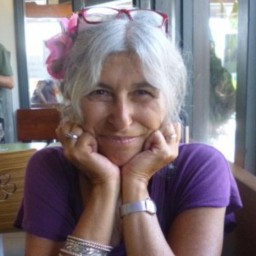 At the lovely small Chanukah party I attended earlier this month, I did not taste the latkes, those delicious potato pancakes fried in oil and typically served with sour cream and applesauce. My hostess offered them to me repeatedly, proudly noting that she’d used her Polish grandmother’s recipe. But I politely said “no thank you,” I’d just started a diet. “Who starts a diet in December?” someone asked. Someone else pointedly wondered “How can you not eat latkes at Chanukah?” but I quietly insisted that I needed to refrain. I promised, though, that I’d have some next year, once I’d shed the extra pounds that were making me uneasy in my own body.
In my Middle Eastern Jewish home it was the height of rudeness not to partake of what someone offered you to eat. So my refusal was difficult on many levels. But in fact, we never ate latkes at Chanukah. Instead we had deep-fried beignets, little balls of dough, sticky-sweet and drenched in rosewater-scented sugar syrup. I wouldn’t be having any of those this year either. And though another friend at the party assured me I didn’t need to lose weight— “You’re zaftig and beautiful just as you are,” she said—I’d decided a few weeks earlier that, Chanukah or no Chanukah, Christmas or no Christmas, this December was exactly when I wanted to begin my journey to what I believe is, for me, a healthier body weight.
A Review of Decembers Past before We Move into the New Year by Marie Cartier

Last month I looked back over six years of postings I have done for FAR. In November, I noticed that I usually during that month tend to review the year and find something to be grateful for.
I decided this month to follow that up by looking back at the posts I have done for the past six years at this time of year, right before the wheel turns into the New Year. I have the privilege of writing for FAR usually right after Thanksgiving and right after Christmas and before New Year’s. I tend to think of this time as a time of looking forward, and Thanksgiving as a time of looking back.
Continue reading “A Review of Decembers Past before We Move into the New Year by Marie Cartier”
Priestesses at the Parliament by Rae Abileah, Bekah Starr & Chaplain Elizabeth Berger

During the first week of November 2018, 12 graduates and current students of the Kohenet Hebrew Priestess Institute attended the Parliament of the World’s Religions in Toronto, Canada. The Parliament is a conference with a 125-year-old history that has grown to an estimated 10,000 participants representing more than 200 spiritual traditions. To share a Jewish feminist perspective with the Parliament’s attendees, we sought to create moving experiences and intimate spaces through a variety of invited and informal initiatives.
Priestessing Panels
Many of us were slated to speak at the Parliament, and rather than just show up and give an academic presentation on a panel, we brought the feminist spirit of Kohenet into our sessions, moving rows of chairs to create a circle, guiding participants through embodied practices rather than giving speeches, and crafting ritual. Continue reading “Priestesses at the Parliament by Rae Abileah, Bekah Starr & Chaplain Elizabeth Berger”
Honoring the Completion of the Year, by Molly Remer
“Beginnings and endings are so very sacred, to give honor to all that has transpired, every experience, every joy, every pain, is a doorway to the magical. Hold your entire year between your hands, every day, every thought, every breath. Now bless it with gratitude, love and humility. You have done more to transform this new year than a thousand resolutions.”
–K. Allen Kay
Two years ago, at the end of the year, I was supposed to hold a closing ceremony for a year-long Ariadne’s Thread study group I had been guiding throughout the year. Every member of the circle ended up backing out of the closing circle at the last minute, but I held the ceremony in full anyway, alone in my front yard, just for myself, and expanding it to include acknowledging and appreciating all the work I had completed in 2016, including my D.Min degree. People’s reasons for backing out of the ceremony were very valid and while on a cognitive level I understood why they couldn’t come, on an emotional level I still felt let down and disappointed at being “abandoned” by them. Holding the closing ceremony for myself anyway and acknowledging that I kept my own commitment to doing a full year of this work in circle, felt like a powerful declaration and affirmation of my own worth. In fact, it was such a validating and powerful experience that I continued the practice with a personal year-end closing ceremony for 2017 as well and I will do the same for myself this year too. Continue reading “Honoring the Completion of the Year, by Molly Remer”
Navigating Social Space as Power-Struggle, Pt. 2 by Elisabeth Schilling
 Disclaimer/Trigger Warning: This post contains details about unwanted sexual advances. Read Part I here.
After Sicily, I went to the English countryside for an intended two weeks in a work exchange. A retired, but part-time, lecturer of Greek and Latin in his 60s was moving house and needed help packing and cleaning and cooking. There would, in a day or two, also be a male student from Lithuania and a Brazilian couple joining the communal house, and I found the position through workaway.info, a site one must pay for that I used three years ago with no problem.
On one hand, I have to use sites like this from time to time due to financial reasons. On the other hand, after traveling alone for awhile, I long for the communal exchange. I enjoy helping someone learn a language, cook for their family, organize their clutter because of the conversations along the way. They have a house and extra food. I have the time (my two classes I teach at university online do not take much)  to help. If the people involved are mindful and truly grateful for community and shared work and resources, it can be a sacred return to a way of life where people can practice sharing, non-greed, and carrying each other’s burdens. We practice living with strangers, with all the challenges that presents, instead of isolating ourselves in presumed comfort. Continue reading “Navigating Social Space as Power-Struggle, Pt. 2 by Elisabeth Schilling”
Queen of Pentacles: Sensual Materiality by Elisabeth Schilling

Most of us are trying to make it to a place of material comfort where we are living in a way that feels honorable. Some of us feel we could have made better decisions in the past so that we might have figured out how to do such before the age we are now. I recently did a tarot card reading that I interpreted as mainly positive or neutrally-revelatory. But one of the cards stood out from the rest, and I really didn’t understand it. I was feeling positive that day, and, even though I have often felt unsure and longing in my recent travels despite all I have accomplished materially and psychologically, I have to say it wasn’t a card I was expecting: the III of Swords, which symbolizes disappointment and heartache, especially due to mental happenings. What could I feel heartache at? Perhaps I am disappointed that creating that place of safety and material comfort seems a long way down the road.
Continue reading “Queen of Pentacles: Sensual Materiality by Elisabeth Schilling”
 Feminism and Religion