Legacy of Carol P. Christ: Goddess as Love: From Experience To Thealogy

This was originally posted on September 24, 2012

If theology is rooted in experience, how do we move from experience to theology? In my life there have been a number of key moments of “revelation” that have shaped my thealogy. One of these was the moment of my mother’s death.

In 1991 my mother was diagnosed with cancer. While she was being treated, I realized that I had never loved anyone as much as I loved her. When I wrote that to her, she responded that “this was the nicest letter” she “had ever received” in her life and she invited me to come home to be with her and my Dad.

My mother died only a few weeks after I arrived, in her own bed as she wished. She was on an oxygen machine, and I heard her call out in the dark of early morning. When my Dad got to the room, he tried to turn up the oxygen, but it didn’t help. Then he called the doctor who reminded him that my mother did not want to go to the hospital under any circumstances.

Continue reading “Legacy of Carol P. Christ: Goddess as Love: From Experience To Thealogy”

Carol P. Christ’s Legacy: Love Divine, All Loves Excelling

This was originally posted on Sept. 9, 2011

In my last blog I wrote that the image of God as a dominating other who enforces his will through violence–found in the Bible and in the Christian tradition up to the present day–is one of the reasons I do not choose to work within the Christian tradition.  To be fair, there is another image of God in Christian tradition that I continue to embrace.  “Love divine, all loves excelling” is the opening line of a well-known hymn by Charles WesleyCharles Hartshorne invoked these words and by implication the melody with which they are sung as expressing the feelings at the heart of the understanding of God that he wrote about in The Divine Relativity.

Love divine, all loves excelling also expresses my understanding of Goddess or as I sometimes write Goddess/God.  Though I am no longer a Christian, but rather an earth-based Goddess feminist, I freely admit that I learned about the love of God while singing in Christian churches.  Hartshorne wrote that he knew the love of God best through the love of his own mother, and I can say that this is true for me as well.  My mother was not perfect, and she did not understand why I wanted to go to graduate school, my feminism, or my adult political views, but I never doubted her love or my grandmothers’ love for me.  (I count myself lucky.  I know others did not have this experience.)  Like Hartshorne, I also learned about the love of God through the world that I always understood to be God’s body.  Running in fields and hills, swimming in the sea, standing under redwood trees, and encountering peacocks in my grandmother’s garden, I felt connected to a power greater than myself.


Continue reading “Carol P. Christ’s Legacy: Love Divine, All Loves Excelling”

Carol P. Christ’s Legacy: Why Don’t Feminists Express Anger At God? by Carol P. Christ

Moderator’s Note: We here at FAR have been so fortunate to work along side Carol Christ for many years. She died from cancer in July, 2021. Her work continues through her non-profit foundation, the Ariadne Institute for the Study of Myth and Ritual and the Goddess Pilgrimage to Crete. To honor her legacy, as well as allow as many people as possible to read her thought-provoking and important blogs, we are pleased to offer this new column to highlight her work. We will be picking out special blogs for reposting. This blog was originally posted July 9, 2012. You can read it long with its original comments here.

My relationship to God changed when I accused “Him” of everything I thought “He” had done or let be done to women—from allowing us to be beaten and raped and sold into slavery, to not sending us female prophets and saviors, to allowing “Himself” to be portrayed as a “man of war.”

In the silence that followed my outpouring of anger, I heard a still small voice within me say: In God is a woman like yourself. She too has been silenced and had her history stolen from her. Until that moment God had been an “Other” to me. “He” sometimes appeared as a dominating and judgmental Other, and at other times as a loving and supportive Other, but “He” was always an “Other.” I as a woman in my female mind-body definitely was not in “His” image. 

Continue reading “Carol P. Christ’s Legacy: Why Don’t Feminists Express Anger At God? by Carol P. Christ”

Remembering Carol Christ – and going forward in her footsteps by Laura Shannon

When I was 17, I left the US to live and study in Europe for a year, with Womanspirit Rising crammed into my backpack. This book, edited by Carol P. Christ and Judith Plaskow, gave me the solid ground of a feminist worldview which honoured women, the body, and the earth. My favourite chapter was the last one: Carol’s foundational essay ‘Why Women Need the Goddess’, where she writes, ‘The simplest and most basic meaning of the symbol of Goddess is the acknowledgement of the legitimacy of female power as a beneficent and independent power’. These words, indeed that whole essay, became the pole star for my journey through the world, helping me name what was missing in both the academic world and the world of dance.

Continue reading “Remembering Carol Christ – and going forward in her footsteps by Laura Shannon”

My Life with Goddess (Part Two) by Deanne Quarrie

Deanne QuarrieRead Part One here.

My way of honoring this Goddess is to be with Her.  I feel Her as my hands when touch Her soil, when I sit on Her body, or when I am walking with Her trees.  I see Her in the birds flying overhead and in the small feather left for me on the ground.  I think I am closest to Her when I am by the sea.   That may be because the ocean is the source of life, but I believe it is because I truly feel Her might and healing power as I stand in Her waves.  I view the mountains with awe, knowing that She is there.  I see the rivers as Her blood flowing, just as our own blood flows through us carrying life force throughout our bodies.  The air we breathe and share with all is given to us by the plants and the trees in their process of photosynthesis, everything carefully crafted in our co-existence.

All these outdoor glimpses of Her are seen only on occasion.  I am, for the most part, now an indoor person, due to physical limitations.  I am, however, a woman whose memories, imagination and mind are strong.   I can, at will, bring these images of Her to myself in my mind’s eye and into my body not only from my memories, but from those things I collect when I can be outside in nature.   I have shells, sand and salt for the sea.  I have rocks of all sizes, shapes and types.  I have feathers and fur.   Continue reading “My Life with Goddess (Part Two) by Deanne Quarrie”

My Life with Goddess (Part One) by Deanne Quarrie

Deanne QuarrieThe Goddess is the “All of Creation.”  She is the Creatress and the Created.  She is the life force of all there is.  She is one, whole, and complete.  Before Her, nothing was. She arose from the Great Void, the source of all potential, giving birth to Herself before anything else had ever been born. She separated the sky and the water, and She danced.  In the ecstasy of Her Dance She conceived of all there is.

In every culture, in every part of the world, the Goddess has been revered as the Birth Giver of all Life.  From the very beginning of time, in our earliest primitive state, we sought to explain the unexplainable by drawing from what we knew.  The female of every species brought forth life; therefore, the Creatrix also had to be Birth Giving Mother and the Great Mother was given Her identity. Continue reading “My Life with Goddess (Part One) by Deanne Quarrie”

Why Is Pizza Round? The Black Goddess of Rome by Stuart Dean

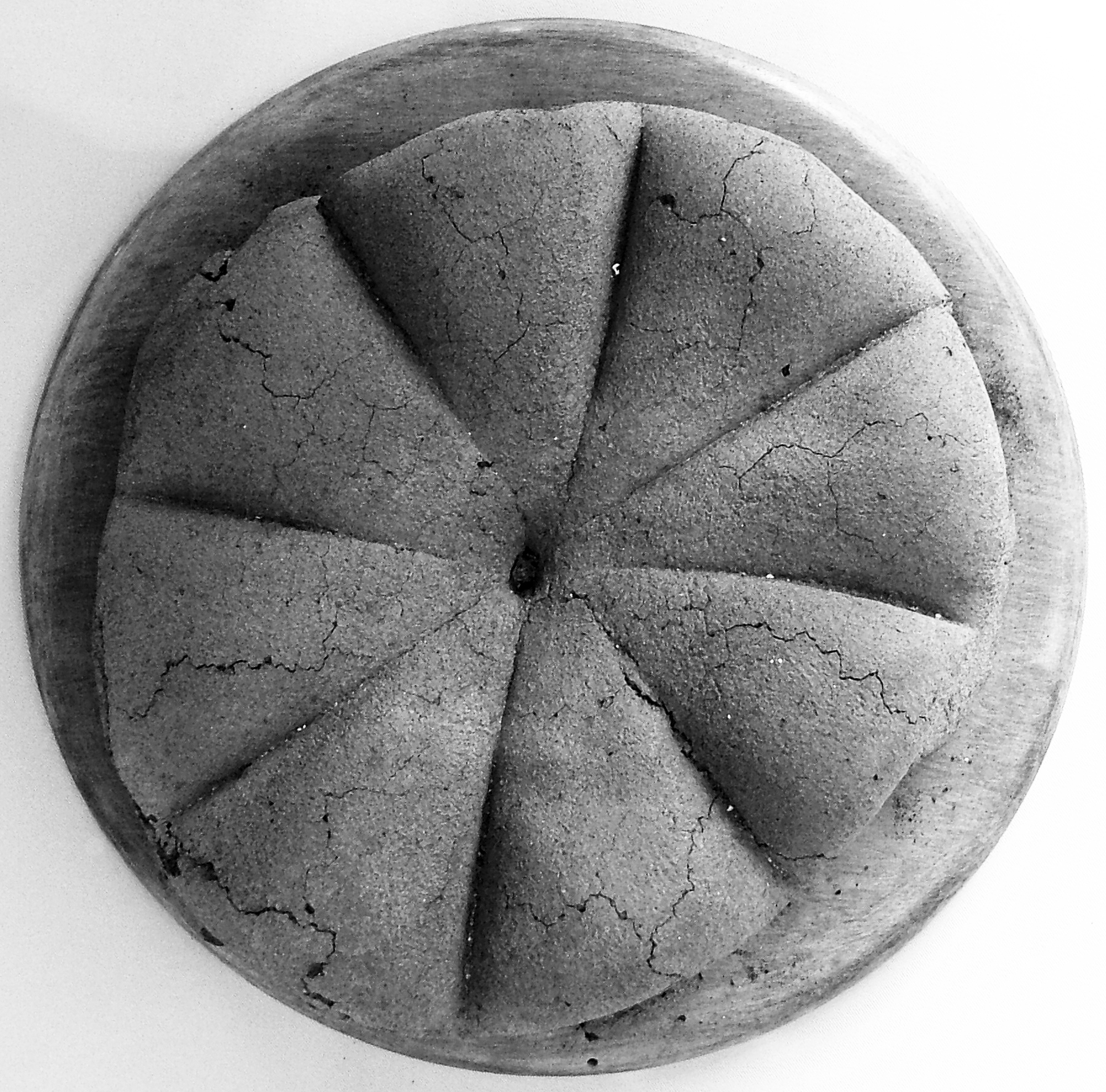
The remains of an ancient Roman bread pie from Pompeii, carbonized in the eruption of Vesuvius in 79 CE
The remains of an ancient Roman bread pie from Pompeii,
carbonized in the eruption of Vesuvius in 79 CE

The poem Moretum (discussed in my last post) narrates the preparation of a meal that can be characterized in modern English as ‘pizza.’  Round flatbread is baked; to go on it, a cheese spread is mixed.  The details of the narration are such as to create a recipe of its ingredients and related cooking instructions.  

The most important ingredient, however, is not an ‘ingredient’ as such, but a shape.  The bread, the cheese, and the cheese spread are all round.  That by itself might not seem remarkable, but the Latin terminology (words from which ‘orbit’ and ‘globe’ derive) is identical to then contemporary astrological terminology.  The bread is even scored into quadrants, symbolizing, among other things, the four elements and the quadrants of an astrological observer’s circle. 

The ancient audience of Moretum would have recognized in all this the world view of the Italian poet from southern Campania, Parmenides.  Though the only poem he is known to have composed is in Greek, the combination of the fact that he likely wrote it while in Italy and that it had over the centuries since its composition become one of the most influential philosophical works of pre-Christian antiquity meant Parmenides had special importance to Romans.  It is not surprising Moretum has the same meter and many of the poetic images as are found in the poem of Parmenides. Continue reading “Why Is Pizza Round? The Black Goddess of Rome by Stuart Dean”

Revolution Through Rituals by Jann Aldredge-Clanton

Jann's pictureA revolution is happening through Divine Feminine rituals! More and more faith communities are reclaiming the power of the Divine Feminine in sacred rituals.
Rituals move feminist theory and theology/thealogy from the head to the heart. Words and visual symbols in rituals shape our deepest beliefs and values, which drive our actions. Multicultural female divine images in our sacred rituals affirm the sacred value of females throughout the world who continue to suffer from violence, abuse, and discrimination. For feminism to transform our culture, we need Divine Feminine rituals in faith communities. In Women-Church: Theology and Practice, Rosemary Radford Ruether writes: “One needs communities of nurture to guide one through death to the old symbolic order of patriarchy to rebirth into a new community of being and living. One needs not only to engage in rational theoretical discourse about this journey; one also needs deep symbols and symbolic actions to guide and interpret the actual experience of the journey from sexism to liberated humanity” (p. 3).

As I was growing up in the Baptist tradition, hymns were my favorite part of our rituals. One of the hymns I loved singing was “He Lives,” increasing in volume along with the congregation as we came to the refrain which repeated over and over the words “He lives.” Not until many years later could I even imagine singing or saying, “She lives.” I had learned to worship a God who was named and imaged as male. But while studying in a conservative seminary, I was surprised to find Her. I discovered female names and images of Deity in scripture and in Christian history. As an ordained minister, my call has included writing, preaching, and teaching to persuade people that we need multicultural female divine names and images in rituals if we are to have social justice, peace, and equality. My call expanded to writing Divine Feminine rituals, including lyrics to familiar hymn tunes. Continue reading “Revolution Through Rituals by Jann Aldredge-Clanton”

The Outraged Ancestral Mother by Molly


crop027During the fifth week of the Rise Up and Call Her Name curriculum by Elizabeth Fisher, “We honor the Outraged Ancestral Mother and the belief that the sacred and secular are one.” When I priestessed this session for my women’s circle, I was caught by the idea of the Outraged Ancestral Mother and we spent some time discussing her and the degree to which humanity has hurt our planet. The next morning while I was practicing yoga, snippets of a poem came floating to my mind. I had the distinct feeling that the Outraged Ancestral Mother was ready to speak to me. I went down to the woods to listen to what she had to say.

Continue reading “The Outraged Ancestral Mother by Molly”

Persephone by Barbara Ardinger

Here we are, creeping up on the vernal equinox (March 21), which astronomers and weathermen on TV tell us is the start of spring. I see Imbolc (as described by Deanne Quarrie) as the true beginning of spring, however. It’s when we see the first little crocuses popping up through the snow…..oh, yeah…..well, maybe not this year, when more than half the U.S. is buried under mountains of snow. Let’s just agree that in ordinary years crocuses pop up and bloom and trees start showing us their tiny green leaves in February. The equinox is really the turning point of spring, the hinge of time when the rising energy tips over into falling energy that is flowing toward summertime, which will arrive at Beltane (May 1 or 2).

Persephone
Demeter and Persephone

We’re probably all familiar with the story of Persephone, who under her childhood name, Kore, was out picking flowers in the meadow one day when her Uncle Hades roared up out of the earth in his mighty chariot and kidnapped her. This led her mother, Demeter, the grain goddess, to search for her and finally go on strike and let the world turn back into winter. This went on until Aunt Hecate told Demeter where her daughter was. When Persephone, now queen of the underworld, came back up with her mother—voilà! It was springtime. That’s how the vegetation myth goes. Continue reading “Persephone by Barbara Ardinger”