This post started as a comment to Annie Finch’s part 1 of Abortion As A Sacrament post. Realizing it was a story that was getting too long, I’m sharing it here as a reiteration of the practical significance of ritual, and finding our way through the no-longer-charted territories of being a female human — in the sense that if we were a female of any other animal form, we would still know exactly how to navigate all the challenges.
I had a years-long pregnancy-related experience in which ritual was the only thing to finally bringing closure, though the real issue was more the other being’s feelings or intent than mine. About a year after the birth of my only child, still nursing full time and using what should have been sufficient birth control, I became pregnant and aborted at Planned Parenthood. I had been well along, not having suspected anything because my menses hadn’t yet returned.
At the time, there was no debate in my mind, if I had added another responsibility to my already excessive load, I would have failed at everything, the most important being my daughter.
One of my oldest friends who I met when I was eight years old reached out to me the other day saying that if there was ever anything she could do, please let her know. She lives in another state far away but is a subscriber to one of my blogs so she has been aware of the various things going on in my life (second divorce, so many changes and transitions in my life yet again, etc.)
Her note said if there was ever anything she could do to help, just let her know.
And I thought to myself: hmmmmmm.
You see I just put a new feature on my app where it emails local events to local users, and one of the first steps in getting this to work is having those local events on the app. So I asked her if she would mind helping me put local events on the app.
We had not actually talked in a long time, and when we had a zoom call to discuss this, I broke down crying.
I felt the pity from her. I also saw just how far I had departed from ‘normal.’
The phrase, “separation of church and state,” crops up frequently in conversation these days. I hear it most often when someone wants to clinch their argument on a politicized subject. Lately, it’s been concerning one’s “right” to an abortion. “It doesn’t matter what your church says, we have separation of church and state in this country.” That phrase, though, is not in the Constitution. It was Thomas Jefferson (1743-1826) who paraphrased the Constitution in a letter to the Danbury Baptists, “…building a wall of separation between church and state.”
The first part of the 1st amendment states: “Congress shall make no law respecting an establishment of religion, or prohibiting the free exercise thereof….” All manner of questions have been raised with this statement. What does it mean to establish a religion? What is religion? Is religion something intrinsically good? Most Americans think of religion in terms of God. What/who is God?
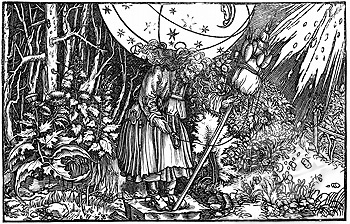
Old woman (witch or fairy) spinning. Woodcut attributed to Holbein from Boethius, De consolatione philosophiae 1547
The Pendle Witches
As a spiritual person, I am fascinated with women’s experience of the sacred. We women, for the past five-thousand years of patriarchy, have been side-lined and marginalized by every established religion in the world. But in every age, there have been women who have heroically rebelled against this patriarchal stranglehold to claim their authentic spiritual experience. Often it has involved looking within rather than without for spiritual guidance.
Thus far in my essay series, A Visionary History of Women, I’ve discussed Hildegard of Bingen and Margery Kempe who carved out their own woman-centered paths as mystics.
But what about women whose mystical experiences fell outside of the parameters of any organized religion?
One of the most important texts I have ever read was J. Kelly Gadol’s essay, “Did Women Have a Renaissance?” She points out that while elite European men were experiencing a Renaissance, women’s rights and lifestyle choices were becoming increasingly constricted during this period. The Renaissance was a very dangerous time to be female–women were the primary targets of the mass witch-hunting hysteria sweeping across Europe. Witchcraft persecutions were not a phenomenon of medieval superstition, as is commonly believed, but of the Renaissance and the Reformation, stretching up to the dawn of the Age of Enlightenment.
Anton Woensam’s idea of the perfect Renaissance woman: silent and obedient
The pre-Reformation Catholic Church, for all its problems and abuses, at least offered a space for female mystical and visionary experience. However, the hard-line Protestantism that followed the Reformation offered no space at all. If you saw visions or whispered prayer charms or left offerings at a holy well or lit a fire on midsummer eve to protect your cattle, you were suddenly seen as a witch, in league with the devil.
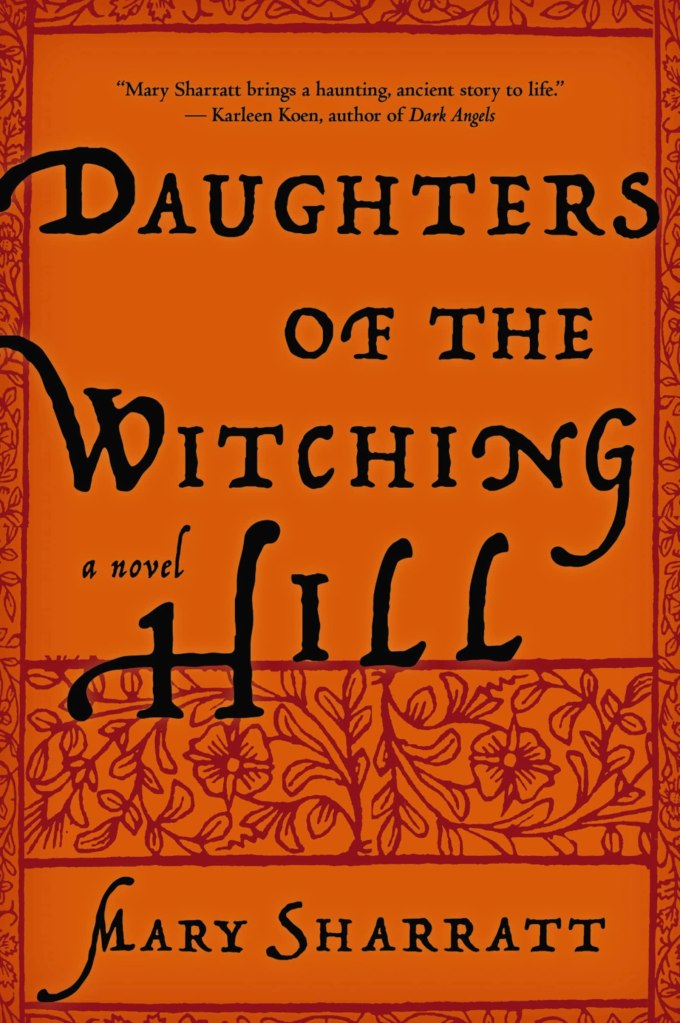
In winter 2002, I moved to Lancashire, in northern England. The back of my house looked out on Pendle Hill, famous for its legends of the Pendle Witches of 1612, the amazing real women at the heart of my novel Daughters of the Witching Hill.
In 1612, in one of the most meticulously documented witch trials in English history, seven women and two men from Pendle Forest were hanged as witches, based on testimony given by a nine-year-old girl.
The most notorious of the accused was Elizabeth Southerns, alias Old Demdike. Allow me to introduce you to a woman of power who changed my life forever.
This is how Thomas Potts describes her in The Wonderfull Discoverie of Witches in the Countie of Lancaster, the official trial transcripts.
She was a very old woman, about the age of Foure-score yeares, and had
been a Witch for fiftie yeares. Shee dwelt in the Forrest of Pendle, a vast
place, fitte for her profession: What shee committed in her time, no man
knows. . . . Shee was a generall agent for the Devill in all these partes: no
man escaped her, or her Furies.
Bess Southerns was a wisewoman of longstanding repute. What fascinated me was not that she had been arrested on witchcraft charges, but that she practiced her craft for decades before anyone dared to interfere with her or stand in her way. Cunning craft, the art of using charms to heal both humans and livestock was her family trade. When interrogated by her magistrate, she freely admitted to being a wisewoman and healer, even bragged about her familiar spirit Tibb, who appeared to her in the likeness of a beautiful young man.
At the time of her arrest, she lived in a place called Malkin Tower. Widow and matriarch of her clan, she lived with her widowed daughter and her three grandchildren, the most promising one being Alizon, a teenager who showed every promise of becoming a wisewoman as mighty of her grandmother.
In England, as opposed to Scotland and Continental Europe, witchcraft persecutions had been rare. Bess had been able to practice her craft in peace. This all changed when the Scottish King James I ascended to the English throne. King James was obsessed with the occult and had even written a book called Daemonologie—a witchhunter’s handbook—that his magistrates were expected to read.
The tide was turning for Bess and her family.
When a pedlar suffered a stroke after exchanging harsh words with Bess’s granddaughter Alizon, the local magistrate, eager to make his name as a witchfinder, played neighbors and family members against each other until suspicion and paranoia reached frenzied heights.
Alizon, first to be arrested, was the last to be tried at Lancaster in August, 1612. Her final recorded words on the day before she was hanged for witchcraft are a passionate tribute to her grandmother’s power as a healer. John Law, the pedlar Alizon had supposedly lamed, appeared before her. John Law, perhaps pitying the condemned young woman, said that if she had the power to lame him, she must also have the power to cure him. Alizon sadly told him that she lacked the powers to do so, but that if her grandmother, Old Mother Demdike, had lived, she could and would have healed him and restored him to full health.
Other novels have been written about the Pendle Witches, but mine is the only one to tell the story from Bess and Alizon’s point of view. I longed to give these women what their own world denied them—their own voice, their own story.
May the voices and visions of our motherline guide us to claim our own voice, our own story, our own vision, our own power. May we all be wisewomen walking forward.
Mary Sharratt is committed to telling women’s stories. If you enjoyed this article, you might want to check out her novel Daughters of the Witching Hilland visit her website.
Because I don’t have the money to fly somewhere else other than …here
Where I can’t get one
I need an abortion and I can’t get one
Because the kid, or the cells of a maybe kid, were put in here by the guy that raped me and if I have to have it, I will kill myself
I need an abortion and I can’t get one
Because I have four kids already and I can’t feed another one
I need an abortion and I can’t get one
Because it’s my dad’s…did you hear me say that? I have never said that. I have never said what he does to me…and now I have to show everyone… if I can’t get this out of me I will…
Moses is an interesting character is in the pantheon of religious leaders. He is such a major personage, considered the founder of Judaism and yet there are no extra-biblical accounts of his life and his deeds. He only exists in the bible. You’d have thought that such a major event as leading a whole class of people away from Egyptian slavers, would have shown up on the radar of other written or mythical accounts from the time. Nothing!
Even his name is interesting. When the Egyptian princess gathered Moses out of the waters she said:
She named him Moses, explaining,
“I drew him out of the water.”
Exodus 2:10
This is one meaning of his name. But there are others. In Egypt, the land where he was born and raised, the M-SH (variations: m-s or m-ss) root simply means “son.” Or it can mean “child” in a non-patriarchal sense. We see this in other Egyptian names Ramses is the child of the sun god Ra. Tutmose is the child of Tut.
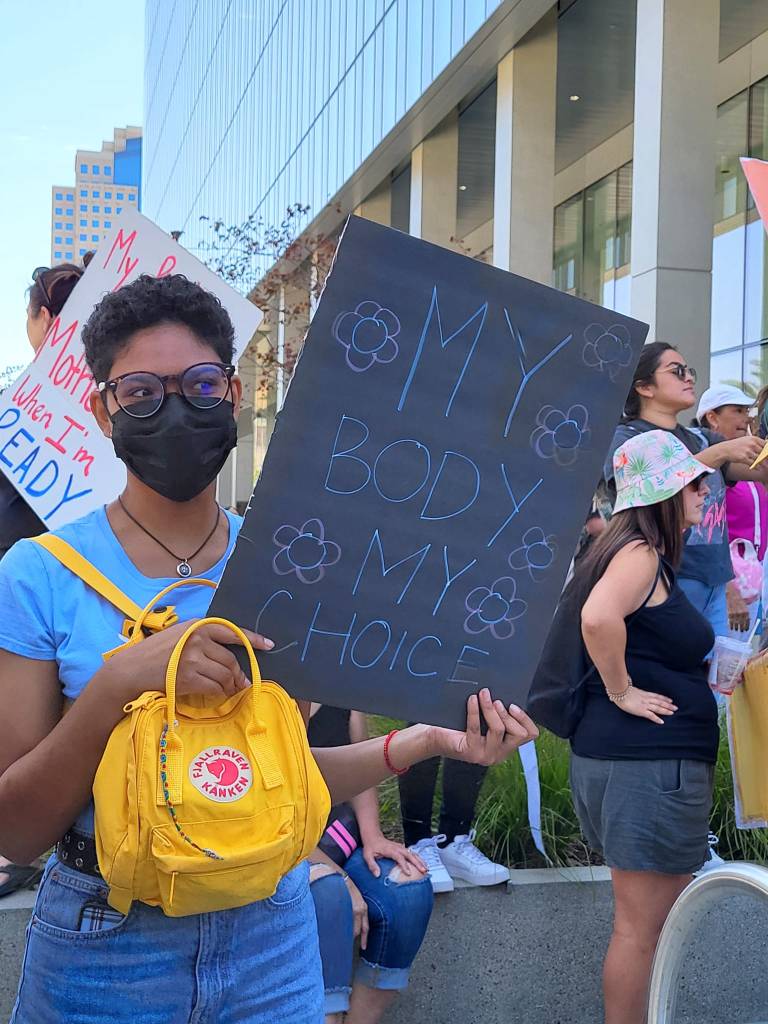
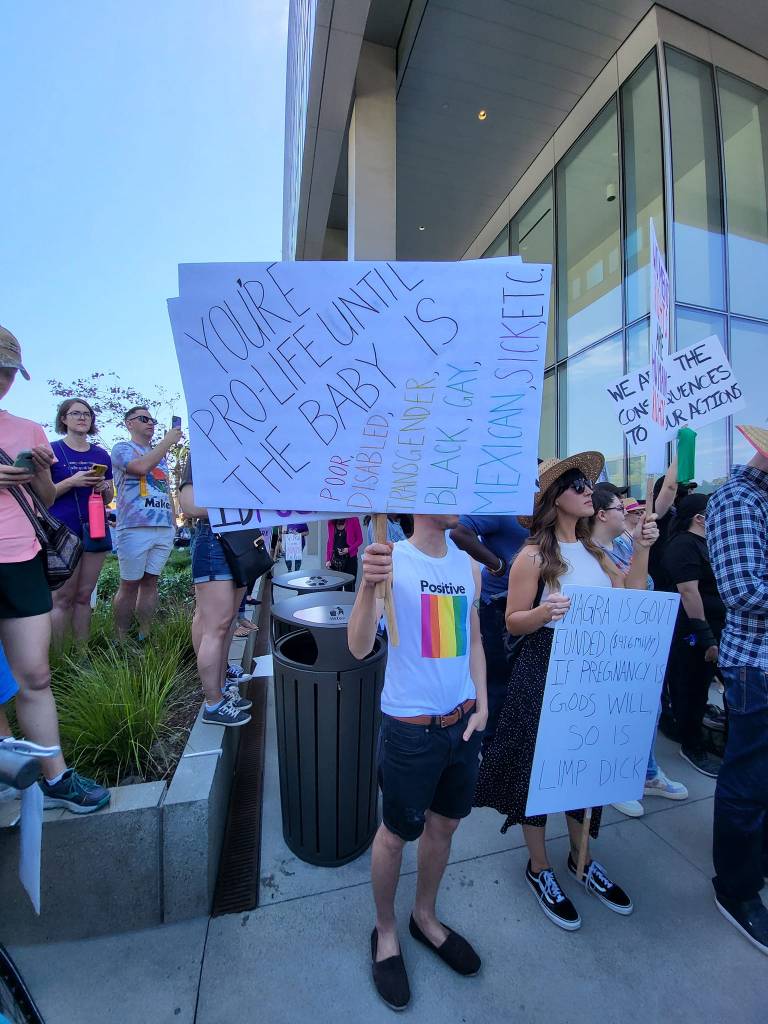
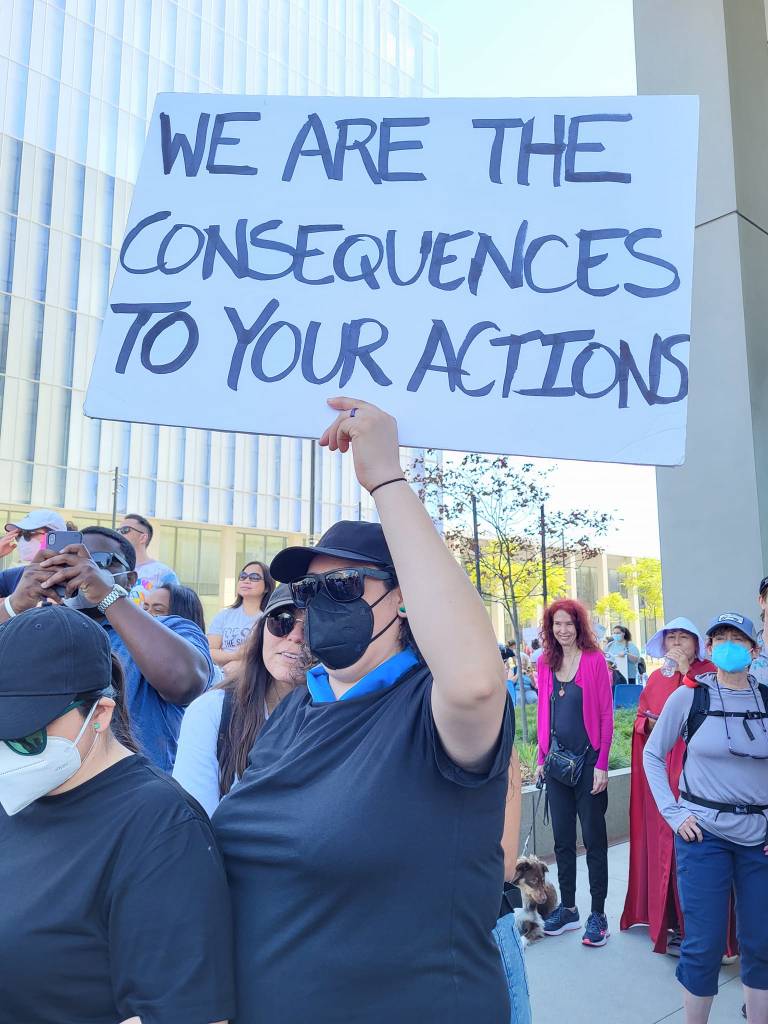
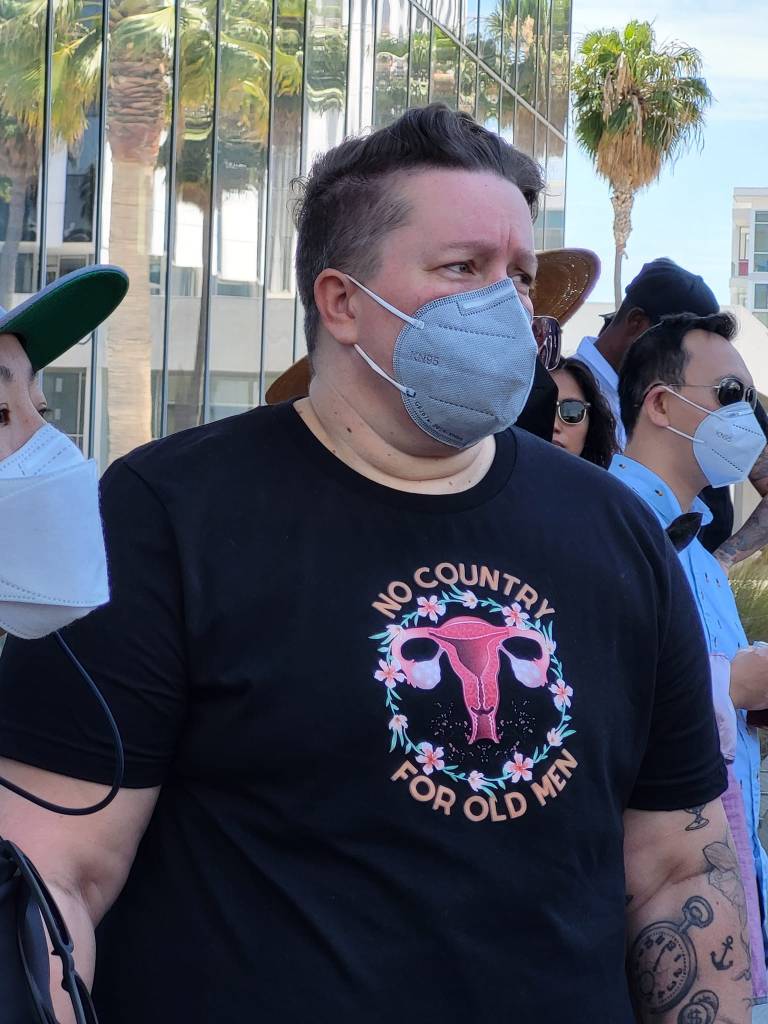
photos from bans off our bodies rally, long beach ca may 14, 2022
all photos by: marie cartier
BIO: Marie Cartieris a teacher, poet, writer, healer, artist, and scholar. She holds a BA in Communications from the University of New Hampshire; an MA in English/Poetry from Colorado State University; an MFA in Theatre Arts (Playwriting) from UCLA; an MFA in Film and TV (Screenwriting) from UCLA; an MFA in Visual Art (Painting/Sculpture) from Claremont Graduate University; and a Ph.D. in Religion with an emphasis on Women and Religion from Claremont Graduate University.
Moderator’s note: This is the 2nd of the two part series. Part 1 was posted yesterday.
A recently leaked draft of the US Supreme Court’s opinion on Dobbs v. Jackson Women’s Health Organization suggests that the court is ready to overturn Roe v. Wade. Most people know the legal consequence of Roe, but few know the grounds for the decision. The focus was on the “important and legitimate interest” the state has in preserving and protecting the health of the pregnant woman. Defining “health” broadly, Justice Blackmun wrote:
The detriment that the State would impose upon the pregnant woman by denying thischoice altogether is apparent. Specific and direct harm medically diagnosable even inearly pregnancy may be involved. Maternity, or additional offspring, may force uponthe woman a distressful life and future. Psychological harm may be imminent. Mentaland physical health may be taxed by child care. There is also the distress, for allconcerned, associated with the unwanted child, and there is the problem of bringing a child into a family already unable, psychologically and otherwise, to care for it. In other cases, . . . the additional difficulties and continuing stigma of unwed motherhood may be involved. (410 U.S. 113, 1973)
Psychological, physical, familial, social, present and future health of the woman are all to be taken into consideration. I would add to this the spiritual well-being of the woman, for this is a deeply personal spiritual decision as well.
Can I finally write about that night? Not sure. Here goes. Hillary Clinton. My heart beat. I voted for her every chance I got. Loved her passionately—the way I’ve heard folks talk about working for a candidate with their whole soul. I was so happy: she was winning. We were going to have a woman president.
What do you want to be when you grow up?
PRESIDENT!
Girls can’t be president, stupid! That’s never gonna happen.
No more. My wife and I wore our white pantsuits to the primaries. What a night! She won! The most exciting political event of my life –and that’s saying a lot for someone who first put her body down in front of a nuclear facility at fifteen. I know politics, And protests.





 Feminism and Religion