Image and Likeness by Dale Allen

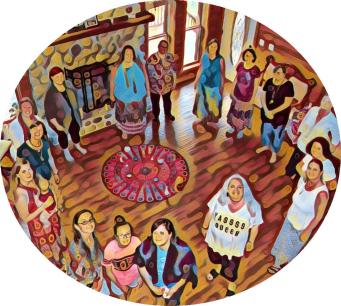
I attended a beautiful women’s circle to celebrate my dear friend Gloria’s birthday recently.  Each woman was invited to bring a sharing for Gloria – a poem, reflection, oracle card, song or dance – whatever felt right.  Each sharing that day was not only a gift to Gloria, but to each of us.

I had met Gloria during the period of my life when I had written a play titled, “Dancers of the Dawn,” with a cast of seven women of different ages, shapes, sizes and colors. The play featured original music, drummers, myth, history, dance, even comedy for a sumptuous experience of the sacred feminine emerging in modern women.  Gloria was a part of the women’s sacred circles that we co-created during that time – circles that continued for a decade and still retain heart-connections today. 

Continue reading “Image and Likeness by Dale Allen”

Ancient Her-Story by Annelinde Metzner

Lately I’ve been rereading and refreshing myself with important books of the Great Goddess.  Three books at a time! I would switch off, chapter by chapter, among  When God Was a Woman by Merlin Stone, When the Drummers Were Women by Layne Redmond, and one that had remained overlooked on my shelf, Sanctuaries of the Goddess, The Sacred Landscapes and Objects, by Peg Streep (1994.)  I’ve been immersed in the knowledge of 30,000 years of honoring and worship of women’s bodies and the Great Goddess. When I got to Chapter 7 of Peg Streep’s well-researched book, “The Goddess at the Peak: Crete,” I was blown away with the evidence we still have, in art, architecture, religion and culture, of a highly advanced society, full of life and joy, where women were central to all life. With my mind, my heart, my intuition and my sense of past lives, I’ve attempted to place myself there, before any influence of patriarchy.

Continue reading “Ancient Her-Story by Annelinde Metzner”

Abundant Life Is for Women, Too by Liz Cooledge Jenkins

I lived in East Palo Alto, CA, for two years in my mid-twenties. During the first year, a man was killed down the street from my apartment building, in the parking lot of the building where my friends lived. I walked through that parking lot often, as a shortcut back to my own place from wherever I could find street parking. I didn’t know the man, but I knew people who knew him. His death was both disturbing and tragic. The neighborhood mourned. My friends and I got together and wrote a prayer for our community. The murder changed my experience of living there.

Continue reading “Abundant Life Is for Women, Too by Liz Cooledge Jenkins”

The World Needs More Feminist Books…And Why You Should Write One of Them by Dr. Angela Yarber

I believe more women—and particularly queer and/or BIPOC women—deserve to publish books. Let me explain why.

It was my first year of seminary. After majoring in religion in undergrad, I had a decent handle on feminist theology, but I hadn’t yet reconciled my strong, feminist upbringing with the faith tradition that held my ordination in their patriarchal hands. A seminary friend recommended I read Sue Monk Kidd’s Dance of the Dissident Daughter and everything changed.

This was twenty years ago. That one book helped me internalize the intersectional feminist theory that had always dwelled outside of me. Decades later, I find myself teaching in my own seminary classrooms and mentoring DMin students, requiring that same text, along with one of my own books, Queering the American Dream, and Christena Cleveland’s God is a Black Woman when discussing the power of feminist memoir in religious leadership.

Continue reading “The World Needs More Feminist Books…And Why You Should Write One of Them by Dr. Angela Yarber”

How Mary Magdalen Came into My Life: an excerpt, edited for brevity, from My Life as a Prayer: A Multifaith Memoir by Elizabeth Cunningham

(Author’s note: Mary Magdalen, or Magdalene, comes to people in many ways. To me, she came as an unconventional, fictional character. I worked hard to get the first century setting of her story as accurate as possible. Otherwise, I make no claim to historicity. I respect all the ways in which others know her.)

When I finished writing my novel Return of the Goddess in 1990, I thought I had nothing more to say. Yet, I sensed there was something—someone—missing.

An artist friend suggested I take up drawing or painting for a time—visual art being a form in which I had no experience, skill, and best of all, no ambition. I dabbled in paint and charcoal but soon reverted to magic markers, my childhood medium. 

One day a line drawing in brown marker took shape. An ample woman sat naked at a kitchen table having a cup of coffee. The round clock on the wall read a little after three in the afternoon. (The same time of day I was born.) She told me her name was Madge.

Continue reading “How Mary Magdalen Came into My Life: an excerpt, edited for brevity, from My Life as a Prayer: A Multifaith Memoir by Elizabeth Cunningham”

From the Archives: Artemis As Artemisia: Ancient Female Spirituality & Modern Medicine by Stuart Dean

This was originally posted on November 29, 2015

Detail of Artemis from a 5th century BCE Attic Vase

The 2015 Nobel Prize for Medicine was awarded in part to a Chinese woman (Tu) for her identification and isolation to treat malaria of a chemical known as Artemisinin.  The name of that chemical derives from the fact that it is found in varying amounts in the ‘family’ (technically, genus) of plants known as Artemisia.  The name of that family derives from its association with the goddess Artemis.

Because Tu’s work began in China in the 1960s it is understandable that even if she knew this about Artemisia (a term I use to refer to any one plant or all of the plants of that family) it would not have been a ‘careerbuilder’ for her to point it out to those for whom she was working.  It was bad enough that she was a woman.  At that place and time, however, if she had said or done something that could be associated with Western culture her name might not even be known today.


Continue reading “From the Archives: Artemis As Artemisia: Ancient Female Spirituality & Modern Medicine by Stuart Dean”

The Importance of Finding a Local Sacred Circle or Event by Caryn MacGrandle

What not many know that the founder Caryn MacGrandle (aka Karen Lee Moon), who is a soul-sister to me, has devoted her life to the building, developing and promoting of this app, in service to the Rising Feminine … “ Jonita D’Souza, Rising Feminine

I came back this weekend from my land in North Carolina to two email messages about women finding divinely feminine events through the divine feminine app. I cannot even begin to tell you how happy this makes me. After nine years of nurturing, developing, daily work and pouring my personal funds into the app, it is truly working.

Continue reading “The Importance of Finding a Local Sacred Circle or Event by Caryn MacGrandle”

A Poem for Enheduanna by Nan Lundeen

Cuneiform Tablet from Nippur, Sumeria
(Modern Iraq) 2300 – 2100 BCE
Mary Harrsch from Springfield, Oregon, USA,
CC BY 2.0 <https://creativecommons.org/licenses/by/2.0&gt;,
via Wikimedia Commons

In beautiful synchronicity, I received an invitation to submit a poem to an anthology in the voice of a female-identified persona around the same time I first learned of Enheduanna. The first named author and poet was mentioned in my New Moon Womyn’s Circle. When I looked her up, I was flabbergasted. I am a poet, a feminist, and a long-time student of Women’s Spirituality, and yet the world’s first author—a high priestess who worshipped a female supreme deity, was unknown to me.

I learned that Enheduanna was a brilliant poet who wrote with majestic metaphors, who shared her emotions, and who grappled with concepts of the divine as a female supreme deity in and with nature, and with whom she experienced a personal relationship. She lived and wrote around 2300 B.C.E. Scholars say they do not have the specific dates of her birth and death, but they do know that she served as high priestess for 40 years at the city of Ur in what is now Iraq.

Continue reading “A Poem for Enheduanna by Nan Lundeen”

Durga Rising: Feminism as Fierce Compassion By Beth Bartlett

In her FAR post earlier this year,[i] “Why Feminism Needs the Fierce Goddesses,” Susan Foster argues that a “flagging” feminist movement needs the revitalizing energy of the “fierce goddesses” of ancient times to challenge the patriarchal forces that seem to be on the rise as increasingly we find women’s lives and freedoms constrained. She writes, “the dark goddesses of ancient times have been submerged in our psyches, but they serve as a repository of fierce energy, of female rage against injustice.”  She continues, “It’s important and healthy for us as women to reclaim our anger, using it to protect ourselves and fight for our rights in systems that are oppressive.”

Reading this, I immediately thought of Beverly Wildung Harrison’s, “The Power of Anger in the Work of Love,” and China Galland’s, The Bond Between Women: A Journey to Fierce Compassion. Anger as the work of love; fierce compassion.  In this time of mass shootings, insurrection, the ongoing assault on women, LGBTQ, and BIPOC peoples, when rage seems so easily fueled by hate, envy, and greed, it is the rage based in love and compassion that is most needed.  This is the rage of the fierce dark goddesses who are moved to act against injustice, the rage of the feminism I love. With its source in love and compassion, it is a rage that rebels in the best sense of the word – that at once refuses injustice and affirms dignity and respect, that speaks truth to power, that is grounded in solidarity and friendship, and values the immanence of the earth, the water, the body, and the divine spark in all beings.[ii] 

Continue reading “Durga Rising: Feminism as Fierce Compassion By Beth Bartlett”

From the Archives: “What If We Touched Ourselves Lovingly Every Day?” by Trelawney Grenfell-Muir

This was originally posted on June 5, 2020

I watched her hand stroke along my arm, so gently, so lovingly. Her voice whispered, “I love you, Trelawney. I love you, Trelawney.” The soft, tender caress felt poignant, healing, magical. I wept with gratitude.

It was my own hand stroking me. My own voice.

I want you to take a moment and imagine the person you love best in the world. Is there anyone? Is there someone you love utterly, you think of with pure, unconditional, compassionate, embracing, affirming, tender, protective, loyal, sacred love? Close your eyes a moment and let that feeling of pure love fill your heart until you understand that feeling with every fiber of your being. Do you have that Love? Truly feel it and know it with all your heart, soul, mind, and strength?

Continue reading “From the Archives: “What If We Touched Ourselves Lovingly Every Day?” by Trelawney Grenfell-Muir”