The Mothers, the Goddess, Lost and Found, part 2 by Elizabeth Cunningham

Excerpts in two parts adapted from My Life as a Prayer: A Multifaith Memoir. Part 1 appeared yesterday. You can read it here.

The Goddess finds me

Between the birth of my son and the birth of my daughter, I had a second miscarriage. The signs that something was wrong were subtle at first. I drove myself to a doctor’s appointment, hoping to be reassured that everything was all right (though I already sensed it wasn’t). En route to the office, perhaps to distract myself, I pondered why it was that I had never written about the church, or Christianity. Then…

I turn onto the main street. I glance at an old clock tower, and there she is superimposed against it, huge, big as the sky, vast as the earth.

I hear her voice.

You have been searching for me all your life.

She speaks inside me, all around me.

The wild mother, the witch in the wood.” [She shows me the stories I’ve written.] “You have been searching for me all your life.

Continue reading “The Mothers, the Goddess, Lost and Found, part 2 by Elizabeth Cunningham”

The Mothers, the Goddess, Lost and Found, part 1 by Elizabeth Cunningham

Excerpts in two parts adapted from My Life as a Prayer: A Multifaith Memoir
(Note: Both excerpts have been edited for brevity)

The author’s mother as an architectural student.

The Mothers

When I was fourteen years old, I had a dream. I was pregnant and riding a donkey through a landscape, all golds and browns, hills crowned with ancient trees. I arrived at a monastery where monks with brown hands helped deliver my baby. From that time on, I longed to have a child.

My first pregnancy ended in miscarriage. I was devastated. Not only had I lost my longed-for baby, I had always taken my body for granted. Despite illnesses and injuries, I had assumed my will and my body’s health and strength were one. Now I knew in my own flesh that I was not in control; doing all the right things (thinking all the right thoughts) could not save me from sorrow. I sat in my own small version of Job’s ash heap.

Continue reading “The Mothers, the Goddess, Lost and Found, part 1 by Elizabeth Cunningham”

Mothering, Society, and The Goddess by Jennifer Eva Pillau

In what I believe was an attempt by my daughter to ease my “mother guilt” for the ways I felt I had let my kids down, she once told me that “the world’s problems can’t be attributed to crappy mothering.”  While I appreciated her apparent effort to soothe my inner turmoiI, I can make a solid case that to a significant degree, they can be.  In fact, the most critical issues we face in the modern world have everything to do with the fact that our social, economic, and cultural structures are materially thwarting, rather than effectively supporting and nurturing, the human animal – our entire species – and particularly children, in our efforts to survive and thrive. 

It is true that mothers are not to blame for all of the ills of the world (though popular psychology can certainly make us feel as if everything is our fault).  Nonetheless, in real and profoundly palpable ways, there are aspects of the human condition that are not receiving the attention, tenderness, and nourishment that we know very well – both by instinct and science – are crucial for physical, emotional, and spiritual resilience.  Predictably, the Earth Herself is suffering in much the same way. 

Continue reading “Mothering, Society, and The Goddess by Jennifer Eva Pillau”

Embodying bell hooks’ theological vision by Liz Cooledge Jenkins

I was recently asked: Who is a theologian you admire? Since I’ve been deeply steeped in the Christian tradition, plenty of Christian theologians could come to mind—Christian theologians, that is, in the sense of humans educated in the Christian theological academy with the theology PhDs to prove it.

 But when I think of theology, these days, I find myself thinking more broadly. Like Kat Armas, who wrote Abuelita Faith as a way of reflecting on and honoring the theological contributions of marginalized women, rather than men who sit in the seats of academic power—and like Sarah Bessey, who writes that theology, at its best, is a field where “everyone gets to play”[1]—I am skeptical of the assumptions Christians often make about who is or isn’t a theologian. And so, when I thought of theologians I look to for wisdom, I thought outside the box. I thought of writer and activist bell hooks.

Continue reading “Embodying bell hooks’ theological vision by Liz Cooledge Jenkins”

Let Your Voice Be Heard • Let Your Heart Be Inspired! by Dale Allen

I was honored to be a part of a special project for the Parliament of the World’s Religions Women’s Task Force: conducting interviews inside the first-ever Women’s Village in Chicago at the Parliament Convening. I had been on a team of women led by Sande Hart with Pat Fero. We met online over the course of nearly a year to plan the Women’s Village. It was a very special endeavor, and our group efforts produced a beautiful, calming, nurturing, sacred and inspiring space.  

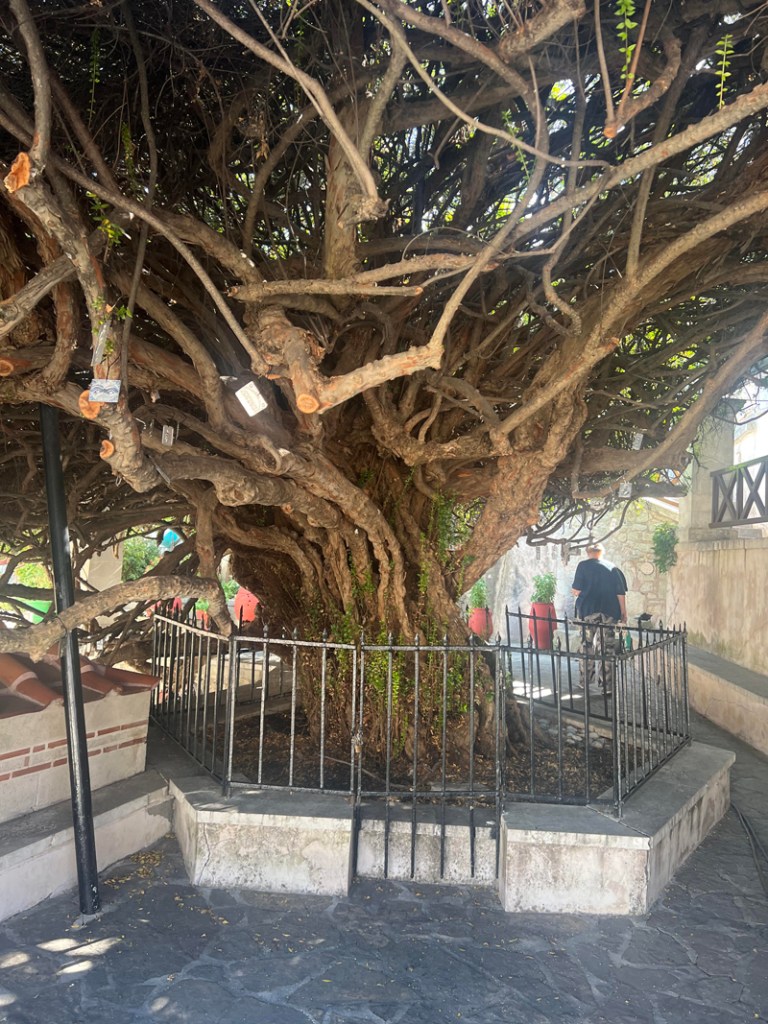
The McCormick Center is America’s largest convention center, and yet we were able to create serenity.  The tapestries of Women’s Woven Voices provided a colorful and meaningful enclosure for our space.  A fountain cascaded a peaceful hum. Majestic staffs created by Erin Beatty stood as sentries; keepers of ancient feminine power. A great Mother Tree crafted by Elisa Guyton and Leah Myers spread her paper branches outward and received the written prayers and blessing posted there by attendees.  The crown-making table was always busy with women talking and crafting exquisite headpieces. The Red Tent room was a tranquil place of mediation, rest, and a variety of spirit-nourishing workshops and presentations.

The Great Mother Tree crafted by Elisa Guyton and Leah Myers, close up with written prayers and blessings.
Continue reading “Let Your Voice Be Heard • Let Your Heart Be Inspired! by Dale Allen”

Three Women Sit on a Stone: Images of Fate in a Jewish Incantation by Jill Hammer

Tapestry, three fates, 16th century Netherlands

There is an old Yiddish incantation, documented from the 18th century forward, that features three mysterious women.  It is a folk spell warding off the evil eye–the negative influence that may come either from demons or from the jealousy and spite of others (or both). Fear of the evil eye is the reason it was traditional not to compliment cute babies or talented people—because the evil eye might be attracted to such beauty or talent and cause harm.  The evil eye, to give a personal example, is the reason my father, who was normally not a religious person, refused to allow my mother to shop for a crib until I was born, lest the evil eye notice they were going to have a baby and prepare some terrible fate for me.

Continue reading “Three Women Sit on a Stone: Images of Fate in a Jewish Incantation by Jill Hammer”

Invisible Connections: The Hidden Web of Women Writers, part 1 by Theresa C. Dintino

Moderator’s Note: We are pleased to announce that we are forming a co-operation with The Nasty Women Writers Project, a site dedicated to highlighting and amplifying the voices and visions of powerful women.The site was founded by sisters Theresa and Maria Dintino. To quote Theresa, “by doing this work we are expanding our own writer’s web for nourishment and support.” This was originally posted on their site on Nov. 16, 2021. You can see more of their posts here. 

created by Data Visualization Specialist Mia S.Szarvas as part of a larger project of Nasty Women Writers about the Web of Women Writers

In the years that my sister Maria and I have been writing for Nasty Women Writers, one of the things that has become increasingly clear is how connected women writers are to one another. Every time I explore the life of a woman writer for Nasty Women Writers, I learn of other women writers she is connected to, inspired and supported by. Some of these connections are through time, meaning one woman writer reads and interacts with the body of work of a woman writer whose lifetime preceded hers chronologically, others are alive at the same time and they interact in person or through letter writing.

Continue reading “Invisible Connections: The Hidden Web of Women Writers, part 1 by Theresa C. Dintino”

Public Goddess Gatherings by Caryn MacGrandle

I swat at her like an annoying fly.  ‘Stop it.  I’m good. I’m very happy.  Go away.’

Photo credit:  Melitas istockphoto

I took a part time security gig on the weekends to bring in some extra cash, and they sent me out to direct traffic at a holiday outdoor market here.  150 booths of incredible, local, organic, home-made, natural items.  Right up my alley.

The festival started at noon.  And the steady stream of cars started.  By 12:45pm, the entire parking lot was filled, several football fields long: a Dave and Busters, a Wahlburgers and a Trader Joe’s sharing the same area.  All their spaces filled too. 

Continue reading “Public Goddess Gatherings by Caryn MacGrandle”

Can Feminist Christians Hasten the Advent of Reproductive Liberation? by Elizabeth M. Freese, PhD

Wikimedia Commons, Servite Church in Hungary

The collision of the 2023 Christian liturgical season of Advent with American reproductive politics has been jarring. Feminist religious critique and transformative activism are imperative.

With the Texas Supreme Court decision on a dire abortion case, alongside increasing criminalization of women having miscarriages, we are witnessing the principle of patriarchal dominance of female reproductive capacity and the denigration of women’s full, equal personhood pushed to the extreme. In part, this barbarity is perpetuated by Christianity. Even though this tradition often challenges social systems of injustice, and it does not actually support their hollow theology of “life at conception,” misogynist oppressors have plenty of Christian religiosity to stand on.

Continue reading “Can Feminist Christians Hasten the Advent of Reproductive Liberation? by Elizabeth M. Freese, PhD”

Better Than a Rainy Norwegian Cruise:  the Divine Feminine App Comes to Another Fork in the Road by Caryn MacGrandle

I have just recently taken on debt with the divine feminine app.  I made the decision to go to the Parliament of World Religions.  We added a weekly email feature and an affiliate program.  I have been investing in some other features in an attempt to make the app sustainable.  I find myself $13,000 in debt. 

And I’m not done.  Both the Operating System that the app is built on and the smartphone apps need to be updated.  In technological terms, they are ancient, and we are starting to have different issues pop up with them. 

If I am lucky and continue to work without a paycheck as I have the past ten years and with the company in India who is about 1/8 the cost of doing this state side, this will cost us about $7,000.

In other words, I need $20,000.

I ask myself, is it worth it?

Yes.

Continue reading “Better Than a Rainy Norwegian Cruise:  the Divine Feminine App Comes to Another Fork in the Road by Caryn MacGrandle”