Take time 
to nourish
your caring.
It is needed.
Last month it was raining heavily on a Saturday morning and I spent time coloring letters to fairies with my younger children and baking a cake. Before I knew it, the day had slipped away into the rain and I didn’t get to make my daily visit to the woods behind my house as I like to do in the morning. While the things I did instead were fun and loving, I found myself telling my husband, once again, that I am feeling burned out in my life in general and like I’ve lost my caring. I sometimes worry that I don’t care anymore, that I’ve used up my care, my inspiration, my passion, that I’ve fueled magic for others for so long, that my own has evaporated and I’m finished, extinguished. I listed off the things I need to refuel my soul and restore my care so that I can be there for others, for our work. My list was simple and short and my husband pointed out that I get the things on it almost every day:
- Go to the woods.
- Write and journal.
- Walk and discover things.
- Create/draw/take pictures.
- Read.
I need to nourish my care, I tell him, because I can’t stop caring.
Caring is what holds life together.
What do you need to nourish your caring?
This year, I have found myself struggling with recurrent episodes of feeling like I don’t care. I feel careworn, care-overloaded, care-burned out, care used-up. Sometimes I even feel like I actually can’t care anymore, like all my care is used up, spent, extinguished, exhausted. I have also found myself feeling a little sad and wistful remembering how much I used to care, about everything, but at times I also feel liberated by owning the “don’t care” sensation. Sometimes it sets me free. The world is stained, strained, and brittle from so much lack of care from so many people. We must keep caring, we must care, even when it is a strain. I suppose the secret may be not to care too much about things that don’t require our care, not to overload ourselves with cares that are not our own, or that don’t actually require our attention and are, frankly, quite fine without us and our meddling.
After the month’s Pink Tent ritual with my local circle, a friend tells me that she has been  going to yoga class and every time she lies on the floor at the end of class, she thinks of me. I consider this a compliment. If I could be known as a lay-down revolutionary, that would please me. At least two years ago, I put on my list of “100 Things to Do this Year,” to lie on the floor for at least three minutes every day. I have kept this up more or less every day since then, even setting my phone timer for three minutes at the end of my personal yoga practice each morning, so I know I’m actually giving this to myself. I wonder what might change for many of us if we allowed ourselves three minutes a day to lie on the floor? Ten minutes? Fifteen minutes? One hour? Another friend tells me she needs a time out to refill herself until she is overflowing, instead of just refilling her cup a tiny bit and then draining it over and over again. I feel this too. I have the sensation that I been coasting on my reserve tank for at least a year and my reserves are now becoming depleted too. It takes more than three minutes to fill the tank, so that it carries sustained and lasting energy to fuel my soul.
In the woods the next day, I sit with my eyes closed in the sunshine, basking in the warmth. I hear the sound of birds from each side of me, ping-ponging off of one another into the sparkling green air. I listen to them until my mind softens and I am no longer tormenting myself with questions of how to be better, be more, fix it all. I am very still on the rock and when I open my eyes, I see a vulture coasting towards me. It swoops very low, skimming the treetops, possibly checking to see if I am actually breathing there on the stone, it circles once, twice, three times, above my head, at each pass coming very low, low enough that I can see its red head turn from side to side, looking at me.
Hey, buddy, I say. Yes, I’m still breathing!
My floor-lying friend has spent the night at my parents lodge and I go to visit her and to paint with my mom, my daughter, and my friend and her family. My head is throbbing with the headache I often get following an intense ritual and I don’t feel very present, but we paint anyway, the colors swirling and mixing and the freeform nature of the pour painting meaning there are no mistakes, only magic. When we finish, I help her load a weaving loom into her car and we speak briefly about group dynamics and ritual etiquette, and priestessing energetics. As we speak, I look up to see nine vultures this time, circling in the wide sky above the large open field surrounding the lodge building. They dance in the air and they whisper, It is okay to let go. It is okay to soar. It is okay to be free. It is okay to clean things out and away. That is how you can keep caring.
Recipe for Rebuilding a Soul:
1 weary heart
2 open arms
1 large flat rock
As many tall pine trees
as you can find
1 empty book
Many pens
Lots of water
2 scoops of sunlight
An infinity of starshine.
Mix together patiently and wait in the shadows. Let rise in the sun. Let rise with the moon. Check for delight. If still soggy and deflated, expose on a hillside or soak in the ocean. Sprinkle with laughter.
Submerge beneath a stream of inspiration.
Drizzle with dreams and a generous helping of time.
Steep with incredible slowness.
Dust with flowers and need well.
Let become exquisitely tender and soft.
When fully risen, warmed throughout, and glowing with strength and satisfaction, enjoy with a tall glass of moonlight, a side of magic, and a handful of enchantment.
Create regularly for best results.
Additional audio poem: Careworn Soul
This essay is excerpted from my book in progress, The Magic of Place: Rebuilding the Soul Where and How You Are.
Molly Remer has been gathering the women to circle, sing, celebrate, and 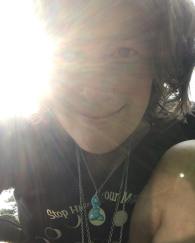 share since 2008. She plans and facilitates women’s circles, seasonal retreats and rituals, mother-daughter circles, family ceremonies, and red tent circles in rural Missouri. She is a priestess who holds MSW, M.Div, and D.Min degrees and wrote her dissertation about contemporary priestessing in the U.S. Molly and her husband Mark co-create Story Goddesses, original goddess sculptures, ceremony kits, mini goddesses, and jewelry at Brigid’s Grove. Molly is the author of Womanrunes, Earthprayer, She Lives Her Poems, and The Red Tent Resource Kit and she writes about thealogy, nature, practical priestessing, and the goddess at Patreon and at Brigid’s Grove.
 I love living in a second-story apartment. Having a view of Los Angeles, of the palm trees, the expansive sky, the distant mountains, and the city lights of downtown, makes life feel bigger, more full of possibilities. In the struggle of transitioning my life back to L.A., the view from my second floor apartment helps make me feel ok in the world. I’m in love with Los Angeles – the land, its topography, its sky, its desertness – and even its traffic. Beside the fact of sometimes being made to arrive late somewhere, I don’t mind being in our famed L.A. gridlocks – I don’t mind being in the slow moving flow of cars. I kind of enjoy being among the thousands of other folks sharing the collective experience of trying to get someplace. Traffic becomes for me a leisurely time when I get to do nothing else but enjoy the city.
 This past term I had the opportunity to teach courses on the Christian doctrines of Christology and Trinity. My first inclination was to approach these doctrines from the perspective of their historical development. For, I find the historical study of doctrinal development to be a fascinating and liberating approach to theology because it delivers the searcher from the illusions of ubiquity and universality, even in matters of the most central tenets of faith. When people can see doctrine in its political, polemical, and posited guises, we can be free from absolutization of belief in past expressions as well as in present permutations.
 Authorities have observed that climate change is a feminist issue because it disproportionately affects women. Among these, the United Nations has gone further to acknowledge that climate change is a feminist issue because women are on the forefront of adopting climate-change mitigating techniques and technologies. A recent UN report states that “women are key actors in building resilience and responding to climate-related disasters…”
 There might be lots of lessons to consider. These lessons might have holes, for I’m not a wise sage, and I’m not really even a mother. As I am a couple of years from 40, I think about what lessons I would teach my daughter if I had one, lessons to honor her physicality, lessons to create space for her soul. What do you think of these lessons? Would I be a bad mother?
  Tall, hearty. sometimes pushy, and usually very loud, Outtadeway-O is easily able to propagate and multiply Herself so that we can find Her in crowded airport terminals, at bus and subway stops, and just about anywhere people are traveling from or to. She’s in charge of trains, planes, and taxi-cabs. She’s the One who, when we’re in a hurry to get somewhere on time, shouts, “Please, oh, please get out of the way!” Pilots, engineers, station masters, ticket agents, and ÜberAlles drivers all hear Her. You better bet they get out of Her way.
 I was once asked “why do I stay Muslim”? That was the question prompt, and it begged an answer…Reason #2: I believe Islam has vagueness in the Quran (I answered
  I used to hate Mother’s Day. I have