 As I write yet another email apologizing in advance that I will miss a deadline, I debate whether to provide a reason. Should I write that I am struggling with sometimes crippling anxiety, that I have physical symptoms related to that anxiety and to depression? Or should I stick with “some health issues”? Or is even that too much information? Is it better not to provide a reason at all?
I have written quite a few such emails over the years and it is only now that I both fear and anticipate the response. If I openly acknowledge what others would call mental health challenges, I usually get no response at all or one that entirely ignores that part of the discussion. Using physical illness as an explanation rarely generates a more direct response either, and if it does, it usually takes the form of wishes that I get well soon, as if I have caught the flu. If only depression and anxiety or even their somatic manifestations went away or could be cured!
When I am able, I analyze such responses for what they can tell me about this society’s willingness and ability to take seriously how we feel, how we function, and what either of those have to do with meaningful living.
There are two main concerns in the above: that we cannot openly discuss our mental and physical health challenges and instead we are expected to suppress them in polite company; and that the boundary between being healthy (mentally or otherwise) and being unhealthy, does not in fact exist despite the language we employ that seems to insist on such a boundary.
As I become a little more confident about sharing my struggles, I find that doing so encourages others to share as well. In conversations with my students, undergrads as well as graduate students, and occasionally with colleagues, I see the light of hope and with that hope, I see relief. I understand that academia, my work environment is as much part of the capitalist system as any other workplace, so the expectation to be functional, perform one’s work tasks and generate profit is not surprising. It is, however, hurting countless individuals, women as well as men, and that, combined with my feminist idealism, has me convinced that a system that enables theoretical reflection and sometimes even induces change in society (however reluctantly) should do better than it does at this point. We may have some access to mental health services (also part of capitalism and thus costing money), but professional services are not all we need.
This brings me to my second point, one which is for me at least more directly related to religion. I realize that the mind, body, and soul division is the product of a particular history, philosophy, and time period. But I do not experience these supposed parts of my being as three distinct thirds that form a whole. They seamlessly blend into each other, all making me who I am and who God made me to be. Why then is it so difficult some days for me to do anything at all? Should it be a daily exercise to determine where I seem to fall that day on a five point spectrum, from mentally healthy (5) to mentally ill (1)? How often do I not have a concrete answer? And whose “mental state” can truly be captured by such a simple scale?
I do not know whether I have ever had a day on which I felt normal or didn’t worry about being normal. Normal compared to whom? Stuck somewhere between protestant work ethic, socialist utility for the community, and gratitude owed to God for being alive, I have serious difficulty relating to modern psychiatry and even conventional medicine. And perhaps the five-point spectrum above exists simultaneously for physical health or even more likely for the same whole. If my body, mind, and soul are all interconnected, it makes sense that my physical health cannot be measured separately from my mental or spiritual health.



 There are three vicious circles: patriarchy, samsara and wanton destruction of environment. All three lead ultimately to annihilation of life. All three are incredibly difficult to escape. One of the reasons for this difficulty is that there are pay-offs. Someone or something benefits from keeping the cycles going.
 Dear Friends,
 1 The beginning could not be reckoned in the time before time was reckoned. 2 For, what was had yet to know itself, and it could not know itself alone. 3 But, for its love, it could not be known. So it was that the beginning that could be reckoned was not the beginning but the beginning of loving, which was the beginning of knowing, which was the beginning of being. 4 And, in that beginning, a great ellipsis had already become of particle and light, and the particle and light thrummed through darkness forming a whole body. 5 Of the great ellipsis of particle and light, a body and a body and a body were formed, in and of the great ellipsis, thrumming through darkness. 6 The thrumming ellipsis pushed forward so far that its particle and light extended beyond itself and then beyond itself and then beyond itself, as though it were to separate, but it did not. 7 A whole body was formed, which was the beginning of the simultaneity of what was and what is and what will have been.
 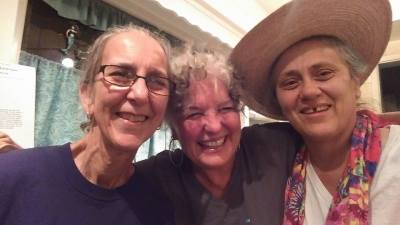 Last week I went out to eat with a group of insightful scholars at the American Academy Religion 2015 Conference
  One tradition I created 20 years ago was the tradition of “Pie Day” with a good friend of mine. We realized this year that we have been doing that for 20 years! Now that is my “tradition” and that is my “family.” We bake an inordinate amount of pies on Pie Day—a very specific recipe—green apple with golden raisin reduction— and people and friends come over. We celebrate. We eat pie with cheese (a New England tradition) and salad- I call it “a French meal”
  Both my sisters claim to have no regrets about their lives. I do. It’s not so much that I regret specific things that happened to me in my life or even some of the particular choices I made although both the “happenings” and “choices” are a result of a larger regret. Nor do I spend much time going over it all in my mind. I don’t believe that listing all the “if onlys” and ruminating about “wrong turns” is productive.
 As we near the end of Domestic Violence Awareness month, I bring attention that as of today, about eighty-four
 At times, being ignored, erased, and made invisible, is more hurtful than open debate and disagreement. Such silencing and marginalization render the energy, activism, and work of so many people mute and, ultimately, they do not serve the communities and society we are attempting to change. In what follows I insist on uplifting and naming some of the radical Muslim activists and advocates for gender justice I saw ignored in a recent Muslim community event.

