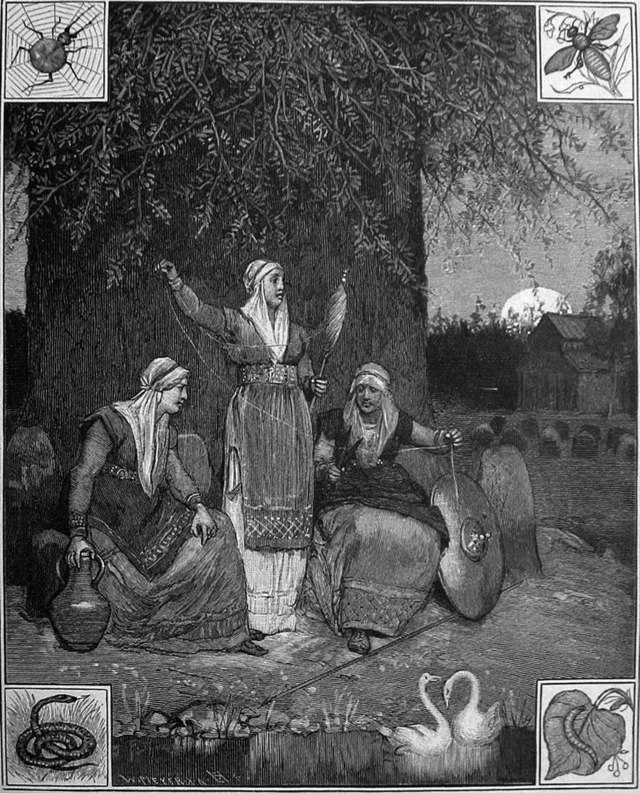
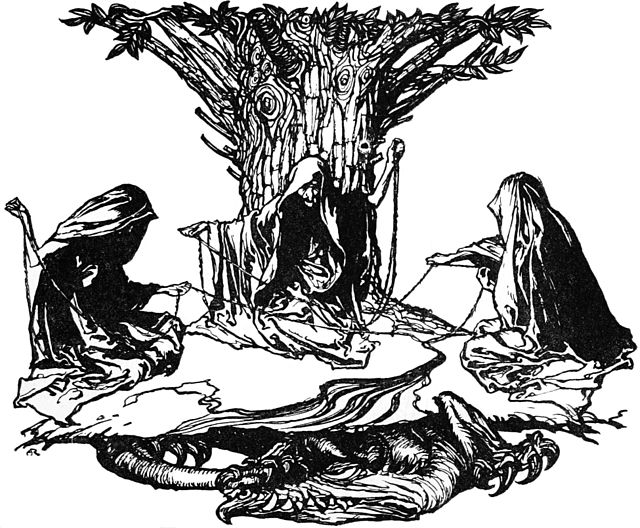
Part 1 was posted yesterday. You can read it here. The Norns were explaining the mess they had made when they got drunk at a Valhalla party.
The Norns looked at me with sadness. “We knocked over one of our looms/templates/arrangements”
Their tone changed, they looked at each other and I thought I could see emotion churning. They were arguing and then they stopped. They turned toward me and looked sheepish, that is if divinities can look sheepish. “It was a disaster/calamity/debacle.”
“Tell me then,” I was growing impatient.
Verdandi: “Well you see the loom we knocked over was . . .”
“What?” I almost shouted at them.
Urd: “It was the loom holding the pattern from Salim/Jerusalem.”
In 2020, I began writing my biography because some weird things were happening in my life including some which were time-bending. To help make sense of it, I wrote up “conversations” with the mythical characters of Persephone, Inanna and the Norns of the Norse. Throughout my bio, I speak to the Norns as an out loud meditation on the nature of time, fate and energy.
The three Norn sisters are Urd, Verdandi and Skuld. Their names come from Old Norse which is not a spoken language. The actual translation of their names is open to speculation. In general, here are their common meanings.
Urd – past
Verdandi – happening or present
Skuld – future or debt.
By mythological tradition, they show up at a child’s birth and then weave their “fateful” decisions about that child’s life into a tapestry. They are considered more powerful and fearsome than the gods because even the gods are ruled by the hands of fate (or Norns in this case). They were also treated as oracles where kings and warriors went to consult them much as was done in Delphi Greece.[1]
The phrase, “separation of church and state,” crops up frequently in conversation these days. I hear it most often when someone wants to clinch their argument on a politicized subject. Lately, it’s been concerning one’s “right” to an abortion. “It doesn’t matter what your church says, we have separation of church and state in this country.” That phrase, though, is not in the Constitution. It was Thomas Jefferson (1743-1826) who paraphrased the Constitution in a letter to the Danbury Baptists, “…building a wall of separation between church and state.”
The first part of the 1st amendment states: “Congress shall make no law respecting an establishment of religion, or prohibiting the free exercise thereof….” All manner of questions have been raised with this statement. What does it mean to establish a religion? What is religion? Is religion something intrinsically good? Most Americans think of religion in terms of God. What/who is God?
Apple trees have always been dear to my heart and of course, they are associated with the goddess. What follows is a little story where the goddess is made manifest.
Torn Apple Heart
Three years ago I had a beloved apple pruned – I do not normally prune trees, believing that to do so may harm them, but because I once trusted a young boy who also loved trees, I allowed him to make a few cuts that spring.
Last year my apple struggled and dropped her apples too soon.
I worried.
This year rain has been scarce except for monsoons that first drown the trees, leave roots barren, with most of the moisture rushing down the hill to the brook. When I noticed so many many apples on too thin young branches I became uneasy….
It’s almost mid August; since mid July we have experienced the hottest summer I have ever endured.
we need a god who bleeds now a god whose wounds are not some small male vengeance some pitiful concession to humility a desert swept with dryin marrow in honor of the lord
we need a god who bleeds spreads her lunar vulva & showers us in shades of scarlet thick & warm like the breath of her our mothers tearing to let us in this place breaks open like our mothers bleeding the planet is heaving mourning our ignorance the moon tugs the seas to hold her/to hold her embrace swelling hills/i am not wounded i am bleeding to life
we need a god who bleeds now whose wounds are not the end of anything
Grounded in an ancient theodicy, Ki Tavo (Deutoronomy 26:1-29:8), the Torah portion for September 17th, is an emotional rollercoaster. In it, the Israelites find their lot in life directly linked to their own behavior. Follow the commandments to gain blessing; ignore them at your own peril. While the commandments listed here are laudable from a feminist perspective, the deity’s response to non-concompliance is problematic. It is full of victim-blaming and empty of compassion. Furthermore, Ki Tavo’s portrayal of divine expectations leaves no room for human nature to actually be anything other than complete perfection. This is unacceptable.
As should sound familiar to the reader by now, Ki Tavo speaks to a specific historical context: the Babylonian exile. As we are aware, the typical theodicy of the Babylonian exile places blame for the Israelites’ lot in life on the Israelites themselves, specifically on how their behavior (or their ancestors’ behavior) has warranted divine punishment. In other words, the Isrealites have not observed the commandments and thus deserve what is happening to them. This justifies an understanding of the divine as vengeful, spiteful, jealous, and victim-blaming.
That being said, what exactly happens in Ki Tavo? Ki Tavo, also like many Torah portions, discusses commandment observance. From a feminist perspective, the portion rightly focuses its description of the commandments on justice and fairness within the community (27:16-25) as well as care for the widow, stranger, orphan, the poor, and the disenfranchised (26:12-13, 27:18-19). Its interpretation of the commandments seem to be truly about how, according to its time, a community, that puts the downtrodden and outcast first, should function. These are generally good principles.
Taken by author.
Ki Tavo then lists, in varying degrees of specificity, what happens to the Israelites when and if they observe the commandments. If they heed the commandments, they receive abundant blessings. These blessings focus on material, this-worldly rewards (28:3-13). Most offer abundant crops, flowing, deep rivers, good bread, fertility of human and animal, and rain, while, unfortunately, there are a few which mention blessings in terms of gaining power-over and, thus, influence. (Here it is impossible to give specific verse references as many verses have a combination of material blessings and less tangible, power-focused ones.)
When the Isrealites fail to heed the commandments, they incur divine wrath. This is depicted in Ki Tavo as curses or cursing. The curses are sometimes quite mundane and other times absolutely disturbing. There are the typical droughts (28:22, 24), plagues (28:22, 38-39, 42), diseases (28:22, 27-28, 35, 59-61), wars (28:49-53) and so on.
And, then, there are some not-so-common curses. One intriguing curse is exile, which forces the Israelites to practice idolatry (28:36). Interestingly, here idolatry is not a breaking of the commandments, but a punishment for doing so (28:36). Exile signifies the physical breakdown of the group, while idolatry distances that same group from their covenantal relationship with their chosen deity (28:64). They are not a people any longer as they live in foreign lands and worship different gods.
The uncommon curses go one step further and remove any semblance of the Israelites’ humanity through cannibalism. In Ki Tavo, this is a result of war. The deity wages a vicious war against the disobeying Israelites, using other humans (28:57). Their cities are so mercilessly besieged to the point that the people completely run out of food. With nowhere else to turn, they are forced to resort to cannibalism (28:53). Even the most gentle and well-behaved man and woman becomes, when this happens, cannibals (28:53-55), eating their own children to survive.
Yet, who is to blame for the death of their community and their own inhumanity? The deity who punishes? No. Ki Tavo makes it clear that it is the Isrealites themselves. By punishing the Israelites’ non-observance, the deity is only being faithful to the established covenant to which both parties freely agreed. This victim-blaming might have made sense of the Babylonian exile for those who were living through it, but it is also clearly a product of patriarchy. Back then victim-blaming justified war and disease. Now, it condones such practices as domestic violence, rape, and various manifestations of power-over. It is problematic because it does not acknowledge who is most often truly at fault: other, more powerful, humans.
Ki Tavo also paints a one-sided picture of divine understanding when it comes to good and evil. There is either goodness (in Ki Tavo, observance) and blessings or evil (non-observance) and curses. There is no middle ground, no explanation, and certainly no compassion.
This lack of divine compassion is what bothers me the most in Ki Tavo. Even though humans are divine creations, the writers of the Torah have depicted the Creator as so disconnected from creation that there is no compassion and no understanding of humanity, only sheer anger and divine wrath. According to Ki Tavo, our Creator is more than willing to shattered the community, our relationship with the divine, and even our own humanity than practice forgiveness and mercy.
Thank goodness that the Jewish tradition’s understanding of the divine does not stop at Ki Tavo. Rather, Jewish tradition teaches us that we, in the covenant, have partnered with the divine who understands us, showers us with compassion and mercy, and does indeed forgive us (when we don’t always behave as we should). We have a faithful deity who is abundant in goodness and rarely upset or disappointed. We can put our hope and our faith in the goodness of the Holy.
As we enter the High Holy Days, may Ki Tavo’s understanding of the divine as wrathful, angry, destructive, and vindictive stay in the past where it belongs. In this new year, may Compassion embrace us, gifting us with a sacred empathy for others and also for ourselves. May mercy and goodness be with us this year and all the days of our lives. And, may the world and our hearts be at peace.
L’shana tova umetukah! (For good and sweet year!)
Ivy Helman, Ph.D.:A feminist scholar and faculty member at Charles University in Prague, Czech Republic where she teaches a variety of Jewish Studies, Feminist and Ecofeminist courses.
This was originally published on September 9, 2015
This essay is inspired by Donna Henes’s brilliant post, I am Mad. Too often as spiritual women, we are told we have to perform niceness all the time, even if it means compromising our boundaries and principles.
Mainstream religions tell us we must forgive those who mistreat us. Too many women in very abusive situations literally turn the other cheek–to their extreme detriment. As Sherrie Campbell points out in her essay The 5 Faults of Forgiveness, the obligation of forgiveness oppresses survivors of abuse because it makes it all about the perpetrator and not about the healing, dignity, or boundaries of the survivor.
In my own Catholic upbringing I learned to swallow my anger and rage until it erupted in depression and burning bladder infections. My background did not teach me to skillfully dance with anger and it’s been a difficult learning curve for me. But I learned the hard way that owning my anger was crucial if I wanted to stand in my power and speak my truth.
Once when I felt a particularly strong need to break out of a dysfunctional situation, I had a powerful dream of a black snake, as beautiful as it was terrifying. In the course of the dream, I realized that the huge black snake was my own repressed anger, power, and strength. The beautiful inner self longing to be claimed.
Meek and mild women don’t make history. Hildegard von Bingen, whose feast is coming up on September 17, famously spoke her mind and ferociously stuck up for what she thought was right, famously locking horns with Emperor Barbarossa himself. She also defied her archbishop and suffered an interdict as a consequence, nearly dying an excommunicant. But she was a strong woman who would not be silenced. We should all be so brave and bold.
Claiming our true spiritual power means claiming each part of ourselves, including our fierceness. Our scary side.
Fierceness means embracing our gut wisdom. Voicing the sacred NO to protect ourselves and our loved ones from compromising situations.
I see modern day women like holistic healer Susun Weed embodying this fierceness as she empowers women and girls to recognize the sacredness of their own bodies, the holy mysteries inherent in menstruation, childbirth, and menopause, which are too often pathologized in male-dominated medicine.
Over the years I’ve learned to trust and act on my own inner knowing and discernment. To know when to say NO. By using strong, no bullshit women like Hildegard and Susun Weed as my role models.
Each time I trusted myself enough to act on my gut wisdom, to trust the inner NO, and speak my truth, it has served me well, although it’s sometimes been a painful learning process.
Anger and fierceness wake us up to what is wrong and needs to be changed. There is so much energy in anger that can be harnessed for healing and transformation. Fierceness is the strongest, most protective form of love, the ferocity with which a mother bear defends her cubs.
Coiled inside each one of us is a snake of great power. Let us all dance in our power and strength.
Minoan Snake Goddess, ca 1600 BCE, Knossos, Crete
Mary Sharratt is committed to telling women’s stories. Please check out her acclaimed novel Illuminations, drawn from the dramatic life of Hildegard von Bingen, and her new novelRevelations, about the mystical pilgrim Margery Kempe and her friendship with Julian of Norwich. Visit her website.
My daughters came to me after Sunday School one day, concerned about a story they had heard in which God drowned almost everyone on Earth. So I sat down and thought about why a community might want to tell that story, and what valuable wisdom might be lifted from it for my children. Here is what I told them:
God/ess has many faces, which help us understand different things we need to know at different times. Sometimes we think of God/ess as Crone, an old, old woman crowned with silver hair as an emblem of her wisdom, who helps us learn to let go of anything that is holding back the wellness of our community and ourselves.
Hospitality is the way of Nature. Every spring, the Earth provides us with warmth, beauty, water, and nourishment. In winter, the Earth offers tools to heat and shelter ourselves. When we are sick, medicine is as close as the forest and meadow. She has welcomed a variety of life forms as the environment changes over our planet’s many geologic ages. Living beings have always been the wanderer in need knocking at Earth’s door and She always gives Her all to us.
This welcoming attitude has been reflected in customs of offering strangers food, water, and shelter in ancient and contemporary cultures and religions around the world, including goddess reverence. We see the influence of hospitality in the many goddess temples that welcomed and, for living traditions, still welcome, anyone in need of healing. These include those of the Egyptian Neith, the Italian Angitia, Idemili of the Nnobi Igbo people, the Yoruba Oshun, and others. We also see it in stories of women caring for one another like that of the Greek Maenads, ecstatic women worshippers who were unable to return home after attending rites and fell asleep in a town along the way. During the night, the town’s women silently encircled them, holding hands, for their protection.
After a spring semester-long sabbatical this year, I am back to campus and to teaching. I was effectively off from January to August and the timing could not have been better. After my dad’s death last July (2021), my world was turned upside down. One of the things that happened with his death was a deep realization that he had a lot to do with my sense of grounding. I wrote about this in a previous post, but I hadn’t quite realized how much he was a source of affirmation and grounding for me, an external one—his death was a catalyst for me to learn how to access that grounding more fully for myself, from within.
Having been on sabbatical, then, was helpful in terms of regaining my brain for research and writing, which was its objective, but also for giving me the time and mental space to work on the grounding aspect of my internal life. A few things came together for me during this time. Leading up to the sabbatical and overlapping with it, I got to participate in the Latinas in Leadership (LIL) program with the Hispanic Theological Initiative – a program designed to strengthen the professional development of the Latina women participants.