This year, I published a book called Return to the Place: The Magic, Meditation, and Mystery of Sefer Yetzirah (available from Ben Yehuda Press, benyehudapress.com). Sefer Yetzirah, or the Book of Creation, is an ancient Jewish mystical work (written in approximately the sixth century CE, though scholars offer dates from as early as the 1st century CE to as late as the 9th century). This brief, cryptic, poetic book describes the process by which God creates the universe. God engraves letters, which are also the elements and fundamental forms of being, into the cosmos. These engraved letters act like energetic channels between the Creator and the Creation, allowing creative intention to flow from the One to the Many. The book instructs the mystical practitioner to develop awareness of this creative process and seek to embody it, thus allowing energy to flow back from the Many to the One.
This flowing between One and Many is called retzo vashov, running and returning—the constant ebb and flow between unity and multiplicity. Sefer Yetzirah says of the elements that “God’s word in them is running and returning.” This means that the divine intention moves within creation, and the elements shape themselves in response to this intention. In Sefer Yetzirah, as in most Jewish texts, the Creator takes a male pronoun. However, the elements—water, air, and fire, since the book has a three-element system rather than the more common four elements— all have female pronouns. These three elements, often identified with the Hebrew letters Aleph, Mem, and Shin, are sometimes known within the text of the book as the three mothers. And, God’s breath or spirit, the ruach elohim chayyim or breath of the living God, which gives rise to all the other elements, also take female pronouns. Not only that, but Wisdom, the feminine entity who is the sum total of all the engraved pathways between God and the world, is also feminine. We can say with certainty that the text gives the feminine unusual primacy, compared with other Jewish texts of the time. We also don’t see in this text any of the misogyny that is common in ancient texts of this time period. Continue reading “Was Sefer Yetzirah Written by a Woman? Jill Hammer”
As we careen toward ever more terrifying surges in the Covid pandemic, with experts predicting apocalypticcatastrophes by Christmas time, I find myself reacting to the vast majority of modern Christmas songs, stories, movies, and cultural norms with increasing distaste. In these scary, painful weeks leading up to Christmas, my culture has very little to offer other than distraction and superficial jollity. Ho ho ho, Santa Claus is comin’ to town.
As we strive to create a better future, we can look to our rich heritage of global goddess and heroine tales for insight into peaceful, creative, and effective means to achieve our goals. Let me introduce you to the delightful ancient story of two young Chinese heroines, Gum Lin and Loy Yi Lung.
Summarized from Merlin Stone’s Ancient Mirrors of Womanhood: Gum Lin’s village was starving due to a drought. Even the bamboo she needed to make objects to sell had disappeared. Searching for bamboo on a nearby mountain, she found a lake, but a locked gate stopped its abundant waters from flowing down to the village. A dragon living in an underwater cave held the key. Gum Lin sang sweetly until the dragon’s daughter, Loy Yi Lung, arose from the depths and together they hatched a plan. They sang in unison to draw the dragon to the surface. While Loy Yi Lung continued her song and the dragon listened, Gum Lin swam to the cave where she encountered treasures she could easily steal for herself. She ignored them and found the key. She unlocked the gate and the waters gently flowed down the mountain in a newly-made river, nourishing the rice and bamboo. In time, Loy Yi Lung moved to the village where she and Gum Lin happily sang at the edge of the water.
She climbed steep hills
and rubble to reach the meadow.
The flat – topped mountain peered down
at the woman
gathering stones
as if they were diamonds.
Amber, moss, pearl white,
rose red and orange,
gray and ebony – a luminescence
emanated from each,
almost as if the moon had
infused each flake and boulder
with her translucent light.
The Pedernal absorbed
her child-like wonder
and gifted her
with stones
that told a story
of a sea of shells and plants
that once lived there
before people.
Stones speak to
those who love them.
Notes on the Pedernal:
In Abiquiu, New Mexico there is a flat – topped mountain that is called the Pedernal that can be seen from most directions and has been painted and photographed from every angle. Indigenous peoples considered this mountain to be sacred. The mythical (Navajo) Changing Woman was born on this mountain, and it is said that she lives there still. Each year she is born in the spring, emerges as a young woman during the summer, becomes a mother in the fall, and turns into an old woman during the winter season, only to be born again. In the East she is Earth Woman, in the South Mountain Woman, in the West she is Water Woman and in the North she is Corn Woman. Changing Woman embodies Nature’s as a whole and since the Navajo trace their lineage through a matrilineal line she is the Mother of all the People.
The first way Changing Woman saves the world is by birthing the twins, the male aspects of herself. This embodied female/male energy is capable of taking action on behalf of all the people, ridding the world of monsters. It is important to note that the twins require the help of Spider Grandmother’s wisdom, guidance and protection because Spider Grandmother is Changing Woman’s older wisdom aspect, a continuation of her mother – line.
The second and most critical way Changing Woman saves the world from “monsters” is because she secures the matrilineal line for the People. The matrilineal system traces descent through maternal roots. Men who marry move to the wife’s residence (matrilocal) and become part of the maternal family. Mothers, aunts, and grandmothers bring up the children, protecting, guiding, and teaching the children the ancestral family stories. This system unites Navajo society and creates the social structure of the culture connecting generations through kinship.
Although in present day Navajo culture Patriarchy has eroded women’s power the four tenets (harmony, beauty, balance, peace) remain part of the judicial system of the Navajo people.
The multicolored stone called chert and its darker twin, flint, are structural (quartz) parts of this mountain. These stones were once collected to craft the finest arrowheads for hunting.
This collection of chert fragments lies on my desk along with a vessel made by an Indigenous woman. These stones remind me of the power of Changing Woman and how she continues to work through my life even as I return to the North, my homeland.
The mountain absorbed
her child-like wonder
with pleasure,
and gifted one
who climbed to her summit
with a stone
that told a story
of a sea of shells and plants
that once lived here.
Stones speak to
those who love them.
In the myth Changing Woman never dies; she grows old and young again with the seasons. In the East she is Earth Woman, in the South Mountain Woman, in the West she is Water Woman and in the North she is Corn Woman.
Changing Woman embodies Nature’s as a whole and since the Navajo trace their lineage through a matrilineal line she is the Mother of all the People.
According to Navajo mythology the first way Changing Woman saves the world is by birthing the twins, the male aspects of herself. This embodied female/male energy is capable of taking action on behalf of all the people, ridding the world of monsters. It is important to note that the twins require the help of Spider Grandmother’s wisdom, guidance and protection because Spider Grandmother is Changing Woman’s older wisdom aspect, a continuation of her mother – line.
The second and most critical way Changing Woman saves the world from “monsters” is because she secures the matrilineal line for the People. The matrilineal system traces descent through maternal roots. Men who marry move to the wife’s residence (matrilocal) and become part of the maternal family. Mothers, aunts, and grandmothers bring up the children, protecting, guiding, and teaching the children the ancestral family stories. This system unites Navajo society and creates the social structure of the culture connecting generations through kinship.
Although in present day Navajo culture Patriarchy has eroded women’s power the four tenets (harmony, beauty, balance, peace) remain part of the judicial system of the Navajo people.
Above photo of plant and shell fossils in the chert was taken by Iren Schio
Working notes:
In Abiquiu, New Mexico the flat – topped mountain we call the Pedernal can be seen from most directions and has been painted and photographed from every angle. Indigenous peoples considered this mountain to be sacred. The mythical (Navajo) Changing Woman was born on this mountain, and it is said that she lives there still. Each year she is born in the spring, emerges as a young woman during the summer, becomes a mother in the fall, and turns into an old woman during the winter season, only to be born again. The multicolored stone called chert and its darker twin, flint, are structural (quartz) parts of this mountain. These stones were once collected to craft the finest arrowheads for hunting.
I have a passion for all stones but especially chert because of its colors. Chert and flint are microcrystalline varieties of quartz. Their crystals are so tiny that chert and flint fracture more like glass than quartz crystals. Skilled Native peoples chipped chert and flint pieces into arrowheads, spear points, scrapers, and other tools. The only difference between chert and flint is color: flint is black or nearly black, while chert tends to be white, gray, pink, or red and can be plain, banded, or preserve fossil traces.
Sara is a naturalist, ethologist ( a person who studies animals in their natural habitats) (former) Jungian Pattern Analyst, and a writer. She publishes her work regularly in a number of different venues and is presently living in Maine.
This is a continuation of an earlier blog in which I discuss home altars as a way to bring beliefs about women’s spiritual power into the body and daily life.
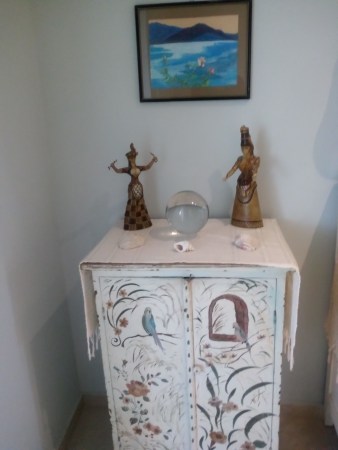
In my bedroom, images of the Snake Goddesses of Knossos sit on a cabinet painted by a Greek woman with images of birds and flowers. Between them is a crystal ball, while before them are three shells, the smaller of which was given to me by a Maori woman from New Zealand. Above them is an image of the sea in Molivos, Lesbos, painted by my friend Judith Shaw in the year we were both living in the village.
All things being relative, remember that collective and individual histories are cyclical but open-ended, and discern the kind of moment you are in and part of.
Remember how to make it better by holding on to all that is dear in life, and becoming more prayerful and thoughtful.
When deprivation comes, return to what is essential— first, beauty, so look for and create beautiful behavior and encourage it.
My wife and I woke up to the fact that Joe Biden surpassed 270 electoral votes needed and that it appeared that he was in all likelihood going to be our next president and Kamala Harris our new VP, and the first ever female, first Black and first Asian American to hold that position. We watched television daring to believe these facts for four hours. Then I said, “We need to drive around.” I just felt we needed to celebrate with all of us who have wanted this so badly.
We yanked the lawn sign off the lawn and drove all around Long Beach, honking the horn, as I jumped up through the moon roof in the rain, my wife honking the horn and folks high-fiving us, thumbs up, waving and yelling shout-outs.
My Aunt Sophie passed into another realm last week. Not from COVID, but, from a life well-lived.
At 98, she lived a remarkable life. She wasn’t famous, nor did she ever strive to be, but what she was, was what love should be, can be, and is.
In her 98 years she played trumpet in the high school marching band, she had a mean left hook, and she was a Rosie the Riveter, where she actually worked as a welder on ships being built for WWII in Richmond, CA. More, she was a devoted wife, she was a sister and caretaker, she was an incredible grandmother, and, she was a mother. Not just to her seven children, but to her grandchildren, her great-grandchildren, neighborhood kids, and to my sister and me, her nieces. Continue reading “The Legacy of Wisdom by Karen Leslie Hernandez”
In the United States turkeys are equated with Thanksgiving. But there is so much more to Turkey – a gentle creature who forms strong attachments. Reputed to be dumb, Turkey is in fact quite intelligent and curious, with the ability to solve problems. Turkeys have an excellent understanding of the details of their location which makes them so successful at feeding themselves. They also love to play and to cluck along with music.
Four years ago I made a trip to New Mexico to spend the winter and returned for three more winters in a row. A true Night Journey through the Desert. I hadn’t been there three weeks before a Great Horned owl appeared at my door. My dead mother (with whom I had had a devastating relationship and who loved owls) was surfacing as a threat…and I just did not want to believe it.
After a few months I was thrilled to make what I believed to be a genuine woman friend. Ironically, I met her at a feminist gathering. Oh, at last! Up until that point the only woman I currently had a close relationship with was a woman who was a former editor that became a virtual friend. I had only met her once (caveat–watch out for FB friends). My dearest friend Lise (we were thirty years strong) lived too far away for us to see each other although we talked and argued periodically! I was so lonely for a real woman friend that I could see regularly, and share my feelings with honestly … When this woman sought me out I could hardly contain myself. I was that excited. Continue reading “Coyote Woman Unmasked….by Sara Wright”



 As we careen toward ever more terrifying surges in the Covid pandemic, with experts predicting


 She climbed steep hills


 This is a continuation of an


 My Aunt Sophie passed into another realm last week. Not from COVID, but, from a life well-lived.

 Four years ago I made a trip to New Mexico to spend the winter and returned for three more winters in a row. A true Night Journey through the Desert. I hadn’t been there three weeks before a Great Horned owl appeared at my door. My dead mother (with whom I had had a devastating relationship and who loved owls) was surfacing as a threat…and I just did not want to believe it.

